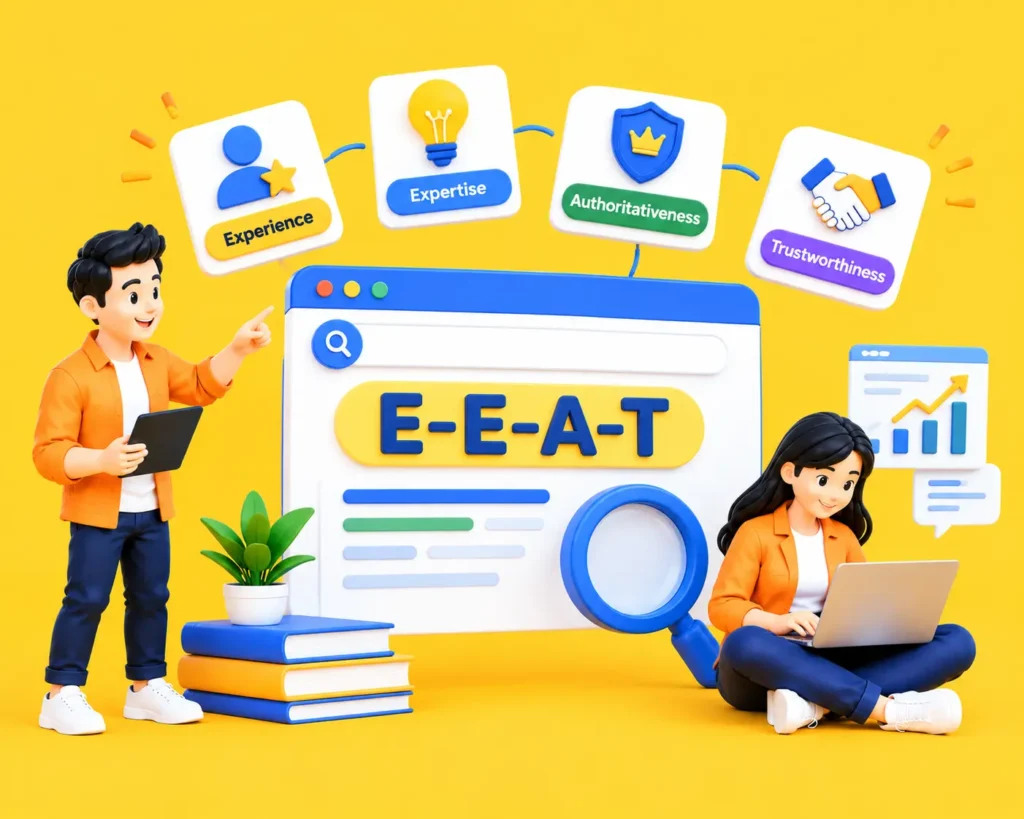
EEAT in SEO refers to how Google evaluates content quality, with its full form being Experience, Expertise, Authoritativeness, and Trustworthiness. Again, it’s not a ranking factor with an attached score, but a sort of quality lens that Google’s human raters use.
In my 14+ years of experience in SEO, I get asked about EEAT in two ways: “What is the EEAT score of my website?” and “Is it yet another buzzword?”; however, the reality lies somewhere in the middle, and it matters way more than anything else.
Having worked on SEO projects across health, finance, local services, B2B, and ecommerce, I’ve noticed the same pattern. Sites that rebuild trust properly tend to hold up better when Google reshuffles results. Sites that fake it, either through stock-photo authors or made-up credentials, end up confusing people about what really happened.
This guide covers what EEAT means in 2026, what has changed, and how I’d improve it step by step.
TL;DR
- EEAT stands for experience, expertise, authoritativeness, and trust, with trust paramount and the other three attributes supporting it.
- It is not a direct ranking factor, and there’s nothing like an EEAT score. Google’s systems use many signals to identify good content, including EEAT.
- EEAT matters way more for topics such as health, fitness, safety, and civic issues, where decisions are heavily influenced by “Your Money or Your Life”.
- In 2025 and 2026, AI was added to the whole scenario, with new rater guidance on AI content and AI Overviews, along with a clear message that mass-produced AI content fails.
What Is EEAT in SEO?
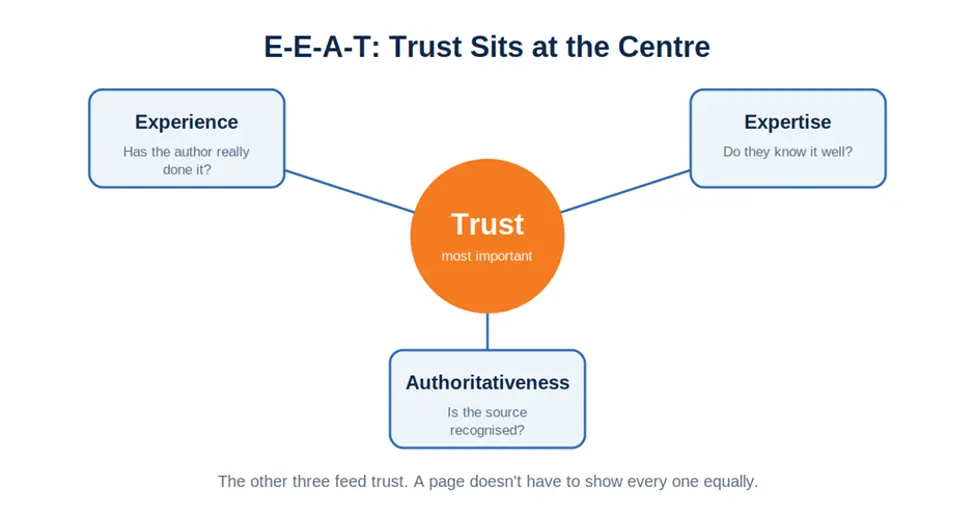
EEAT is a framework from Google’s Search Quality Rater Guidelines, the manual given to the human raters who evaluate search results. Each letter is a different question about the content or the person behind it.
- Experience: Has the author actually done, used, or lived what they’re writing about?
- Expertise: Do they have the knowledge or skill the topic needs?
- Authoritativeness: Is the author or site recognized as a go-to source on this subject?
- Trust: Is the page accurate, honest, transparent, and safe to rely on?
How EEAT in SEO Has Changed From 2015 to 2026
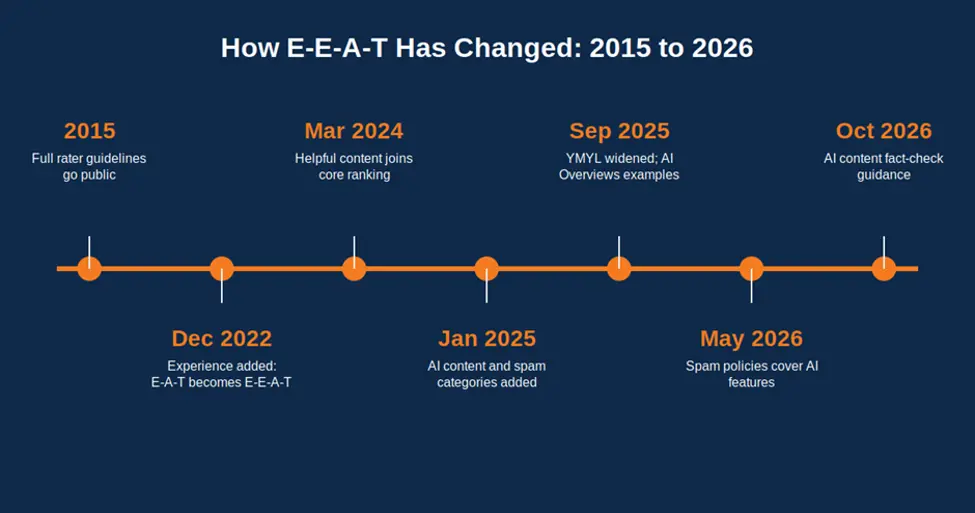
The acronym looks static. The guidance around it isn’t, and most articles I read stop at “Google added an extra E in 2022.” That was one of several shifts.
- 2015: Google published the full rater guidelines publicly, after years of leaks and an abridged edition in 2013. SEO professionals got a direct look at how quality is defined.
- December 2022: “Experience” joined the framework, turning EAT into EEAT. Google’s announcement framed it as an acknowledgment that first-hand experience can make content more useful.
- March 2024: Google folded its helpful content system into its core ranking systems and tightened its spam policies, including scaled content abuse. People-first quality stopped being a side system and became part of the core ranking.
- January 2025: The rater guidelines added a definition of generative AI content and guidance on spam categories. Google’s position: using AI isn’t penalized by itself, but low-effort, unoriginal content is.
- September 2025: A further update widened the YMYL definitions, with a category now covering government, civics and society, and added examples for rating AI Overviews. Google described it to Search Engine Land as a minor update with no change to the overall rater guidance.
- May 2026: Google stated that its spam policies, including scaled content abuse, apply to content surfaced in AI Overviews and AI Mode.
- October 2026: Google updated its guidance on generative AI content to say a manual check of AI-generated material should be performed before publication.
Is EEAT a Ranking Factor?
No, not directly. Google has said EEAT isn’t a specific ranking factor. What Google does say is that its systems use a mix of factors to identify content that demonstrates good EEAT, and that it gives more weight to that alignment for topics that could affect health, finances, safety, or society. The mechanism looks like this:
- Thousands of trained raters score real search results against the guidelines.
- Google’s engineers use those ratings to judge whether search changes are improving results.
- Ranking systems are continually adjusted so that well-rated results appear more often.
Why EEAT in SEO Matters in 2026
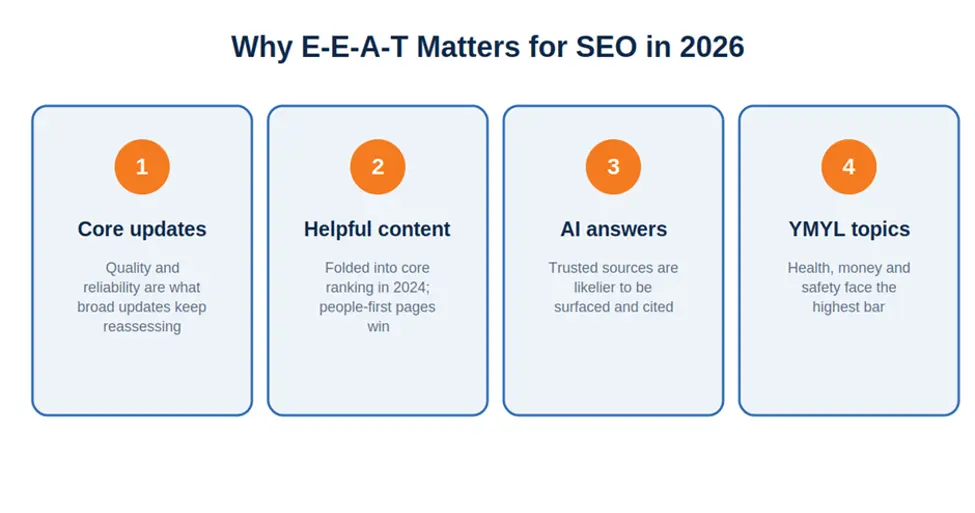
Core updates keep reassessing quality: A broad core update isn’t a penalty. It’s a reassessment of relevance and quality across the whole index. Sites with weak trust signals are exposed every time.
Helpful content is now part of core ranking: Google’s guidance asks you to think in terms of “who, how, and why”: who created the content, how it was created, and why it exists. EEAT is how you answer those questions on the page.
AI answers lean on trusted sources: The sources cited in AI summaries are typically high-trust, high-authority sites. I’d treat that as direction, not a guarantee. Nobody outside Google can promise what will be cited.
To understand how these concepts fit into a broader search strategy, read our AI SEO Guide, which explains how to improve your website’s visibility across AI-powered search experiences.
YMYL topics are scrutinized the most: The higher the stakes for a reader, the stronger the evidence needs to be.
The Four Parts of EEAT, Explained Properly
Experience
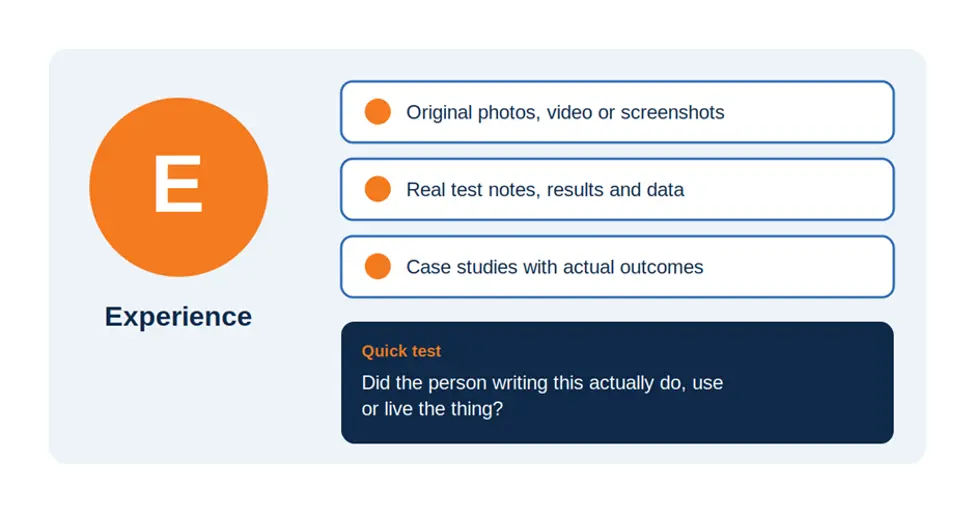
Experience is first-hand contact with the subject.
How I show it:
- Original photos, screenshots, video, or data from your own work.
- Specific details that only someone who did the thing would know, including the awkward ones.
- Case studies with the problem, the approach, and the real outcome.
- Plain statements of how you tested or used something.
Experience is the signal that generic AI text can’t fake well. It can describe a process, but it can’t remember the afternoon it went wrong.
Expertise
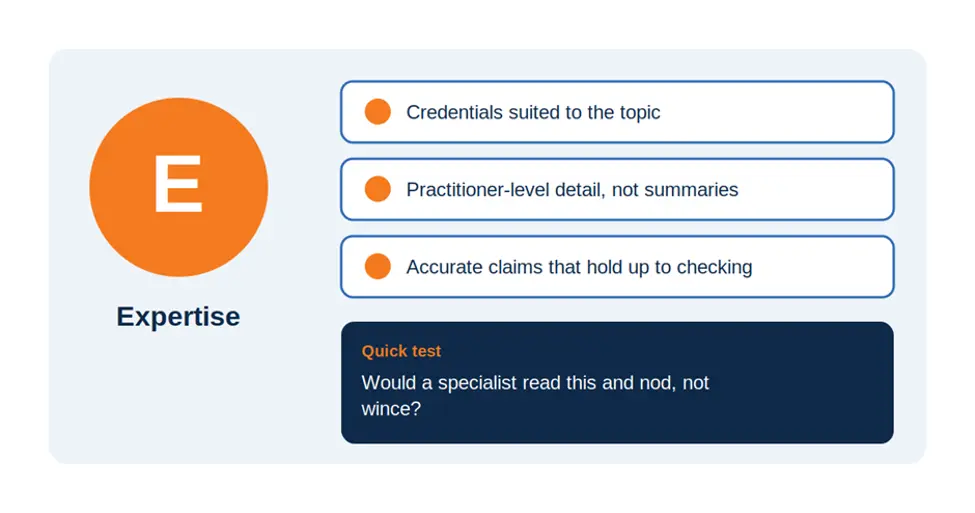
Expertise is the depth of knowledge behind the content. For a YMYL page, that usually means formal qualifications. For lower-stakes topics, practical, demonstrated skill can be enough.
How I show it:
- A named author with a bio that states relevant qualifications and work
- Expert review on sensitive topics, with the reviewer credited and linked
- Practitioner-level detail instead of a summary of other pages
- Accurate claims, backed by sources a reader can check
Authoritativeness
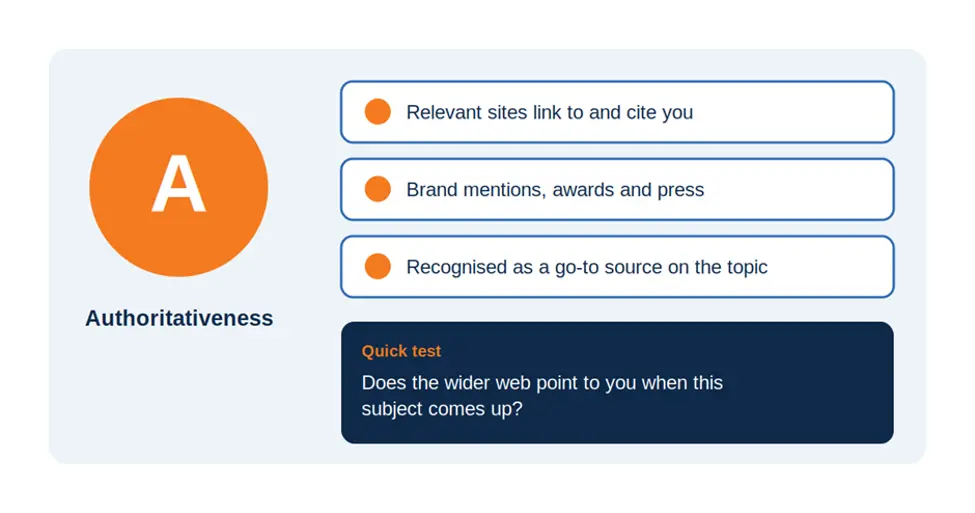
Authoritativeness is reputation. Are you the source others turn to? It’s built outside your own website as much as on it.
How I built it:
- Topical depth: A cluster of connected pages covering a subject from several angles, not one lonely page.
- Relevant backlinks and citations from respected sites in your field.
- Brand mentions, awards, speaking slots, and press, linked or not.
- Expert authors who are visible and active elsewhere.
Relevant backlinks can help people discover your content and contribute to your site’s reputation. Explore our guide to Backlink Building Strategies for practical approaches to earning relevant links without relying on manipulative tactics.
Trustworthiness
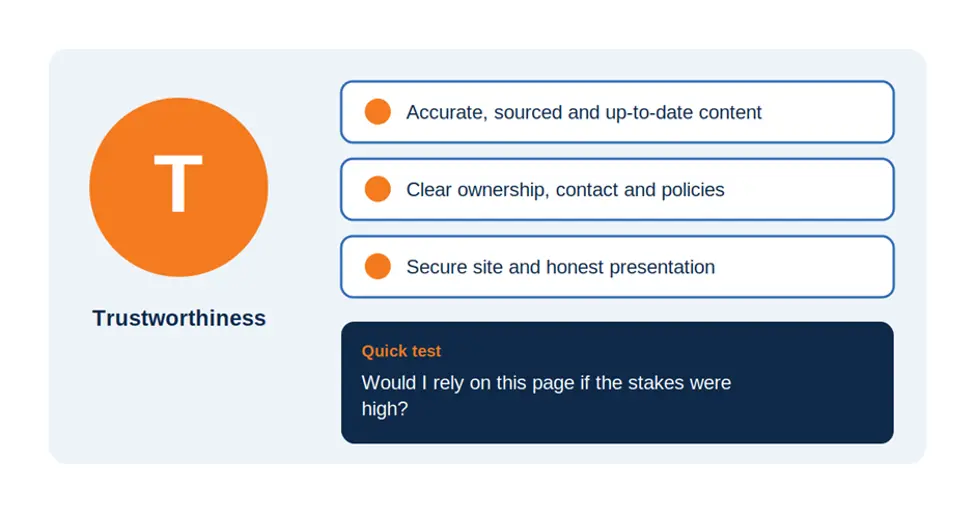
Trust is the center of the model, and it’s mostly about not letting the reader down. Accuracy, honesty, transparency, and safety all feed it.
How I show it:
- HTTPS, a clear privacy policy, and no deceptive design.
- Clear ownership: who runs the site, where they are, how to reach them.
- Cited sources, correct facts, and honest limits (“here’s what we don’t know”).
- Real reviews and testimonials, handled openly.
- Content that is reviewed and updated, with the date visible.
How Much EEAT Does Your Page Need?
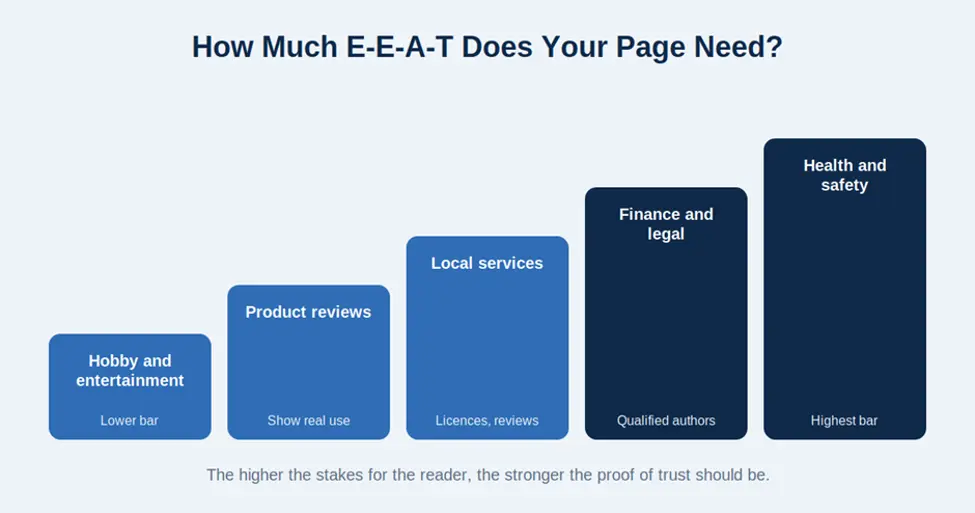
This is where most EEAT guides don’t give the right answer. The standard scales with the potential harm to the reader.
Page type | Risk to the reader | Proof |
Hobby, entertainment, general interest | Low | Genuine enthusiasm, accurate facts, and a real person behind the content |
Product reviews and comparisons | Low to medium | Hands-on testing, original photos, honest pros and cons, disclosed affiliations |
Local services | Medium | Licenses, genuine reviews, team details, consistent business information |
Finance, legal, tax | High (YMYL) | Qualified authors or reviewers, jurisdiction stated, sources, disclosures |
Health and safety | High (YMYL) | Clinician authorship or review, cited research, review dates, clear limits |
Government, civics, elections | High (YMYL) | Official or primary sources, neutrality, careful fact-checking |
My 5-Step EEAT Audit
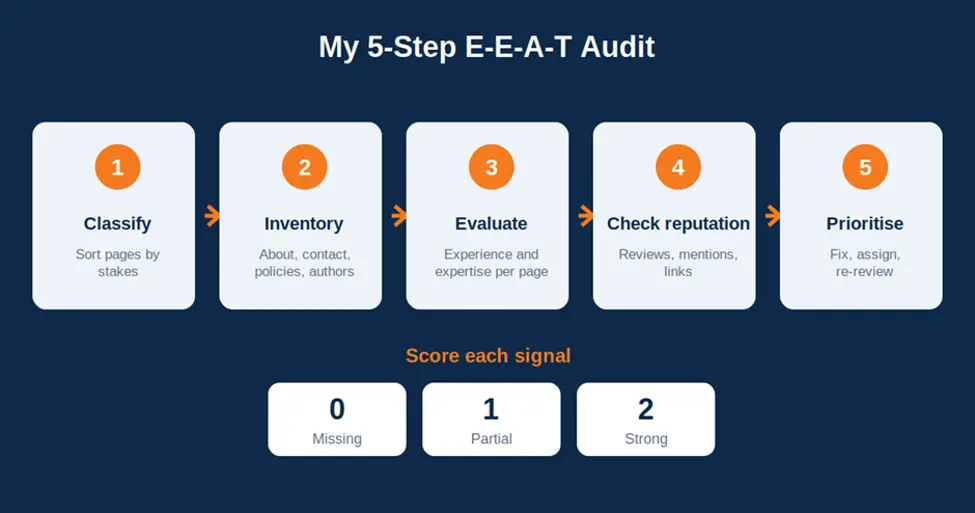
EEAT work goes wrong when it starts with a rewrite. I start with an audit because most sites are missing basics rather than brilliance.
Step 1: Classify your pages by stakes
Sort pages into low-risk, product and service, and YMYL. This tells you how much proof each group needs and stops you from wasting effort on pages that don’t need much.
Step 2: Inventory the trust basics
Check the About page, contact details, privacy and editorial policies, author pages, review handling, and returns or refund terms where relevant. A crawler like Screaming Frog can flag pages with no named author in minutes.
Step 3: Evaluate each priority page for experience and expertise
Ask whether the page shows first-hand evidence, whether the author is qualified for the topic, and whether claims are sourced. Be harsh. If you’d struggle to defend a claim to a specialist, so will a rater.
Step 4: Check your reputation off-site
Look at reviews, brand mentions, backlinks from relevant sites, and the consistency of your details across profiles. For businesses serving local customers, review quality and profile accuracy matter a lot.
Step 5: Prioritize, fix, and re-review
Fix the weakest high-stakes pages first, assign owners, and set a review date. Turning this into a plan with owners and deadlines is exactly what a structured program like our 90 Days SEO Performance Blueprint is for.
What EEAT Looks Like in Different Industries
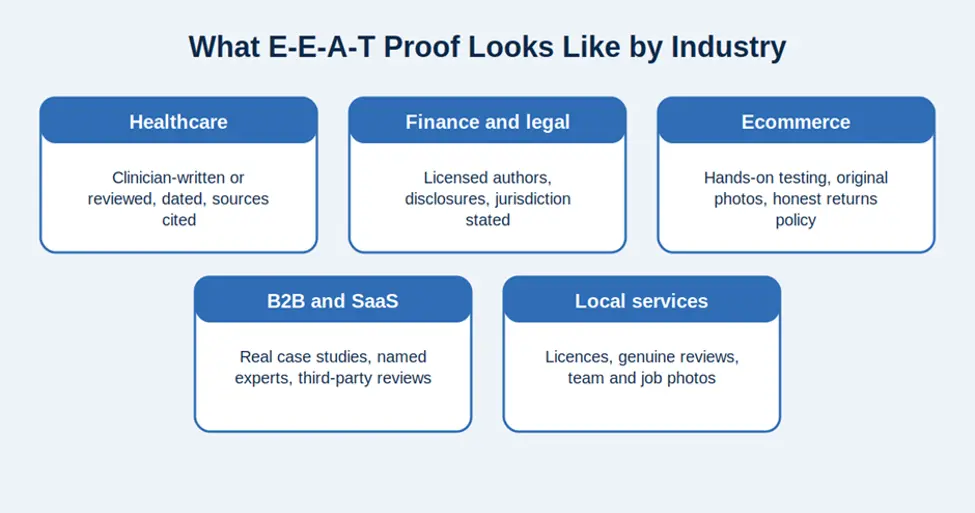
Healthcare: Clinician-written or clinician-reviewed content, dated reviews, cited research, and clear statements of what the page can’t advise on. A named medical reviewer beats a generic “medically reviewed” badge.
Healthcare websites need to communicate expertise and reliability particularly clearly. Our guide to AI SEO for Doctors and Hospitals explores ways healthcare providers can strengthen their visibility in AI-powered search.
Finance and legal: Licensed or qualified authors, jurisdiction stated up front, disclosures about affiliations and any registration details that can be verified.
Ecommerce: Hands-on testing, original photography, honest comparisons that admit weaknesses, and a clear returns policy. Verified purchase reviews carry more weight than a wall of five-star quotes.
B2B and SaaS: Case studies with real, permission-approved outcomes, product experts as named authors, documentation that works, and profiles on third-party review sites.
Local services: Licenses and insurance where relevant, genuine reviews, photos of real jobs and a visible team. Keep business details identical across your site and listings.
EEAT Myths vs. Facts
Myth | What’s actually true |
EEAT is a ranking factor with a score | It’s a framework for judging quality. Google’s systems use many signals that help identify content with good EEAT, but there is no EEAT score. |
Adding an author box fixes it | The box is only a container. The expertise and experience behind the name have to be real. |
AI content can’t have EEAT | Google judges quality and purpose, not just the tool. Unreviewed, mass-produced content is the problem. |
Only YMYL sites need to worry | YMYL has the highest bar, but every page is judged for trust relative to its purpose. |
Backlinks alone prove authority | Links help, but reputation also comes from reviews, mentions, awards, and what others say about you. |
Schema markup boosts EEAT. | Schema labels facts. It doesn’t make unverifiable claims credible. |
Common EEAT Mistakes I See
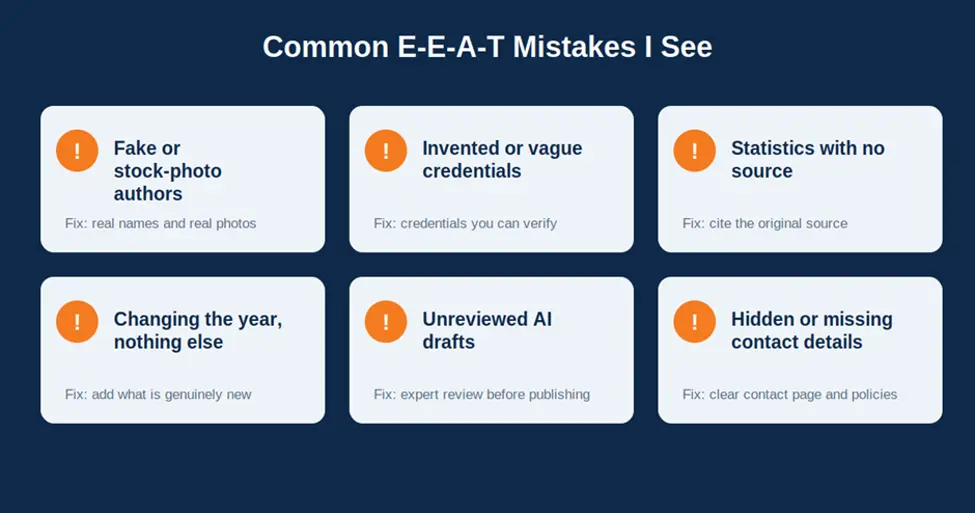
- Fake or stock-photo authors: If a reader can’t find the person anywhere else, trust drops, and so does yours.
- Invented or vague credentials: “Industry expert” isn’t a credential. Claims you can’t back up are worse than saying nothing.
- Statistics with no source: A number without an origin is just a number.
- Refreshing by changing the year: Updating “Best X in 2025” to “Best X in 2026” with no real changes helps nobody. Ask what has genuinely changed and add that.
- Publishing AI drafts without expert review: Fast, unchecked content is what the policies are aimed at. AI can support research and content production, but human verification remains essential. Read our guide to AI in SEO to understand how AI can be incorporated into SEO workflows without losing sight of content quality.
- Hiding the business: No address, no team, no contact page, no policy pages, and more; it is where Google catches you off guard.
- Treating it as a one-off project: Trust compounds over time, and it decays when ignored.
How to Measure EEAT in SEO Progress?
EEAT in SEO can’t be measured with a single number, but rather with a fleet of different signals. How do I do that, you ask? I track the signals that move as trust improves, and I compare them quarter to quarter.
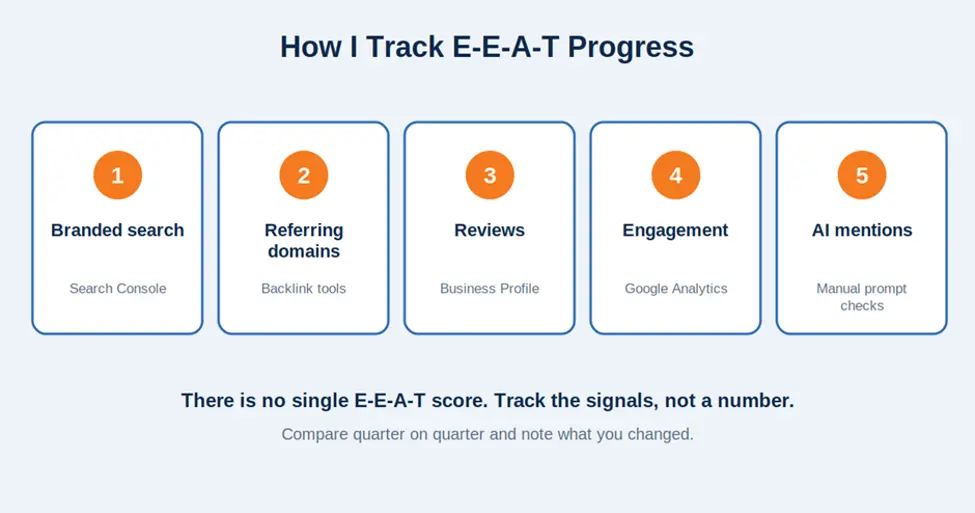
Here’s how I keep track of the EEAT Progress:
- Branded Search: Determining how many people are searching for your brand directly by your brand name. Understanding how many branding impressions and clicks there are on Google Search Console.
- Referring Domains: Determining what domains are relevant and respected sites that are linking to you more than before.
- Reviews: What’s the volume, recency, and ratings on the platforms that matter to your business?
- Engaged Sessions: What’s the number of engaged sessions and conversions on the pages that you have optimized?
- AI Mentions: How your brand is described when you ask relevant questions across AI search tools.
Apart from this, I have a pre-defined simple checklist where I myself ensure that every blog or article has a named author and a review date. I also ensure that every page has a credited reviewer and is linked to a relevant case study or author.
What I’m checking | Tools I may use |
Branded and topic queries | Google Search Console |
| Engagement and conversions | Google Analytics |
| Backlinks and referring domains | Ahrefs, Semrush, SE Ranking |
| Missing authors, dates, and metadata at scale | Screaming Frog |
| Schema validity | Rich Results Test, Schema Markup Validator |
| Reviews and local profile accuracy | Google Business Profile |
| Reporting | Looker Studio |
How to Improve EEAT in 2026?
Improving EEAT in 2026 is less about adding new elements to your pages and more about proving the ones you already claim. This is what my team and I do:
Fix the trust basics first: Before I touch any content, I check that the site says who runs it and how to reach them.
A clear About page, contact details, privacy and editorial policies, and review handling come before any rewrite. A strong article on a site that hides its owner still loses trust.
Put real people behind the content: Every important page needs a named author with a bio that explains why they’re qualified, plus links to their profiles elsewhere.
On YMYL pages, I add a credited expert reviewer and a visible review date. A real person can be checked, and a stock photo can’t.
Show proof, not claims: This is where first-hand experience pays off. I’d always rather show a result than describe a capability.
We saw this with a flight school we worked with, Pilot Academy, which wanted visibility in the USA and Canada.
Pilot training is a major career decision, so readers want straightforward answers about licenses, training pathways, and requirements before they trust a school. We built its training pages and FAQs around those questions and made technical improvements across the site. Organic traffic grew 121.35% in a few months, and the full numbers are in the Pilot Academy case study. Traffic isn’t the same as EEAT, but it shows what happens when high-stakes questions get clear, well-organized answers.
Build depth, not just volume: Cover a topic from several angles, such as cost, process, requirements, alternatives, and common mistakes, and link those pages together. A connected cluster shows that your site knows the subject. Ten thin posts don’t.
For a more structured approach to building topical depth and making content useful for AI-powered search, explore our guide to SEO Content Strategy for AI Visibility.
Earn reputation outside your site: Ask happy customers for genuine reviews, pursue relevant mentions and backlinks, and get your experts quoted or published where your audience reads. Keep your business name, address, and profile details identical everywhere so search systems can recognize you.
For a closer look at how RankON has approached the shift towards AI-powered search, read RankON Technologies’ Journey to AI SEO.
Use AI as a drafting aid, not a publisher: Google’s updated guidance says AI-generated material should get a manual check before publication. I have an editor who verifies every fact, adds original examples or data, and rewrites anything that reads as generic.
If you want to create content that offers genuine value beyond generic AI-generated answers, read our guide on How to Write AI-Proof Content for practical ways to strengthen originality, first-hand insight, and usefulness.
Keep content fresh and honest: Update a page when something has genuinely changed, show the date, and correct errors openly. Changing the year in a title isn’t an update.
Review it every quarter: Then I return to the signals I track above, compare them quarter-to-quarter, and fix whatever is still weakest. EEAT compounds when it’s treated as ongoing work, not a one-off project.
Bottom Line
EEAT is neither a trick nor a score; instead, it is a way to establish trust and credibility in your content, affirming to readers that they can rely on it.
If you were to ask me one way to assess the EEAT of any website, I would say have a specialist read the piece in full and see whether they trust it and find it convincing.
If yes, you’re on the right track; if not, take a step back to understand what needs fixing.
Want an EEAT Review of Your Site?
At RankON Technologies, we help businesses reinforce their trust signals through our results-oriented SEO services by building topical authority and improving visibility in AI-powered search.
FAQs About EEAT in SEO
What is EEAT?
EEAT stands for experience, expertise, authoritativeness, and trust. It’s a framework from Google’s Search Quality Rater Guidelines, in which trust is of paramount importance.
Is EEAT a ranking factor?
No, it isn’t. Google has no EEAT score. Its ranking signal uses a mix of signals to identify content with strong EEAT, especially in YMYL-related niches.
What is the difference between EAT and EEAT?
While EAT was a former framework, the new framework adds an extra “E” at the beginning, which stands for “Experience”. It says firsthand experience is always beneficial for making the content more helpful.
What is YMYL, and why does it matter to EEAT?
YMYL translates to “Your Money or Your Life”. It covers topics that can directly influence someone’s life or financial decisions. Google expects stronger EEAT signals on these topics because poor, inaccurate, and incomplete decisions can cause real harm.
Can AI-generated content have good EEAT?
It can, when it is closely reviewed, verified, and modified by a real industry expert. Google says AI use alone doesn’t decide quality, but unreviewed mass-produced content does.
How long does it take to improve EEAT?
Improving EEAT isn’t a one-shot process; it takes weeks and months to fix the basics and, thereafter, to improve reputation, topical authority, and more.
Does EEAT affect AI Overview and AI Search?
Clear authorship, content accuracy, topical depth, and a credible reputation make your brand easier for search systems to evaluate. Although nobody can guarantee citations or mentions, it improves the odds of being present where it matters.