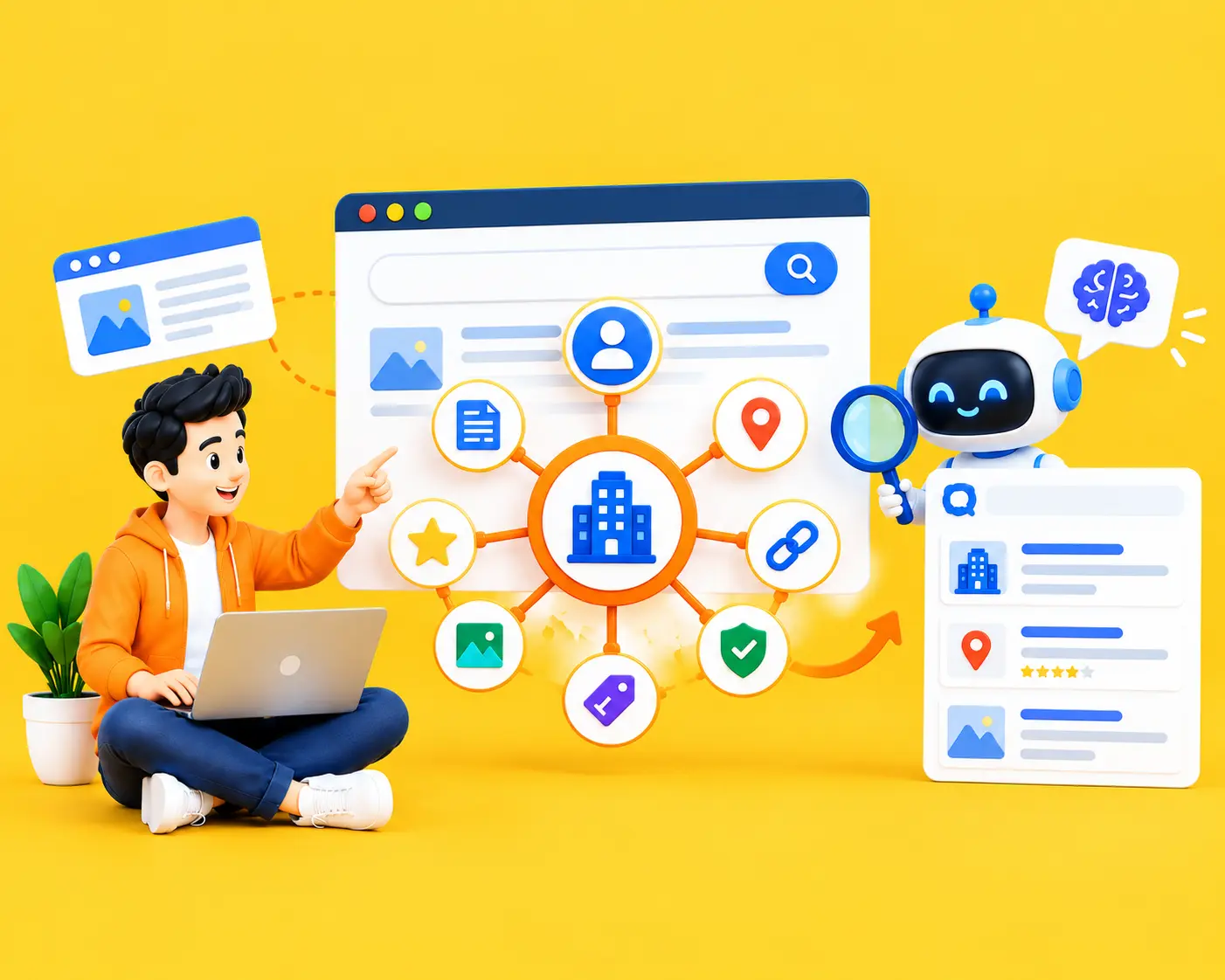

Search is changing. Earlier, someone looking for a product or service would open Google or Bing, type a few keywords, and compare the websites in the results. Today, many people also ask ChatGPT, Gemini, Perplexity, or Google AI Overviews a detailed question and get a summarized answer, often with recommended brands and links to supporting sources.
For example, a business owner who once searched “best SEO company in the USA” might now ask ChatGPT, “Can you recommend a reliable SEO agency for a small business that wants to improve its organic search visibility?” The AI platform may recommend several agencies, summarize what they offer, and link to the sources it used.
That shift raises the question this guide answers: Is AI SEO replacing traditional SEO, or do businesses need both?
In my experience, AI SEO is an expansion of search optimization, not a replacement for it. Traditional SEO focuses on visibility in conventional search results. AI SEO extends that work so your brand and content are easier for AI-powered platforms to discover, understand, and potentially reference. Ranking on Google’s first page is still valuable, but it is no longer the only visibility opportunity worth planning for.
Key takeaways
- Traditional SEO remains the foundation for organic visibility, traffic and leads.
- AI SEO (including GEO and AEO) adds new ways for customers to discover your brand.
- AI visibility cannot be guaranteed, and a mention in an AI answer does not automatically become a visit or a sale.
- The two approaches overlap heavily in content quality, technical accessibility, topical authority and brand credibility.
- The practical path is to strengthen your SEO fundamentals first, then layer AI search optimization and monitoring on top.
In this guide
- How search behavior is changing: Traditional search vs. AI search
- What is traditional SEO?
- What is AI SEO? Understanding GEO and AEO
- SEO vs. GEO vs. AEO: Key differences
- Traditional SEO vs. AI SEO: Key differences
- Benefits and challenges of traditional SEO and AI SEO
- Can AI SEO replace traditional SEO? An expert’s perspective
- How AI is changing traditional SEO
- How to combine traditional SEO and AI SEO: An 8-step plan
- The future of traditional SEO and AI SEO
- Conclusion: Why traditional SEO and AI SEO should work together
- Frequently asked questions (FAQs) about AI SEO vs. traditional SEO
How Search Behavior Is Changing: Traditional Search vs. AI Search
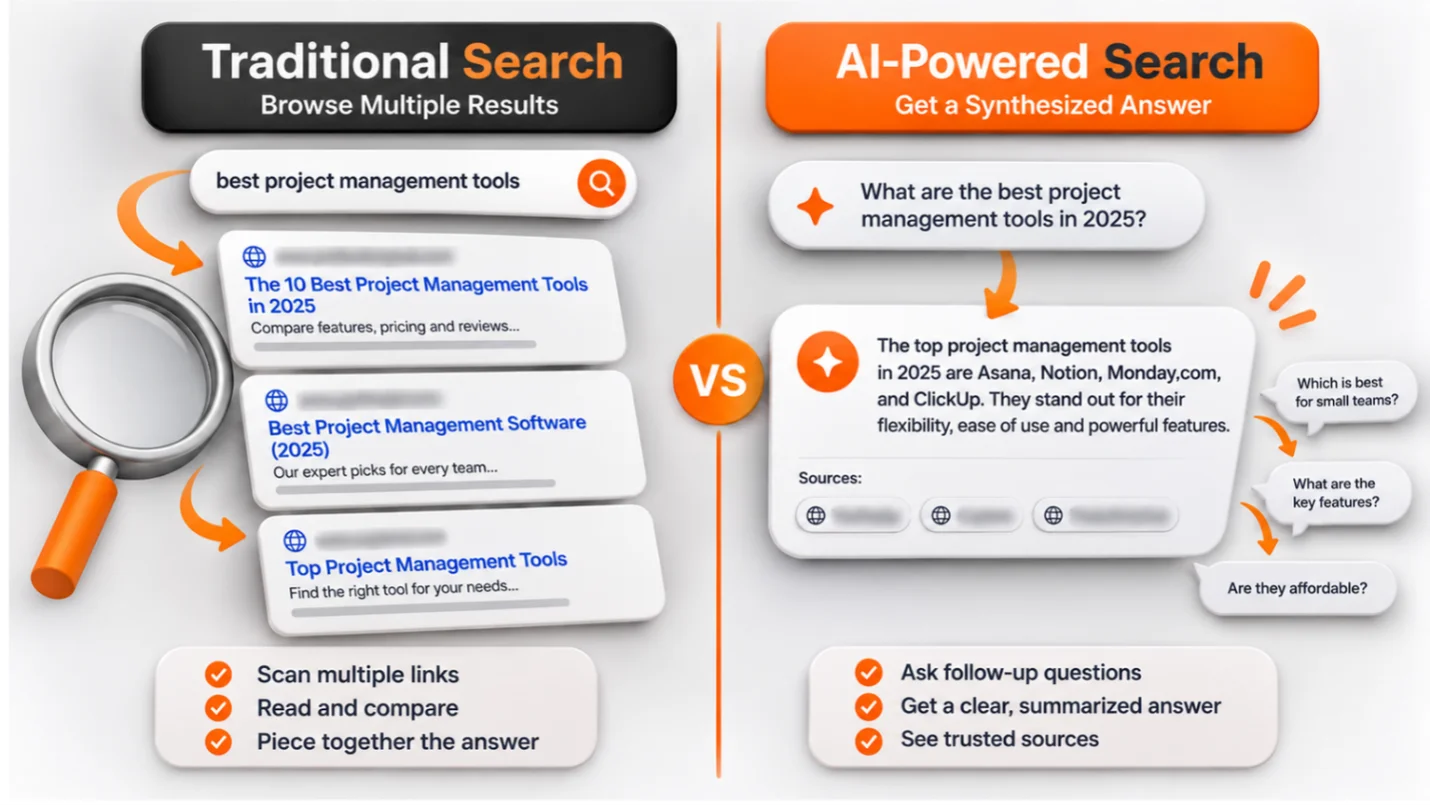
People still use search engines, but AI platforms have added a second way to discover information, compare options, and make decisions. Understanding both journeys is the starting point for any modern SEO strategy.
How traditional search works
Traditional search usually starts with a short keyword query such as “SEO agency near me”, “best SEO company in the USA” or “affordable SEO services”. The journey typically looks like this:
- Enter a query: the user types keywords describing what they need.
- Review results: they scan web pages, business listings, ads, and other search features.
- Visit websites: they explore service pages, pricing, reviews and resources.
- Compare options: they weigh experience, reputation, pricing and suitability.
- Decide: they contact a business, request a quote, or buy.
This journey creates competition for rankings and organic clicks, and traditional SEO is designed to improve visibility throughout it.
How is AI search different?
AI-powered search is more conversational. Instead of “SEO agency near me,” a user might ask: “Can you recommend reliable SEO agencies for a small business that needs technical SEO, local SEO, and monthly reporting within a reasonable budget?” The main differences are:
- Conversational, detailed queries: users describe their situation in natural language, providing the platform with far more context than keywords would.
- Summarized responses: explanations, comparisons, recommendations, and links arrive in one answer. This can reduce visits for basic information, although users may still open sources to verify details.
- Follow-up questions: users can refine the conversation (“How much do these services cost?”, “How long does SEO take?”) without starting a new search.
- Information from multiple sources: AI platforms may draw on your website, industry publications, reviews and other third-party references. The sources they use vary by platform and query.
- Discovery through recommendations and citations: people can meet a brand through an AI answer before they ever search for its name. Being mentioned is never guaranteed.
Traditional search vs AI search: examples
| User need | Traditional search | AI search |
| Finding an SEO agency | SEO agency near me | Recommend reliable SEO agencies for a small business |
| Learning about SEO | What is technical SEO? | Explain how technical SEO improves website visibility |
| Comparing services | SEO vs PPC | Which is better for long-term leads: SEO or PPC? |
| Finding a product | Best CRM software | Compare CRM platforms based on my business requirements |
| Understanding pricing | Website development cost | What should a small business budget for a professional website? |
| Solving a problem | Website loading slowly | My website takes five seconds to load. What could be causing it? |
| Finding local services | Best dentist in my area | Help me find a reliable dentist based on location, services, and reviews |
The important difference is not just the query length. It is how users interact with information: traditional search sends people through a list of results to explore, while AI search offers a guided conversation in which they refine their needs.
What changing behavior means for businesses
- The first page is no longer the only goal. Organic rankings still drive traffic, inquiries, and sales, but customers can now also find you through AI-generated responses, recommendations, and citations.
- Brand recognition and authority matter more. AI answers may name brands. A clear digital identity, relevant expertise, and a credible presence across the web give you more opportunities to be recognized.
- Content must answer specific questions. Keep targeting commercial keywords such as “website development services, and also publish answers to the questions buyers ask: How much does website development cost? WordPress or custom development? How long does it take to build a business website? How often does a website need maintenance?
- AI mentions are an extra discovery channel. An AI answer can introduce your brand to someone who has never visited your site. Treat it as an addition to organic rankings, referrals, and other channels, not a substitute.
- Traffic and conversion journeys may shift. Some queries may produce fewer clicks, while visitors who do arrive after AI research may have a clearer idea of what they need. Monitor lead quality, conversions, branded searches and AI referral traffic, not just sessions.
What Is Traditional SEO?
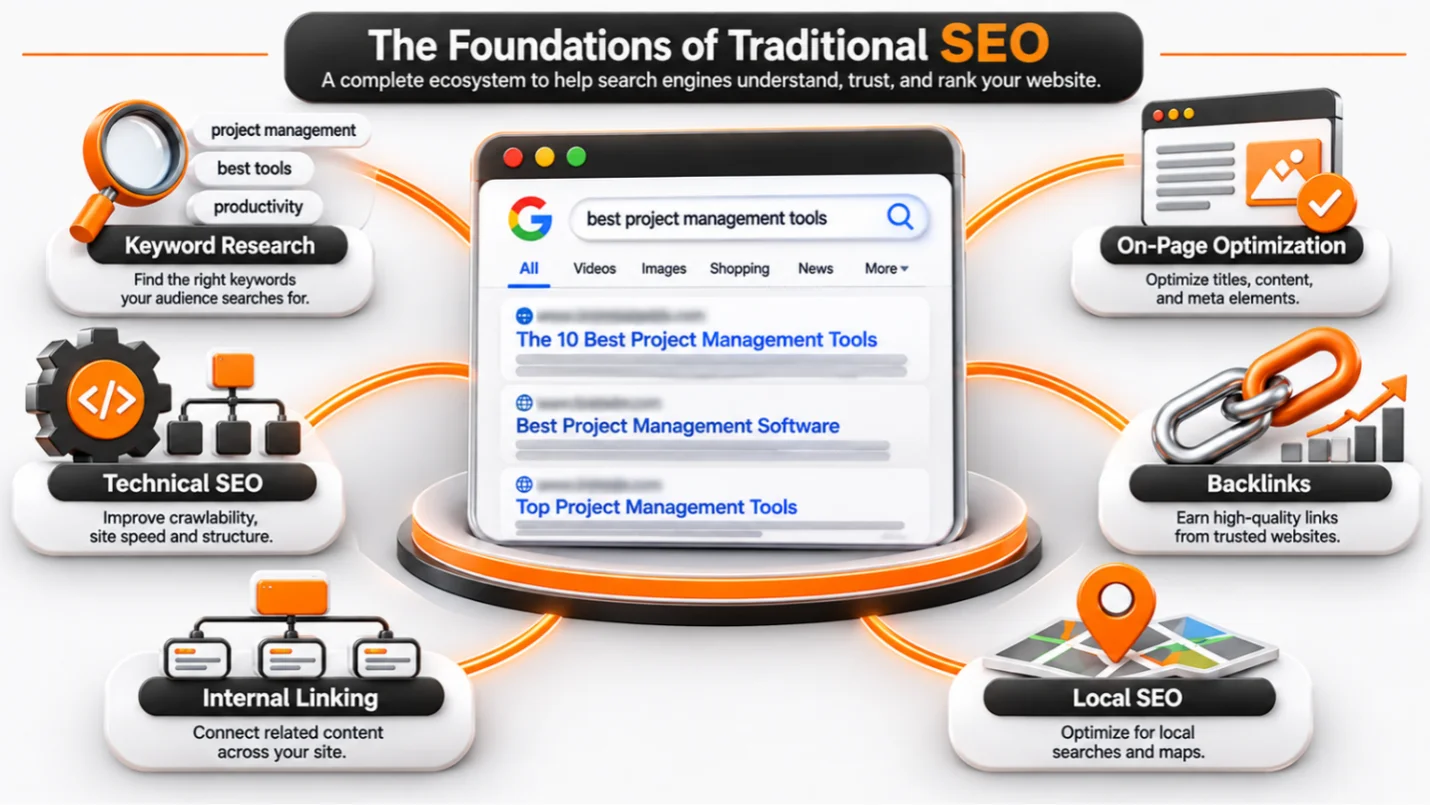
Traditional SEO is the process of improving a website’s visibility in organic search results on engines such as Google and Bing. The goal is to help search engines understand your content, match it with relevant queries,s and show it to people looking for what you offer. Success is usually measured by keyword rankings, organic traffic, impressions, clicks, and conversions.
These are the core strategies I consider important.
1. Keyword research and search intent
Keyword research identifies the terms people use when looking for information, products, or services. Search volume alone is not enough; intent matters just as much. Someone searching “what is technical SEO” wants to learn, while someone searching “technical SEO services” may be ready to hire an agency. These searches need different content.
My approach is to identify relevant keywords, understand their intent, evaluate competition, and map each keyword to the right page. That brings in visitors who are more likely to engage or become customers.
2. On-page SEO and content optimization
On-page SEO improves individual pages so they are relevant, well-structured, and easy to understand. Key activities include:
- Optimizing title tags and meta descriptions
- Using keywords naturally in headings and body content
- Creating descriptive URLs and a clear H1, H2 and H3 hierarchy
- Adding relevant internal and external links
- Optimizing images and alt text
- Improving readability and user experience
I always recommend writing for people first. Search engines have become much better at understanding context, relevance, and quality, so articles written only to include target keywords rarely perform well.
3. Technical SEO and website performance
Technical SEO ensures search engines can access, crawl, understand, and index your website. Even excellent content can struggle if technical problems get in the way. Core activities include:
- Crawling and indexing optimization, XML sitemaps and robots.txt configuration
- Canonical tags and duplicate content management
- Fixing broken links and redirect issues
- Mobile usability and Core Web Vitals
- Site architecture and URL structure
- Relevant structured data
Technical SEO is not a one-time task. New pages, plugins, design updates, and development changes can introduce issues at any time.
4. Link building and backlink acquisition
Backlinks are links from other websites to yours, and they help search engines gauge credibility and relevance. Common ways to earn them include guest posting on relevant sites, digital PR, link-worthy resources, original research, industry partnerships,s and natural editorial references.
I do not recommend chasing link quantity. Relevance, editorial quality,ty and the credibility of the referring site matter far more than hundreds of low-quality links.
5. Internal linking and topical authority
Internal links connect related pages, help users navigate, and show search engines how topics relate. An agency’s technical SEO article, for example, can link to related guides on website audits, page speed, site architecture, and technical SEO services.
Build topic clusters rather than publishing unrelated blog posts. When a site covers a subject in depth and links the pieces together, it is more likely to demonstrate expertise and topical authority.
6. Local SEO
Local SEO improves visibility for location-based searches such as “SEO agency in New York”. Important activities include:
- Optimizing your Google Business Profile
- Keeping business information accurate and consistent
- Building local citations and earning genuine reviews
- Creating location-specific landing pages
- Earning relevant local backlinks
For businesses that depend on local customers, local SEO is an essential part of the organic strategy.
What Is AI SEO?
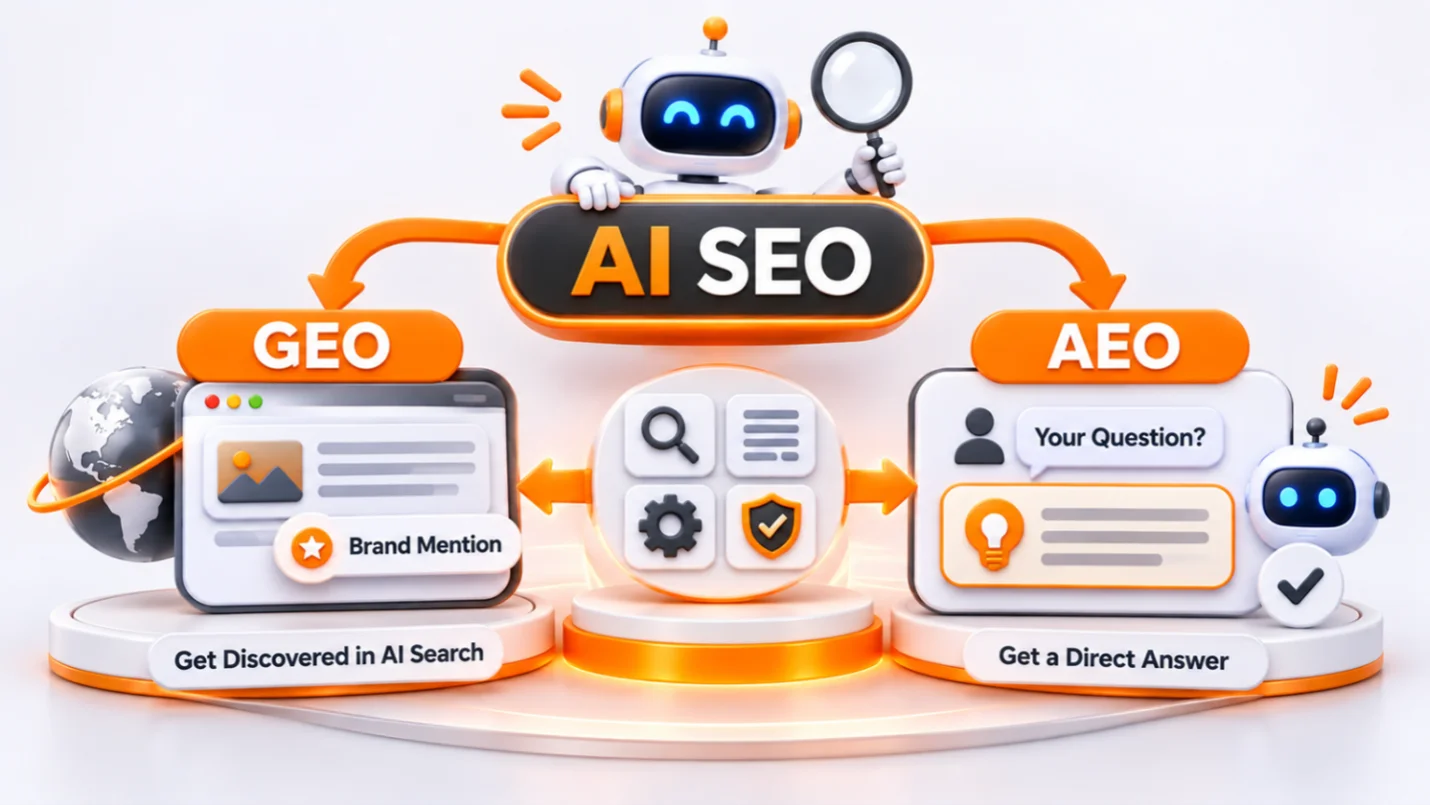
AI SEO expands traditional optimization to cover how AI-powered platforms discover, retrieve, interpret, and present information. Instead of looking only at rankings and organic traffic, it also asks whether your brand is mentioned, referenced, or cited when users ask relevant questions. Its two main disciplines are GEO and AEO.
What is Generative Engine Optimization (GEO)?
GEO is the practice of improving a brand’s visibility in AI-generated responses from platforms such as ChatGPT, Gemini, and Perplexity. Someone might ask, “Which digital marketing agencies offer SEO services for healthcare companies?” The AI may answer with several agencies and supporting references. GEO aims to improve the likelihood that your brand and content are discovered and considered in answers like that.
Important GEO practices include:
- Brand authority and entity recognition: AI systems need to understand what your business does, which industry it serves,es and how it relates to specific topics. Consistent information across your website, professional profiles, and directories helps establish a clear digital identity. Entity recognition is not a single setting or a guaranteed ranking factor; it develops over time through reliable information and a credible presence.
- Factual, well-supported content: publish accurate information backed by reliable data, practical examples, expert insight and credible sources, and avoid unsupported claims.
- Relevant third-party mentions: industry publications, respected directories, professional communities and expert interviews all add independent information about your business. Relevance, credibility, and context matter more than the number of mentions.
- Contextual depth: explain your services, processes, expertise and the problems you solve. An agency writing about technical SEO should cover crawling, indexing, site architecture, and Core Web Vitals, not just repeat the phrase.
- Topical authority: build useful, connected resources around your core subjects.
GEO does not guarantee that an AI platform will mention or cite your website. Each platform uses its own retrieval and selection systems, and these change over time. I recommend building genuine authority and publishing reliable information rather than trying to manipulate AI responses.
What is Answer Engine Optimization (AEO)?
AEO is the practice of making content easy for search engines and AI answer experiences to understand and use when responding to specific questions. People increasingly search in full questions, so a business might target “How often should a website have an SEO audit?” and “What does an SEO audit include?” rather than only the keyword “SEO audit”.
Important AEO practices include:
- Question-based content: find real questions through keyword tools, Google’s People Also Ask, customer inquiries, forums and sales conversations.
- Direct, concise answers: answer the main question first, then expand. For example, Technical SEO is the process of improving a website’s technical structure so search engines can crawl, index, and understand its pages effectively.
- FAQ sections: cover related questions that do not fit the main body. An FAQ section does not guarantee featured snippets or AI visibility.
- Structured content: use descriptive H2 and H3 headings, short paragraphs, numbered steps, bullet points and comparison tables.
- Schema markup, where appropriate: structured data such as Article, Organization, LocalBusiness, Product and BreadcrumbList can clarify page content. It must match visible content and does not guarantee rich results or AI inclusion.
- Specific explanations: replace vague copy such as “We provide comprehensive SEO solutions” with concrete details such as “Our SEO services include keyword research, technical audits, on-page optimization, content planning and link building.”
AEO is not about writing every paragraph as a question and answer. It is about making information easier to understand, navigate, and use.
Supporting practices for AI visibility
- Write for AI-generated answers: use clear headings, direct answers, relevant examples, accurate facts, and logical sections. Keep important information updated and avoid repetition and vague statements.
- Use AI to assist, not replace, human expertise: mass-produced AI content with little original value does not help. AI tools can support creation, but editorial review and fact-checking remain essential.
- Understand mentions vs. citations v. backlinks: a brand can be mentioned without a clickable link. Each contributes to your online presence, but their impact should not be assumed to be identical.
- Monitor AI visibility: track brand mentions, citations, share of AI visibility against competitors, AI referral traffic, how often you are recommended, and how platforms describe your brand. Test a consistent set of prompts on a regular schedule and record the platform, date, and results, because AI responses vary by query, location, platform, and time.
Also Read: Complete Guide to AI SEO
SEO vs GEO vs AEO: Key Differences
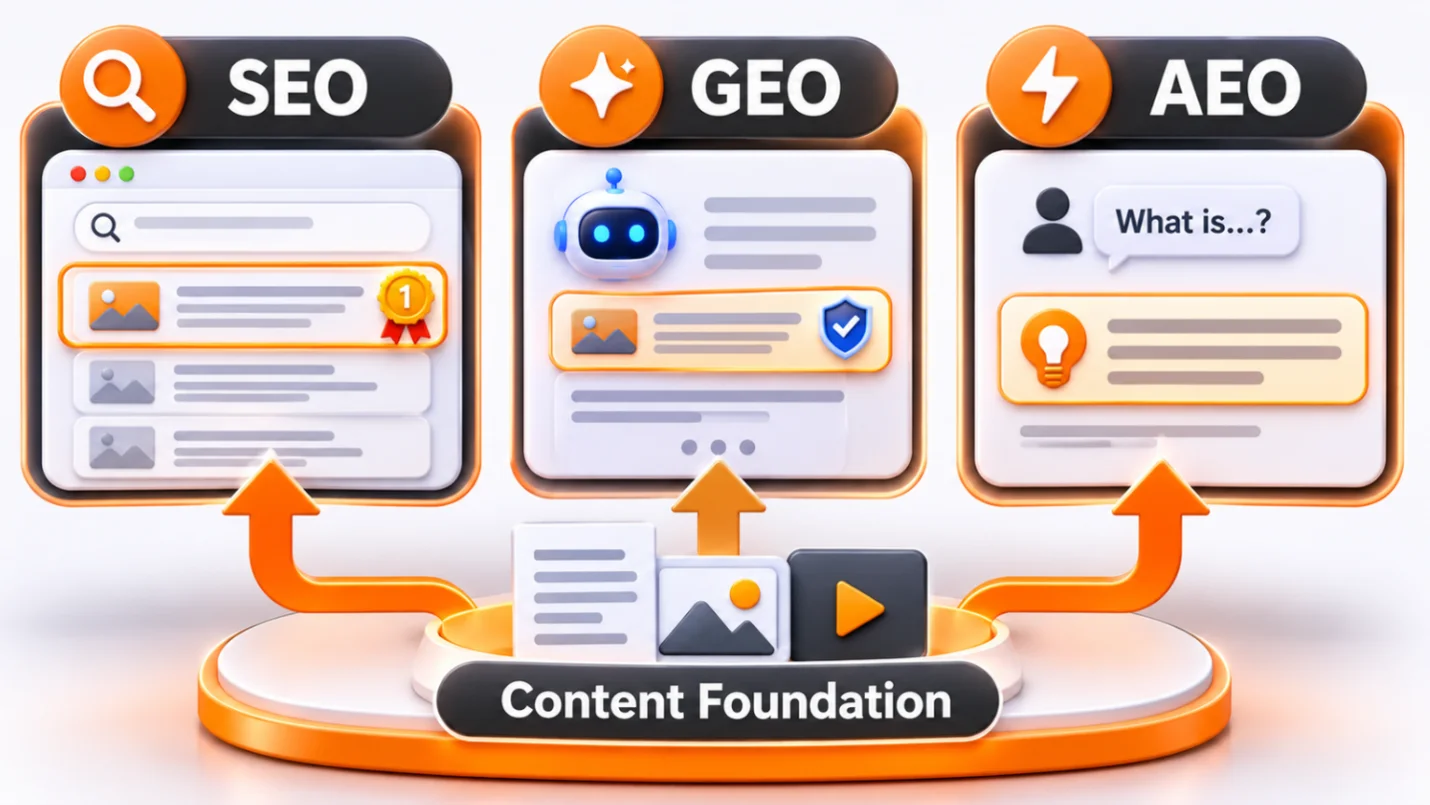
Businesses often treat these three terms as interchangeable. They overlap, but each has a different focus.
| Parameter | SEO | GEO | AEO |
| Full form | Search Engine Optimization | Generative Engine Optimization | Answer Engine Optimization |
| Main focus | Search engine visibility | Visibility in AI-generated responses | Visibility in direct answers |
| Primary objective | Improve organic rankings and visibility | Increase the chances of AI mentions and citations | Make content useful for answering specific questions |
| Content approach | Search intent, relevance, quality | Context, authority, factual accuracy, credibility | Clear, structured, direct answers |
| Key platforms | Google, Bing | ChatGPT, Gemini, Perplexity | Featured snippets, voice search, AI answer experiences |
| Core activities | Technical SEO, keyword research, content optimization, link building | Brand authority, entity recognition, contextual content, third-party mentions | Question-based content, FAQs, concise answers, structured headings |
| Measurement | Rankings, organic traffic, impressions, clicks, conversions | Brand mentions, citations, AI referral traffic, AI platform visibility | Featured-answer visibility, relevant impressions, clicks, answer presence |
How SEO, GEO, and AEO work together
These are overlapping disciplines, not separate channels. Take a website development company publishing an article on WordPress website maintenance:
- SEO: target relevant keywords, optimize the title and headings, improve internal linking, and make sure the page is technically accessible.
- GEO: show expertise through detailed explanations, practical recommendations, credible brand information and relevant third-party mentions.
- AEO: answer questions such as “How often should a WordPress website be updated?” with clear explanations and a logical structure.
The same article can support conventional rankings, AI discovery, and direct-answer experiences. I recommend building a strong SEO foundation first, then adding GEO and AEO practices to your existing content, technical work, and brand-building.
Traditional SEO vs AI SEO: Key Differences
Both approaches aim to improve visibility, but they differ in their priorities, platforms, and measurement methods.
| Comparison factor | Traditional SEO | AI SEO |
| Primary objective | Improve organic search visibility | Improve visibility in AI-generated answers and recommendations |
| Main platforms | Google, Bing | ChatGPT, Gemini, Perplexity, Google AI experiences |
| Content focus | Keywords, relevance, search intent | Context, clarity, factual accuracy, answer relevance |
| Optimization approach | On-page, off-page, and technical SEO | GEO, AEO, brand authority, and content optimization |
| Visibility | Rankings and organic listings | Mentions, citations,s and recommendations |
| Link strategy | Relevant backlink acquisition | A credible presence through relevant references and mentions |
| Content structure | Search-focused content and topic relevance | Clear, contextual, well-organized information |
| Measurement | Rankings, traffic, impressions, conversions | AI mentions, citations, referral traffic, visibility |
| Main challenge | Competition and ranking volatility | Changing AI systems and inconsistent measurement |
The biggest difference is not that one targets search engines and the other targets AI. Businesses now need visibility across multiple search environments, each with its own methods for discovering and presenting content.
Benefits and Challenges of Traditional SEO and AI SEO
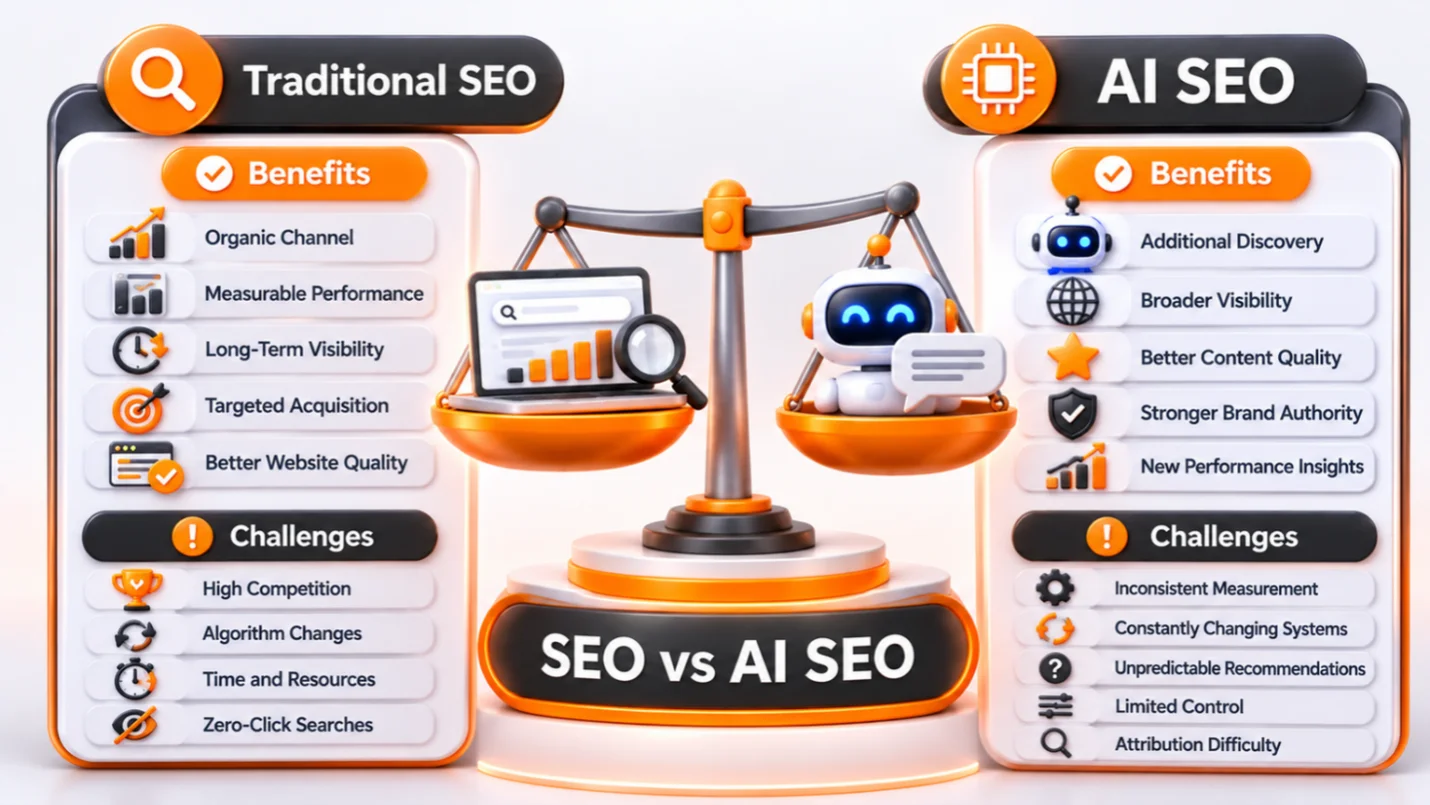
Both approaches offer real opportunities, and both have limits. Understand them before you allocate budget.
Traditional SEO
Benefits
- Established organic channel: reaches people actively searching for your products, services and information.
- Measurable performance: rankings, clicks, impressions, traffic and conversions can be tracked with established tools.
- Long-term visibility: quality content can keep attracting traffic over time, although rankings and traffic are never guaranteed.
- Targeted acquisition: keyword and intent analysis help you reach audiences with specific needs.
- Better website quality: technical and content improvements enhance the overall user experience.
Challenges
- High competition: commercially valuable keywords are hard to rank for, especially in competitive industries.
- Algorithm changes: search updates can affect rankings and traffic.
- Time and resources: effective SEO needs ongoing research, content, technical work and monitoring.
- Zero-click searches: featured snippets and AI Overviews can answer queries directly, potentially reducing clicks for some queries.
AI SEO
Benefits
- Additional discovery opportunities: reach users through AI-generated answers and recommendations.
Broader visibility encourages a presence beyond conventional search results.
- Better content quality: GEO and AEO reward clear, comprehensive, informative content.
- Stronger brand authority: a consistent digital presence supports industry recognition.
- New performance insights: AI visibility monitoring shows how your brand compares with competitors.
Challenges
- Inconsistent measurement: AI visibility metrics are still developing, and platforms respond differently to similar queries.
- Constantly changing systems: retrieval methods, source selection and answer generation evolve frequently.
- Unpredictable recommendations: optimized content does not guarantee a mention.
- Limited control: you cannot directly control how AI systems summarize your content or describe your services.
- Attribution difficulty: someone may discover you in an AI answer and visit later through another channel, making the original source hard to track.
Can AI SEO Replace Traditional SEO? An Expert’s Perspective
No. AI SEO cannot completely replace traditional SEO. The two serve different but increasingly connected purposes, and the requirements for online visibility still come down to website quality, content relevance, technical accessibility, and brand authority.
One of the biggest misconceptions I see is that businesses must abandon traditional SEO and focus entirely on AI search. That is not practical, especially for businesses that depend on organic traffic, inquiries,s and online sales. Some customers still search Google, compare websites,es and read reviews before deciding. Others ask ChatGPT or Perplexity for recommendations and explore the brands mentioned. Both journeys create opportunities, so the real question is how to build visibility across both.
Here are six reasons why traditional SEO will continue to play an important role.
1. Organic search still drives traffic, inquiries, and sales
People still use Google and Bing to buy products, compare providers, find local businesses, and research solutions. Someone searching “SEO services for healthcare companies” may visit several organic results to compare experience, services, pricing, and expertise. A business that abandons traditional SEO in favor of focusing solely on AI visibility risks missing those customers. I recommend continuing to invest in organic optimization while exploring AI platforms, because both channels contribute to discovery, traffic, and customer acquisition.
2. AI search platforms still depend on discoverable web content
AI search presents information differently, but many platforms still retrieve information from the web. Google AI Overviews can show AI-generated summaries with links to supporting pages, and Perplexity and ChatGPT Search can retrieve online sources and reference websites in their answers. A healthcare company that publishes an accurate, detailed guide to a medical service, answers common patient questions, and provides trustworthy information gives both search engines and AI systems something useful to draw on.
Publishing content does not guarantee a citation or recommendation. Each platform has its own retrieval and selection mechanisms. My advice is to become a reliable source of information rather than to write content solely to satisfy AI algorithms.
3. Technical SEO still decides whether your content can be accessed
Search engines must discover, crawl, process, and index content before it can appear in conventional results, and retrieval systems must also be able to access it. Imagine a site with excellent articles whose important pages are blocked from crawling, carry incorrect canonical tags,s or have serious rendering problems. Those issues limit discoverability no matter how much effort goes into AI SEO.
That is why I continue to prioritize:
- Crawlable and indexable important pages
- A logical site architecture and strong internal linking
- Fixing broken links and unnecessary redirects
- Correct canonical tags
- Mobile-friendly performance and Core Web Vitals
- Relevant structured data
- Accessible important business information
These practices mainly support conventional discoverability, and some also make content easier for other systems to retrieve. I always treat technical SEO as the foundation of the strategy.
4. Keyword research still reveals customer demand
Even as people use conversational queries with AI platforms, they still search for specific products, services,s and solutions. Keyword research helps you understand:
- What potential customers are searching for
- Which topics generate demand
- What problems do users want solved
- Whether a query has informational or commercial intent
- What content opportunities competitors are targeting
A business offering SEO services might research terms like “technical SEO services”, “local SEO agency”, “e-commerce SEO services” or “SEO consultant for small businesses”, then build service pages, supporting articles and topic clusters around them. AI search adds a second layer: detailed questions such as “How can I improve organic traffic for my healthcare website?” Keywords are not becoming irrelevant. Their role is expanding from ranking targets to a window into what audiences actually need.
5. Authority, backlinks, and brand mentions still matter
Backlinks help search engines understand relationships between websites and assess credibility. Authority is broader than links, though. A company’s reputation is also shaped by its industry presence, expert contributions, customer reviews, brand mentions and credible third-party references.
Compare two digital marketing agencies offering similar services. One publishes generic articles with little original insight. The other regularly shares expert opinions, practical strategies, case studies and industry knowledge, earns backlinks from relevant sites, collects genuine client reviews and keeps company information consistent across platforms. The second agency has far more opportunities to demonstrate expertise and build a recognizable brand, and those same references can give AI systems useful information about who it is.
A brand mention does not automatically improve rankings or guarantee an AI recommendation, and backlinks from unrelated websites are not a sustainable strategy. Focus on relevant, genuine, and credible references.
6. AI visibility does not automatically produce traffic or conversions
Appearing in an AI-generated answer and attracting a website visitor are two different outcomes. Someone might ask ChatGPT to recommend SEO agencies for a small business and see three named. They may remember one, search for it on Google later, check its social profile,le or visit through another channel. An AI platform may also summarize your content without generating a click.
Traditional SEO has established measurement: Google Search Console shows impressions, clicks, average positions, and queries, and Google Analytics 4 shows engagement and conversions. AI SEO needs additional metrics, such as how often your brand appears in AI answers, which platforms cite your site, which competitors are recommended, how your services are described, and how much referral traffic comes from AI platforms. These metrics do not always translate directly into leads or revenue, and AI responses vary by platform, prompt, location, and time, so testing needs a consistent method rather than isolated searches.
I recommend keeping both measurement systems. Treat AI visibility as an additional brand discovery opportunity, and judge success by business outcomes such as qualified leads, inquiries, and conversions.
Where traditional SEO supports AI search visibility
Traditional SEO and AI SEO are not separate disciplines. They overlap in content quality, website accessibility, topical relevance, and brand authority:
- A technically accessible website makes content easier for supported systems to retrieve.
- Well-organized content with clear headings communicates a page’s subject and context.
- Comprehensive articles provide useful material for answering related questions.
- Strong topical coverage helps establish expertise.
- Credible third-party references strengthen your reputation.
Success in one does not automatically carry over to the other, however. A page ranking first on Google may not be mentioned by ChatGPT or cited by Perplexity for the same query. That is why it is worth evaluating how clearly your brand communicates its expertise across the wider web, not just to improve rankings.
My Expert Take: Should businesses stop investing in traditional SEO?
Absolutely not. Technically sound websites, relevant content, strong authority, and a clear understanding of your audience are not outdated practices; they are the foundations of sustainable visibility. What has changed is the scope of optimization. Businesses used to focus on appearing in conventional results. Now they also need to consider how their content and brand can be found in AI-powered experiences.
“AI is changing how people discover information, but it doesn’t eliminate the fundamentals of SEO. Businesses still need technically sound websites, relevant content, strong authority, and a clear understanding of their audiences. The real opportunity lies in combining traditional SEO practices with AI search optimization to build visibility wherever potential customers are searching.
- Alok Kumar, RankON Technologies
How Is AI Changing Traditional SEO?
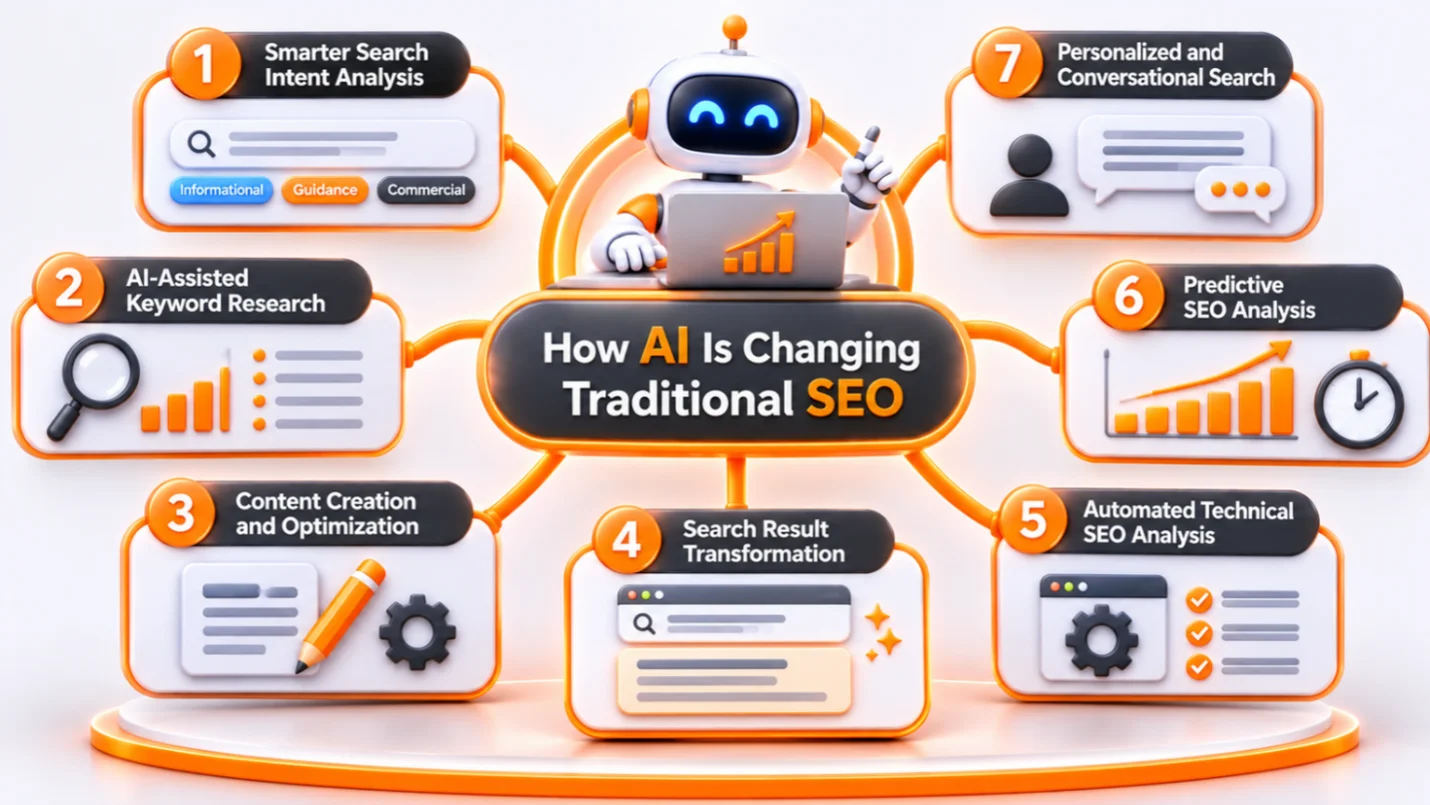
AI is changing almost every stage of SEO work, from keyword research and content planning to technical analysis and performance monitoring. Tasks that once required extensive manual research can now be supported by tools that process large amounts of data, spot patterns, and suggest actions.
The purpose of SEO has not changed: to help businesses become visible when potential customers look for relevant information, products, or services. What has changed is how professionals work toward that goal. I have found AI most useful for research, analysis, and decision-making, but using AI alone does not guarantee a successful strategy. Results still depend on how well people interpret the data and implement the recommendations.
Here are seven ways AI is changing traditional SEO.
1. Smarter search intent analysis
AI can analyze large groups of queries, identify semantic relationships, and categorize keywords by intent. Consider these four searches:
- What is technical SEO?
- How does technical SEO improve rankings?
- Technical SEO checklist for websites
- Hire a technical SEO expert
The first two are informational, the third needs practical guidance,e and the fourth shows commercial intent. AI can help group queries like these into content categories.
My recommendation: do not rely entirely on AI intent classifications. Check actual Google results, analyze competing pages, and understand your audience before deciding what to create. AI speeds up research, but human judgment interprets it.
2. AI-assisted keyword research
Tools such as Ahrefs, Semrush, Google Keyword Planner, and Google Search Console remain valuable, and AI adds new capabilities on top of them. For a web development website, AI can expand initial research into topics such as custom website development, e-commerce development, WordPress development, redesign services, website maintenance, and speed optimization. Practical uses include:
- Semantic keyword discovery: finding related terms and phrases that add context.
- Keyword clustering: grouping queries by topic and intent to plan content.
- Content gap analysis: spotting subjects competitors cover that you have not addressed well.
- Search pattern analysis: examining trends and query relationships for emerging opportunities.
- Long-tail research: finding more specific queries that signal clearer needs.
AI makes keyword research more efficient, but search volume, difficulty, competition, business relevance, and intent still need professional evaluation before you choose targets.
3. Content creation and optimization
Content is where AI has had the most visible impact. Tools such as ChatGPT and Gemini can help generate topic ideas, outlines, and content briefs; suggest headings and supporting keywords; identify related questions; improve readability; flag missing information; suggest internal links; and draft title tags and meta descriptions.
AI-assisted content and unreviewed AI-generated content are very different things. Using AI to build an outline or find gaps makes the process more efficient. Publishing generic, repetitive, or inaccurate articles just to increase volume rarely creates lasting value. My approach is to use AI as a research and productivity assistant while keeping strategy, expertise, fact-checking,g and editorial decisions under human control. The goal is not to publish more content with AI; it is to publish better content with its help.
4. Search result transformation
Google once showed mostly a list of pages, ads,ds and featured snippets, and users visited several sites to gather information. Today, Google AI Overviews can summarize a topic from multiple sources, and conversational search lets users ask follow-up questions. Someone asking “What are the benefits of SEO for a small business?” may get a summary covering organic traffic, brand visibility, lead generation, and long-term value, with links to supporting sources where available.
Ranking in conventional results remains important, but your content should also be useful enough that AI-powered experiences may retrieve and reference it. This is one of the biggest reasons SEO professionals need to look beyond keyword rankings.
5. Automated technical SEO analysis
AI-assisted workflows can help analyze crawl reports, identify recurring errors, review redirect chains and broken URLs, find duplicate content, analyze internal linking, flag missing or inconsistent metadata, examine Core Web Vitals reports and prioritize issues by likely impact. On a site with thousands of URLs, finding repeated title tag issues by hand is slow, whereas AI can surface patterns in exported crawl data. Screaming Frog, Ahrefs, and Semrush can feed these workflows.
The limitation is important: validate every AI-generated technical recommendation before implementing it. Changing canonical tags, robots.txt directives,s or redirects without understanding the site’s architecture can cause serious problems. Use AI to speed up diagnosis and reporting, and leave implementation decisions to an experienced SEO professional or developer.
6. Predictive SEO analysis
Traditional analysis looks at historical and current performance. AI can also highlight patterns that point to future opportunities, such as keywords gaining impressions, pages with slowly declining traffic, rising industry topics, seasonal search patterns, and competitor content expansion. An e-commerce store that sees demand for certain product categories rise in specific months can use this to prepare landing pages and content early. A service page with falling impressions can be investigated for changes in demand, competitor activity, or content relevance.
Predictive analysis is not a guaranteed ranking forecast. Algorithms, competitors, user behavior, and markets keep changing. I find it most useful for planning and prioritization, not as a replacement for monitoring actual performance.
7. Personalized and conversational search
Traditional searches are short, such as “Best website development company.” AI search invites longer, more detailed questions: “Which website development company should I choose for building an e-commerce website with payment integration and ongoing maintenance?” The second query carries far more context, and AI systems can use it to give more relevant answers and support follow-ups.
That means optimizing only around short, high-volume keywords is no longer enough. A website development company can also publish resources such as how to choose an e-commerce development company, what features an e-commerce website needs, how much custom e-commerce development costs, the difference between Shopify and custom development, and how often an e-commerce site needs maintenance. Conversational search makes understanding your audience even more important: not just what people search for, but why they search for it and what they need to know before deciding.
My Expert Take: Will AI replace SEO professionals?
I don’t believe AI will replace SEO professionals. It will change their skills, responsibilities, and workflows. AI can analyze data, draft outlines, identify keyword relationships, summarize reports, and assist with technical analysis, but an effective strategy requires more than those tasks. Someone must understand the business, identify the audience, evaluate competitors, prioritize opportunities, and validate recommendations.
For example, AI might suggest a keyword with high search volume. An experienced professional still needs to judge whether it is relevant to the business, whether the site has a realistic chance to compete,e and whether the traffic could produce qualified leads or sales. Likewise, AI can generate an article but cannot ensure it shows genuine expertise or accurately represents a company’s services. Treat AI as a productivity tool, not a replacement for SEO expertise.
How to Combine Traditional SEO and AI SEO: An 8-Step Plan
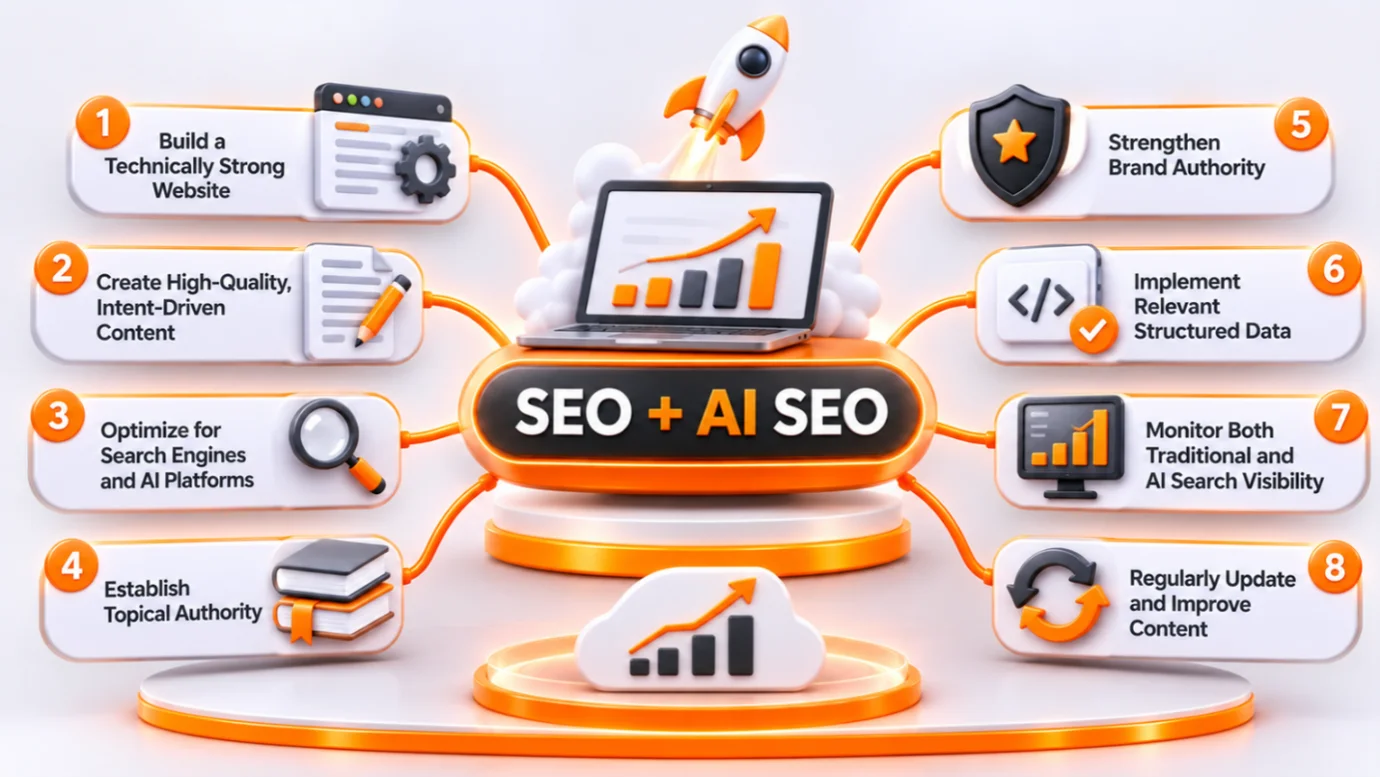
Businesses no longer need to choose between the two. In my experience, the most effective approach is to build a strong SEO foundation and gradually add AI search optimization to the same strategy. These eight steps show how.
Step 1: Build a technically strong website
Before chasing rankings or AI visibility, make sure search engines and other discovery systems can access and understand your site. I recommend starting with:
- Crawlability: let crawlers reach important pages without unnecessary restrictions.
- Indexability: confirm valuable pages are not accidentally blocked by robots.txt or noindex tags.
- Website speed: optimize images, reduce unnecessary scripts and use efficient hosting.
- Mobile usability: make sure the site works well on smartphones, tablets and desktops.
- Site architecture: organize pages logically for users and search engines.
- Core Web Vitals: monitor Largest Contentful Paint (LCP), Interaction to Next Paint (INP) and Cumulative Layout Shift (CLS).
A useful site on an accessible foundation is also easier for AI platforms to discover, although technical optimization alone does not guarantee that they will retrieve or reference it.
Step 2: Create high-quality, intent-driven content
Publishing large volumes of articles without considering user needs is unlikely to produce lasting results. Aim for original, well-researched content that answers real customer questions. An accounting firm targeting construction companies, for example, would do better with specific resources than generic accounting posts:
- How construction companies can manage cash flow
- Construction accounting methods explained
- Common financial reporting challenges in construction
- How to calculate job costs in construction projects
- What is work in progress (WIP) reporting?
When developing content, keep three things in mind:
- Understand search intent: decide whether users want information, are comparing solutions, or are ready to buy.
- Provide original insight: include expert opinion, practical examples, industry knowledge, research, and first-hand experience.
- Answer related questions: cover what customers ask before deciding, not just the primary keyword.
Step 3: Optimize content for search engines and AI platforms
Combine established on-page SEO with structuring techniques that make key information easy to identify:
- Use descriptive H1, H2 and H3 headings.
- Include primary and related keywords naturally.
- Write introductions that state what the page covers.
- Give direct answers to important questions.
- Explain industry terms rather than assuming every reader knows them.
- Use bullets, numbered steps and comparison tables where they help.
- Support factual claims with credible sources and include relevant examples.
For a page on website maintenance services, go beyond a general description: explain what maintenance includes, why it matters, how often it should happen, what it costs, and when professional support is needed.
Step 4: Establish topical authority
Topical authority is the depth and relevance of your coverage of a subject. Instead of isolated articles on unrelated keywords, build connected resources around your core services and expertise. A digital marketing agency could structure an SEO cluster like this:
- Pillar page: SEO Services: A Complete Guide
- Supporting guides: Technical SEO, On-Page SEO, Off-Page SEO, Local SEO, Keyword Research, SEO Content Strategy, SEO Audit and Link Building
Supporting articles link to the pillar page and to each other where useful. This helps search engines understand how your pages relate, gives visitors a logical path through the topic, and gives AI systems broader context about your expertise. Identify your core service categories first, research the topics and questions around each, then build supporting content systematically. Do not create multiple articles just to cover keyword variations; every page needs a distinct purpose.
Step 5: Strengthen brand authority
Your reputation across other credible websites influences how people and search systems understand your business, which is especially relevant when generative platforms draw on multiple sources. I recommend:
- Earning relevant backlinks from industry publications, business sites and professional organizations.
- Contributing expert insights through articles, commentary and industry discussions.
- Keeping brand information consistent across company name, services, business description and profiles.
- Building a credible reputation through genuine reviews, case studies and an informative company profile.
- Publishing original resources such as research, guides and tools that give people a reason to reference you.
The objective is a recognizable, trustworthy brand, not an accumulation of mentions or links.
Step 6: Implement relevant structured data
Schema markup, commonly implemented with Schema.org vocabulary, describes entities and page types so eligible systems can interpret your content.
| Schema type | Typical use |
| Organization | Business name, logo, contact information,n and other organization details |
| LocalBusiness | Local details such as address and opening hours |
| Article | Blog posts and articles |
| Product | Product details, pricing, and availability where applicable |
| BreadcrumbList | Website navigation hierarchy |
| Service | Services offered are supported by the implementation |
Schema is not a shortcut to AI visibility. It does not guarantee a Google rich result or a citation from ChatGPT, Gemini or Perplexity. Implement only relevant types, make sure the markup matches visible page content, and validate it with appropriate testing tools.
Step 7: Monitor both traditional and AI search visibility
Traditional SEO has established metrics, and AI SEO adds visibility indicators. Track both instead of relying on rankings alone.
| Performance metric | What it measures |
| Organic rankings | Position of target keywords in conventional results |
| Organic traffic | Visitors arriving through organic search |
| Search impressions | How often do our pages appear in search results |
| Search clicks | Visits generated from search result clicks |
| Conversions and leads | Business outcomes from organic visibility |
| AI brand mentions | How often does your brand appear in relevant AI-generated responses |
| AI citations | Whether AI responses reference or link to your website |
| AI referral traffic | Visitors arriving from AI platforms, where referral data is available |
| AI platform visibility | Brand presence across relevant AI search experiences |
Use Google Search Console and Google Analytics 4 for conventional performance and conversions. For AI visibility, periodically test relevant customer queries on ChatGPT, Gemini and Perplexity, and record whether your brand appears, whether your site is cited, which competitors are mentioned and how responses change over time. Keep the queries consistent and log the platform, date, and context. Connect visibility metrics to business outcomes too: a brand mention may be valuable, but qualified leads and conversions give a clearer picture of commercial performance.
Step 8: Regularly update and improve existing content.
As information ages, customer expectations shift, and search intent evolves, an article that performed well a year ago may no longer be the most useful answer. Review important pages periodically and check:
- Accuracy: Are facts, statistics, examples and recommendations still correct?
- Relevance: Does the content meet the current needs of your audience?
- Completeness: Are important questions or subtopics missing?
- Search intent: does the page still match what users expect for the target query?
- Structure: Are headings and explanations easy to follow?
- Internal links: do they point to relevant, updated resources?
- Technical health: Is the page accessible, indexable, and working properly?
An article about AI SEO written when AI search was new, for instance, may need updating as platforms add features and user behavior changes. Updating a page only to change its publication date is not a meaningful strategy; every update should improve accuracy, usefulness, relevance, or completeness.
The Future of Traditional SEO and AI SEO
I believe traditional SEO and AI SEO will become increasingly interconnected rather than develop as separate marketing disciplines. People’s underlying needs are not changing: they still want accurate information, reliable businesses, useful recommendations, and solutions to their problems. What is changing is how search platforms deliver them. I expect five developments to shape what comes next.
- Visibility will extend beyond keyword rankings. Rankings will stay important, but they will not tell the whole story. Businesses will need to watch organic performance alongside AI mentions, citations and recommendations.
- Brand authority will become a greater priority. Content on your own site matters, but so does a credible presence across the wider web: industry mentions, expert contributions, customer reviews and authoritative references.
- Content quality will matter more than volume. Original research, expert insight, practical examples, and well-supported information will stand out from repetitive, high-volume content.
- SEO professionals will need broader skills. Conventional optimization, GEO, AEO, AI content discovery, entity recognition, and AI visibility measurement will increasingly sit together. The role is expanding from managing rankings to shaping a broader search visibility strategy.
- Integrated strategies will win. Rather than running two separate campaigns, businesses will combine technically sound websites, authoritative content, relevant backlinks and brand mentions, and visibility monitoring across platforms.
The biggest opportunity is not choosing between traditional SEO and AI SEO. It is about understanding how they work together to reach potential customers wherever they choose to search.
Conclusion: Traditional SEO and AI SEO Should Work Together
Search behavior is evolving, but the fundamentals of online visibility have not disappeared. Traditional SEO still helps businesses improve organic visibility, attract relevant visitors and generate leads, while AI-powered search creates additional ways for customers to discover them through generated answers, recommendations and citations.
Here are the key points to take away:
- Traditional SEO remains essential. Technical optimization, keyword research, relevant content, backlinks, and user experience continue to drive organic performance.
- AI SEO creates new discovery opportunities. Improving how AI-powered platforms understand your brand and content expands your reach.
- GEO and AEO are growing in importance. Brand authority, contextual content, clear explanations and question-based optimization support visibility in generative and answer-focused search.
- AI tools are transforming workflows, not replacing expertise. AI can assist with keyword research, content planning, competitor analysis, and technical audits, but human judgment still drives strategy, quality control, and decision-making.
- An integrated strategy is the way forward. Optimize for conventional search engines and AI-powered platforms together rather than treating them as competing channels.
My final recommendation: don’t stop doing traditional SEO because AI search is growing. Strengthen your SEO fundamentals, then incorporate AI search optimization into the same strategy. Businesses that do both will have more opportunities to build visibility, establish credibility and reach customers across the changing search landscape.
Frequently Asked Questions (FAQs) on AI vs Traditional SEO
What is the difference between traditional SEO and AI SEO?
Traditional SEO improves a website’s visibility in conventional search results through keyword research, technical optimization, content, backlinks, and user experience. AI SEO improves a brand’s visibility across AI-powered search experiences, including AI-generated answers, recommendations, mentions and citations. The main differences in the discovery experience are that traditional SEO targets organic search visibility, while AI SEO considers how your business and content can be discovered on generative AI platforms.
Is traditional SEO still relevant in 2027?
Yes. Search engines still rely on website content, technical accessibility, relevance, and other signals to deliver useful results. Although AI-powered search is changing how people find information, businesses still need technically sound websites, relevant content, strong authority, and a good user experience. In my opinion, traditional SEO is not becoming obsolete; it is evolving to support additional search experiences.
Can AI SEO replace traditional SEO, and do I need separate strategies?
No to both. Traditional SEO helps websites improve organic visibility, while AI SEO increases brand discoverability on AI platforms, and the two are closely connected. One content optimization effort can support keyword relevance and on-page improvements while also supporting AI visibility through clear explanations, factual information and useful answers. I recommend one integrated strategy built on content quality, technical accessibility, topical authority and brand credibility, with AI visibility monitoring added to your existing SEO reporting.
What is the difference between SEO, GEO, and AEO?
- SEO (Search Engine Optimization): improves a website’s visibility in conventional search results.
- GEO (Generative Engine Optimization): improves a brand’s chances of being mentioned or referenced in AI-generated responses. AEO (Answer Engine Optimization) makes content easy for answer engines to understand and use when responding to specific questions.
These approaches overlap, and a well-structured, authoritative website can support all three through useful content, technical optimization and consistent brand information.
How do I optimize my website for ChatGPT and other AI search engines?
No method can guarantee that your website appears in ChatGPT, Gemini, or Perplexity responses. You can improve your overall discoverability, though:
- Publish original, accurate and well-researched content.
- Build topical authority around your products, services and industry.
- Use clear headings and logical structure, and answer customer questions directly.
- Implement relevant schema markup.
- Keep brand information consistent across relevant platforms.
- Earn credible third-party mentions and relevant backlinks.
- Keep your site technically accessible and update existing content regularly.
- Monitor brand mentions and citations across AI platforms.
Focus on genuine expertise and content quality rather than trying to manipulate AI answers. The right combination depends on your business, industry, audience,e and the platforms where your customers search.
Does traditional SEO help websites appear in AI search results?
It can support AI visibility, but it does not guarantee inclusion. Technical SEO keeps pages accessible, while relevant content, topical authority and credible references help establish usefulness and trustworthiness. Many AI-powered experiences retrieve or reference website information, but the systems and selection processes differ between platforms. Strong SEO fundamentals are a sensible starting point for broader search visibility.
How can I measure AI SEO performance?
Use a mix of visibility and business metrics:
- AI brand mentions: how often your business appears in relevant AI-generated responses.
- AI citations: whether AI platforms reference or link to your website.
- AI referral traffic: visits from AI platforms, where referral data is available.
- Competitor visibility: how often competitors appear for the same queries.
- Branded search demand: changes in searches for your company or brand name.
- Leads and conversions: inquiries, purchases and other outcomes linked to AI-related discovery.
You can also manually test relevant queries on ChatGPT, Gemini and Perplexity. Track the results consistently because AI responses vary between queries and over time.
Will AI search reduce organic website traffic?
It may reduce clicks for some query types, especially when users find what they need directly in an AI-generated answer. Someone asking a basic informational question may not need to visit several websites after reading a summary. The impact will vary by industry, search intent, query type, and platform, and users still visit websites for detailed information, original research, product comparisons, professional services, and purchases. Avoid relying on organic traffic alone as your measure of success. Also monitor qualified leads, conversions, branded searches, referral traffic, and visibility across AI-powered search experiences.
Improve Your Search Visibility with RankON Technologies
At RankON Technologies, we believe SEO should evolve alongside search technology and customer behavior. Our approach combines technical SEO, on-page optimization, content marketing, link building, and emerging AI search optimization practices to help businesses strengthen their online presence. With more than 14 years of industry experience and over 500 completed SEO projects, our team understands how to build sustainable search visibility through strategic optimization.
Whether your website needs stronger organic rankings, better content performance, improved technical health,h or an approach that accounts for AI-powered search, we can help you identify the right opportunities. Results depend on factors such as competition, website condition, and industry, so we start by understanding where you are today.
Want to know how prepared your website is for the changing search landscape? Talk to RankON Technologies about your SEO goals and explore ways to improve your visibility across traditional and AI-powered search platforms.