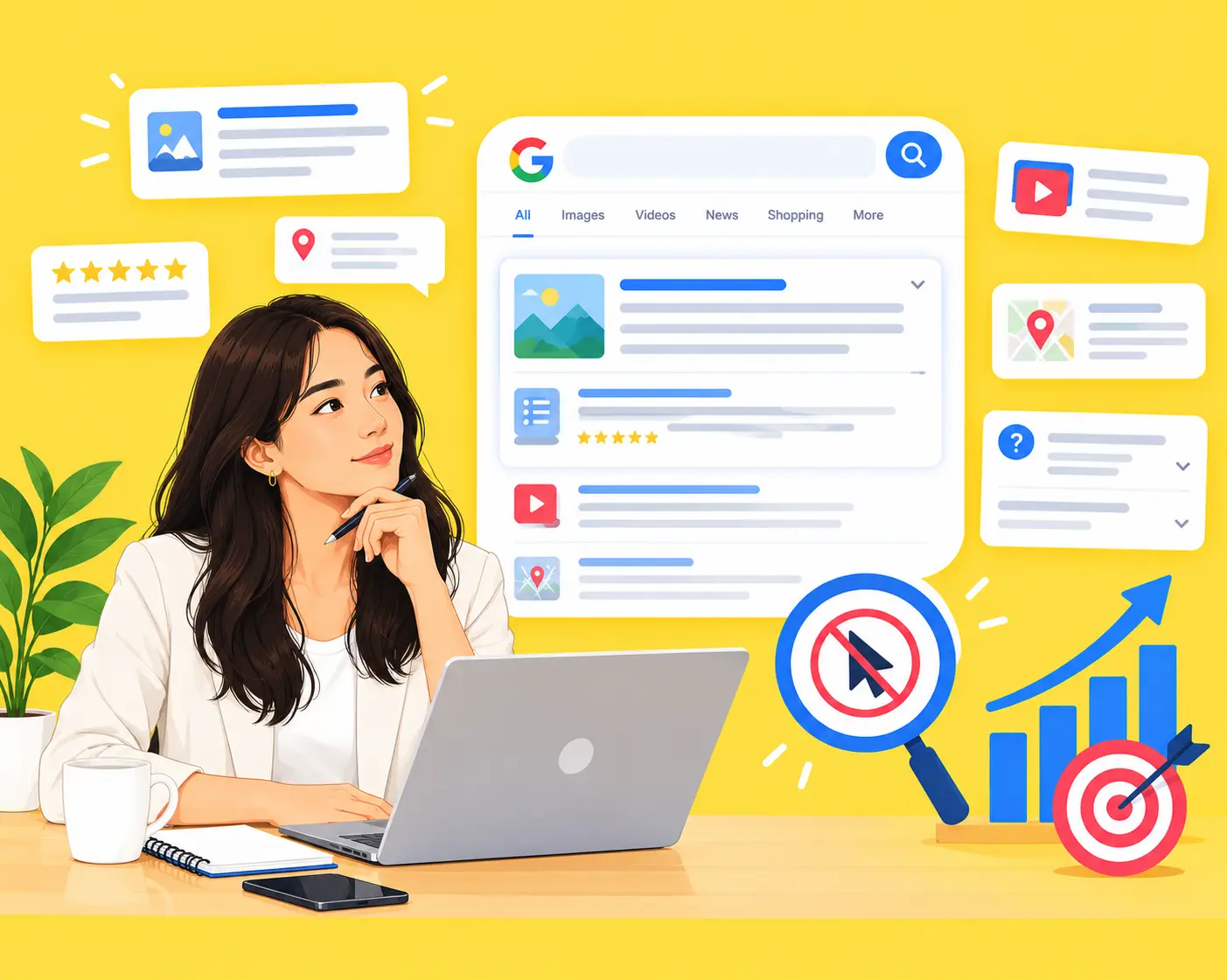


In my experience working on SEO projects across different industries, I’ve noticed that many websites struggle with organic growth because they lack content or SEO activities. They struggle because important opportunities remain undiscovered.
A business might publish blog posts regularly but fail to target keywords its potential customers use. Another website might have excellent content but struggle with indexing issues, weak internal linking, or a lack of relevant backlinks. Sometimes, a competitor ranks higher simply because its pages address users’ questions more effectively.
These are examples of SEO gaps.
When I analyze a website, I don’t look only at its existing rankings. I also look for what is missing, what competitors are doing better, what users expect to find, and what prevents the website from reaching its organic growth potential.
For example:
If I’m working with an SEO agency that wants to generate more leads, I might discover that it has several informative blog posts but lacks dedicated landing pages for important services.
In this situation, publishing more blog posts may not be the best next step. The more valuable opportunity could be creating or improving commercial pages that target customers ready to hire an SEO provider.
This is why identifying SEO gaps is an important part of my SEO strategy. It helps me prioritize improvements based on actual opportunities rather than simply doing more SEO work.
In this guide:
I’ll explain the different types of gaps in SEO, how I identify them, which tools I use, and how businesses can turn these gaps into practical opportunities for better search visibility.
What Are SEO Gaps?

SEO gaps are missing or underperforming elements in a website’s search engine optimization that may prevent it from reaching its organic search potential.
These gaps can exist in keyword targeting, content coverage, search intent, technical implementation, backlink profiles, internal linking, website structure, and other areas that influence search visibility and user experience.
I identify SEO gaps by comparing three things:
- What my client’s website currently offers: Its content, rankings, technical setup, authority, and existing performance.
- What the target audience needs: The information, products, services, and answers people are searching for.
- What competing websites do better: The relevant opportunities competitors are capturing that my client’s website may be missing.
For example:
Suppose a company offers technical SEO services but has only one general service page. Its competitors have dedicated resources covering technical audits, website migration, crawlability, indexation, and Core Web Vitals.
This doesn’t automatically mean the company needs five new pages. However, it gives me a starting point for investigating whether its website adequately addresses those topics and whether additional pages could serve distinct user needs.
I then evaluate search demand, business relevance, existing content, and search intent to determine the best course of action.
It’s important to understand that an SEO gap is an opportunity to investigate, not proof that a website has an SEO problem or that fixing it will automatically improve rankings.
The goal is to identify meaningful opportunities, prioritize them, and take action where the evidence supports it.
What Are the Main Types of Gaps in SEO?
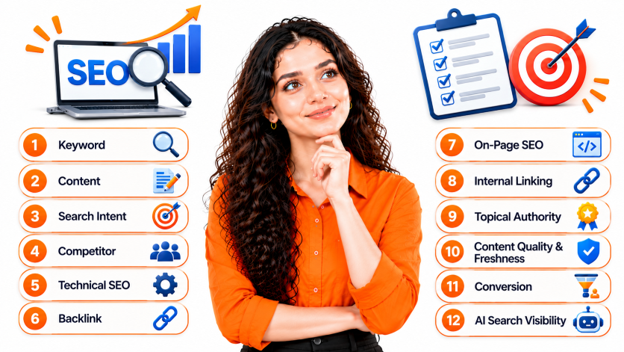
There are several types of SEO gaps, and each requires a different approach to identification and resolution.
For practical SEO analysis, I categorize them into the following 12 types.
| No. | Type of SEO Gap | What It Means | Typical Solution |
| 1 | Keyword Gap | Relevant keywords are missing from your SEO coverage, or competitors outperform you for them | Improve existing pages or create relevant new pages |
| 2 | Content Gap | Important topics, questions, or customer needs aren’t adequately covered | Expand existing content or develop new resources |
| 3 | Search Intent Gap | Your content doesn’t match what searchers expect to find | Rework the page’s focus, format, or purpose |
| 4 | Competitor Gap | Competitors have relevant strengths or search visibility that your website lacks | Identify and address realistic competitive opportunities |
| 5 | Technical SEO Gap | Technical issues or limitations may affect crawling, indexing, or user experience | Audit and fix relevant technical problems |
| 6 | Backlink Gap | Relevant websites link to competitors but not to your website | Develop legitimate link-earning and digital PR opportunities |
| 7 | On-Page SEO Gap | Important pages have weaknesses in their content, structure, or optimization | Improve titles, headings, content, and other page elements |
| 8 | Internal Linking Gap | Important pages lack useful internal links or are difficult to discover | Improve contextual links and website navigation |
| 9 | Topical Authority Gap | Your website has incomplete or underdeveloped coverage of relevant subject areas | Build a coherent, useful collection of related resources |
| 10 | Content Quality and Freshness Gap | Existing content is outdated, incomplete, inaccurate, or less useful than it could be | Update, improve, or consolidate content |
| 11 | Conversion Gap | Organic visitors aren’t taking the desired business actions | Improve relevance, trust, usability, and conversion paths |
| 12 | AI Search Visibility Gap | Your brand or content is missing from relevant AI-powered discovery opportunities | Improve content usefulness, accessibility, and brand discoverability |
These categories overlap. For example, a content gap may also be a keyword gap, while a technical SEO gap may prevent an otherwise valuable page from appearing in search results.
I use these categories as a practical framework for investigating problems and opportunities, not as an official Google classification.
Let’s examine each type in detail.
1. Keyword Gap in SEO
A keyword gap occurs when a website misses opportunities to rank for relevant search queries or performs worse than competitors for valuable keywords.
This is one of the first gaps I investigate because keyword coverage helps reveal whether a website is reaching its intended audience.
However, I don’t assume that every keyword a competitor ranks for is worth targeting.
A keyword must be relevant to the business, align with the audience’s needs, and represent an opportunity the website can reasonably pursue.
Example of a Keyword Gap
Suppose I am analyzing an SEO agency’s website.
The agency offers comprehensive SEO services, but its website receives little organic visibility for searches related to specific service offerings.
A competitor, meanwhile, ranks for queries such as:
- Technical SEO services.
- Enterprise SEO services.
- Ecommerce SEO services.
- Local SEO packages.
- SEO competitor analysis.
- On-page SEO services.
These keywords may reveal opportunities if the agency genuinely provides those services and its current website doesn’t adequately address them.
I would then investigate whether the agency needs dedicated service pages, improved existing pages, or more relevant supporting content.
How I Identify Keyword Gaps
I use a combination of keyword research, competitor analysis, and first-party search performance data.
My process includes:
Step 1: Identify relevant competitors. I select websites competing for the same services, products, or search queries.
Step 2: Compare keyword rankings. I identify queries where competitors have visibility but my client’s website has little or no visibility.
Step 3: Filter irrelevant opportunities. I remove keywords that don’t match the business, its audience, or its offerings.
Step 4: Analyze search intent. I determine whether each keyword calls for a service page, category page, blog post, comparison guide, or another format.
Step 5: Prioritize opportunities. I consider business value, search demand, ranking feasibility, existing page performance, and implementation effort.
Tools such as Semrush’s Keyword Gap tool and Ahrefs’ Site Explorer can help identify these opportunities.
How to Fix a Keyword Gap
The solution depends on whether the keyword represents a missing topic, a weak existing page, or a distinct search intent.
| Situation | Recommended Action |
| A valuable service keyword has no relevant landing page | Create a dedicated service page if the service warrants one |
| An existing page targets the topic but performs poorly | Improve its relevance, usefulness, structure, and internal links |
| Several keywords share the same intent | Consider addressing them on one comprehensive page |
| A keyword has little relevance to the business | Exclude it from the strategy |
| A competitor ranks for a query your website already covers | Investigate why its page performs better before deciding what to change |
My recommendation: Don’t create a separate page for every keyword. Group queries by intent and build pages that satisfy real user needs.
2. Content Gap in SEO
A content gap exists when your website doesn’t adequately address a topic, question, or information need relevant to your target audience.
Unlike a keyword gap, which often focuses on specific search queries, a content gap can reveal a broader weakness in your website’s coverage.
For example, a business may have pages targeting important keywords but still fail to explain its services thoroughly or answer common customer questions.
Example of a Content Gap
Imagine a website offering accounting services to construction companies.
It has a general accounting services page and several articles about bookkeeping.
However, it doesn’t cover topics such as:
- Job costing for construction companies.
- Construction cash flow management.
- Work-in-progress reporting.
- Construction project profitability.
- Financial reporting for contractors.
If these topics are relevant to its services and customers, they may represent meaningful content opportunities.
I would evaluate each topic before deciding whether to create a new article, improve an existing page, or address the information within a broader resource.
How I Identify Content Gaps
I examine the website’s existing content alongside customer questions, relevant search queries, and competitor resources.
I look for:
- Important topics the website doesn’t cover.
- Existing articles that overlook useful subtopics.
- Customer questions that remain unanswered.
- Missing content for important stages of the buying journey.
- Relevant comparisons or practical examples that could help readers.
- Outdated information that no longer meets users’ needs.
I also review Google Search Console to identify queries that already generate impressions. These queries can reveal where the website has an opportunity to improve existing content.
How to Fix a Content Gap
First, I determine whether the missing information deserves a new page.
If the topic represents a distinct user need, a separate resource may be appropriate. If the information belongs naturally within an existing page, expanding that page may be the better option.
For example:
A comprehensive technical SEO guide could cover crawling, indexing, canonicalization, and XML sitemaps in connected sections. Separate articles might be appropriate when a subject requires a deeper explanation and serves a distinct search intent.
I also prioritize original insights and practical usefulness rather than simply increasing word count.
Google’s official guidance emphasizes creating helpful, reliable, people-first content that provides value to readers.
The objective is to close genuine information gaps, not to publish content just because competitors have covered a topic.
I applied these keyword, content, technical, and on-page gap fixes to a printing company’s website, helping our client achieve 305% traffic growth quickly.
3. Search Intent Gap
A search intent gap occurs when a page doesn’t adequately satisfy the purpose behind a search query.
This can happen even when the page includes the target keyword and contains relevant information.
The problem is that the content may not provide the type of answer the searcher expects.
Example of a Search Intent Gap
Suppose a website targets the keyword “SEO packages.”
Its page contains a lengthy article explaining SEO fundamentals, the benefits of organic search, and the importance of keyword research.
However, searchers looking for SEO packages may expect to compare service inclusions, deliverables, pricing options, and package suitability.
The page might contain relevant keywords but still fail to satisfy the primary intent.
In this case, adding more general SEO information may not solve the problem.
The page may need a clearer commercial focus and a structure that helps users evaluate the available packages.
How I Identify Search Intent Gaps
I review the search results for the target query and examine the types of pages that appear.
I ask:
- Are the top results service pages, product pages, blog posts, or comparison guides?
- What questions do these pages answer?
- What information appears prominently?
- What does the searcher likely want to accomplish?
- Does my client’s page provide an appropriate answer?
I also consider whether the keyword has mixed intent. Some queries can serve multiple needs, so I avoid assuming that every search term has only one interpretation.
How to Fix a Search Intent Gap
The solution may involve changing the page’s focus, reorganizing the content, or creating a different type of resource.
| Search Query | Likely User Need | Suitable Page Type |
| What is technical SEO? | Understand a concept | Educational guide |
| Technical SEO checklist | Follow a practical process | Checklist or tutorial |
| Technical SEO services | Evaluate a provider | Service landing page |
| Best SEO tools | Compare available tools | Comparison guide |
| SEO packages and pricing | Evaluate costs and deliverables | Pricing or packages page |
These are typical patterns rather than absolute rules.
Before making changes, I verify that the proposed format aligns with the actual search results and the business’s objectives.
My approach is to match the page to the user’s task before trying to optimize the page for a keyword.
4. Competitor Gap in SEO
A competitor gap exists when competing websites have relevant advantages or opportunities that your website hasn’t yet matched.
This is a broader category than keyword gap analysis. It can include differences in content coverage, website architecture, backlink profiles, page quality, user experience, and visibility for commercially valuable searches.
When I conduct competitor SEO analysis, I don’t simply look at which website has the highest rankings. I investigate what might explain the difference and which opportunities are realistic for my client.
Example of a Competitor Gap
Suppose two agencies offer similar SEO services.
Agency A has a general SEO services page, a few blog posts, and limited supporting resources.
Agency B has dedicated pages for its main services, detailed case studies, useful educational content, and strong internal links connecting related resources.
Agency B may be better positioned to address a wider range of relevant searches and customer questions.
However, I wouldn’t automatically conclude that its content structure explains its rankings. I would investigate technical factors, search intent, competition, backlinks, and other relevant evidence.
How I Identify Competitor Gaps
My competitor analysis typically includes:
- Comparing organic keyword visibility.
- Identifying high-performing competitor pages.
- Reviewing content structure and topic coverage.
- Comparing important service and product pages.
- Analyzing relevant backlink opportunities.
- Evaluating internal linking and site architecture.
- Identifying content formats competitors use successfully.
- Reviewing their strengths and weaknesses in the target market.
I use these findings to understand where my client’s website has a realistic opportunity to improve.
How to Fix Competitor Gaps
I prioritize opportunities that align with the business rather than trying to replicate every competitor activity.
For example:
If competitors have useful service pages that my client lacks, I may recommend developing those pages.
If they attract links through original research, I may explore whether my client has the expertise or data to create a useful resource of its own.
If their pages provide clearer answers to important customer questions, I may recommend improving the content on my client’s existing pages.
The solution should address the underlying weakness rather than copy the competitor’s website.
Important: A competitor ranking above your website doesn’t automatically mean you’ve missed a specific SEO activity. Rankings reflect multiple factors, so I investigate the evidence before recommending changes.
5. Technical SEO Gap
A technical SEO gap occurs when a website has technical weaknesses or missing capabilities that may interfere with crawling, indexing, rendering, or the user experience.
These gaps are particularly important because they can limit the effectiveness of otherwise valuable content.
For example:
Creating a new landing page won’t deliver its intended search visibility if the page is accidentally blocked from indexing.
Common Technical SEO Gaps
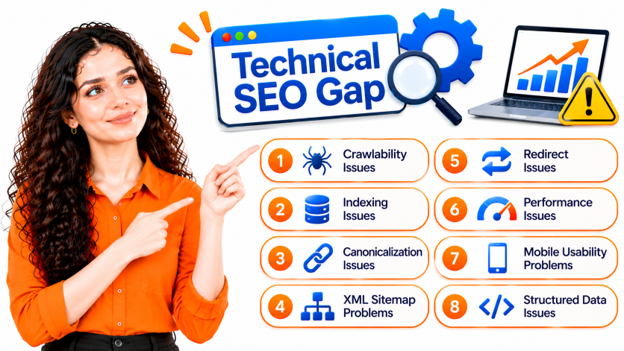
I frequently investigate the following areas:
Crawlability issues: Important pages may be difficult for search engines to discover because of poor linking, incorrect directives, or website architecture problems.
Indexing issues: Pages may be excluded from Google’s index because of technical configuration, duplication, quality concerns, or other reasons.
Canonicalization issues: Canonical tags may point to inappropriate URLs or fail to reflect the intended preferred version.
XML sitemap problems: Sitemaps may contain URLs that are redirected, non-canonical, or otherwise unsuitable for inclusion.
Redirect issues: Redirect chains, loops, and incorrect redirects may interfere with navigation or URL consolidation.
Performance issues: Slow loading, poor responsiveness, or layout instability may negatively affect the user experience.
Mobile usability problems: Content, forms, and navigation may be difficult to use on smaller screens.
Structured data issues: Relevant structured data may be missing, invalid, or inconsistent with the visible content.
How I Identify Technical SEO Gaps
I combine technical crawling tools with search performance data and manual investigation.
My toolkit may include:
- Google Search Console for indexing reports and search performance.
- Screaming Frog SEO Spider for crawling and identifying technical issues.
- Google PageSpeed Insights for performance analysis.
- Google’s URL Inspection documentation for understanding how to inspect individual URLs.
I don’t treat every warning reported by a tool as an urgent problem. I validate the issue, identify its cause, and evaluate its potential impact.
How to Fix Technical SEO Gaps
The right solution depends on the problem.
| Technical Gap | Potential Solution |
| Important pages are blocked from crawling | Review robots.txt and other access controls |
| Important pages aren’t indexed | Investigate indexing signals, page quality, canonicalization, and technical configuration |
| Incorrect canonical tags | Correct the canonical URL implementation |
| Broken internal links | Update links to appropriate working URLs |
| Redirect chains | Simplify redirects where appropriate |
| Poor page performance | Investigate images, scripts, server response, and layout issues |
| Missing or invalid structured data | Implement or correct appropriate schema markup |
| Important pages are difficult to discover | Improve internal linking and site architecture |
Google’s SEO Starter Guide explains the importance of helping search engines discover content and understand a website’s structure.
My recommendation: Fix critical technical issues before investing heavily in activities that depend on the affected pages performing well in search.
6. Backlink Gap in SEO
A backlink gap exists when relevant websites link to competing websites but not to yours, potentially revealing opportunities to earn recognition and links from useful sources.
Backlink gap analysis is a common part of competitor SEO research.
However, I don’t assume that every competitor backlink is valuable or that my client needs to reproduce the same backlink profile.
The goal is to identify relevant opportunities that make sense for the business.
Example of a Backlink Gap
Suppose an SEO agency’s competitors have earned links from:
- Digital marketing publications.
- Relevant industry blogs.
- Business directories with genuine editorial standards.
- Websites featuring useful research.
- Business partners and professional associations.
The agency’s website has very few comparable links from relevant sources.
This may indicate an opportunity to improve its visibility and earn recognition within its industry.
However, the value of each opportunity depends on its relevance, quality, context, and legitimacy.
How I Identify Backlink Gaps
I compare referring domains and the pages receiving links across competing websites.
I investigate:
- Which relevant websites link to multiple competitors.
- Which competitor pages attract the most useful backlinks.
- What content or resources earned those links.
- Whether similar opportunities are appropriate for my client.
- Whether the website has a useful resource worth referencing.
Tools such as Ahrefs and Semrush can help identify referring domains and compare backlink profiles.
How to Fix Backlink Gaps
I look for legitimate ways to earn links rather than pursuing backlinks purely to increase a third-party metric.
Potential activities include:
- Creating original research and useful industry resources.
- Developing genuinely link-worthy guides.
- Building relationships with relevant publishers.
- Contributing expert commentary where appropriate.
- Participating in legitimate industry associations.
- Identifying relevant unlinked brand mentions.
- Promoting useful content to audiences who may benefit from it.
For example:
An accounting firm could publish an original report about financial challenges faced by construction businesses. If the report contains useful findings, relevant publishers may have a reason to reference it.
I also avoid manipulative link schemes, automated link building, and irrelevant link exchanges.
The objective is to earn relevant recognition, not simply to match a competitor’s backlink count.
7. On-Page SEO Gap
An on-page SEO gap exists when important pages lack elements, content, or clarity that could help them better serve users and communicate their purpose.
A website can target the correct keywords and still have weak page optimization.
For example:
A service page may have a vague title, poorly organized headings, insufficient information about the service, and no useful internal links.
These weaknesses can affect both the user experience and the page’s ability to compete effectively.
Common On-Page SEO Gaps
I investigate issues such as:
- Unclear or unhelpful title tags.
- Headings that don’t reflect the page’s structure.
- Content that doesn’t adequately address search intent.
- Missing explanations of important service details.
- Weak or irrelevant internal links.
- Poorly optimized images.
- Duplicate or overly similar page content.
- Confusing calls to action.
- Missing contextual information that users need.
Not every page needs every possible optimization. I focus on improvements that make the page more useful and relevant.
How I Identify On-Page SEO Gaps
I compare the page’s purpose, content, structure, and performance against the needs of its intended audience.
I also examine search queries in Google Search Console to see which topics are generating impressions and whether the page appears relevant to those searches.
When a page receives impressions but attracts few clicks, I investigate its search position, query mix, title, and snippet presentation.
When it attracts visitors but performs poorly, I examine the content, user journey, and conversion experience.
How to Fix On-Page SEO Gaps
My recommendations may include:
- Writing clearer, more descriptive page titles.
- Organizing headings into a logical hierarchy.
- Improving content coverage and accuracy.
- Addressing unanswered customer questions.
- Adding relevant internal links.
- Improving image descriptions and performance.
- Making service information easier to understand.
- Strengthening calls to action where appropriate.
For example:
A page offering technical SEO services should explain what the service includes, which problems it addresses, how the process works, and what the customer can expect.
Simply inserting the phrase “technical SEO services” into multiple headings won’t compensate for missing or unhelpful information.
8. Internal Linking Gap
An internal linking gap occurs when important pages lack useful links from other pages on the same website.
Internal links help users navigate a website and help search engines discover pages and understand their relationships.
When important pages are poorly connected, users may struggle to find them, and search engines may have fewer clear pathways to discover them.
Example of an Internal Linking Gap
Imagine a website has published 20 articles about technical SEO.
It also has a technical SEO services page, but none of the articles link to it.
Readers who discover the educational content may never find the relevant service, even if they’re interested in hiring a provider.
This represents a potential internal linking opportunity.
The problem isn’t necessarily the number of links. It’s whether the website provides useful connections between related content and important destinations.
How I Identify Internal Linking Gaps
I examine:
- Important pages with few or no internal links.
- Pages that are difficult to reach through navigation.
- Relevant blog posts that don’t link to associated service pages.
- Broken internal links.
- Orphaned pages that lack incoming internal links.
- Important pages that require unnecessary navigation steps.
- Opportunities to connect related resources naturally.
A website crawl can help identify orphaned pages and pages with few incoming internal links, although the findings need to be interpreted in the context of the website’s structure.
How to Fix Internal Linking Gaps
I build a logical internal linking structure based on the relationship between pages.
For example:
Educational article → Supporting guide → Relevant service page
A blog post about identifying website crawl errors might link to a technical SEO audit guide, which could then direct readers to the relevant technical SEO service.
I use descriptive anchor text that accurately reflects the destination and makes sense in context.
I don’t force internal links into unrelated content or add them solely to increase link counts.
My recommendation: Review internal links whenever you publish new content, update existing pages, or identify important pages that aren’t receiving sufficient attention.
9. Topical Authority Gap
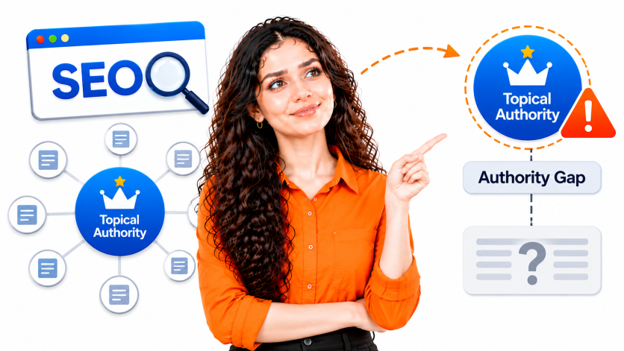
A topical authority gap occurs when a website has incomplete or underdeveloped coverage of a subject area relevant to its audience and business.
This is closely related to content gap analysis, but the focus is broader: instead of investigating individual missing keywords, I examine whether the website covers a subject coherently.
I also want to clarify that topical authority is an SEO concept, not a publicly defined Google ranking score that can be measured precisely.
Example of a Topical Authority Gap
Suppose a website offers comprehensive SEO services but has only a few articles about keyword research.
Meanwhile, its audience regularly needs information about:
- Keyword research methods.
- Search intent.
- Keyword clustering.
- Competitor keyword analysis.
- Keyword mapping.
- Content optimization.
- Keyword performance measurement.
These subjects are closely related.
If the website wants to build a useful resource around keyword research, it may need to expand its coverage of the subject.
However, I wouldn’t automatically recommend publishing every possible article. I would first establish which topics are relevant to the audience and which resources serve distinct purposes.
How I Identify Topical Authority Gaps
I map the website’s major topics and supporting subtopics.
Then I evaluate:
- Whether important subjects are covered.
- Whether the existing resources are useful and accurate.
- Whether related pages address distinct user needs.
- Whether supporting content connects to relevant core pages.
- Whether the website has unnecessary duplication.
- Whether the content reflects genuine expertise.
I also compare the topic map with relevant customer questions and competitor coverage.
How to Fix Topical Authority Gaps
I develop a content plan organized around the website’s core subject areas.
For an SEO agency, this might involve a central SEO services page supported by resources about technical SEO, keyword research, content optimization, local SEO, and link building.
Each page should have a clear purpose and contribute meaningful information.
I also establish appropriate internal links between related resources.
The goal is not to publish the largest number of articles or to claim expertise in every possible subject. It’s to build a coherent collection of useful resources that supports the business and its audience.
10. Content Quality and Freshness Gap
A content quality gap exists when existing content doesn’t provide sufficient value, clarity, accuracy, or depth for its intended purpose.
A freshness gap occurs when information has become outdated or no longer reflects current circumstances.
These gaps are particularly relevant for websites with large content libraries.
Example of a Content Quality or Freshness Gap
Suppose an agency published a guide to SEO tools several years ago.
The article still attracts organic traffic, but several tools have changed their features, pricing, or availability. Some screenshots are outdated, and newer alternatives are missing.
The article may still have value, but its information needs reviewing.
Similarly, a service page might have accurate information but fail to explain the service clearly or address common customer concerns.
In both situations, updating the existing content may be more useful than publishing another article on the same subject.
How I Identify Content Quality Gaps
I review pages that:
- Have declining organic performance.
- Contain outdated facts or recommendations.
- No longer match current search intent.
- Receive impressions but attract limited clicks.
- Overlap significantly with other pages.
- Fail to answer important audience questions.
- Contain broken links or outdated references.
- Lack useful examples or supporting information.
A decline in rankings or traffic doesn’t automatically mean the content is poor. I also investigate changes in search demand, competitors, search results, and technical performance.
How to Fix Content Quality and Freshness Gaps
Depending on the issue, I may:
- Update outdated facts and examples.
- Improve explanations and organization.
- Add useful information missing from the page.
- Remove irrelevant or repetitive sections.
- Verify sources and replace broken references.
- Improve internal links.
- Consolidate overlapping pages where appropriate.
- Redirect URLs when a consolidation or replacement makes that necessary.
I don’t recommend changing publication dates without making meaningful updates.
Likewise, I don’t refresh content merely because it is old. A page that remains accurate and useful may not need substantial changes.
My priority is to maintain content quality and relevance, not to update every page on an arbitrary schedule.
11. Conversion Gap in SEO
A conversion gap occurs when a website attracts relevant organic visitors but fails to turn enough of them into desired business outcomes.
Those outcomes might include inquiries, purchases, consultation bookings, demo requests, or phone calls.
This gap is important because more traffic doesn’t necessarily mean more business.
Example of a Conversion Gap
Suppose a service page attracts 1,000 organic visits in a month but generates very few inquiries.
The page may be ranking for relevant searches, yet visitors might struggle to understand the service, assess its suitability, or determine what to do next.
Potential problems could include:
- Unclear service descriptions.
- Weak or difficult-to-find calls to action.
- Missing pricing or deliverable information.
- Insufficient trust signals.
- Complicated inquiry forms.
- Poor mobile usability.
- A mismatch between search intent and page content.
These are possibilities to investigate, not assumptions to make without evidence.
How I Identify Conversion Gaps
I combine organic search data with analytics and, where available, CRM or sales data.
I examine:
- Which organic landing pages generate conversions.
- Which pages attract visitors but produce few inquiries.
- Whether important conversion events are being tracked correctly.
- How visitors interact with forms and calls to action.
- Whether leads from organic search are relevant to the business.
- Whether conversion rates differ by landing page or audience.
I also consider the type of business. A visitor researching a complex B2B service may need several interactions before becoming a qualified lead.
How to Fix Conversion Gaps
The solution depends on what the data reveals.
For example, I might recommend clarifying service deliverables, improving the visibility of a consultation form, adding genuine case studies, simplifying form fields, or aligning page content more closely with the visitor’s needs.
I also verify that analytics tracking is working correctly before drawing conclusions.
Conversion optimization isn’t a substitute for SEO, but it helps ensure that organic visibility has a better chance of delivering business value.
12. AI Search Visibility Gap
An AI search visibility gap occurs when a business has limited visibility in relevant AI-powered search experiences compared with the opportunities available to it.
For example, a user might ask an AI search tool to recommend providers in a particular industry or explain how to solve a business problem.
If competing brands are repeatedly mentioned or cited while your business is absent, that may be worth investigating.
However, AI-generated answers can vary by platform, query, location, context, and time. A brand’s absence from one answer doesn’t establish a persistent visibility problem.
How I Identify AI Search Visibility Gaps
I start by identifying realistic questions potential customers might ask AI-powered search tools.
For example, an SEO agency might investigate prompts such as:
- How do I choose an SEO agency for a small business?
- What should a technical SEO audit include?
- Which SEO services are useful for an ecommerce website?
- How can a business improve organic search visibility?
I then review the answers, noting which brands are mentioned, which sources are cited, and what types of information appear to be useful to the response.
Where possible, I repeat checks across relevant prompts and platforms rather than drawing conclusions from one result.
I also review available referral analytics to determine whether AI platforms send measurable traffic to the website.
How to Address AI Search Visibility Gaps
My approach begins with the website’s underlying quality and discoverability.
I focus on:
- Publishing accurate, useful, original content.
- Demonstrating relevant first-hand experience.
- Providing clear information about products and services.
- Maintaining a technically accessible website.
- Using appropriate structured data.
- Building legitimate brand recognition.
- Ensuring important pages can be discovered through sensible internal linking.
- Monitoring AI-related visibility and referrals where reliable data is available.
I don’t assume that a particular heading format, schema implementation, or AI optimization tactic guarantees citations.
My recommendation is to improve the quality and accessibility of the information your business provides, then measure AI search visibility where the available data allows it.
SEO Gap Analysis vs. SEO Audit: What’s the Difference?
I often use both SEO audits and SEO gap analysis when developing an SEO strategy, but they serve slightly different purposes.
An SEO audit examines the website’s current condition and identifies issues or areas for improvement.
SEO gap analysis compares the website’s current performance or capabilities with a relevant benchmark, such as competitors, audience needs, or business objectives.
The two processes overlap, but they emphasize different questions.
| Factor | SEO Audit | SEO Gap Analysis |
| Primary purpose | Identify existing issues and weaknesses | Identify missing opportunities and performance differences |
| Main focus | Current website condition | Difference between current and desired performance |
| Common inputs | Website crawl, indexing data, page content, analytics | Competitor data, keyword research, audience needs, analytics, technical findings |
| Typical finding | Important service pages have incorrect canonical tags | Competitors rank for relevant commercial keywords that the website doesn’t adequately target |
| Typical output | List of SEO issues and recommended fixes | Prioritized opportunities and actions |
| Business value | Helps address weaknesses | Helps identify potential areas for growth |
Which Should You Do First?
I generally recommend starting with an initial SEO audit and business assessment, followed by a more focused gap analysis.
The audit helps establish the website’s current condition. The gap analysis then helps determine which improvements and new opportunities deserve priority.
However, I don’t treat this as a rigid sequence.
If the business already has reliable technical data and a clear understanding of its website, I may begin with competitor or keyword gap analysis to investigate a specific growth opportunity.
The best approach depends on the information available and the question the business needs to answer.
How I Conduct an SEO Gap Analysis: My Step-by-Step Process
Identifying SEO gaps is only useful when the findings lead to practical decisions.
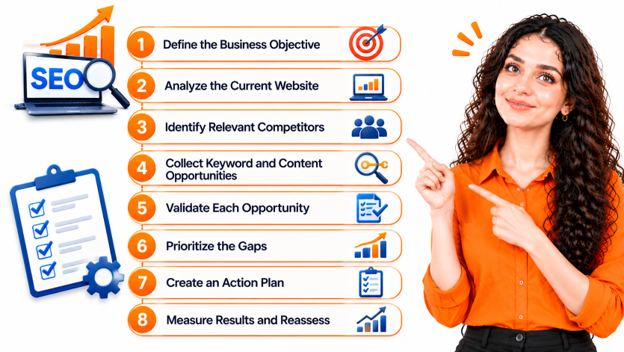
When I conduct an SEO gap analysis, I follow a structured process that helps me distinguish valuable opportunities from irrelevant or low-priority findings.
Step 1: Define the Business Objective
I first establish what the business wants to achieve.
For example, the objective might be to increase qualified leads, improve visibility for a particular service, expand into a new market, or grow organic sales.
This determines which gaps deserve attention.
Step 2: Analyze the Current Website
I review the website’s existing pages, organic search performance, technical condition, and conversion data where available.
I also identify pages that already perform well because these may offer opportunities for further improvement.
Step 3: Identify Relevant Competitors
I select competitors based on the target market, services, and search queries.
I avoid comparing the website with unrelated businesses simply because they operate in the same broad industry.
Step 4: Collect Keyword and Content Opportunities
I compare relevant competitor keywords and pages, investigate missing topics, and review queries already generating impressions for the website.
I then group the findings into meaningful categories, such as keyword gaps, content gaps, search intent gaps, and backlink gaps.
Step 5: Validate Each Opportunity
I don’t treat every item in an SEO tool’s report as a recommendation.
For each potential gap, I ask:
- Is it relevant to the business?
- Does it reflect a genuine audience need?
- Does the website already address it adequately?
- Would a new page or an existing-page improvement be more appropriate?
- Is there evidence of a technical or content problem?
- Is the opportunity realistic given the competition and available resources?
This step helps prevent unnecessary content creation and wasted effort.
Step 6: Prioritize the Gaps
I evaluate the potential business value, likely impact, confidence in the diagnosis, implementation effort, and dependencies.
For example, correcting an indexing problem affecting an important commercial page may deserve priority over writing a new article targeting a low-value keyword.
Step 7: Create an Action Plan
Finally, I convert the findings into specific tasks with clear priorities, owners, and success measures.
A practical action plan might look like this:
| Identified Gap | Recommended Action | Priority | Success Measure |
| Important service keyword has no relevant landing page | Create or improve the appropriate service page | High, if commercially valuable | Relevant search visibility and qualified leads |
| Existing article doesn’t satisfy search intent | Rework the page to answer the intended query | High, if the opportunity is validated | Relevant clicks, rankings, and engagement |
| Important page has an indexing problem | Diagnose and resolve the underlying issue | High, if indexing is necessary for the page’s purpose | Indexing status and subsequent search performance |
| Competitors earn relevant editorial backlinks | Develop a suitable link-earning campaign | Medium, depending on the opportunity | Relevant links earned and referral or visibility outcomes |
| Related pages lack contextual internal links | Add appropriate links between relevant resources | Medium or high, depending on page importance | Improved discovery and page performance |
| Organic visitors aren’t converting | Investigate the landing page and conversion journey | High, if the traffic is relevant | Qualified leads or sales |
These priorities are illustrative. I determine the actual order based on the website’s condition, business goals, and evidence.
Step 8: Measure Results and Reassess
After implementing changes, I monitor the relevant metrics and compare results with the starting baseline.
I also allow for the time search engines and users may need to respond to changes.
If an improvement doesn’t produce the expected result, I investigate further rather than assuming that the entire strategy has failed.
SEO gap analysis is most effective when it becomes an ongoing process of research, implementation, and learning.
Best Tools for Finding SEO Gaps
I use different tools depending on the type of gap I’m investigating.
No single tool identifies every opportunity, so I combine automated reports with manual analysis and first-party performance data.
| Tool | Best For | How I Use It |
| Semrush | Keyword and competitor gaps | Compare keyword visibility and identify relevant missing opportunities |
| Ahrefs | Keyword and backlink gaps | Analyze competitor pages, rankings, and referring domains |
| Google Search Console | Search performance and indexing gaps | Identify queries, page performance changes, and technical concerns |
| Google Analytics 4 | Conversion gaps | Evaluate organic landing pages, user activity, and conversions |
| Screaming Frog SEO Spider | Technical and internal linking gaps | Crawl the website and investigate page-level issues |
| Google PageSpeed Insights | Performance gaps | Investigate loading, responsiveness, and visual stability |
| Google Keyword Planner | Keyword discovery | Explore keyword ideas and estimated search demand |
I choose tools based on the problem rather than running every available report.
For example:
If organic visibility has declined because important pages aren’t being indexed, I start with technical investigation. If the website has strong technical foundations but limited visibility for commercial searches, keyword and competitor analysis may be more useful.
The purpose of the tool is to support a decision, not to produce a large report without a clear next step.
How to Prioritize SEO Gaps
Finding 100 potential SEO gaps doesn’t mean you should fix all 100 immediately.
I prioritize them according to their relevance, potential business value, confidence in the diagnosis, and the resources required to address them.
A practical scoring framework can help.
For example, I might assign each gap a score from 1 to 5 across four dimensions:
- Business impact: How closely does the opportunity relate to important business outcomes?
- SEO opportunity: Is there credible evidence of meaningful search visibility or performance potential?
- Confidence: How strong is the evidence that the identified gap is real and the proposed action is appropriate?
- Effort: How much time and implementation work will the solution require?
A simple prioritization score could be calculated as:
Priority Score = (Business Impact × SEO Opportunity × Confidence) ÷ Effort
Higher scores indicate opportunities that may deserve earlier attention.
This is an internal planning framework, not a validated formula for predicting SEO results. The scores depend on the assumptions and evidence used.
I also consider dependencies. For example, a new content campaign may need to wait until an important technical issue has been resolved.
Ultimately, I prioritize actions that are likely to make a meaningful difference without wasting resources on irrelevant or speculative opportunities.
Common Mistakes to Avoid When Identifying SEO Gaps
Even a detailed gap analysis can lead to poor decisions if the findings aren’t interpreted correctly.
Here are some mistakes I recommend avoiding.
1. Targeting Every Keyword Competitors Rank For
Competitors may rank for keywords unrelated to your services or business objectives.
I filter keyword opportunities based on relevance, intent, and realistic business value rather than copying an entire competitor keyword list.
2. Creating New Content for Every Gap
Some gaps can be addressed by improving an existing page.
Creating another page when the website already has a relevant resource may introduce duplication or competing search intent.
I evaluate the existing content before deciding whether a new page is necessary.
3. Ignoring Search Intent
A page can contain relevant keywords but still fail to satisfy the searcher’s needs.
Before optimizing content, I determine what the user expects to find and whether the page provides an appropriate answer.
4. Treating Every Technical Warning as Critical
SEO tools can identify many issues, but not all of them have the same impact.
I validate technical findings and prioritize those that meaningfully affect crawling, indexing, usability, or the performance of important pages.
5. Focusing Only on Competitors
Competitor analysis is useful, but it shouldn’t determine the entire strategy.
A competitor might publish content that isn’t relevant to your audience or business goals.
I use competitor research alongside customer needs, first-party data, and business objectives.
6. Ignoring Existing Strengths
Gap analysis should identify what is missing, but it should also recognize what is already working.
Pages that generate valuable leads, attract relevant backlinks, or rank well for important queries may deserve protection and further improvement.
I don’t sacrifice successful assets simply to pursue every new opportunity.
7. Expecting Immediate Results
Closing an SEO gap doesn’t guarantee an immediate ranking improvement.
The outcome depends on the nature of the issue, the quality of the solution, competition, and other factors.
I track results over an appropriate period and refine the approach based on evidence.
Conclusion: Turn SEO Gaps Into Growth Opportunities
In my experience, identifying SEO gaps is one of the most useful ways to move from routine optimization to a more focused SEO strategy.
It helps me understand what a website is missing, where competitors have relevant advantages, which existing pages need improvement, and which opportunities could contribute to business growth.
However, I don’t recommend treating every missing keyword, technical warning, or competitor advantage as a problem that must be fixed.
The real value comes from evaluating the evidence and deciding which changes are worth making.
My approach is to begin with the business objectives, analyze the website’s current performance, investigate relevant gaps, and prioritize actions based on their likely value and implementation requirements.
Whether the opportunity involves keyword research, content improvement, technical SEO, backlink analysis, internal linking, or AI search visibility, the goal remains the same: make the website more useful to its intended audience and improve its ability to attract relevant organic traffic.
At RankON Technologies, we use this type of analysis to help businesses identify SEO opportunities and develop practical strategies around their objectives.
If your website isn’t generating the organic visibility or qualified leads you expect, a structured SEO gap analysis can help reveal where improvements may be needed.
Ready to identify the SEO gaps holding your website back?
Explore RankON Technologies’ SEO services to learn how a structured SEO strategy can help your business improve organic visibility, strengthen its website, and attract more relevant visitors.
FAQs About Types of Gaps in SEO
1. What Are the Main Types of Gaps in SEO?
The main types include keyword gaps, content gaps, search intent gaps, competitor gaps, technical SEO gaps, backlink gaps, on-page SEO gaps, internal linking gaps, topical authority gaps, content quality and freshness gaps, conversion gaps, and AI search visibility gaps.
These categories help organize SEO analysis, but they can overlap. A single issue may involve several types of gaps.
2. What Is the Difference Between a Keyword Gap and a Content Gap?
A keyword gap identifies relevant search queries that a website doesn’t target effectively or for which competitors have stronger visibility.
A content gap identifies topics, questions, or information needs that the website doesn’t adequately address.
For example:
A competitor may rank for the keyword “technical SEO audit checklist,” revealing a keyword opportunity. A broader review might also reveal that the website lacks a comprehensive technical SEO resource, indicating a content gap.
The appropriate solution depends on whether the existing page needs improvement or a distinct resource is missing.
3. How Do I Find SEO Gaps on My Website?
Start by reviewing your website’s organic search performance, existing content, technical condition, and competitors.
Use Google Search Console to identify search queries and page performance patterns. Use keyword and backlink research tools to compare your website with relevant competitors.
Then validate the findings, remove irrelevant opportunities, and prioritize the gaps that align with your business goals.
4. Which SEO Gap Should I Fix First?
There is no universal answer.
If important pages are blocked from indexing, resolving the technical issue may be the highest priority.
If the website is technically sound but lacks important commercial landing pages, creating or improving those pages may be more valuable.
I recommend prioritizing gaps according to business impact, evidence, implementation effort, and dependencies.
5. How Often Should I Conduct an SEO Gap Analysis?
For many businesses, reviewing SEO gaps quarterly is a useful starting point.
However, I may conduct more frequent reviews for competitive markets, rapidly changing websites, large ecommerce platforms, or businesses launching new services.
I also revisit the analysis when organic performance changes significantly, competitors introduce relevant offerings, or business objectives evolve.
6. Can SEO Gap Analysis Improve Rankings?
SEO gap analysis can help identify opportunities to improve search visibility, but it doesn’t directly improve rankings by itself.
Results depend on identifying genuine gaps, implementing appropriate changes, and how search engines evaluate the website and its competitors.
The value of the process is that it helps focus resources on relevant improvements rather than relying on guesswork.
7. Which Tools Are Best for SEO Gap Analysis?
Semrush and Ahrefs are useful for keyword, competitor, and backlink analysis.
Google Search Console helps evaluate search performance and indexing, while Screaming Frog can identify technical and internal linking issues.
Google Analytics 4 helps assess whether organic visitors contribute to business outcomes.
I generally combine multiple tools because each provides a different perspective.
8. Is SEO Gap Analysis Important for Small Businesses?
Yes. Small businesses often have limited resources, making prioritization especially important.
A gap analysis can help identify missing service pages, relevant local keywords, content opportunities, technical issues, and opportunities to improve conversions.
The key is to focus on a manageable number of high-value actions rather than attempting to fix everything at once.
9. What Is an AI Search Visibility Gap?
An AI search visibility gap is the potential difference between a business’s current visibility in AI-powered search experiences and its relevant discovery opportunities.
It can be investigated by reviewing how AI tools respond to customer questions, which brands they mention, and which sources they cite.
Because AI-generated answers vary and measurement remains platform-dependent, I treat these findings as evidence to investigate rather than definitive ranking data.
10. Does Every SEO Gap Need to Be Fixed?
No. Some gaps have little business value, some are impractical to address, and others may not represent genuine problems.
For example, a competitor may rank for a keyword that is irrelevant to your business. Pursuing it would waste resources.
I recommend validating each gap and prioritizing only those that align with the website’s goals and audience.