

Search is evolving beyond traditional search engine results pages. People are increasingly using AI-powered platforms to discover businesses, compare products, research services, and find answers to their questions. As a result, businesses need to understand not only how their websites perform in Google but also how effectively their brands appear in AI-generated answers.
This is where an AI gap analysis can help:
“An AI gap analysis identifies the differences between your current AI search visibility and your desired visibility. “
It helps you understand where competitors have an advantage, which topics your website fails to cover, whether AI platforms recognize your brand as a relevant source, and what improvements could strengthen your presence across AI-driven search experiences.
For example:
“An SEO agency might rank well for competitive keywords on Google but rarely appear when users ask ChatGPT, Perplexity, or Google’s AI-powered search features to recommend SEO services. This indicates a potential visibility gap worth investigating.”
By systematically evaluating these gaps, businesses can prioritize improvements to their content, technical SEO, brand authority, and overall search strategy.
In this guide:
“We’ll explain how to perform an AI gap analysis, which areas to examine, what tools to consider, and how to turn your findings into an actionable optimization plan.”
What Is an AI Gap Analysis?
An AI gap analysis is a structured process for comparing your current performance, capabilities, or visibility with a desired outcome and identifying what needs to change to close the difference.
In the context of digital marketing and SEO, it helps businesses understand how effectively their websites and brands appear across AI-powered search experiences.
Traditional SEO gap analysis often focuses on keyword rankings, backlink profiles, organic traffic, and content opportunities. An AI SEO gap analysis extends this process by examining how AI platforms interpret your content, which sources they reference, whether they recognize your brand, and what information competitors provide that your website may lack.
For example:
Imagine you operate a digital marketing agency offering SEO services.
When potential customers search Google for relevant keywords, your website appears on the first page. However, when they ask an AI platform to recommend SEO agencies for small businesses, your brand is missing from the response.
This situation raises several questions:
- Does your website adequately explain your SEO services and expertise?
- Are competitors publishing more useful, specific, and trustworthy content?
- Does your brand have sufficient third-party mentions and industry recognition?
- Can search engines and AI systems easily access and understand your website content?
- Are you covering the questions your potential customers ask AI platforms?
An AI gap analysis helps investigate these questions systematically instead of relying on assumptions.
Important distinction: AI search visibility analysis is one application of AI gap analysis. Organizations can also use the same framework to evaluate AI adoption, data readiness, employee skills, automation opportunities, and operational processes. This guide focuses primarily on AI search visibility and SEO.
Why Is AI Gap Analysis Important?

AI-powered search is changing how people discover information and evaluate businesses. Your website may attract organic traffic while still missing opportunities to become a useful source in AI-generated answers.
An AI gap analysis helps you identify these opportunities and make informed decisions about where to invest your optimization efforts.
1. Identify Missed AI Search Opportunities
Your audience may ask AI platforms questions about your services, pricing, expertise, or available solutions. If competitors appear in those answers while your brand does not, you may have an opportunity to improve your visibility.
For instance, a prospective customer might ask:
- Which SEO agencies specialize in healthcare businesses?
- What should I look for when hiring an SEO company?
- Which agencies offer technical SEO audits?
- How much does professional SEO cost?
- What is the difference between traditional SEO and AI search optimization?
Testing relevant questions can reveal where your brand appears, where it is absent, and which competitors are being mentioned.
The goal is not simply to get your brand mentioned more frequently. It is to identify relevant opportunities to become a credible and useful source of information.
2. Discover Content Gaps
AI systems can draw on information from multiple sources when generating answers. If your website lacks detailed explanations, practical examples, relevant comparisons, or answers to common customer questions, it may be less useful for certain queries.
A content gap analysis helps you compare your existing resources with the information users need.
For example:
An SEO agency might offer technical SEO services but have limited content explaining:
- Common technical SEO problems and how to resolve them.
- How a technical SEO audit works.
- Which technical SEO issues should be prioritized.
- How technical SEO improvements affect website performance.
- How businesses can evaluate the results of technical SEO work.
Identifying these gaps gives your content team a practical roadmap for creating resources that address real customer needs.
3. Understand Competitor Advantages
Your competitors may have stronger visibility because they publish more comprehensive content, receive more relevant third-party mentions, demonstrate their expertise more clearly, or provide information that better matches a user’s question.
AI gap analysis helps you investigate these differences.
Rather than copying competitor content, identify what makes their information useful and determine how your website can provide something more relevant, accurate, or valuable.
4. Strengthen Brand Credibility
Brand recognition and trust are important considerations in a competitive search environment.
If your business has a limited digital footprint beyond its own website, potential customers may find it harder to verify your expertise.
An AI gap analysis can help identify opportunities to strengthen your digital presence through:
- Detailed author and company profiles.
- Original research and practical case studies.
- Relevant industry publications and expert contributions.
- Accurate business information across reputable platforms.
- Genuine customer reviews and testimonials.
- Consistent brand descriptions across your website and external profiles.
These activities can improve the information available about your business, although no individual action guarantees that an AI platform will mention or recommend your brand.
5. Prioritize SEO Investments
Not every gap deserves immediate attention.
Some issues may affect several important pages, while others may have little impact on your business goals. An AI gap analysis helps you evaluate opportunities according to their potential value, implementation effort, and relevance to your audience.
This allows you to create a more focused strategy instead of publishing content or making technical changes without a clear objective.
How to Perform an AI Gap Analysis: A Step-by-Step Process
The following process can help businesses, SEO teams, and digital marketing agencies evaluate their AI search visibility and develop an actionable improvement plan.
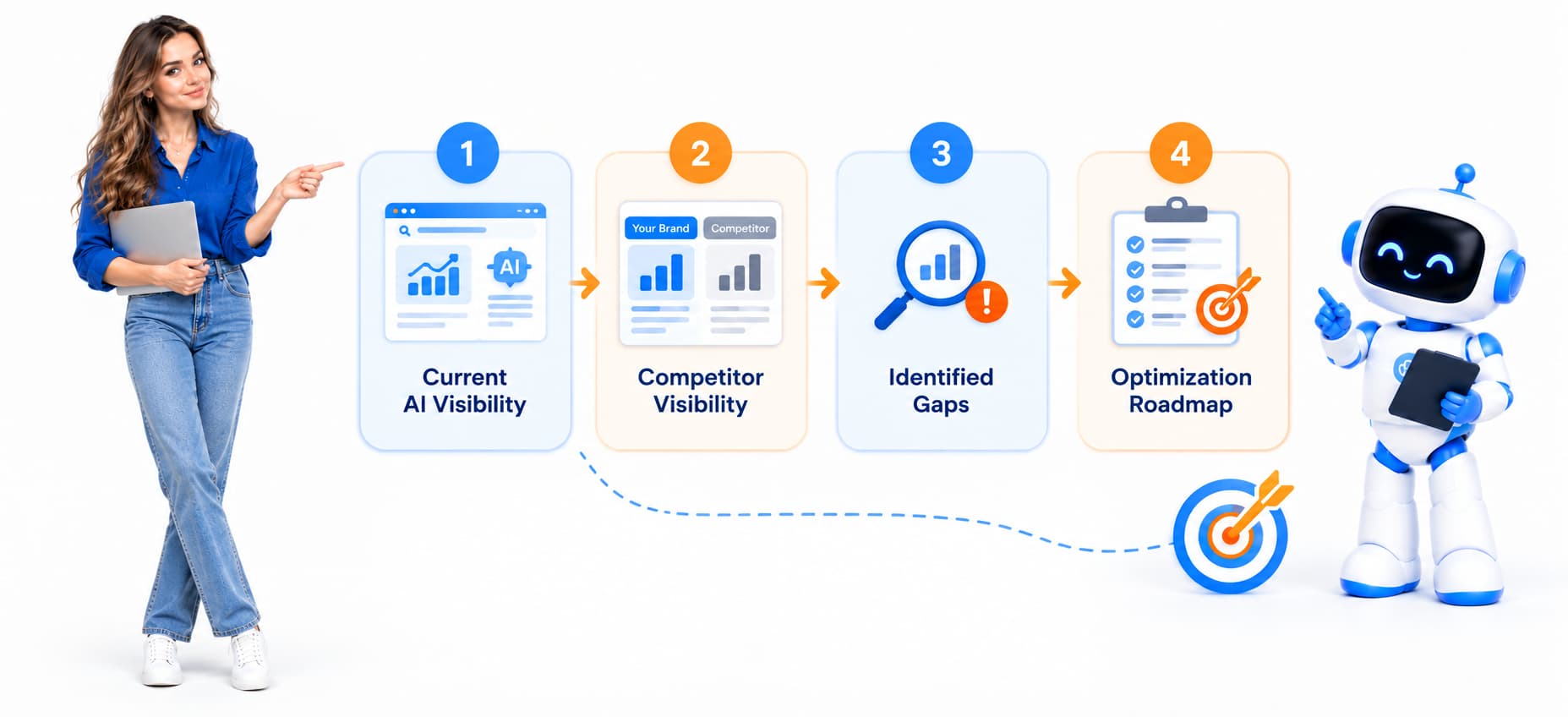
Step 1: Define Your AI Visibility Goals
Before collecting data, determine what you want your AI gap analysis to achieve.
Without clear objectives, you could spend hours testing prompts and reviewing competitors without identifying meaningful business opportunities.
Start by answering these questions:
- Which products or services do you want to increase visibility for?
- Which audiences are most important to your business?
- Which geographic markets do you serve?
- What questions do potential customers ask before making a purchase?
- Which AI search experiences are relevant to your audience?
- What would meaningful improvement look like?
For example:
A digital marketing agency targeting businesses in the United States might want to improve its visibility for queries such as:
- Best SEO agency for small businesses.
- Technical SEO services for ecommerce websites.
- How to choose an SEO consultant.
- SEO agencies specializing in healthcare.
- AI SEO services for growing businesses.
These questions connect your AI visibility analysis to actual services and customer needs.
Establish measurable objectives
Your objectives should be specific enough to evaluate over time.
Consider tracking:
Objective | Measurement |
Improve AI brand visibility | Percentage of relevant test prompts mentioning your brand |
Increase citation opportunities | Number and proportion of responses referencing your website |
Identify competitor advantages | Frequency of competitor mentions across test prompts |
Improve content coverage | Number of priority customer questions addressed by relevant pages |
Strengthen business outcomes | Qualified leads and conversions from measurable AI-related referral traffic |
Treat these measurements as directional indicators rather than guaranteed predictors of AI search performance. AI-generated responses can vary by platform, location, wording, personalization, and time.
Step 2: Audit Your Current AI Search Visibility
The next step is to understand how your business currently appears in AI-generated responses.
Choose the platforms most relevant to your audience. Depending on your market and research objectives, these may include ChatGPT, Google Search’s AI-powered experiences, Perplexity, and other relevant AI search products.
Create a list of questions covering your services, expertise, industry, location, and customer problems.
For example, an SEO agency could test:
Service-related questions
- Which companies provide technical SEO services?
- What are the best SEO services for a growing ecommerce business?
- Where can I hire an SEO consultant for a website migration?
Informational questions
- How can I improve organic search visibility?
- What should a comprehensive SEO audit include?
- How can businesses measure SEO performance?
Comparison questions
- What should I compare when choosing an SEO agency?
- Is it better to hire an SEO consultant or an SEO agency?
- What questions should I ask before hiring an SEO company?
Industry-specific questions
- Which SEO agencies work with healthcare businesses?
- How can law firms improve their organic search visibility?
- What SEO strategies work for local service businesses?
For each prompt, record whether your brand appears, which competitors are mentioned, which sources are cited, and whether the answer accurately represents your business.
Create a baseline visibility report
Use a spreadsheet to organize your observations.
Test prompt | AI platform | Brand mentioned? | Website cited? | Competitors mentioned | Observation |
Best SEO agency for small businesses | Platform A | No | No | Competitor A, B | Investigate competitor visibility |
How to perform a technical SEO audit | Platform B | Yes | Yes | Competitor C | Review the cited content |
Best AI SEO services | Platform C | No | No | Competitor A | Assess content and brand gaps |
How to choose an SEO consultant | Platform A | Yes | No | Competitor B | Review the source and brand context |
The entries above are illustrative examples, not actual platform results.
Repeat your tests periodically and keep the prompts consistent when comparing performance over time. This helps reduce the risk of drawing conclusions from a single response.
Key takeaway:
“Your first objective is to establish a baseline, not to force your brand into every answer.”
Our Real Experiment: Checking RankON Technologies’ AI Search Visibility
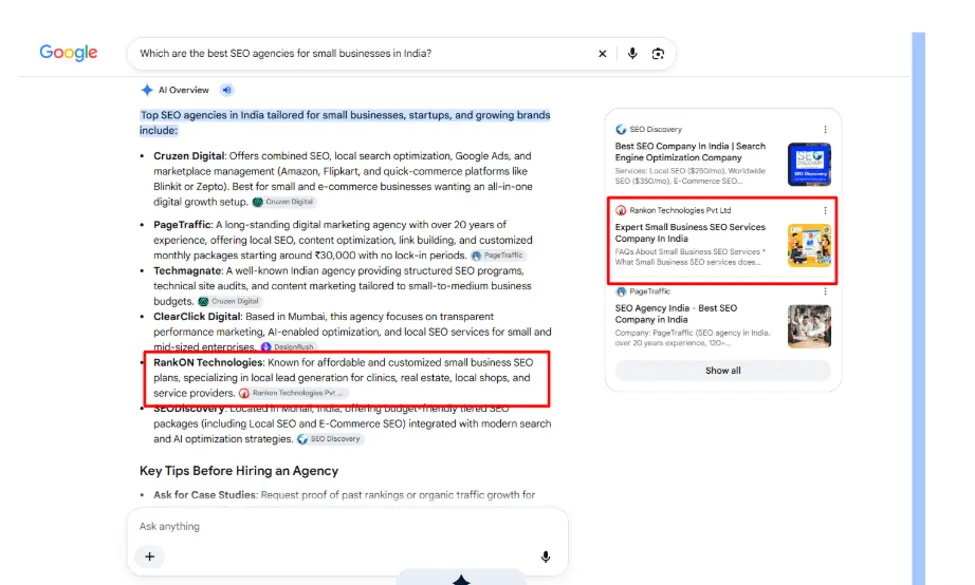
First, we searched this query:
“Which are the best SEO agencies for small businesses in India?”
In Google AI Overviews. In the screenshot below, we can see that RankON Technologies is mentioned in the AI-generated answer, and its website is also cited.
Second, we searched this query:
“What services does RankON Technologies offer, and what evidence is available about its SEO expertise?”
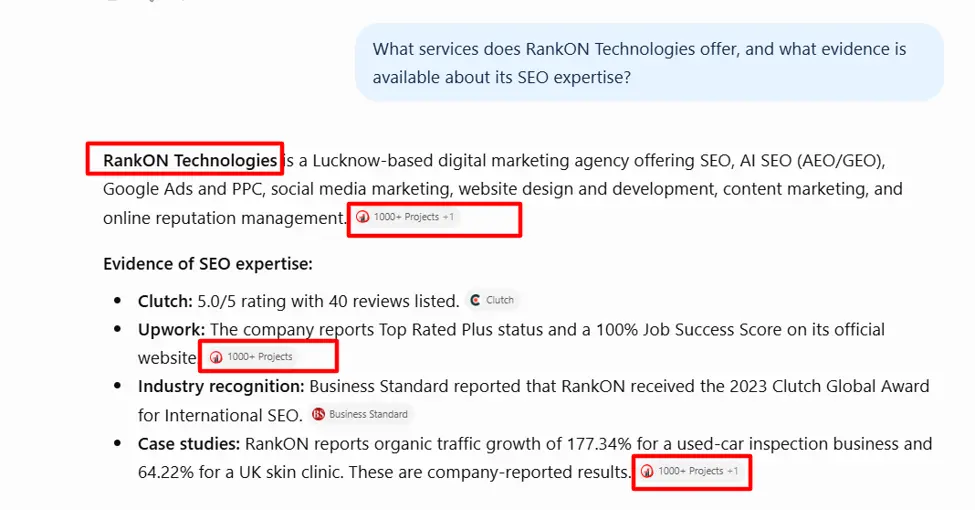
We ran a branded query in ChatGPT to check whether the AI platform could identify our brand and understand our services. As shown in the screenshot below, ChatGPT provided information about RankON Technologies and its services, along with references to third-party platforms that also contain information about our brand.
We tested two real examples:
One service-related query and one branded query. In our experiment:
“We found that RankON Technologies was visible for the service-related query in Google AI Overviews, while ChatGPT also provided information about our brand and services.”
This shows how we can manually analyse AI search visibility by testing relevant service keywords and branded queries one by one. By checking brand mentions, website citations, and competitor visibility, we can identify potential AI visibility gaps and understand where further optimization may be needed.
These results represent our observations from two individual tests. They provide an initial example of RankON Technologies’ AI search visibility, but further testing across more prompts and competitors is needed to identify specific visibility gaps and compare performance over time.
Our Testing Methodology: How We Checked RankON Technologies’ AI Visibility
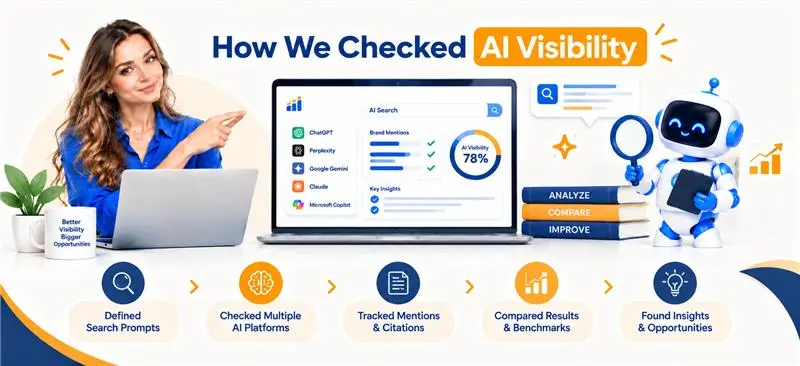
To understand how AI search platforms present our brand, we manually tested two queries using Google AI Overviews and ChatGPT.
Test 1: Google AI Overviews
- Query tested: “Which are the best SEO agencies for small businesses in India?”
- Platform: Google AI Overviews
- What we checked: Whether RankON Technologies appeared in the AI-generated answer and whether its website was cited as a source.
- Observation: In our test, RankON Technologies was mentioned in the AI-generated answer, and its website was cited, as shown in the screenshot below.
Test 2: ChatGPT
- Query tested: “What services does RankON Technologies offer, and what evidence is available about its SEO expertise?”
- Platform: ChatGPT
- What we checked: Whether ChatGPT could identify RankON Technologies, describe its services, and provide references to sources containing information about the brand.
- Observation: In our test, ChatGPT provided information about RankON Technologies and its services. The output also included third-party platform references, as shown in the screenshot below.
How we Evaluated the Results
We recorded brand mentions and website citations separately. A brand mention means the platform names RankON Technologies in its answer. A website citation means the platform links to or identifies a source website supporting its answer. A third-party reference is recorded separately when another website or platform is shown as a source.
These results represent two individual tests, not a comprehensive measurement of AI search visibility. Additional prompts, competitors, platforms, and repeat tests would be needed to identify broader visibility gaps and compare results over time.
Step 3: Identify Your Main AI Visibility Gaps
Once you have collected baseline data, group the findings into meaningful categories.
This makes it easier to identify recurring problems and determine which actions may address multiple gaps at once.
Content gaps
Content gaps occur when your website does not adequately address important questions or topics that matter to your audience.
For example, a competitor may have a detailed guide explaining the technical SEO audit process, including common errors, prioritization methods, tools, and expected outcomes. Your website may only have a short service description.
This difference could represent an opportunity to improve the depth and usefulness of your content.
Review whether your website contains:
- Detailed service pages.
- Helpful answers to customer questions.
- Relevant industry-specific resources.
- Original examples and case studies.
- Clear explanations of complex topics.
- Comparisons that help users make informed decisions.
- Updated information supported by reliable sources.
The objective is to cover important topics thoroughly without adding unnecessary content simply to increase word count.
Brand authority gaps
Your website is only one part of your brand’s online presence.
Potential customers may also evaluate your business through industry publications, business directories, professional profiles, reviews, and other independent sources.
Compare your brand’s digital footprint with that of competitors appearing in relevant AI responses.
Investigate:
- Whether your business information is accurate and consistent.
- Whether credible websites mention your company.
- Whether your experts contribute useful industry insights.
- Whether your business has verifiable case studies or achievements.
- Whether customer reviews provide meaningful evidence of service quality.
- Whether your authors and leadership team have clear professional profiles.
Prioritize relevant, trustworthy sources instead of pursuing large numbers of low-quality mentions.
Technical SEO gaps
Technical problems can make it more difficult for search engines and other systems to discover, crawl, render, and interpret your website.
Review the fundamentals, including:
- Crawlability and indexability.
- XML sitemaps and robots.txt configuration.
- Internal linking and site architecture.
- Page speed and mobile usability.
- Canonical tags and duplicate content.
- Redirects and broken links.
- Structured data accuracy.
- Accessibility of important content to relevant crawlers.
Do not assume that every AI platform uses the same crawling, indexing, or retrieval process. Check the technical requirements and published documentation of the platforms you are evaluating.
Structured data can help describe page content, but adding schema markup does not guarantee AI citations or recommendations.
Entity and information gaps
AI systems may encounter inconsistent descriptions of your business across different sources.
For example, your website may describe your company as an SEO agency, while other profiles use outdated descriptions, incorrect contact details, or inconsistent service information.
Review your key business details:
- Company name.
- Website and contact information.
- Core services.
- Industries served.
- Geographic coverage.
- Leadership and author information.
- Verifiable experience and achievements.
Use accurate, consistent information and ensure that important claims can be supported by reliable evidence.
Also Read: What is Entity SEO & Why Does Is Matter for AI Search
Customer intent gaps
Sometimes, the issue is not a lack of content but a mismatch between your content and the user’s actual question.
Consider someone searching for an SEO agency. They may want to understand pricing, compare providers, evaluate expertise, or find a specialist for a particular industry.
A generic page about the benefits of SEO may not adequately address those needs.
Map your content to different stages of the customer journey:
Customer stage | Example question | Recommended content |
Awareness | How does SEO help a business grow? | Educational guides |
Research | What does an SEO audit include? | Detailed explanations and checklists |
Comparison | How do I compare SEO agencies? | Comparison guides and evaluation criteria |
Decision | Which SEO services does my business need? | Service pages, case studies, and consultations |
This helps ensure that your content addresses the problems your audience is actually trying to solve.
Step 4: Analyze Competitors Appearing in AI Responses
Competitor analysis is one of the most valuable parts of an AI gap analysis.
The objective is to understand why certain competitors appear for relevant questions and identify opportunities to improve your own visibility.
Start by selecting competitors that repeatedly appear in your baseline tests. Include direct business competitors and other websites that AI systems frequently cite as information sources.
Then compare their websites and digital presence against yours.
What should you compare?
Content coverage
Do competitors answer more customer questions? Do they provide better explanations, examples, original research, or industry-specific information?
Content structure
Are their pages organized with descriptive headings, clear explanations, useful lists, and direct answers to relevant questions?
Subject expertise
Do their authors demonstrate relevant experience? Do their articles include practical examples, evidence, and accurate information?
Brand mentions
Are competitors discussed by credible publications, industry websites, or relevant professional communities?
Technical accessibility
Can important pages be discovered and indexed? Are there technical issues that might affect search visibility?
Source citations
When a competitor appears in an AI-generated answer, which pages or external sources are referenced? Are those sources providing information that your website lacks?
Build a competitor gap matrix
A gap matrix helps turn your observations into a structured comparison.
Evaluation area | Your website | Competitor website | Potential opportunity |
Service information | Basic service descriptions | Detailed service explanations | Expand important service pages |
Educational content | Limited topic coverage | Comprehensive guides | Address missing customer questions |
Original evidence | Few case studies | Detailed examples and research | Publish verifiable results and insights |
Author information | Limited expert profiles | Detailed professional biographies | Improve author and leadership profiles |
External mentions | Limited relevant coverage | Frequent industry mentions | Build legitimate industry relationships |
Technical SEO | Some unresolved issues | Important pages accessible | Audit and resolve technical problems |
This matrix should reflect your actual research findings. Do not assume that a competitor has better content or authority simply because it appears in an AI response.
Also, do not equate visibility with business quality. A brand’s appearance in a generated answer is not proof that it is the best provider.
Step 5: Prioritize the Gaps That Matter Most
After completing your audit, you may discover dozens of potential improvements.
Trying to address everything simultaneously can waste resources and delay meaningful progress.
Instead, prioritize gaps according to their likely business impact, relevance, urgency, and implementation effort.
Consider these examples:
Identified gap | Potential impact | Effort | Suggested priority |
| Important service pages contain insufficient information | High | Medium | High |
| Several key pages are blocked from crawling or indexing | High | Low to medium | High |
| Author credentials are incomplete | Medium | Low | Medium to high |
| Competitors cover important unanswered customer questions | High | Medium | High |
| A low-priority blog has outdated formatting | Low | Low | Low |
| A minor visual element needs adjustment | Low | Medium | Low |
These priorities are illustrative. Your final assessment should reflect the website’s actual condition and business goals.
Use a simple scoring system
You can score each gap from 1 to 5 across four dimensions:
- Business impact: How much could fixing the issue contribute to important business goals?
- AI visibility relevance: How directly does the issue relate to your identified AI search visibility gaps?
- Urgency: How important is it to address the issue now?
- Effort: How much time and work will implementation require?
One simple prioritization formula is:
Priority Score = (Business Impact + AI Visibility Relevance + Urgency) ÷ Effort
Use scores from 1 to 5, with 5 representing greater impact, relevance, urgency, or effort.
For example, suppose an important service page has these scores:
- Business impact: 5
- AI visibility relevance: 4
- Urgency: 4
- Effort: 2
Its priority score would be:
(5 + 4 + 4) ÷ 2 = 6.5
Compare the scores across identified issues to create an initial work order.
This formula is a practical planning aid, not a validated predictor of AI search performance. Use professional judgment when technical risks, business constraints, or dependencies require a different order.
Step 6: Create an Action Plan to Close the Gaps
An AI gap analysis is valuable only when its findings lead to concrete improvements.
Convert your prioritized gaps into an action plan that specifies what needs to change, who is responsible, when the work should be completed, and how success will be measured.
Your action plan should cover five main areas.
Improve existing content
Start with important pages that are relevant to your services and customer questions.
Depending on your findings, you might:
- Expand service pages with specific, useful information.
- Add explanations addressing common customer questions.
- Improve headings and content organization.
- Include relevant examples and original insights.
- Update outdated information.
- Add credible sources where they support important claims.
- Remove redundant or misleading content.
Avoid rewriting every page simply because competitors have longer articles. Focus on usefulness, accuracy, completeness, and alignment with user intent.
Publish content that addresses missing topics
Develop a content plan around the most important gaps identified in your research.
For an SEO agency, this could include guides covering technical SEO, local SEO, ecommerce SEO, AI search optimization, SEO pricing, and agency selection.
Each piece should have a clear purpose and complement your existing resources rather than repeat them.
For example, if your website already has a general guide to technical SEO, you could create a more specific resource explaining how to conduct a technical SEO audit for an ecommerce website.
This approach helps build a more useful collection of related content.
Strengthen your brand’s digital footprint
Improve the accuracy, depth, and credibility of the information available about your business.
Possible activities include:
- Completing your company and leadership profiles.
- Publishing original research or practical case studies.
- Contributing expert commentary to relevant publications.
- Building relationships with reputable industry websites.
- Encouraging genuine customer reviews.
- Updating inaccurate business information.
- Ensuring that professional credentials and company achievements are verifiable.
Do not purchase artificial mentions or create misleading claims about your experience. Sustainable visibility depends on providing information that users and other sources can reasonably trust.
Resolve technical SEO problems
Fix technical issues that interfere with discovery, crawling, rendering, indexing, or understanding of important pages.
Start with issues affecting high-priority content and service pages.
Check whether the pages you want to surface are accessible to the relevant search crawlers. Review canonicalization, internal links, structured data, redirects, and other technical elements as appropriate.
Remember that access requirements differ across platforms. A page being indexed by Google does not automatically mean that every AI platform can access or retrieve it.
Improve the measurement process
Establish a consistent method for tracking progress.
Record your original test prompts, AI platforms, responses, brand mentions, citations, and relevant competitors. Repeat the tests periodically using the same methodology.
Alongside AI visibility observations, track more established SEO and business metrics, such as:
- Organic impressions and clicks.
- Rankings for relevant search queries.
- Organic landing-page traffic.
- Conversions and qualified leads.
- Referral traffic from AI platforms, where measurable.
- Engagement with important service and educational pages.
This provides a broader view of performance rather than relying on AI mentions alone.
Example: AI Gap Analysis for a Digital Marketing Agency
Consider a hypothetical digital marketing agency that wants to improve its visibility in AI-generated answers.
The agency has established organic search visibility and several service pages, but its team notices that competitors frequently appear in AI-generated responses to relevant questions.
The agency conducts an AI gap analysis and discovers the following opportunities.
Area | Finding | Recommended action |
AI visibility | The agency rarely appears in a set of relevant recommendation prompts | Investigate the responses, cited sources, and competing brands |
Service content | Several service pages provide limited detail | Improve the pages with useful service-specific information |
Educational resources | Important customer questions remain unanswered | Create a targeted content plan |
Brand credibility | Leadership profiles lack detailed professional experience | Improve author and leadership biographies with verifiable credentials |
External presence | The agency has limited relevant third-party coverage | Pursue legitimate expert contributions and industry mentions |
Technical SEO | Some important pages have weak internal linking | Improve site architecture and contextual internal links |
The agency then organizes these actions into a phased implementation plan.
Phase 1: Address foundational issues
The team checks crawlability, indexability, internal linking, business information, and the accuracy of existing content.
Phase 2: Improve important pages
The team updates service pages, adds missing information, and improves the usefulness of relevant educational resources.
Phase 3: Strengthen credibility
The agency improves expert profiles, publishes verifiable case studies, and pursues relevant industry contributions.
Phase 4: Measure progress
The team repeats its AI visibility tests, compares results with the baseline, and reviews changes in organic performance and qualified leads.
The agency does not assume that every change will result in an AI citation. Instead, it evaluates the evidence and adjusts its strategy based on what it learns.
The key lesson:
“AI gap analysis turns an uncertain visibility problem into a structured improvement process. It helps a business understand what to investigate, which actions to prioritize, and how to evaluate the results.”
Tools to Help You Perform an AI Gap Analysis
You do not necessarily need an expensive AI SEO platform to begin. You can start with a spreadsheet, manual testing, and established SEO tools.
The right combination depends on your website, budget, audience, and reporting requirements.
Tool | How it can help |
ChatGPT | Develop test prompts, organize findings, analyze competitor content, and structure an action plan |
Google Search Console | Review search impressions, clicks, indexing information, and organic search performance |
Google Analytics 4 | Analyze website traffic, engagement, and conversions where relevant data is available |
Ahrefs | Research keywords, compare competitor content, examine backlinks, and identify content opportunities |
Semrush | Research competitors, keywords, organic visibility, and content gaps |
Perplexity | Test relevant questions and inspect the sources referenced in its answers |
These tools serve different purposes. General AI assistants can help with research and analysis, while dedicated SEO tools provide structured data about search performance, backlinks, and competitor websites.
When testing AI search visibility, use the actual platform you want to evaluate. A response generated by one AI system does not establish how another system will answer the same question.
How to Choose the Right Tools
Before investing in a dedicated AI visibility platform, establish your requirements.
Consider:
- How many brands and websites do you need to monitor?
- How many prompts do you need to track?
- Which AI platforms matter to your audience?
- Do you need historical visibility data?
- Do you need source and citation tracking?
- Will multiple team members use the reports?
- Can the platform export data for analysis?
For a small business, manual testing and a well-maintained spreadsheet may be sufficient to identify initial opportunities.
For agencies managing many clients, a dedicated platform may make ongoing monitoring more efficient. Evaluate its coverage, methodology, reporting capabilities, and pricing before choosing one.
Common Mistakes to Avoid During AI Gap Analysis
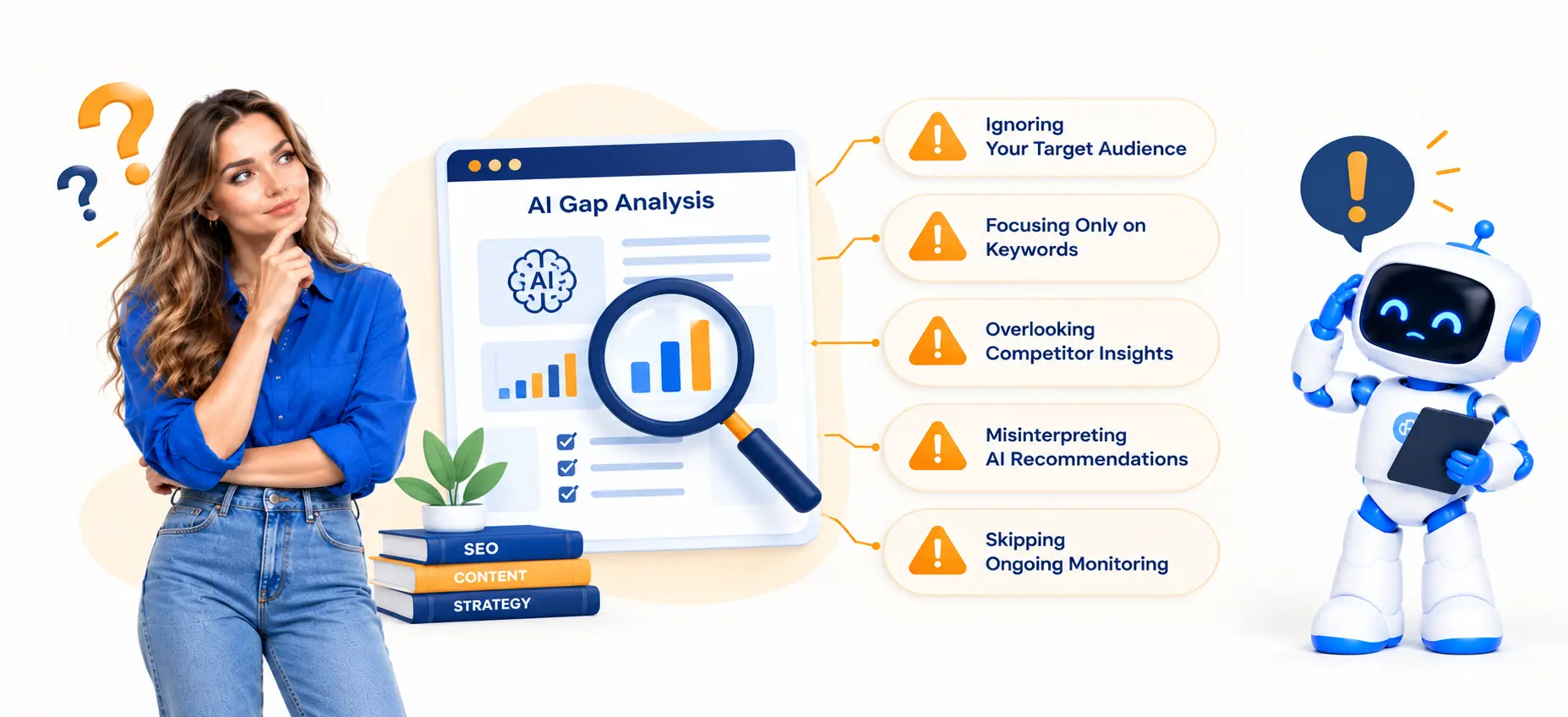
Even a well-planned analysis can produce misleading conclusions if the research process is inconsistent or the findings are interpreted incorrectly.
Avoid these common mistakes.
Relying on a Single AI Response
AI-generated answers can change between sessions. Different prompts, locations, account settings, and available sources can produce different results.
What to do instead: Test a representative set of relevant prompts, document the methodology, and repeat your analysis over time.
Confusing AI Mentions With Website Citations
A platform may mention your brand without linking to your website. It may also cite a page without recommending your company directly.
These are different visibility signals and should be tracked separately.
What to do instead: Record brand mentions, source citations, and recommendations as distinct observations.
Copying Competitors Without Understanding Their Success
A competitor’s visibility does not mean every element of its content strategy is effective or appropriate for your business.
What to do instead: Identify the specific information needs your competitors address and create resources that serve your audience more effectively.
Publishing Content Primarily for AI Systems
Creating large volumes of generic, repetitive, or lightly modified content is unlikely to provide lasting value to your audience.
What to do instead: Focus on accurate, original, helpful content that answers genuine questions. Use AI to support research and production where appropriate, but maintain human oversight and factual verification.
Ignoring Traditional SEO Fundamentals
AI search visibility and traditional SEO are not identical, but they overlap in important areas, including content quality, discoverability, technical accessibility, and the usefulness of information.
What to do instead: Treat AI visibility analysis as an extension of your broader search strategy rather than a replacement for technical SEO, content optimization, and brand-building activities.
Expecting Immediate Results
Improving content, technical accessibility, and brand credibility does not guarantee immediate changes in AI-generated answers.
What to do instead: Establish a baseline, implement prioritized improvements, and monitor results over an appropriate period. Evaluate business outcomes as well as visibility signals.
Conclusion: Turn AI Visibility Gaps Into Growth Opportunities
AI gap analysis gives businesses a structured way to understand their current position, identify missed opportunities, and prioritize improvements that support their search visibility goals.
Rather than guessing why competitors appear in AI-generated answers, you can investigate the differences in content coverage, technical accessibility, brand credibility, and customer intent.
The process starts with clear objectives and a reliable baseline. From there, you can evaluate your website, compare relevant competitors, prioritize the most important gaps, and implement a practical action plan.
Remember that AI search visibility is only one part of a successful digital marketing strategy. Your website still needs to provide useful information, demonstrate genuine expertise, deliver a good user experience, and support your business objectives.
Start with these five actions:
- Identify the AI search queries that matter to your audience.
- Test your brand’s visibility across relevant AI platforms.
- Compare your findings with competitors and their cited sources.
- Prioritize content, technical SEO, and brand credibility improvements.
- Monitor your progress and refine your strategy using real data.
For businesses that want to strengthen their visibility across traditional search engines and AI-powered search experiences, a structured gap analysis provides a practical starting point.
Want to identify opportunities to improve your website’s search visibility?
Explore the SEO and AI search optimization solutions offered by RankON Technologies to understand how a data-driven strategy can support your business goals.
FAQ About How to Perform an AI Gap Analysis
What is an AI gap analysis?
An AI gap analysis is a structured evaluation of the difference between your current state and your desired state in areas involving artificial intelligence.
In SEO and digital marketing, it can identify gaps in AI search visibility, content coverage, brand mentions, technical accessibility, and competitor positioning. In broader business settings, it can assess AI readiness, data, skills, workflows, and technology.
How is AI gap analysis different from traditional SEO gap analysis?
Traditional SEO gap analysis generally compares keyword rankings, organic visibility, content coverage, backlinks, and other search performance factors.
An AI search visibility gap analysis additionally examines how brands and websites appear in AI-generated answers, which sources are cited, and how competitors are represented in relevant AI search experiences.
The two approaches complement each other and can share research, content, and technical SEO findings.
Which AI platforms should I include in my analysis?
Choose platforms based on how your target audience searches for information.
Depending on your market, you might include ChatGPT, Google’s AI-powered search experiences, Perplexity, and other relevant products.
Evaluate each platform separately because their responses, source selection, and retrieval methods can differ.
How do I know whether my brand has an AI visibility gap?
Create a representative list of questions related to your services, industry, and customer needs. Test those questions across relevant AI platforms and record whether your brand appears, whether your website is cited, and which competitors or sources are mentioned.
Compare the findings with your business goals and repeat the tests over time.
A lack of mentions in a small sample is a reason to investigate, not conclusive evidence that your entire website lacks AI visibility.
Can AI gap analysis improve my website’s rankings?
An AI gap analysis can uncover content and technical SEO issues that may also affect traditional organic search performance.
However, conducting the analysis does not directly improve rankings. Results depend on the quality and relevance of the improvements implemented, along with other ranking factors.
How often should I perform an AI gap analysis?
Start with a baseline assessment and repeat your analysis at regular intervals. Monthly reviews can be a practical starting point for active SEO campaigns, while major website changes, new service launches, or significant changes in AI search products may justify additional reviews.
Choose a schedule that provides enough time to implement improvements and evaluate meaningful changes.
Can small businesses benefit from AI gap analysis?
Yes. Small businesses can use AI gap analysis to identify unanswered customer questions, improve important service pages, strengthen their online presence, and understand which competitors appear in relevant AI-generated answers.
A simple spreadsheet and a focused list of prompts can provide a useful starting point without requiring a large software budget.
Does appearing in AI-generated answers guarantee more traffic or leads?
No. AI visibility does not automatically translate into website visits, qualified leads, or sales.
Some answers may include citations, while others may satisfy a user’s needs without a website visit. Track AI visibility alongside referral traffic, conversions, and other business metrics to understand its practical value.