

I’ve spent 14 years in SEO and digital marketing, and I can’t remember a shift that moved as quickly as AI. Tasks that once took my team hours, such as clustering thousands of keywords, summarizing performance reports, or drafting content outlines, can now be done in minutes.
But I’ve also seen what happens when businesses adopt AI without a plan. They publish thin content faster, automate decisions they don’t understand, and measure activity instead of results. Speed is not a strategy.
AI digital marketing is the use of artificial intelligence to plan, execute, analyze, and optimize digital marketing activities. It helps businesses understand customer behavior, personalize experiences, automate repetitive tasks, and make better-informed decisions.
In 2027, success with AI will take more than using it to write blog posts or social media captions. You’ll need to combine AI with human expertise, reliable data, strong marketing fundamentals, and a clear understanding of your customers.
In this guide:
I’ll explain what AI digital marketing is, where it genuinely helps, and how I’d incorporate it into a digital marketing strategy in 2027, based on what I’ve seen work and fail over the years.
Why You Can Trust This Guide
I’m Anand Kumar, and I’ve worked in SEO for 14 years. At RankON Technologies, our team has completed 500+ SEO projects for clients across industries and markets, and today we have 20+ people working on SEO, content, and digital marketing. RankON Technologies is a Top-Rated Plus agency on Upwork and has been recognized by Clutch and 50Pros.
I’m telling you this not to impress you, but so you know the advice below comes from hands-on work. I’ve been through the major search shifts, from the early Panda and Penguin updates to mobile-first indexing and Google’s helpful content guidance. Each one rewarded businesses that focused on real value rather than shortcuts. AI is following the same pattern.
What Is AI Digital Marketing?
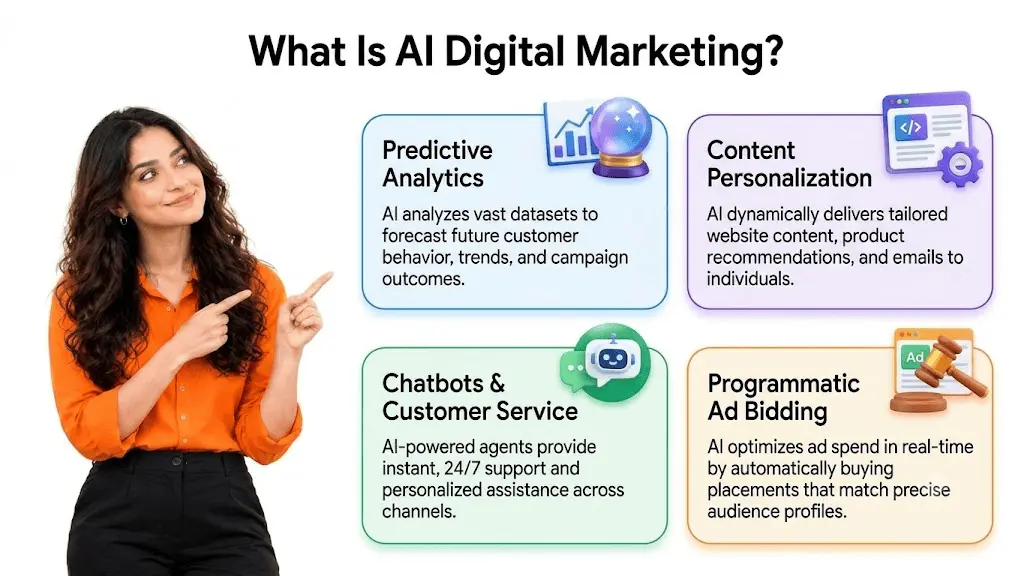
AI digital marketing is the application of artificial intelligence, machine learning, natural language processing, predictive analytics, and automation to improve digital marketing processes.
Traditional digital marketing often relies on manually analyzing campaign performance, segmenting audiences, creating content, and adjusting advertising campaigns. AI can support these activities by processing large amounts of data, identifying patterns, generating recommendations, and automating specific tasks.
For example:
An e-commerce business can use AI to analyze customers’ browsing behavior, recommend relevant products, personalize email campaigns, and identify which advertising audiences are more likely to convert.
Similarly, in my own field, an SEO team can use AI to analyze search intent, find content gaps, organize keyword research, and prioritize technical SEO issues.
Here’s the caveat I give every client:
AI does not automatically make marketing more effective. Its value depends on the quality of your data, the suitability of the tool, the accuracy of its outputs, and the expertise of the people using it.
How Does AI Work in Digital Marketing?
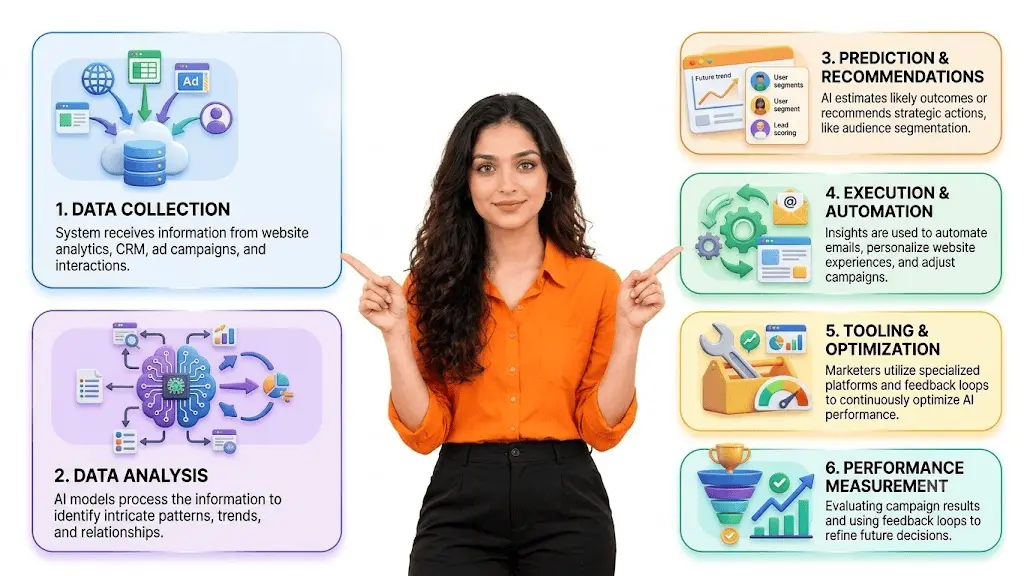
AI-powered marketing systems generally work through a combination of data collection, analysis, prediction, content generation, and automation.
The process typically looks like this:
- Data collection: The system receives information from sources such as website analytics, customer relationship management (CRM) platforms, advertising campaigns, and customer interactions.
- Data analysis: AI models analyze the information to identify patterns, trends, and relationships.
- Prediction and recommendations: Depending on the application, AI estimates likely outcomes or recommends actions, such as adjusting audience targeting or prioritizing leads.
- Execution and automation: Marketing platforms use these insights to automate emails, personalize website experiences, or adjust campaign settings.
- Performance measurement: Marketers evaluate the results and use reliable feedback to improve future decisions.
Not every AI tool performs all five steps. Some generate content, while others specialize in analytics, forecasting, personalization, or automation.
My rule is to use AI where it improves efficiency, decision-making, or customer experience, while keeping humans in charge of important decisions.
Why Is AI Digital Marketing Important in 2027?
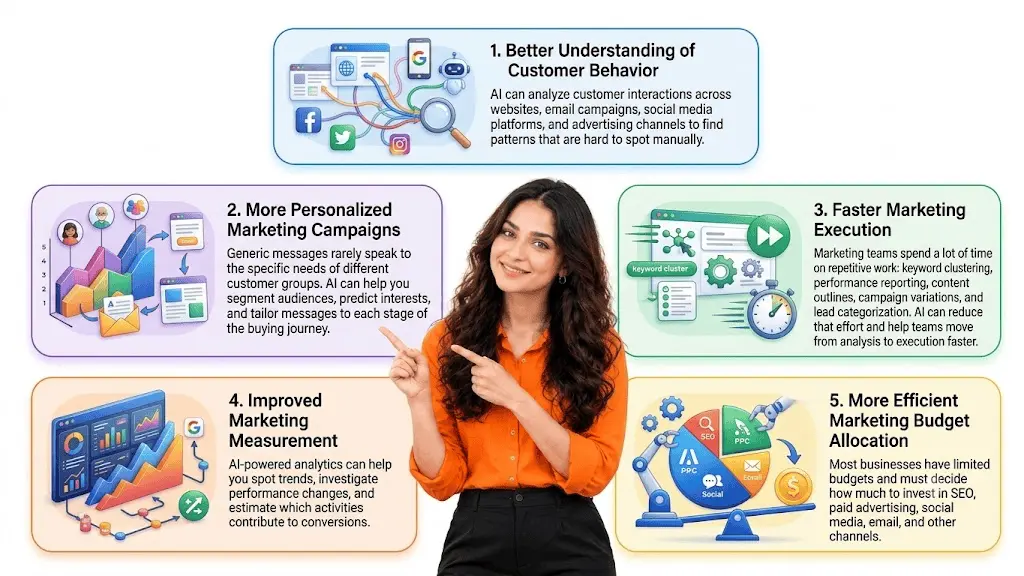
Businesses need to understand customers, respond to changing markets, and manage increasingly complex digital campaigns. AI helps with all three.
In my view, the opportunity in 2027 is not to produce more content or automate more tasks. It is to make marketing more relevant, efficient, measurable, and aligned with business goals. Here are the main reasons I recommend businesses consider AI.
1. Better Understanding of Customer Behavior
AI can analyze customer interactions across websites, email campaigns, social media platforms, and advertising channels to find patterns that are hard to spot manually.
For example:
A software company might discover that visitors who read its pricing page and implementation guide are more likely to request a demo. The team can then build targeted follow-up campaigns, improve those landing pages, and prioritize high-intent prospects.
Just make sure your analysis uses appropriate data, respects customer privacy, and complies with applicable data protection requirements.
2. More Personalized Marketing Campaigns
Generic messages rarely speak to the specific needs of different customer groups. AI can help you segment audiences, predict interests, and tailor messages to each stage of the buying journey.
An online retailer could recommend products based on previous purchases or browsing activity. A B2B company could send different email content to first-time visitors and to prospects who have already requested a consultation.
The goal is relevance, not simply sending more automated messages.
3. Faster Marketing Execution
Marketing teams spend a lot of time on repetitive work: keyword clustering, performance reporting, content outlines, campaign variations, and lead categorization. AI can reduce that effort and help teams move from analysis to execution faster.
That doesn’t mean everything should be automated. Strategic decisions, creative direction, fact-checking, and quality control still need human judgment.
4. Improved Marketing Measurement
AI-powered analytics can help you spot trends, investigate performance changes, and estimate which activities contribute to conversions.
For example, by analyzing paid advertising and CRM data together, you can identify campaigns that generate qualified leads rather than just clicks. This distinction matters. A low cost per click is not profitable if those clicks rarely become customers.
When you focus on meaningful business outcomes, budget and optimization decisions improve significantly.
5. More Efficient Marketing Budget Allocation
Most businesses have limited budgets and must decide how much to invest in SEO, paid advertising, social media, email, and other channels. AI can support these decisions by analyzing historical performance, finding patterns in conversion data, and forecasting possible outcomes.
For instance, an AI-assisted analysis might show that organic search generates fewer leads initially but delivers greater long-term value than a particular paid campaign.
Treat forecasts as estimates, not guarantees. Results depend on data quality, market conditions, attribution methods, and campaign execution.
10 Ways to Incorporate AI Into Your Digital Marketing Strategy in 2027
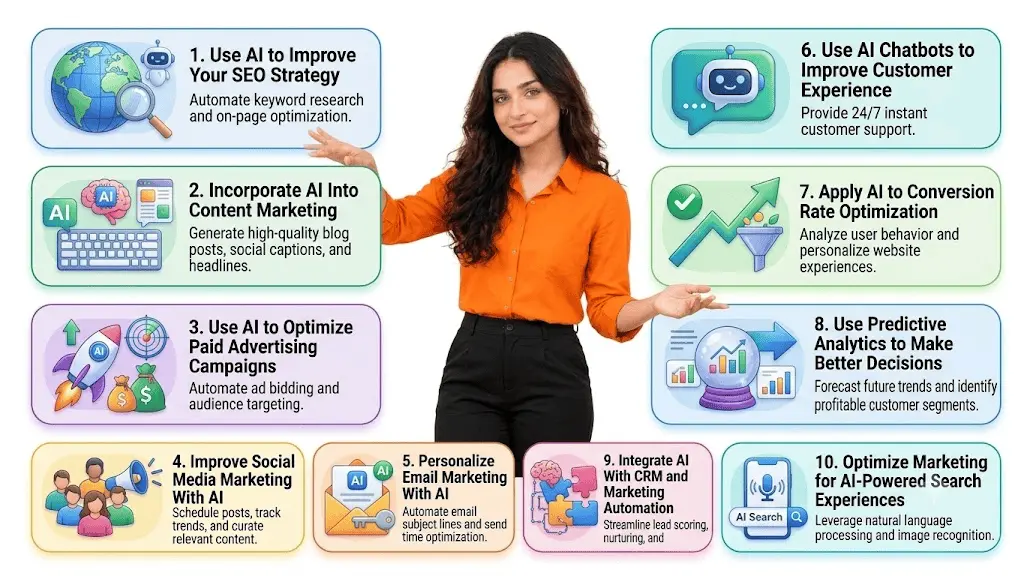
In my experience, AI adoption works best when you start with a specific marketing problem rather than a popular tool. The ten strategies below cover the main digital marketing channels.
1. Use AI to Improve Your SEO Strategy
SEO remains one of the most valuable channels because it connects you with people who are actively searching for what you offer. AI can speed up research, surface patterns, and handle repetitive analysis, but it should complement established SEO practice, not replace it.
AI-assisted keyword research. AI can organize large keyword lists into groups based on search intent, topic relevance, and business value. An accounting firm, for example, might group keywords into categories such as bookkeeping services, tax preparation, financial reporting, and accounting software. That makes it easier to plan landing pages and supporting blog content.
Search intent analysis. Understanding intent determines what type of content a keyword needs. AI can classify queries as informational, comparison, transactional, or navigational. I still recommend reviewing the actual search results and the language customers use to confirm those classifications.
Content gap analysis. AI can compare your content with competitors’ coverage to find unanswered questions and missing subtopics. If several competing pages explain technical SEO but none offers a practical website audit checklist, that’s your opportunity to add original guidance.
Technical SEO analysis. AI-assisted tools can help interpret crawl reports, categorize errors, spot patterns in indexation problems, and prioritize issues. Always verify technical recommendations against the website’s actual configuration before implementing them. I’ve seen confident-sounding AI suggestions that would have broken a site if applied blindly.
Content optimization. AI can suggest improvements to headings, structure, internal linking opportunities, and unclear explanations. Human editors should make sure the final content reflects real expertise and fully answers the searcher’s question.
If you’d like expert help aligning SEO with your broader marketing goals, that’s exactly what our SEO services team at RankON Technologies. and also check my SEO Package.
An important point about AI content and Google: AI-generated content is not automatically ineligible to appear in Google Search. What matters is whether it is useful, accurate, original, and created for people. Generating large numbers of low-value pages mainly to manipulate rankings can violate Google’s scaled content abuse policy.
2. Incorporate AI Into Content Marketing
Content marketing involves research, planning, writing, editing, distribution, and analysis. AI can support several of these stages, but I treat it as an assistant, never as a replacement for subject-matter expertise.
Content ideation and topic research. AI can help identify customer questions, suggest topics, organize content clusters, and draft initial briefs. A roofing company could brainstorm topics around roof inspections, storm damage, replacement costs, and maintenance. Then the team should validate those ideas using keyword research, customer questions, sales conversations, and actual search results.
Creating content outlines. AI can organize a topic into headings, supporting questions, and examples. Writers should treat the outline as a starting point and add original insights, practical recommendations, and details specific to the business.
Improving content quality. AI writing assistants can catch grammar errors, suggest clearer sentences, improve readability, and help maintain a consistent brand voice. They can also help repurpose content into newsletters, social posts, and short video scripts.
Updating existing content. Instead of publishing a new article for every keyword, use AI to find outdated sections and missing explanations in existing pages. Editors should verify suggested changes and update a page only when the improvement is meaningful.
How to maintain content quality when using AI. Google’s guidance emphasizes helpful, reliable, people-first content, including content created with AI assistance. Its quality evaluation framework considers experience, expertise, authoritativeness, and trustworthiness, collectively known as E-E-A-T. E-E-A-T is not a single ranking factor, but it describes the qualities Google aims to reward. To apply it:
- Include insights from people with relevant experience or expertise.
- Verify facts, statistics, quotations, and external references.
- Add original examples, research, or practical demonstrations.
- Identify authors clearly and provide accurate author biographies.
- Review AI-generated content for misleading claims and unsupported conclusions.
- Make sure every article genuinely helps its audience.
The goal is not to hide that you use AI. It is to make sure the finished content meets the standard your audience expects from any publication.
3. Use AI to Optimize Paid Advertising Campaigns
Ad platforms increasingly use AI for audience targeting, bidding, creative variations, and campaign optimization. You can use these capabilities to test approaches and improve budget allocation.
Generate and test ad creatives. AI can produce alternative headlines, descriptions, calls to action, and creative concepts for different segments. A digital marketing agency might test messaging around lead generation, local visibility, and e-commerce growth to see which value proposition resonates. The final creative must reflect your actual services and avoid misleading promises.
Improve audience targeting. AI-assisted ad systems use available signals to find people who are more likely to engage or convert. You still need to define the right campaign objectives, supply accurate conversion data, and apply audience exclusions.
Optimize conversion performance. AI can help analyze campaign data and highlight opportunities in landing pages, creative, and conversion tracking. If a campaign gets many clicks but few inquiries, the cause might be a mismatch between the ad and the landing page, an unclear offer, or a complicated form. AI can help with investigation, but marketers need to verify the actual cause.
Measure business outcomes. Don’t judge paid campaigns only by impressions, clicks, or cost per click. Track qualified leads, sales, customer acquisition cost, and return on ad spend. These show whether AI-assisted optimization is producing real business results.
4. Improve Social Media Marketing With AI
Social media takes constant attention: understanding audience interests, creating content, publishing consistently, and responding to people. AI makes this more manageable, especially for businesses without large social teams.
Content planning. AI can help brainstorm post ideas and build content calendars around campaigns, seasonal events, product launches, or customer questions. A healthcare practice could plan educational posts about appointment preparation and general wellness, but any medical claims must be reviewed by a qualified professional.
Platform-specific adaptation. One idea can be adapted for LinkedIn, Instagram, Facebook, or YouTube. AI can turn a detailed blog post into a LinkedIn update, a short video script, or a series of educational posts. Adapt for each platform’s audience and format rather than copying the same text everywhere.
Social listening and sentiment analysis. AI can categorize comments, find recurring complaints, and detect common questions. An e-commerce company might learn that customers keep asking about delivery times or product compatibility, then improve product pages, support documentation, and future content accordingly.
Faster community management. AI can draft replies to common questions and sort messages by urgency or topic. Sensitive complaints, complex inquiries, and public responses with legal or reputational risk should always get human review.
5. Personalize Email Marketing With AI
Email is still one of the most reliable channels for nurturing leads, retaining customers, announcing offers, and driving repeat purchases. AI helps by analyzing behavior and supporting segmentation, content recommendations, and timing.
Segment subscribers. An online store could separate first-time buyers, repeat customers, inactive subscribers, and people interested in a specific product category. Each group then receives more relevant communication.
Create personalized content. AI can adapt subject lines, product recommendations, and message content to each segment. For a B2B company, prospects who downloaded an introductory guide may need educational emails, while those who requested a quote may need information on implementation, pricing, or next steps.
Optimize timing. Some email platforms use historical engagement data to suggest when each subscriber is most likely to open an email. Test these recommendations against your own engagement and conversion data rather than assuming they work universally.
Automate lead nurturing. AI can support workflows that deliver relevant information based on customer actions. Someone who downloads a service guide might receive a follow-up explaining your solutions, then a case study, then an invitation to a consultation. Respect consent requirements, offer clear unsubscribe options, and avoid sending excessive or irrelevant messages.
6. Use AI Chatbots to Improve Customer Experience
AI chatbots can answer routine questions, guide visitors to useful resources, and collect initial information from potential customers. Unlike traditional rule-based bots, some AI chatbots interpret natural-language questions and generate responses from the information they have. Their effectiveness depends on how well they’re configured and how reliably they handle real inquiries.
Answer common questions. A chatbot can explain service options, share business hours, clarify basic processes, or point visitors to relevant pages. A web development company could use one to explain the differences among redesign, custom development, and ongoing maintenance.
Qualify leads. Chatbots can ask about a visitor’s needs, budget range, timeline, or preferred service. With proper consent and safeguards in place, that information can be shared with your sales team for follow-up.
Provide support outside business hours. Chatbots can handle routine inquiries when no one is available, but they should be clear about their limits and offer a path to a human when they can’t answer with confidence.
Reduce repetitive support work. By handling simple questions, chatbots free your support team to focus on complex issues that require investigation, empathy, or judgment. Review chatbot conversations regularly to catch inaccurate answers, recurring frustrations, and gaps in the knowledge base.
7. Apply AI to Conversion Rate Optimization
Driving traffic is only half the job. Visitors also need to understand your offer and take action. Conversion rate optimization (CRO) increases the percentage of visitors who request a quote, book an appointment, subscribe, or make a purchase. AI can help find friction points and generate ideas to test.
Analyze website behavior. AI-assisted analytics can reveal patterns in user journeys, form abandonment, landing-page performance, and navigation. You may find that visitors often leave a service page before reaching the inquiry form. Further investigation might show the form is hard to find, the page lacks key information, or the call to action is unclear.
Generate hypotheses for testing. AI can suggest simplifying a form, clarifying a headline, reordering information, or answering common objections. Treat these as hypotheses to test, not proven solutions.
Support A/B testing. Test alternative headlines, layouts, and calls to action to see which version performs better. Reliable testing requires sufficient data, a clear objective, and a method that accounts for differences across audiences and traffic sources.
Improve the user journey. AI can help map common customer journeys and show where to offer relevant information. The aim is to remove unnecessary friction, not to push users into actions they don’t understand or want.
8. Use Predictive Analytics to Make Better Marketing Decisions
Predictive analytics uses historical data and statistical or machine learning models to estimate future outcomes. In marketing, that can mean forecasting demand, identifying high-value customers, estimating churn risk, and planning campaign budgets.
Forecast customer demand. An e-commerce company can analyze historical sales, seasonality, and campaign performance to estimate demand by product category. This can inform promotions and inventory, although unexpected events and market shifts affect accuracy.
Identify high-value prospects. B2B businesses can use predictive lead scoring to estimate which prospects are more likely to become customers. Sales teams can prioritize follow-up, but should make sure scoring doesn’t unfairly exclude promising prospects.
Estimate customer churn. Subscription businesses can analyze engagement, usage, support interactions, and renewal patterns to find customers at risk of leaving, then respond with helpful resources, outreach, or retention offers.
Improve campaign planning. Predictive models help compare scenarios before you commit a large budget. Validate model performance, monitor changing conditions, and never treat predictions as certain.
9. Integrate AI With CRM and Marketing Automation
CRM systems hold information about prospects, customers, opportunities, and interactions. Adding AI to CRM workflows can help marketing and sales teams organize information, identify follow-up opportunities, and reduce manual administrative work. Practical applications include:
- Summarizing sales conversations and customer interactions.
- Categorizing leads by need or interest.
- Flagging inquiries that need prompt follow-up.
- Drafting personalized follow-up messages for human review.
- Analyzing customer journeys across marketing and sales touchpoints.
- Identifying retention and upselling opportunities.
For example:
A digital marketing agency could use an AI-assisted CRM workflow to categorize incoming inquiries by service requirement, website type, and business objective, so the sales team can review them and prepare a more relevant response.
For this to work, you need accurate CRM records, clear data-access permissions, and controls over sensitive customer information. Build safeguards around important actions too. Sending a draft for review is very different from automatically changing a contract, issuing a refund, or making a commitment on behalf of the business.
10. Optimize Marketing for AI-Powered Search Experiences
People increasingly meet AI-generated summaries, conversational search interfaces, and tools that synthesize information from multiple sources. Your content should stay useful and discoverable in both traditional results and AI-powered experiences.
From what I’ve seen, AI search optimization works best when it builds on established SEO principles rather than unverified shortcuts. Here’s what I focus on.
Answer customer questions directly. Explain topics clearly, use descriptive headings, and give readers the context they need. A company offering technical SEO, for example, can explain how crawlability, indexation, canonicalization, structured data, and Core Web Vitals affect website performance.
Demonstrate first-hand expertise. Add original insights from real work, expert commentary, relevant examples, and genuine case studies where available. Content that goes beyond common summaries gives readers a reason to trust you and come back.
Strengthen your technical foundations. Make sure important pages can be crawled and indexed, internal links are accessible, and content is clearly structured. Use structured data where appropriate and make sure it accurately matches the visible content.
Build a consistent reputation. Publish reliable information, keep business details accurate, and earn relevant mentions and links through legitimate marketing and PR. Don’t manufacture endorsements or artificial mentions to influence AI-generated answers.
Monitor performance across channels. Track organic traffic, conversions, branded searches, and referral traffic from AI platforms where it’s measurable.
Google’s published guidance for its generative AI search experiences recommends maintaining foundational SEO practices and creating unique, useful content. It also advises against relying on supposed AI-search hacks that lack a sound basis. My takeaway is simple: make your site technically accessible, provide original value, and give users clear, trustworthy answers.
Best AI Digital Marketing Tools to Consider in 2027
The right AI tools depend on your objectives, existing processes, budget, and team. I always advise clients not to buy several subscriptions at once. Identify the tasks that consume the most time or cause the biggest problems, then pick tools for those. These are the tools I see used most often across different areas of digital marketing.
| AI Tool | Primary Use | How Marketers Can Use It |
| ChatGPT | Content and marketing assistance | Brainstorm content ideas, develop outlines, analyze information, and assist with campaign planning. |
| Google Gemini | Research and productivity | Assist with research, content development, and workflows within supported Google tools. |
| Semrush | SEO and competitive research | Research keywords, analyze competitors, identify optimization opportunities, and monitor search performance. |
| Ahrefs | SEO analysis | Research backlinks, analyze competitors, identify content opportunities, and evaluate organic search performance. |
| HubSpot | CRM and marketing automation | Manage leads, personalize marketing workflows, and support sales and customer engagement. |
| Mailchimp | Email marketing | Create campaigns, organize audiences, and automate customer communications. |
| Canva | Creative production | Develop social media graphics, advertising creatives, presentations, and marketing materials. |
| Google Analytics | Marketing analytics | Understand website behavior, analyze conversions, and evaluate marketing performance. |
| Google Ads | Paid advertising | Use platform-supported automation for bidding, targeting, and campaign optimization. |
| Zapier | Workflow automation | Connect supported applications and automate repetitive marketing tasks. |
Important: These platforms have different capabilities, and not every feature uses AI. Availability, integrations, and pricing vary by subscription and region. Evaluate tools on their current functionality and your own requirements, not on their marketing.
AI Digital Marketing Trends to Watch in 2027
AI is moving fast, so I’m cautious about predicting exactly which capabilities will go mainstream. Still, these are the developments I’m watching closely as I plan strategy with clients for 2027.
1. AI Agents for Marketing Workflows
AI agents can handle multi-step tasks, use connected tools, and respond to what they find along the way. A marketing workflow might identify underperforming landing pages, pull the relevant performance data, prepare recommendations, and create tasks for the optimization team.
Their practical value will depend on how reliably they execute tasks and how well they integrate with your existing platforms. My advice is to start with clearly defined workflows and limited permissions before allowing an agent to access advertising budgets, customer records, or published content.
2. More Advanced Marketing Personalization
Personalization will remain a major area of development. Businesses can use preferences, purchase history, and behavioral signals to tailor website experiences, product recommendations, and messages.
The challenge is balancing relevance with privacy. Use appropriate data, respect customer choices, and avoid intrusive experiences.
3. Greater Focus on AI-Powered Search Visibility
AI-generated answers and conversational search are changing how some people discover and evaluate information. Marketers should monitor whether their content appears in these experiences and whether those appearances lead to meaningful engagement.
This does not mean abandoning traditional SEO. Crawlability, indexation, relevant content, a clear information architecture, and a strong user experience remain the foundation.
4. AI-Assisted Video Marketing
Video takes considerable time and resources, especially when you need content for several platforms. AI tools can assist with scripting, transcription, editing, subtitling, localization, and creative concepts, helping smaller teams produce and repurpose content more efficiently.
Review generated visuals, audio, scripts, and claims before publishing, and make sure the content complies with platform policies and intellectual property requirements.
5. Greater Emphasis on First-Party Data
As businesses seek more reliable ways to understand customers, data collected directly through appropriate interactions becomes increasingly valuable. That includes website interactions, purchase history, customer preferences, and consented email engagement. AI can help analyze it to improve campaign relevance.
But more data does not automatically mean better marketing. You need consent, clear data governance, secure storage, and a legitimate reason to use the information.
6. Stronger Human Oversight of AI Marketing
As AI becomes more capable, human judgment will matter even more for strategy, creative direction, brand positioning, and customer relationships. AI output can be inaccurate, incomplete, or inconsistent with what your business can actually deliver.
Teams need processes for reviewing outputs, checking claims, protecting confidential information, and measuring results. Businesses that pair automation with accountability will use AI most responsibly.
How to Implement AI Digital Marketing in Your Business: A Step-by-Step Plan
Understanding what AI can do is only the first step. This is the six-step process I’d follow to bring AI into your marketing operations in 2027.
Step 1: Identify Your Biggest Marketing Challenges
Review your current marketing and find where AI could provide real help. For example:
- Your SEO team spends too much time organizing keyword data.
- Your content team struggles to publish consistently.
- Your ad campaigns generate clicks but few qualified leads.
- Your sales team can’t follow up with inquiries quickly enough.
- Your reports take too long to prepare manually.
- Your support team keeps answering the same questions.
Choose problems with clear business impact, not tools you’re adopting because competitors are.
Step 2: Define Clear Objectives and KPIs
Before choosing a tool, decide what success looks like. Objectives should be measurable and tied to business outcomes.
| Marketing Objective | KPI to Monitor | How AI May Help |
| Improve SEO efficiency | Time required for keyword research and content audits | Organize data and identify patterns. |
| Increase qualified leads | Marketing-qualified leads and lead-to-customer conversion rate | Support lead scoring and segmentation. |
| Improve advertising performance | Customer acquisition cost and return on ad spend | Assist with campaign analysis and optimization. |
| Improve email engagement | Click-through rate and conversion rate | Support segmentation and message testing. |
| Increase website conversions | Conversion rate and cost per acquisition | Identify potential friction points and test ideas. |
| Reduce reporting effort | Time spent preparing reports | Automate data summaries and recurring workflows. |
| Improve customer retention | Repeat purchase rate and customer churn | Identify engagement patterns and retention opportunities. |
Establish a baseline before you introduce AI. Without one, you can’t tell whether the new process actually improved anything.
Step 3: Choose the Right AI Tools
Select tools based on the problems you identified. A small business might begin with an AI writing assistant and an analytics platform. An e-commerce company may benefit more from product recommendations, segmentation, and ad automation. An agency managing several clients might prioritize SEO analysis, reporting automation, and content workflows.
When comparing tools, consider:
- Compatibility with your existing marketing platforms.
- Data privacy and security controls.
- Accuracy and reliability.
- Ease of use for your team.
- Total implementation and subscription costs.
- Human review requirements.
- The ability to measure business outcomes.
Avoid paying for overlapping tools until you’ve confirmed whether your existing software already does the job.
Step 4: Start With a Small Pilot Project
Don’t automate your whole marketing operation at once. Test AI in one clearly defined area. An SEO team, for example, could use AI to categorize keywords and prepare initial content briefs for existing or planned pages, then compare that workflow with the previous process in terms of time saved, accuracy, editorial effort, and the usefulness of the briefs.
An advertising team could test AI-assisted creative in a limited campaign while retaining control over budgets and publishing decisions. A pilot shows you the practical limits before you scale.
Step 5: Establish Quality and Governance Guidelines
Set clear rules for how your people use AI. Your guidelines should cover:
- Which tools employees may use.
- What information can be shared with external AI platforms?
- How factual claims and statistics must be verified.
- Who approves content before publication?
- Which decisions require human authorization?
- How customer data is collected, stored, and processed.
- How errors and unexpected results are reported.
For SEO content, set editorial standards that require original value, factual accuracy, appropriate expertise, and a clear purpose for the reader. Google warns against using automation to generate large volumes of unoriginal content, primarily to manipulate search rankings. The concern is not whether AI was involved, but whether the content gives users meaningful value.
Step 6: Measure Results and Improve Continuously
After your pilot, compare results with your baseline and evaluate both efficiency and effectiveness. An AI-assisted content workflow might shorten the time to first drafts, but if editors spend far longer fixing factual errors, the real productivity gain may be small. An automated ad campaign might increase conversion volume but attract lower-quality leads.
Review your KPIs regularly, fix weaknesses, and refine the workflow. Expand AI adoption only when the results show clear, sustainable benefits.
Common Mistakes to Avoid When Using AI in Digital Marketing
Poor implementation leads to wasted spend, lost customer trust, and weaker campaigns. These are the mistakes I see most often.
1. Publishing AI-Generated Content Without Reviewing It
AI content can include inaccurate information, outdated recommendations, unsupported claims, and misleading explanations. Publishing it unchecked damages your credibility.
What to do instead: Verify important claims, review for accuracy, add real expertise, and make sure the content answers the reader’s question.
2. Using AI to Produce Content at Scale Without Adding Value
Publishing hundreds of similar articles does not guarantee organic visibility. Content that repeats what’s already available elsewhere gives readers little reason to choose you, and producing large quantities of low-value pages mainly to manipulate rankings can violate Google’s spam policies.
What to do instead: Prioritize original insights, useful examples, expert contributions, and content that addresses genuine customer needs.
3. Automating Every Marketing Decision
AI recommendations depend on available data, model capabilities, and the assumptions built into the workflow. Accepting every recommendation blindly leads to poor targeting, inappropriate messaging, and wasted spend.
What to do instead: Decide which activities can be automated and which need human approval. Monitor performance and keep the ability to step in when results decline.
4. Ignoring Customer Privacy
Marketing automation often involves personal information, browsing behavior, purchase records, and customer communications. Using it without safeguards creates legal and reputational risk.
What to do instead: Collect and process data responsibly, limit access, evaluate vendor security practices, and comply with applicable privacy and data protection requirements.
5. Measuring Activity Instead of Business Results
More content, more emails, and more ads do not necessarily mean better outcomes.
What to do instead: Measure what matters to your business: qualified leads, customer acquisition cost, revenue, conversion rate, and retention.
6. Assuming AI Tools Will Replace Marketing Expertise
AI can assist with research, analysis, and execution, but it can’t automatically understand your market, customers, brand, or commercial objectives.
What to do instead: Pair AI with experienced marketers who can interpret results, understand context, and make informed decisions. After 14 years, this is the point I’d stress most.
How Much Does AI Digital Marketing Cost in 2027?
There is no single price. Cost depends on the tools you choose, the complexity of your workflows, your team size, and the amount of human support you need.
A small business using existing marketing software with basic AI features may spend relatively little extra. A company building advanced analytics, custom integrations, and automated customer journeys will need a much larger budget. The main cost categories are:
| Cost Category | What It Includes |
| AI software subscriptions | Writing assistants, SEO platforms, analytics tools, and automation software. |
| Implementation | Tool configuration, integrations, workflow development, and technical setup. |
| Staff training | Teaching employees how to use AI tools and evaluate their outputs. |
| Human review | Editing content, verifying facts, checking campaign settings, and reviewing recommendations. |
| Data and infrastructure | Data storage, APIs, processing, and supporting technical resources. |
| Ongoing optimization | Performance monitoring, troubleshooting, and workflow improvements. |
Before investing, estimate the expected value. If a tool reduces the time a recurring task takes, work out the labor cost saved and compare it with subscription and implementation costs.
Don’t decide on time savings alone. Also weigh quality, accuracy, customer experience, conversion performance, and the potential cost of errors.
My recommendation is to start with a manageable investment, measure the results, and expand when the business case is clear.
How RankON Technologies Can Help with Your AI Digital Marketing Campaigns
I’ve seen both sides of AI adoption: businesses that used it to work smarter and businesses that used it to publish more of the same. The difference almost always lies in strategy, data quality, and the number of experienced people reviewing the output. That’s how we approach it at RankON Technologies.
With 14 years of SEO experience, 1000+ SEO projects completed by our team, and a team of 20+ specialists, we use AI to speed up tasks where it helps and rely on human expertise for decisions that require judgment. Here is where RankON can help.
| Area | How RankON Can Help |
| AI-assisted SEO | Keyword clustering, search intent mapping, content gap analysis, and technical audits, with every recommendation verified by an SEO specialist before it goes live on your website. |
| AI search visibility | Making your content clear, well-structured, and technically accessible, so it can be understood and surfaced in both traditional search results and AI-powered answer experiences. |
| Content marketing | Research-backed content plans and editorial workflows in which AI supports the process and experienced writers and editors add expertise, accuracy, and original insight. |
| Paid campaigns and conversion tracking | Setting up accurate conversion tracking and measuring campaigns by qualified leads and customer acquisition cost, not just clicks. |
| Reporting and workflow automation | Cutting manual reporting time so more of your budget goes into strategy and execution. |
| Strategy and consulting | Helping you choose tools, define KPIs, run a small pilot, and set governance guidelines before you scale AI across your marketing. |
Why Work with RankON Technologies
- Experience you can verify. RankON Technologies has Top-Rated Plus SEO experts on Upwork and has been recognized by Clutch and 50Pros, with global clients across multiple industries.
- Current SEO knowledge. We keep up with Google’s guidance on AI-generated content, helpful content, and AI search experiences, and build strategies around them, not around shortcuts.
- Structured delivery. Our project management systems and processes keep your campaigns organized, with on-time support and clear communication.
- Honest expectations. I won’t promise guaranteed rankings or instant results, and neither will anyone credible. Outcomes depend on your competition, website condition, industry, search demand,/ existing authority, content quality, and the speed at which recommendations are implemented. What I can promise is a practical plan, transparent reporting, and a team that is accountable for the work.
If you’re not sure where AI fits into your marketing, a good first step is to have a conversation about your goals, your current setup, and where your team is losing the most time.
Talk to RankON Technologies about your AI digital marketing goals or request an SEO consultation, and we’ll help you build a practical plan.
Conclusion: Build a Smarter Digital Marketing Strategy With AI
AI can help businesses work more efficiently, better understand customers, personalize campaigns, and make better decisions across SEO, content, paid advertising, email, and analytics.
But after 14 years in this industry, my view is simple: adopting AI tools is not a strategy. Results come from choosing the right applications, feeding them reliable data, holding content to a high-quality standard, and measuring what actually matters to your business.
In 2027, use AI to strengthen the marketing capabilities you already have rather than automating everything without a clear purpose. Start with one specific challenge, test a suitable solution, measure the results, and expand when the evidence supports it.
At RankON Technologies, we combine the right technology with strategic thinking, technical expertise, and a clear understanding of business goals. Whether you want to improve organic visibility, refine paid campaigns, or build a stronger content strategy, our aim is the same: reach the right audience, deliver real value, and turn marketing activity into measurable business results.
Ready to talk through your AI digital marketing plan? Get in touch with Anand and the RankON team for a practical, no-pressure consultation.
FAQs About AI Digital Marketing
1. What is AI digital marketing?
AI digital marketing is the use of artificial intelligence technologies to improve digital marketing activities, including SEO, content marketing, paid advertising, social media, email marketing, analytics, and customer engagement. AI helps businesses analyze data, automate repetitive tasks, personalize customer experiences, and make better-informed decisions.
2. How will AI change digital marketing in 2027?
AI is likely to play a bigger role in marketing automation, predictive analytics, personalization, content development, advertising optimization, and AI-powered search. Businesses will need to combine these capabilities with reliable data, human expertise, and effective measurement to get meaningful results. The pace of adoption will vary by industry, budget, and business requirements.
3. Can AI replace digital marketers?
AI can automate or assist with specific tasks, but it doesn’t remove the need for marketing expertise. Businesses still need people to develop strategy, understand customer motivations, evaluate creative work, manage relationships, verify information, and make decisions that require context and accountability. In my experience, AI works best when it supports marketers rather than replacing them.
4. How can AI improve SEO?
AI can assist with keyword research, search intent classification, content gap analysis, technical SEO investigation, content optimization, and performance analysis. Verify AI recommendations before implementing them. Successful SEO still depends on technical accessibility, relevant content, a good user experience, and a clear understanding of search intent.
5. Is AI-generated content good for SEO?
It can perform well in search when it is useful, accurate, relevant, and created to satisfy its audience. Google does not prohibit content simply because AI was used to create it. However, using AI to produce large volumes of unoriginal content mainly to manipulate rankings may violate its policy on scaled content abuse. Focus on the quality and purpose of the finished content, not on the tool that produced it.
6. Which AI tools are best for digital marketing?
It depends on your objectives. ChatGPT and Google Gemini can assist with research and content development. Semrush and Ahrefs support SEO analysis. HubSpot helps manage CRM and marketing workflows, and Google Analytics supports performance measurement. Evaluate current features, integrations, pricing, and data security before choosing a platform.
7. How can small businesses use AI in digital marketing?
Small businesses can start with practical applications such as content planning, keyword research, email drafting, social media scheduling, inquiry categorization, and marketing reporting. The best starting point is usually a repetitive task that takes time but doesn’t need complex automation. Measure the results before investing in more advanced solutions.
8. How do you measure the ROI of AI digital marketing?
Compare the financial benefits attributable to the AI implementation with its total costs. A basic formula is:
ROI = (Financial Benefits − Total Costs) ÷ Total Costs × 100
For example, if an AI-assisted workflow generates an attributable financial benefit of $10,000 and costs $4,000 to implement and operate, the ROI is 150%. Include implementation expenses, subscriptions, staff time, and other relevant costs, and estimate benefits carefully so you don’t credit AI for improvements that other factors produced.
9. How can RankON help with AI digital marketing campaigns?
RankON can help you identify where AI will make the biggest difference, choose tools that fit your goals, run a small pilot, and set quality and governance guidelines. We support AI-assisted SEO, AI search visibility, content marketing, conversion tracking, and reporting, with experienced specialists reviewing the work to ensure AI speeds up the process without sacrificing quality.