

Quick answer: No. Google does not penalize content simply because AI helped create it. Google evaluates whether content is helpful, reliable, and written for people. Its spam policies target something different: publishing pages at scale primarily to manipulate search rankings, whether written by a human or an AI.
AI tools like ChatGPT, Google Gemini, and Claude have made research, outlining, and drafting much faster. They have also raised a question I hear constantly from business owners, marketers, and SEO professionals: Does Google penalize AI-generated content?
After 14+ years in SEO and 1000+ SEO projects across industries, my view is practical. Using AI is not the risk. Publishing unreviewed, generic, or mass-produced AI content is.
In this AI-generated content guide, I explain Google’s position on AI content, where scaled content abuse comes in, how I use AI for SEO content writing, and how to make AI-assisted content useful enough to rank in Google Search and appear in AI Overviews.
What Does Google Say About AI-Generated Content?

Google clarified its position in February 2023: appropriate use of AI or automation is not against its guidelines. What matters is the quality of the content and the intent behind it.
I summarize Google’s published guidance in three points:
- Quality matters more than the creation method. Content should be accurate, original, and helpful, whether produced by a person or an AI tool.
- AI can support content creation. Using AI for research, structure, and drafting is acceptable when the final page meets quality expectations.
- Manipulative automation is not allowed. Generating large volumes of low-value content mainly to influence rankings can violate Google’s spam policies.
Google also suggests explaining how content was created when readers would reasonably want to know. That is a recommendation, not a requirement for every AI-assisted article.
For the source material, read Google’s guidance on using generative AI content.
Two Examples: Safe vs. Risky AI Content
AI-assisted content (low risk). I’m writing about technical SEO. I research the keyword, study search intent, and review competing pages. I use an AI tool to draft an outline and first draft. Then I verify every technical claim, add practical examples from real projects, and edit before publishing.
Fully automated publishing (high risk). A site owner generates 100 articles around keyword variations, makes few or no edits, skips fact-checking, and publishes everything. This pattern can trigger Google’s scaled content abuse policy.
The difference is not whether AI was used. It is whether the published page gives readers real value.
What Is Scaled Content Abuse in Google’s Spam Policies?
Scaled content abuse means producing many pages primarily to manipulate search rankings rather than help users. Google applies this policy to AI-written, human-written, and mixed content alike.
Practices that create scaled content abuse risk include:
- Publishing hundreds of AI-generated articles with no meaningful editing or original insight
- Creating multiple pages for slight keyword variations that say almost the same thing
- Rewriting existing articles with AI without adding value
- Building location pages that only swap the city name
- Combining information from other websites without original analysis or usefulness
For example, an SEO agency might publish pages for “best SEO company in New York,” “best SEO company in Chicago,” “best SEO company in Dallas,” and “best SEO company in Miami.” If those pages share nearly identical copy with only the city changed, they offer users little extra value and may be treated as scaled content abuse.
My recommendation: Publishing at scale is not the problem. Publishing low-quality content at scale is. Every page should have a clear purpose, a distinct search intent, and something useful to say.
Is AI Content Bad for SEO?

No. AI content is not inherently bad for SEO. Problems arise when businesses use AI to replace content strategy, subject-matter expertise, and editorial review.
How AI Can Help SEO Content
- Faster research: AI helps explore topics, subtopics, and questions, shortening the path from keyword to first draft.
- Better structure: It can suggest headings, definitions, FAQs, and supporting sections that make articles easier to navigate.
- Content optimization ideas: It can surface related terms, semantic variations, and missing subtopics for your outline.
- Easier updates: It can flag outdated sections, simplify complex explanations, and improve readability in existing posts.
- More efficient production: Writers and SEO specialists can spend less time on repetitive tasks and more on strategy, research, and quality.
How AI Content Can Hurt SEO
| Common problem | Potential SEO impact |
| Inaccurate information | Reduces reliability and user trust |
| Repetitive content | Adds little value for readers |
| Generic explanations | Fails to satisfy search intent |
| Keyword stuffing | Creates unnatural, hard-to-read copy |
| Duplicate or near-duplicate pages | Weakens content differentiation |
| Missing expertise | Makes content less credible |
| Unverified claims | Can mislead readers |
The biggest mistake I see is assuming an AI draft is ready to publish. AI can produce a draft. It cannot confirm that the draft meets your audience’s needs or your quality standards.
How Does Google Evaluate AI-Generated Content?
Google does not use a separate ranking system for AI-written articles. Its existing ranking systems aim to surface helpful, reliable information created for people. When I review AI-assisted content, I check four areas.
1. Content Quality and Originality
The question I ask about every article: does it offer something readers can’t find on every other page?
AI tools often produce generic information that already appears on hundreds of sites. To make content original, I recommend:
- Adding your own research and analysis
- Including practical examples and case studies
- Explaining industry-specific challenges
- Giving actionable recommendations rather than basic definitions
An article about SEO services, for instance, should go beyond defining SEO. It should cover real optimization challenges, common ranking issues, and how businesses can approach them.
2. Search Intent and Relevance
Your article should answer what searchers actually want to know. Someone searching “does Google penalize AI-generated content” wants clear answers on Google’s policies, ranking risks, and safe practices. A page that spends most of its length explaining how AI works misses that intent.
Use AI to explore the topic, then structure the final article around the reader’s real questions.
3. E-E-A-T and AI Content
Google uses E-E-A-T to describe content quality:
- Experience: Does the content show firsthand experience?
- Expertise: Does the author have relevant knowledge?
- Authoritativeness: Is the author or website a recognized, reliable source?
- Trustworthiness: Is the information accurate, transparent, and dependable?
AI can help prepare an article, but it cannot establish an author’s real-world experience. A technical SEO article reviewed by an experienced practitioner, with practical scenarios and verified recommendations, carries value that a raw AI draft doesn’t. That is the experience I recommend bringing into AI-assisted content.
4. Accuracy and Reliability
AI models can generate incorrect explanations, outdated statistics, misleading advice, and even fictional references. Google advises publishers to fact-check AI-generated content before publishing. I verify:
- Statistics and research findings
- Technical explanations
- Product features and pricing
- Legal or regulatory information
- Industry updates
- External references and citations
Never publish a claim just because an AI tool stated it confidently.
Can Google Detect AI-Generated Content?
Google uses automated systems to evaluate web content, but it has not published a definitive AI-detection test or a percentage threshold that decides whether a page can rank. Its published guidance focuses on quality, accuracy, originality, and spam-policy compliance.
Does Google Use AI Detectors Like Originality.ai or GPTZero?
There is no official confirmation that Google uses third-party AI content detectors to decide rankings. These tools can help editors flag drafts that need review, but I wouldn’t treat their scores as proof of poor quality or of a Google penalty:
- A detector can flag genuinely human-written content.
- An AI-assisted article can receive a low AI score.
- A high AI score does not prove a spam policy violation.
Don’t spend your editing time chasing a 0% AI score. Focus on originality, accuracy, usefulness, and editorial quality.
AI Content vs. Human-Written Content: Which Is Better for SEO?
I don’t find it useful to treat AI and human writing as opposing camps. Each has strengths, and results depend on the topic, audience, and quality of execution.
| Comparison | AI-generated content | Human-written content |
| Production speed | Generally faster | Usually slower |
| Research support | Organizes and summarizes information | Can offer deeper contextual research |
| Original insights | Needs human input and verification | Can include firsthand knowledge |
| Accuracy | May contain hallucinations | Depends on the writer’s knowledge |
| Brand voice | Needs clear guidance and editing | Easier to maintain naturally |
| Scalability | Supports larger content workflows | Needs more editorial resources |
| SEO potential | Can rank when useful and high quality | Can rank when useful and high quality |
Is AI-Assisted Content Better Than Fully AI-Generated Content?
For professional content workflows, I prefer AI-assisted content creation. AI handles brainstorming, outlining, summarizing research, and first drafts. Human writers and SEO specialists then focus on accuracy, originality, brand voice, and search intent.
That said, a well-researched AI-generated article can still beat a poorly researched human-written one. The strongest approach combines AI efficiency with human expertise.
How to Use AI for SEO Content Writing: My 8-Step Process
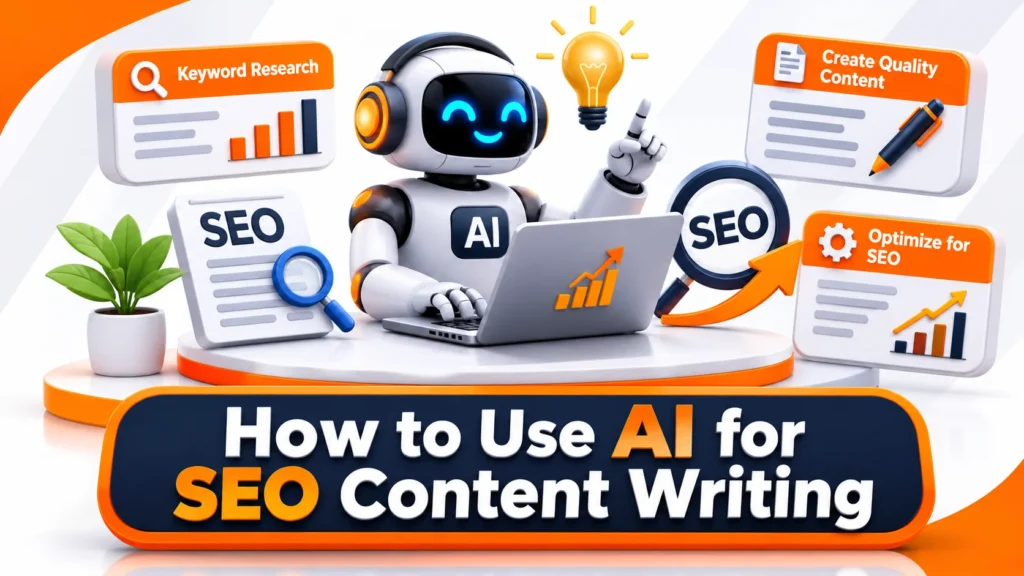
Successful SEO content takes more than keyword placement and word count. It needs strategy, accurate information, and a clear understanding of your audience. This is the workflow I follow.
Step 1: Do Keyword Research Before Writing
I start with keyword research, not with a prompt. I identify:
- The primary keyword and secondary keywords
- Long-tail variations and related questions
- Search intent
- Competitor content gaps
Tools like Ahrefs, Semrush, and Google Search Console help here. For this article, the primary keyword is “does Google penalize AI-generated content,” with supporting terms such as “is AI content bad for SEO,” “can ChatGPT content rank on Google,” and “Google AI content guidelines.”
Step 2: Analyze Search Intent and Competing Pages
Before outlining, I review the pages that currently rank. I note the topics they cover, the questions they answer, their formats and heading structures, and what they miss. The goal is not to copy them. It is to understand what users expect and find room to add value.
Step 3: Build a Detailed Outline With AI
With intent clear, I ask ChatGPT, Gemini, or Claude for a structured outline. I give the tool the target keyword, audience, search intent, questions to cover, competitor gaps, tone, and any sources it should rely on. Then I remove repetitive sections and add anything important that’s missing.
Step 4: Draft Section by Section
Instead of requesting a full article in a single prompt, I draft it section by section. This gives me tighter control over structure, depth, and accuracy. I supply context and reliable reference material, and I use AI to explain concepts simply, suggest examples for small businesses, compare approaches, and draft FAQs. I never treat the first draft as publish-ready.
Step 5: Add Human Expertise and Original Insights
This is the most important step. AI drafts typically lack the practical, industry-specific insight that makes an article worth reading. I add:
- Firsthand experience and real-world examples
- Expert opinions and original analysis
- Client or project insights, where permission allows
- Practical recommendations
An article on SEO content writing should explain how search intent shapes structure, why some keyword-focused articles never rank, and how content quality affects long-term performance.
Step 6: Edit, Humanize, and Fact-Check
Humanizing AI content doesn’t mean swapping words just to make it look human-written. It means making the content natural, accurate, and useful. My editing checklist:
- Remove repetition and long-winded introductions.
- Replace generic statements with specifics.
- Simplify complex sentences.
- Verify facts, statistics, and external references.
- Add relevant examples and practical insights.
- Keep a consistent brand voice.
- Check grammar, readability, and flow.
I also avoid inventing personal anecdotes just to sound human. Real expertise reads better than imitation.
Step 7: Optimize AI-Written Content for SEO
| SEO element | What I recommend |
| Title tag | Include the primary keyword naturally |
| H1 heading | State the article’s topic clearly |
| Introduction | Address the main search intent early |
| H2 and H3 headings | Organize key subtopics with descriptive wording |
| Keyword placement | Use relevant variations naturally |
| Internal links | Link to related blogs and service pages |
| External links | Cite trustworthy sources |
| Images | Use relevant visuals with descriptive alt text |
| Meta description | Write a clear, accurate summary |
| Readability | Use short paragraphs and simple language |
Don’t force every keyword into the article. Search engines reward clear, relevant content, not repeated phrases.
Step 8: Review Performance After Publishing
Content optimization is ongoing. I track each article in Google Search Console and Google Analytics 4, watching impressions, organic clicks, keyword positions, organic traffic, engagement, and conversions.
If an article underperforms, I check search intent, content quality, competition, indexing, internal linking, and technical SEO.
I update based on performance data, not to inflate word count.
Does AI-Generated Content Work in Google AI Overviews and AI Search?
Businesses increasingly want visibility in AI-powered search, including Google AI Overviews, Google AI Mode, ChatGPT search, and Perplexity. This has pushed interest in Generative Engine Optimization (GEO) and Answer Engine Optimization (AEO).
Can AI-Generated Content Appear in Google AI Overviews?
Yes, it can. AI-assisted content may be shown as a supporting source in AI Overviews if it meets Google’s requirements and its systems select it.
Google states that existing SEO best practices still apply to AI Overviews and AI Mode, with no extra technical requirements. A page must be indexed and eligible to appear in Google Search with a snippet, but eligibility does not guarantee inclusion.
How to Improve Your Chances of Being Cited
No method guarantees a citation, but these practices help:
- Answer questions directly near the start of each relevant section.
- Use descriptive headings built around specific questions.
- Support claims with reliable sources and evidence.
- Add original insight through research, examples, and expert explanation.
- Stay topically relevant and cover the subject thoroughly without drifting.
- Follow technical SEO basics so pages can be crawled, indexed, and displayed correctly.
Traditional SEO vs. GEO vs. AEO
| Approach | Primary focus |
| Traditional SEO | Visibility in search engine results |
| GEO | Visibility and citations in generative AI platforms |
| AEO | Content that supplies clear, direct answers |
These approaches overlap. Accurate, well-structured, trustworthy content helps in all three, so I treat AI search optimization as an extension of a strong SEO strategy, not a replacement for it.
Best AI Writing Tools for SEO Content
The right tool depends on whether you need help with research, drafting, editing, or optimization.
| Tool | Best used for |
| ChatGPT | Brainstorming, outlines, first drafts, FAQs, content improvements |
| Google Gemini | Research assistance, summarization, ideation, drafting |
| Claude | Long-form writing, editing, summarizing research, and restructuring content |
| Jasper AI | Brand-focused marketing copy and campaign content |
| Semrush | Keyword research, competitor analysis, content optimization |
| Ahrefs | Keyword research, competitor analysis, backlink data |
| Surfer SEO | Analyzing competing pages and topic-based optimization |
My recommendation: Use a general AI assistant for research and first drafts, pair it with an SEO platform like Ahrefs or Semrush for keyword research and optimization, and have an experienced editor review the final content.
7 Common AI Content Mistakes That Hurt SEO
- Publishing without editing. Drafts often contain generic statements and factual errors.
- Writing only to hit keywords. Multiple articles on near-identical variations create repetitive content.
- Ignoring search intent. A page can contain the right keywords and still not answer the question.
- Trusting AI statistics and references. Always verify numbers, quotations, and external links.
- Overusing AI at scale. High volume without editorial oversight invites scaled content abuse risk.
- Ignoring brand voice. Without clear instructions, AI copy sounds generic.
- Never updating content. AI may supply outdated information, so review older articles when facts or search requirements change.
How to Measure the SEO Performance of AI-Generated Content

Use the same metrics you’d apply to human-written articles, mainly in Google Search Console and Google Analytics 4.
| Metric | What it tells you |
| Impressions | How often does your page appear in Google Search |
| Clicks | How many visitors arrive from organic search |
| Average position | Your page’s average ranking position |
| CTR | The percentage of impressions that become clicks |
| Organic sessions | Traffic coming from organic search |
| Conversions | Leads, inquiries, or sales generated |
Don’t judge an article by ranking position alone. An informational post may draw heavy traffic with few inquiries, while a lower-traffic post may attract highly relevant visitors who convert. Aim for content that supports both organic visibility and business goals.
Final Thoughts: Should You Use AI for SEO Content Writing?
After 14+ years in SEO and 1000+ projects, my takeaway is simple: using AI doesn’t guarantee better rankings, and avoiding it doesn’t guarantee better content. Results depend on strategy, search intent, technical health, and content quality.
Use AI to speed up research, planning, and drafting. Rely on experienced writers and SEO professionals for accuracy, originality, and editorial judgment. At RankON Technologies, we focus on sustainable search visibility rather than publishing pages just to inflate keyword coverage. Results vary based on competition, website condition, and industry, so we build a strategy around your specific situation.
Need a content and SEO strategy built for long-term organic performance? Talk to RankON about your goals through our SEO services.
References and Further Reading
- Google Search’s Guidance About AI-Generated Content
- Google’s Guidance on Using Generative AI Content
- Google Search Spam Policies
- Creating Helpful, Reliable, People-First Content
- Google AI Features and Your Website
Frequently Asked Questions About AI-Generated Content and Google
Does Google penalize AI-generated content?
No. Google does not penalize content just because AI generated it. However, AI content that violates Google’s spam policies, especially scaled content abuse, can lose rankings or be removed from search results.
Is AI content bad for SEO?
No. AI content can support SEO when it is accurate, original, relevant, and helpful. Trouble starts when businesses publish generic, repetitive, or inaccurate AI content without editing.
Can ChatGPT content rank on Google?
Yes. ChatGPT-generated articles can rank if they satisfy search intent and provide useful information. I recommend reviewing every draft for accuracy, originality, and quality first.
Is AI content allowed by Google?
Yes. Google’s guidelines allow generative AI for content creation. Using AI to mass-produce low-value pages mainly to manipulate rankings can violate its spam policies.
How much AI content is safe for SEO?
Google sets no percentage or word-count limit. No official rule says 30%, 50%, or 100% AI-generated content is safe or unsafe. Focus on the quality and usefulness of the final page.
Should I use AI to write blog posts?
Yes, for research, outlines, drafting, and readability improvements. Human review, fact-checking, and editorial input are essential before publishing.
Can Google detect AI-generated content?
Google uses automated systems to evaluate content, but it has not published an AI-detection threshold for ranking. Its guidance emphasizes quality, usefulness, accuracy, and compliance with spam policies.
Does AI-generated content affect E-E-A-T?
Not automatically. But AI content that lacks firsthand experience, expertise, reliable sourcing, or accuracy will struggle to show the qualities E-E-A-T describes.
Should I disclose AI-generated content on my website?
Google suggests considering disclosure when readers would reasonably want to know how content was created. It does not require an AI disclosure on every AI-assisted article.
Can AI-generated content appear in Google AI Overviews?
Yes, if it meets Google’s technical requirements and content policies. There is no special AI-content optimization and no guaranteed inclusion.