
There is no fixed estimate for Google Ads cost in India. Google Ads uses an auction to determine which eligible ads appear, where they appear, and how much the advertiser is charged. Your cost can change from one search to the next because the auction weighs your bid, ad quality, Ad Rank thresholds, the searcher’s context, the expected impact of assets, and competition.
That means no single India-wide CPC figure can predict your cost. Published benchmarks do show a useful pattern, though: clicks in low-value categories like retail can cost a few rupees, while clicks in insurance and lending can run into hundreds.
This Google Ads pricing guide shows the reported ranges, explains how to convert CPC to cost per lead, and walks you through budgets, GST, and agency costs so you can build a forecast for your own business.
Quick Answer: What Does Google Ads Cost in India?
- Per click: Published 2026 benchmarks put Search CPCs from about ₹3 in retail to ₹300–₹460 or more in insurance, and some estimates go much higher for the most competitive insurance keywords. There is no official Google-published average CPC for India.
- Minimum spend: Google does not set a minimum daily budget. In practice, third-party planning ranges from around ₹15,000 per month for low-CPC local services to ₹1,50,000–₹5,00,000+ for competitive sectors.
- Tax: Google lists 18% GST on Google Ads purchases in India. A ₹50,000 media month therefore costs about ₹59,000 before any agency fee.
- Agency cost: Commonly reported management costs run from about ₹20,000 to ₹3,00,000+ a month, or 10%–20% of ad spend. cost are separate from the budget you pay Google.
- The number that matters most: cost per lead and cost per customer, not cost per click.
Every third-party benchmark in this Google Ads pricing guide is an indicative planning reference, not a Google-guaranteed rate. Validate it against Google Keyword Planner and your own campaign data.
How Google Ads Pricing Works
Google runs an ad auction whenever an eligible ad opportunity occurs. For Search, Google uses Ad Rank to decide whether an ad can show and where. Ad Rank combines your bid, ad quality, Ad Rank thresholds, auction competitiveness, search context, and the expected impact of assets and other ad formats.
Quality Score is a 1–10 diagnostic metric in your account that summarizes aspects of ad quality, such as expected click-through rate, ad relevance, and landing page experience.
It helps you diagnose problems, but it is not an input in the auction and not the full Ad Rank formula. The auction-time quality it reflects does influence Ad Rank, which is why more relevant ads can win better positions and may pay less per click.
With manual CPC bidding, your actual CPC is often lower than your maximum bid because you typically pay the minimum required to meet the relevant Ad Rank threshold and beat competing ads. Automated bidding can work differently, so do not assume every campaign follows a simple “next competitor plus ₹1” formula.
Google Ads Billing Models
| Model/approach | What you may pay for | Where it can apply |
| CPC | Clicks or interactions, depending on the campaign and bidding setup | Common in Search and other campaigns |
| CPM / vCPM | Impressions or viewable impressions, depending on the strategy | Awareness-focused inventory/campaigns |
| CPV / engagement-based models | Views or engagements, depending on campaign format | Video campaigns |
| Pay for conversions | Conversions rather than clicks, where eligible | Eligible Display campaigns |
The billing method depends on the campaign type, bid strategy, and eligibility. Do not state that all Google Ads campaigns charge only when someone clicks.
If you’re specifically running campaigns on Google Search, learn more about Google Search Ads and how they work.
Watch my video: Best Google Search Ads Tutorial for Beginners
Google Ads CPC in India by Industry (2026)
Industry is the biggest driver of pay-per-click cost. Click prices track how much a converted customer is worth: an insurer or lender can afford to bid far more per click than a retailer selling a ₹400 item.
Two published 2026 benchmarks illustrate the spread. They use different methods, so they do not always agree, and that disagreement is itself a reason to build your own forecast.
| Industry | (Keyword Planner-based, June 2026) | (September 2026) |
| E-commerce/retail | ₹3–₹20 | ₹15–₹80 |
| Travel and hospitality | ₹14–₹30 | ₹10–₹80 |
| Home services | ₹25–₹75 | Not reported |
| Legal | ₹50–₹130 | Not reported |
| Healthcare | ₹95–₹210 | ₹30–₹250 |
| Real estate | ₹50–₹330 | ₹40–₹400 |
| Education | ₹295–₹385 | ₹25–₹180 |
| B2B SaaS/technology | ₹205–₹255 | ₹80–₹400 |
| Finance/lending | ₹65–₹270 | ₹100–₹600+ |
| Insurance | ₹310–₹460 | ₹80–₹3,000 |
Get Your Own CPC Estimate in Keyword Planner
Google Keyword Planner is free inside a Google Ads account. For each keyword, it shows a “top of page bid” low range and high range, which Google describes as roughly the 20th and 80th percentiles of what advertisers have historically paid.
Pull both ranges for your core keywords in your target cities, and treat the high range as the cautious planning figure. These are estimates, not guaranteed costs.
What Is the Average Google Ads CPC in India?
There is no single reliable India-wide CPC benchmark that applies to every advertiser. Published agency benchmarks often disagree because they may use different industries, keywords, dates, locations, match types,s and campaign data.
Instead of publishing a table that implies fixed CPCs such as ₹20–₹150 for Search or ₹180–₹300+ for loans, use your own keyword and campaign data. Google Keyword Planner can provide historical statistics and forecasts based on keywords, location, bids, budget, and other inputs. These are estimates, not guaranteed costs.
The City Effect: Why Metro Clicks Can Cost More
Google Ads is priced locally. Some benchmarks report that the same keyword can cost two to three times more in Tier-1 metros such as Mumbai, Delhi NCR, and Bengaluru than in Tier-2 cities, because more advertisers compete for the same audience. If you serve only one metro, you pay that metro’s price.
If you can serve several cities, location targeting and location bid adjustments let you pay the local price in each market instead of overpaying in cheaper ones. Review where your clicks and conversions actually come from before changing city bids.
CPC vs. Cost Per Lead: The Cost That Actually Matters
A click is not what you are buying. You are buying leads and customers; a click only becomes one after it survives your landing page and sales process.
Cost per lead = cost per click ÷ landing-page conversion rate
Cost per customer (CAC) = cost per lead ÷ lead-to-customer close rate
For a content page about Google Ads cost, it is safer to show illustrative examples rather than claim that a particular industry normally costs a specific amount.
A worked example (illustrative numbers)
| Same ₹60 click | Weaker landing page | Stronger landing page |
| Landing-page conversion rate | 2.5% | 5% |
| Clicks needed for one lead | 40 | 20 |
| Cost per lead | ₹2,400 | ₹1,200 |
| Cost per customer (20% close rate) | ₹12,000 | ₹6,000 |
The click price did not change, but the cost per customer halved. Fixing a slow or confusing page can lower acquisition cost more than shaving a few rupees off a bid. These conversion rates are assumptions for the example; measure your own from the first weeks of data.
Estimate Your Own Google Ads Cost in 5 Steps
- Pick a planning CPC. Use Keyword Planner and cross-check against the industry ranges above.
- Estimate your landing-page conversion rate. Use real data if you have it. Without it, plan conservatively and test.
- Calculate cost per lead: CPC ÷ conversion rate.
- Apply your close rate to get the cost per customer.
- Compare to customer value. If a customer is worth ₹60,000 to you and costs ₹12,000 to acquire, the economics can work. If a customer is worth ₹8,000, fix the offer, page, or close rate before scaling spend.
These numbers are mathematical examples for planning and should not be presented as typical industry CPCs.How Much Should You Budget Per Month for Google Ads in India?
Start with your business goal instead of a random monthly figure.
Required clicks ≈ required customers ÷ visitor-to-customer conversion rate
Ad spend ≈ required clicks × expected CPC
Example: If you need 10 customers, 1% of ad visitors become customers, and your planned CPC is ₹50, you need about 1,000 clicks and roughly ₹50,000 in ad spend before taxes. This is an illustration, not a performance guarantee.
Planning ranges by business type
Third-party agencies publish planning ranges for the media budget (what you pay Google before GST). Two 2026 guides broadly agree on the pattern:
| Business type | Commonly cited monthly media range | Why does it sit here |
| Local service business, single city | ₹15,000–₹75,000 | Low to moderate CPCs, tight radius |
| D2C / e-commerce | ₹40,000–₹1,50,000 | Needs conversion volume to calibrate Smart Bidding and Shopping |
| Mid-market service, SaaS, or B2B | ₹1,00,000–₹3,00,000 | Higher CPCs, longer sales funnels |
| High-CPC categories (healthcare, fintech, insurance, lending) | ₹1,50,000–₹5,00,000+ | Few clicks per rupee, intense competition |
Why do very small budgets struggle
Automated bidding needs data. Google says a bid strategy can take roughly 50 conversion events, or about three conversion cycles, to calibrate to a new objective, and that changes to settings can restart that learning. Another agency guide suggests aiming for at least 30 conversions per campaign per month.
A budget so small that it produces only a handful of clicks cannot generate that data, so what you “learn” is mostly noise. Concentrating a modest budget on one city and a tight set of keywords usually teaches you more than spreading it thinly across many.
Daily vs. monthly budget
Google Ads campaigns use an average daily budget. Google says monthly planning can be estimated by multiplying the average daily budget by 30.4. On any given day, a campaign can spend more than its daily average, but monthly charges are capped at the average daily budget multiplied by 30.4. Use Google’s billing and budget reports rather than assuming the same spend every day.
GST and TDS on Google Ads in India
Google’s India tax help lists 18% GST on Google Ads purchases. Depending on your billing details, this appears as IGST or as 9% CGST plus 9% SGST for certain bill-to states, and Google lists 0% for SEZ advertisers.
Business accounts billed by Google India Private Limited must provide a GSTIN that matches the bill-to state. Taxes are generally assessed and charged monthly.
| Illustrative month | Amount | Note |
| Media spend | ₹50,000 | Paid to Google |
| GST at 18% | ₹9,000 | Per Google’s India tax guidance |
| Total before agency fee | ₹59,000 | The agency fee is extra |
If you deduct TDS, the rate Google cites on advertising payments to Google India Private Limited is 2% (excluding GST). Treatment depends on which Google entity serves you and on your own tax profile, so confirm your position with a chartered accountant or tax adviser.
Google Ads Agency Cost in India
If you outsource campaign management, agency costs are a separate line from your media budget. Commonly reported models are:
| Fee model | Commonly reported range | Typically suits |
| Fixed monthly retainer | ₹20,000 to ₹3,00,000+ per month, depending on scope | Media spend that is modest or where the scope is clearly defined |
| Percentage of ad spend | 10%–20% of monthly media spend | Larger budgets, where the fee funds senior attention |
| Hybrid | Base retainer (often ₹30,000–₹75,000) plus a smaller percentage (often 5%–8%) | Growing accounts as spend rises |
What to check before you sign
- Scope: Are landing pages, conversion tracking, and creative included or extra?
- Account ownership: You should own your Google Ads account, not the agency.
- Reporting: Reports should show leads and sales, not only clicks and impressions.
- Who works on the account, and how many hours a month?
Budget about 5%–15% of total spend, as one agency suggests, for landing page tools, creative, call tracking, and tag management. Skipping this line is a common reason conversions quietly decay.
Agency, freelancer, or in-house?
One agency’s rule of thumb: run it in-house if you spend under ₹50,000 a month and someone can give it 5–10 hours a week; consider an agency once spend passes about ₹1,00,000 a month and internal time costs more than the fee; at ₹3,00,000+ a month, a shared model often works, with the agency owning strategy and an internal analyst handling daily optimization. Treat these as starting points, not rules.
What Affects Your Google Ads Cost in India?
- Keyword and auction competition: More competition can raise the amount needed to win an auction.
- Search context and intent, including location, device, time, query, and user signals, can affect Ad Rank and cost.
- Ad quality and landing page experience: Better relevance can contribute to a stronger Ad Rank and may reduce actual CPC.
- Ad Rank thresholds: Google applies thresholds that vary by auction and context.
- Location: Competition differs sharply between cities, regions, and target areas.
- Bidding strategies: Manual CPC and automated strategies such as Maximize Clicks, Maximize Conversions, Target CPA, and Target ROAS behave differently.
- Match types and negative keywords: Poor targeting creates irrelevant traffic and wasted spend.
- Seasonality: Demand and competition shift during festivals, sales periods, and admission seasons.
- Conversion rate: A higher CPC can still be profitable if the conversion rate and customer value are strong.
How to Reduce Wasted Google Ads Spend in India
There are several effective Google Ads cost-reduction strategies you can use to control wasted spend and improve campaign efficiency.
- Use search-term data to identify irrelevant queries and add appropriate negative keywords.
- Align keywords, ads, and landing pages so the user sees a consistent message.
- Use location targeting carefully and review where clicks and conversions actually come from.
- Track meaningful conversions, such as qualified leads, sales, and calls, rather than relying solely on clicks.
- Review device, location, time, and audience performance before making bid or budget changes.
- Improve landing-page speed, relevance, clarity, and conversion paths.
- Test bidding strategies against business goals rather than trying to minimize CPC at any cost.
- Pause or reduce spend on traffic that repeatedly fails to produce economically viable results.
Avoid blanket rules such as ‘always use a 2 – 5 km radius’ or ‘add these exact negative keywords every week.’ The right settings depend on the business, service area, search behavior, and campaign data.
Is Google Ads Worth It?
Judge Google Ads by business outcomes rather than CPC alone. A ₹150-per-click cost can be profitable for a high-value service, whereas a ₹10-per-click cost can be unprofitable if visitors rarely convert.
- Average profit or contribution margin per customer
- Lead-to-customer close rate
- Target cost per qualified lead
- Target customer acquisition cost (CAC)
- Customer lifetime value, where relevant
A useful rule is to work backward from the maximum acquisition cost the business can afford, then determine whether the available search demand and expected conversion rate make the campaign viable.
Google Ads vs SEO: How They Work Together

| Factor | Google Ads | SEO |
| Cost model | Paid advertising: cost depends on the campaign and the billing/bidding model | Investment in content, technical SEO, links/authority, and ongoing optimization |
| Speed | Can generate visibility soon after campaigns are approved and eligible | Usually requires sustained work and time to build organic visibility |
| Control | Strong control over budget, targeting, and campaign settings | Less direct control over rankings |
| Longevity | Traffic generally stops when ads stop driving | Successful organic VIPs can continue to provide value without paying per click, but it requires ongoing maintenance |
Many businesses use both. PPC campaigns can drive immediate traffic and provide valuable conversion data, while SEO can build long-term organic visibility. Neither channel guarantees rankings, traffic, or sales.
What Do Real Google Ads Campaigns Cost? Our September 2026 Data
Public benchmarks can help businesses estimate Google Ads costs, but real campaign data often reveals how much results can vary by industry, location, Google ads campaign type, and bidding strategy.
Reliable Google Ads marketing agency, At RankON Technologies, our approach focuses on understanding actual campaign performance rather than relying solely on general industry averages.
In September 2026, we reviewed anonymized Google Ads campaigns for local appointment-based businesses in the UK and US to understand their advertising costs and conversion performance.
The accounts recorded the following results: Here is a quick table.👇
Business | Campaign Type | Spend | Conversions | Cost per Conversion | Conversion Rate |
UK osteopathy clinic | Performance Max | £485.61 | 127.33 | £3.81 | 13.86% |
UK tattoo clinic | Performance Max | £282.28 | 62 | £4.55 | 6.48% |
UK massage business | Search, Target CPA | £249.37 | 109 | £2.29 | 25.47% |
UK dermatologist clinic | Search | £1,056.82 | 119.47 | £8.85 | 11.02% |
US dental clinic | Search + Performance Max | $911.03 | 80 | $11.39 | — |
US massage business | Performance Max | $2,008.80 | 75 | $26.78 | 5.54% |
Conversion means the action tracked by the account, such as a phone call, form submission, or booking. It does not necessarily represent a paying customer. Campaign names and identifying details are hidden in the screenshots.👇
What Does Our Campaign Data Show?
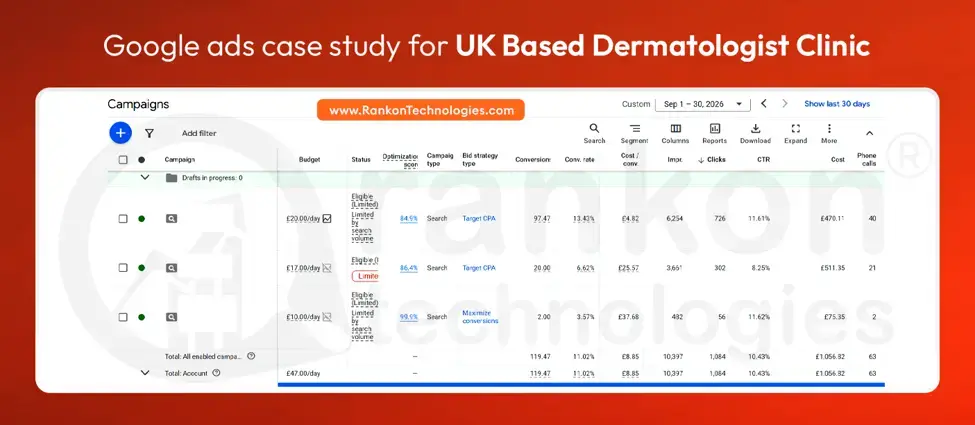
Our campaign data highlights how significantly Google Ads costs can vary, even within the same industry. For example, three campaigns for one UK dermatologist account recorded cost-per-conversion figures of £4.82, £25.57, and £37.68.
Similarly, in a US dental account, Search recorded $14.11 per conversion, compared with $6.03 for Performance Max.
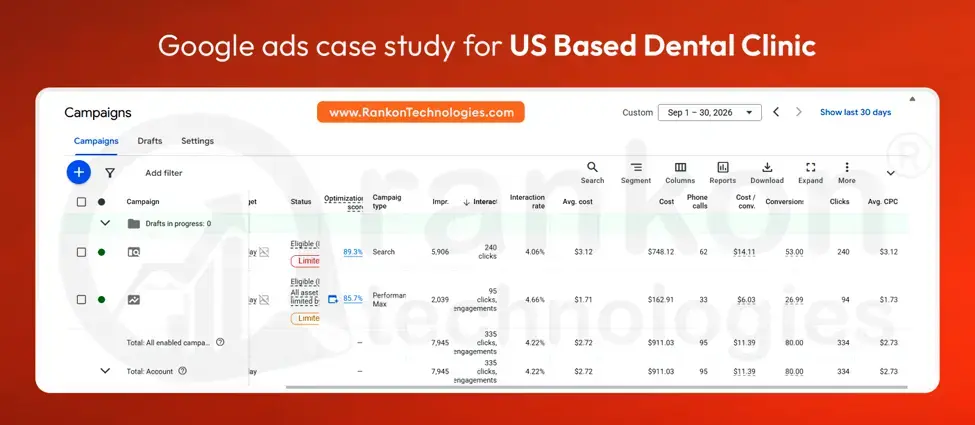
At RankON Technologies, these differences reinforce the importance of evaluating each campaign individually. Rather than assuming that one campaign type will always deliver the lowest cost, businesses should consider their objectives, conversion tracking, audience targeting, and the quality of the leads generated.
Note: These campaign figures come from UK and US accounts we manage, so they are not India CPC benchmarks. We include them only to show how much cost per conversion can vary by campaign type, tracking setup and business, even within the same industry. For India, use Google Keyword Planner and your own campaign data to build a forecast.
Expert Insights from RankON Technologies Pvt Ltd.

Under the guidance of Anand Kumar, an expert at RankON Technologies, businesses can approach digital advertising with a greater focus on campaign performance, measurable outcomes, and data-driven decision-making.
An effective Google Ads strategy involves more than reducing the cost per conversion. It also requires understanding whether conversions turn into genuine inquiries, appointments, and paying customers.
You can learn more about Anand Kumar and his professional background on his official team profile.
What Do These Google Ads Costs Mean for Your Business?
These figures are not universal Google Ads benchmarks. They are observations from managed campaigns that demonstrate why advertising budgets should be estimated based on a business’s industry, location, campaign type, conversion data, and customer economics.
For businesses considering Google Ads, the key takeaway is simple:
The lowest cost per conversion does not always mean the best return on investment. Lead quality, conversion tracking, and advertising-generated revenue are equally important.
At RankON Technologies, analyzing real campaign data helps inform advertising decisions and identify opportunities to improve performance over time.
The campaign screenshots below show the underlying account data, with campaign names and identifying details hidden.
Why Businesses Choose RankON Technologies for Google Ads Management
Estimating Google Ads cost is only the first step. Turning that budget into qualified leads depends on how the account is structured, tracked, and optimized. RankON Technologies is a Google Partner agency that provides Google Ads management alongside SEO, so paid and organic visibility can be planned together.
- Google Partner agency: RankON is a Google Partner Agency with a team of Google Ads-certified professionals managing campaigns.
- 14+ years of experience: RankON brings over 14 years of digital marketing and SEO expertise to campaign planning, keyword research, and conversion tracking.
- 100+ clients supported with Google Ads strategy: RankON has helped over 100 clients improve results through Google Ads strategy across a range of industries.
- 500+ SEO projects and a 20+ member team: Paid campaigns are supported by landing page, content, a nd technical SEO expertise, which can help improve ad relevance and conversion rates.
- Global client experience: RankON works with businesses in India, the USA, the UK, Canada, and Australia.
- Independently reviewed: RankON is a Top Rated Plus agency on Upwork and has been recognized by Clutch and 50Pros.
- Practical tools and reporting: Campaign planning uses Google Keyword Planner, Google Analytics, and Google Search Console, with reporting focused on qualified leads and sales rather than clicks alone.
What RankON Technologies can help with
- Google Ads account audits and wasted-spend reviews
- Keyword research and cost forecasting using Keyword Planner
- Search, Display, Shopping, and Performance Max campaign setup and management
- Conversion tracking, call tracking, and landing page improvements
- Ongoing optimization, search-term review, and performance reporting
Results depend on factors such as your industry, competition, budget, offer, website quality, and sales follow-up, so RankON does not promise specific rankings, costs,s or lead volumes.
Conclusion
Google Ad costs in India are not fixed. The amount you pay depends on the auctions your ads enter, your targeting, bidding strategy, ad quality, competition, budget, and, most importantly, how well your traffic converts into valuable business outcomes.
Rather than relying on generic CPC tables, build a forecast around your actual keywords and locations, start with a controlled budget, measure qualified conversions, and optimize from real data. If you combine paid search with a technically sound, useful, and trustworthy website and a long-term SEO strategy, you can build a more balanced acquisition system.
Need More Help with Google Ads Estimate for your Campaign?
Talk to RankON Technologies, a Google Partner agency, about your Google Ads and SEO goals. Share your industry, locations, and target customers, and our Google Ads expert can help you build a realistic budget forecast and a practical plan that connects paid campaigns with long-term organic visibility.
If you’re comparing providers before getting started, see our guide on choosing a Google Ads agency.
FAQs About Google Ads Cost in India
What is the minimum budget for Google Ads in India?
There is no single India-wide minimum monthly budget. You set campaign budgets based on your goals. However, a budget that is too small for your CPC and target market may produce too little traffic or conversion data to make useful decisions.
How much does a click cost on Google Ads in India?
There is no official fixed CPC range for India. Your actual CPC depends on the auction, keyword, location, device, competition, ad quality, bidding strategy, and other factors. Use Keyword Planner and your own campaign data for planning.
Is GST charged on Google Ads in India?
Google’s current India tax guidance says GST applies to Google Ads purchases. The rate and treatment shown on the invoice depend on the billing arrangement and relevant tax details. Check your invoice and confirm tax treatment with your accountant.
How much should a small business spend on Google Ads per month?
There is no universal figure. Calculate the budget from target customers or leads, expected conversion rate, CPC, customer value, and affordable acquisition cost.
Why is my Google Ads CPC high?
Possible causes include strong competition, expensive search terms, auction context, lower ad quality, targeting choices, bidding strategy, and seasonal changes. Review actual CPC, search terms, auction insights, and conversion performance before changing the budget.
How long does it take to see results from Google Ads?
Ads can begin serving after approval and eligibility checks, but reliable performance conclusions require sufficient data. The time varies by budget, traffic volume, conversion cycle, campaign type,e and business.
Should I choose Google Ads or SEO?
Use Google Ads when you need controllable paid visibility and are willing to pay for advertising. Use SEO when you want to build organic visibility over time. Many businesses benefit from combining both.