

Facebook Ads vs Google Ads depends on your business goals, target audience and how customers discover your products or services. Google Ads helps you reach people actively searching for solutions, while Facebook and Instagram ads can introduce your business to potential customers who may not be looking for it yet.
Quick answer: Choose Google Search Ads when relevant searches already exist and you want to capture demand. Choose Facebook and Instagram ads when visual content, audience discovery or demand generation is important. If your budget allows, test both platforms and compare qualified leads, sales and customer acquisition costs before scaling.
In this guide, we compare Google Ads and Meta Ads by cost, targeting, campaign types, business goals and conversion tracking so you can decide where to start.
Key Takeaways
- Google Ads can capture existing demand, while Meta Ads can help build awareness and generate interest among potential customers.
- Meta Ads may deliver lower cost-per-click results in some campaigns, but costs vary by industry, audience, location and campaign objective.
- Google Search Ads can reach people with strong purchase intent when they actively search for relevant products or services.
- Meta Ads can work well for visual products, new brands, retargeting and reaching audiences who may not be actively searching.
- Compare cost per qualified lead, sale and customer acquisition cost rather than relying on clicks or impressions alone.
- Start with the platform that best matches your business goals, and test both when your budget and tracking setup allow it.
Here is a quick pick table before we go deeper.
| If this sounds like you | Start with |
| People search for my service every day | Google Ads |
| Nobody knows my brand yet | Facebook Ads |
| My product looks great in photos or video | Facebook Ads |
| My customers have an urgent problem | Google Ads |
| I want to run a long-term brand and sales plan | Both, in stages |
At RankON Technologies, we run both Google Ads and Meta Ads as part of our PPC services and social media marketing services. This guide shows how we think about the choice, and it includes real numbers from our own ad accounts.
You will learn how the platforms differ, what they cost, how to pick by business type, how to track results and how to test fairly.
What are Google Ads and Facebook Ads?
Google Ads is Google’s paid advertising platform. It shows your ads on Google Search, Google Maps, YouTube, Google Shopping and partner websites. You usually pay when someone clicks, which is called pay-per-click, or PPC.
Facebook Ads are paid ads you buy through Meta Ads Manager. They appear on Facebook, Instagram, Messenger and Meta partner apps. People still say Facebook Ads, but one campaign can also show your ad on Instagram.
The table below shows where each platform places your ad.
Platform | Where your ad can appear |
Google Ads | Google Search, Google Maps, YouTube, Google Shopping, Gmail, Discover, partner websites |
Facebook Ads (Meta) | Facebook Feed, Instagram Feed, Stories, Reels, Messenger, Meta partner apps |
How are the two platforms different?
Google Ads is pull marketing, and Facebook Ads is push marketing. On Google, the customer starts the search and you answer it. On Facebook, you start the conversation while the person scrolls.
Think about one shopper. On Monday she sees a pair of running shoes on Instagram and likes them. On Wednesday she searches for the shoe name on Google and clicks a search ad. Facebook planted the idea, and Google collected the sale.
Feature | Google Ads | Facebook Ads |
Main idea | Answer a search | Catch attention in a feed |
Buyer readiness | Often high | Often low to medium |
Targeting | Keywords, location, audiences | Interests, behaviors, location, lookalike audiences |
Main formats | Text, Shopping, video, Performance Max | Image, video, carousel, Reels, lead forms |
Creative work needed | Low to medium | High |
Best for | Capturing demand | Creating demand |
Facebook Ads vs Google Ads Cost: Which Is Cheaper?
In Facebook Ads vs Google Ads cost, Facebook wins on click price, while Google often wins on cost per sale. Judge cost by customer.
Public benchmarks show a big gap in click prices. WordStream data, summarized by Whatagraph, covers Google Ads. LocaliQ data, also from WordStream, covers Facebook Ads.
Metric | Google Ads | Facebook Ads |
| Average cost per click | $5.42 | $0.70 (traffic campaigns), $1.92 (lead campaigns) |
| Average cost per lead | $66.69 | $27.66 |
| Average click-through rate | 6.64% | Not comparable (varies by campaign type) |
| Average conversion rate | 8.18% | Not comparable (varies by campaign type) |
Read this table with care. The numbers come from different reports, time periods and campaign types, and they mostly reflect United States advertisers. Meta does not publish one official average, so every Facebook figure is a third-party estimate. US benchmarks also do not transfer directly to India, so use your own account data as soon as you have it.
Why a cheap click is not always a cheap customer
A click only costs money. A customer makes money. This example shows why the two can point in opposite directions.
Imagine you buy the same number of clicks on each platform. The numbers below are made up to show the math, so please do not treat them as a forecast.
Example (illustrative only) | Google Ads | Facebook Ads |
Clicks bought | 100 | 100 |
Cost per click | $5.00 | $1.50 |
Total spend | $500 | $150 |
Visitors who become customers | 10 | 2 |
Cost per customer | $50 | $75 |
In this example Facebook clicks are three times cheaper, but Google gives the cheaper customer. Your own numbers can go the other way. That is why you must track customers and not only clicks.
What makes ad costs go up or down?
Four things decide your cost on both platforms: competition, ad quality, audience and season. You control only two of them, which are ad quality and audience.
Cost driver | What it means | What you can do |
Competition | More advertisers bid for the same people or keywords | Target a narrower offer or location |
Ad quality | Better ads earn more clicks at lower cost | Improve headlines, images and the landing page |
Audience | Broad or rare audiences cost different amounts | Test audiences and keep the best |
Season | Prices usually rise near Black Friday and the holidays | Plan budgets early and avoid last-minute launches |
Some industries cost more than others. Legal, insurance and finance keywords are among the most expensive on Google.
Our guide on common Google Ads mistakes that waste your budget explains how to avoid paying for the wrong clicks.
What do our real Google Ads and Facebook Ads accounts show?
Our own Facebook Ads vs Google Ads data follows the rule in this guide. Google Ads worked well for local businesses that people search for, and Facebook Ads worked for lead campaigns where the offer had to catch attention.
The tables below come from campaigns managed by RankON Technologies, taken from the ad accounts themselves. Business names are hidden.
Read one warning first. These are real numbers, but they are not a controlled head-to-head test. The businesses, countries, goals, budgets and dates differ, so do not compare one row against another as if they were equal.
How did our Google Ads campaigns perform in September 2026?
Our Google Ads campaigns for local appointment businesses produced conversions at low cost per conversion in September 2026. A conversion here means the action each account tracks, such as a call, form or booking. It does not always mean a paying customer.
Business | Country | Campaign type | Period | Daily budget | Spend | Clicks | Conversions | Cost per conversion | Conversion rate |
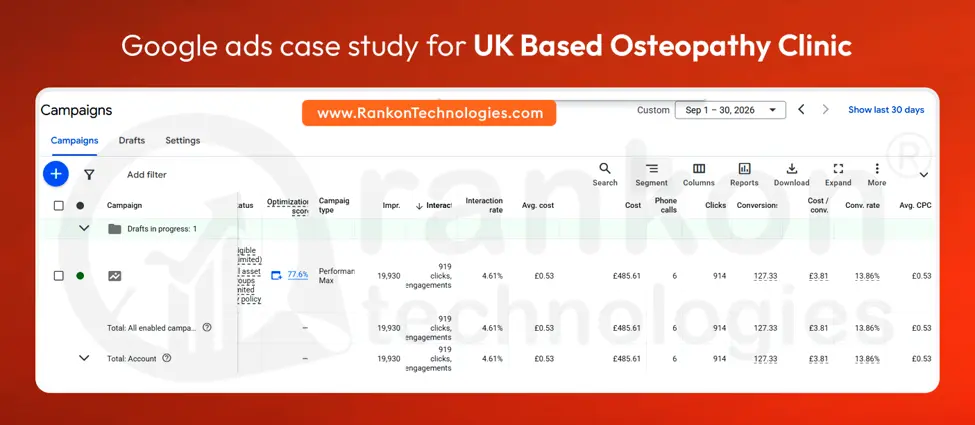
Osteopathy clinic | UK | Performance Max | 1 to 30 Sep 2026 | Not shown | £485.61 | 914 | 127.33 | £3.81 | 13.86% |
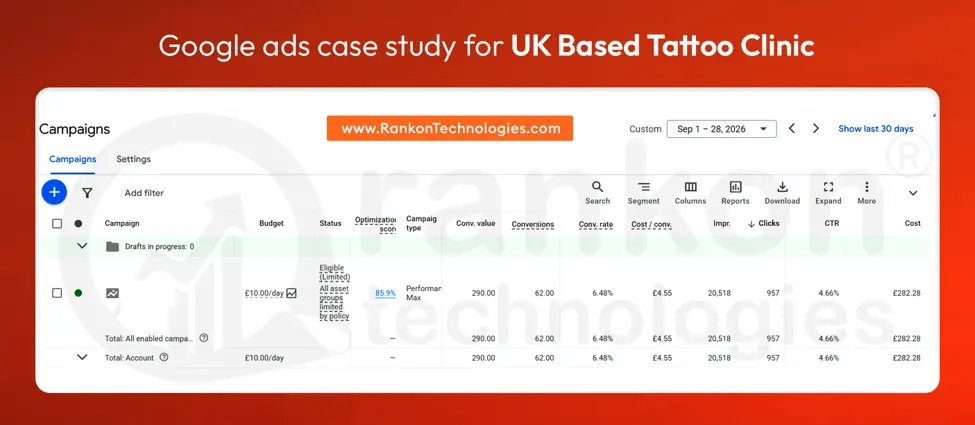
Tattoo clinic | UK | Performance Max | 1 to 28 Sep 2026 | £10 | £282.28 | 957 | 62.00 | £4.55 | 6.48% |
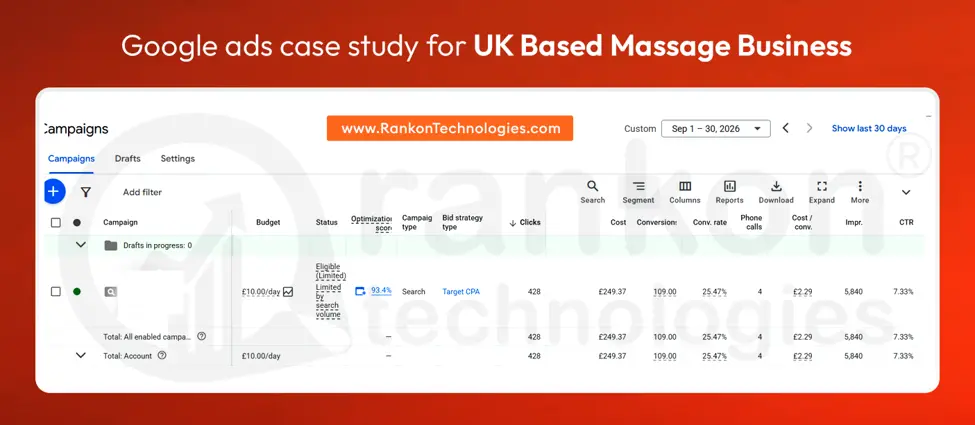
Massage business | UK | Search (Target CPA) | 1 to 30 Sep 2026 | £10 | £249.37 | 428 | 109.00 | £2.29 | 25.47% |
Dermatologist clinic | UK | Search (3 campaigns) | 1 to 30 Sep 2026 | £47 in total | £1,056.82 | 1,084 | 119.47 | £8.85 | 11.02% |
Dental clinic | US | Search and Performance Max | 1 to 30 Sep 2026 | Not shown | $911.03 | 334 | 80.00 | $11.39 | Not shown |
Massage business | US | Performance Max (2 campaigns) | 1 to 28 Sep 2026 | $70 in total | $2,008.80 | 1,355 (clicks and engagements) | 75.00 | $26.78 | 5.54% |
Google Ads, UK osteopathy clinic, 1 to 30 Sep 2026. Campaign names hidden.👇
———————————————————————————————————————————–
Google Ads, UK tattoo clinic, 1 to 28 Sep 2026.👇
———————————————————————————————————————————–
Google Ads, UK massage business, 1 to 30 Sep 2026.👇
How does our data compare with the public benchmark?
Our accounts show a lower cost per click and a higher conversion rate than the public Google Ads average in several cases. The benchmark covers many industries and mostly US advertisers, so it is only a rough guide.
Metric | Public benchmark (WordStream data, US dollars) | Our accounts |
| Average cost per click | $5.42 | £0.53 (UK osteopathy), $2.73 (US dental) |
| Average cost per interaction | Not published | $1.48 (US massage, Performance Max) |
| Click-through rate | 6.64% | 7.33% (UK massage), 10.43% (UK dermatologist), 4.66% (UK tattoo) |
| Conversion rate | 8.18% | 25.47% (UK massage), 13.86% (UK osteopathy), 11.02% (UK dermatologist), 6.48% (UK tattoo), 5.54% (US massage) |
Currencies differ between the benchmark and our accounts, so we have not converted them. Local appointment businesses also tend to differ from the all-industry average. Use this table to see the shape of the results, not to claim that one platform beats the other.
What does the same-account data teach us?
Campaign setup changes the result inside one account. Three accounts show this clearly.
Account | Campaign | Daily budget | Spend | Conversions | Cost per conversion |
UK dermatologist clinic | Search, Target CPA (campaign 1) | £20 | £470.11 | 97.47 | £4.82 |
UK dermatologist clinic | Search, Target CPA (campaign 2) | £17 | £511.35 | 20.00 | £25.57 |
UK dermatologist clinic | Search, Maximize conversions (campaign 3) | £10 | £75.35 | 2.00 | £37.68 |
US dental clinic | Search | Not shown | $748.12 | 53.00 | $14.11 |
US dental clinic | Performance Max | Not shown | $162.91 | 26.99 | $6.03 |
US massage business | Performance Max (campaign 1) | $60 | $1,721.15 | 54.05 | $31.84 |
US massage business | Performance Max (campaign 2) | $10 | $287.66 | 20.95 | $13.73 |
Google Ads, UK dermatologist clinic, 1 to 30 Sep 2026.👇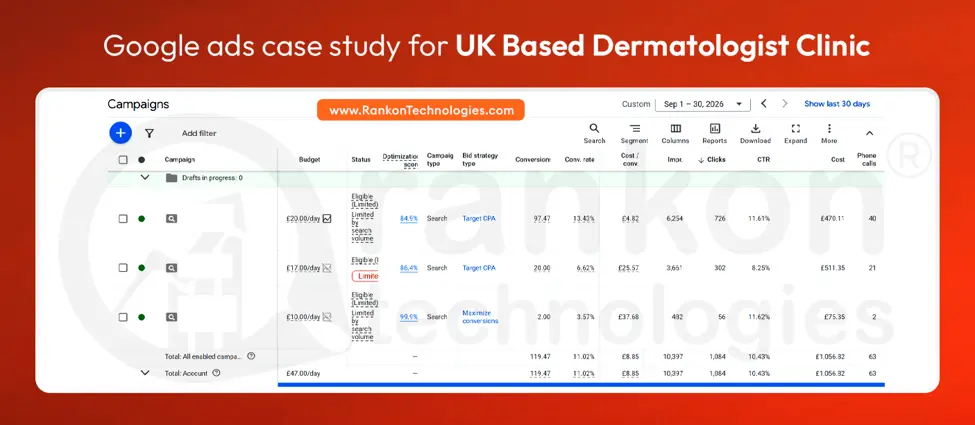
——————————————————————————————————————————-
Google Ads, US dental clinic, 1 to 30 Sep 2026.👇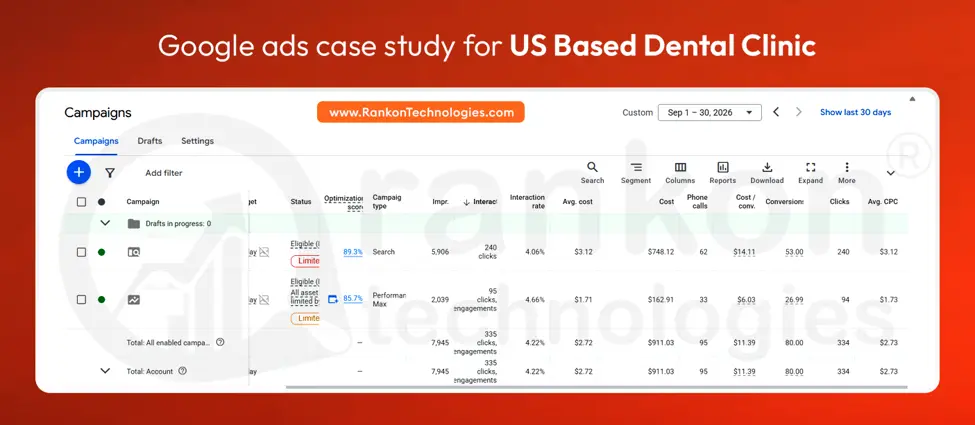
———————————————————————————————————————————–
Google Ads, US massage business, 1 to 28 Sep 2026.👇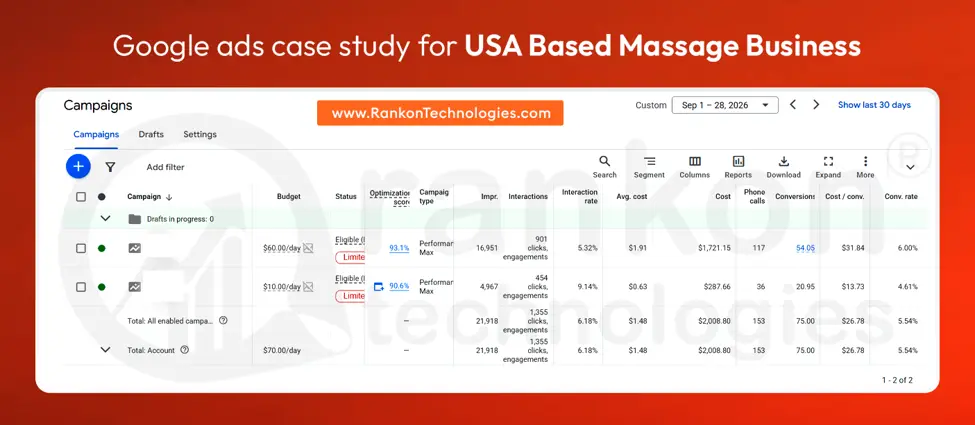
Two lessons stand out. First, the same business can pay several times more for a conversion in one campaign than in another, so split tests and weekly reviews matter.
Second, Performance Max cost less per conversion than Search in the dental account, but it also brought fewer conversions and offers less detail on where ads ran, so we watch both.
How did our Facebook Ads campaigns perform?
Our Facebook Ads campaigns produced leads and messages, and the cost per result varied widely between campaigns. A UK tattoo removal clinic ran one lead campaign, and an agency account ran many campaigns for courses and services.
UK tattoo removal clinic | Result |
Period | 1 Apr to 31 Aug 2026 |
Campaign goal | Leads (form) |
Daily budget | £10 |
Amount spent | £733.46 |
Impressions | 45,452 |
Reach | 15,196 |
Leads | 46 |
Cost per lead | £15.94 |
Attribution setting | 7-day click or similar (as shown in the account) |
Bid strategy | Highest volume |
Meta Ads Manager, UK tattoo removal clinic, 1 Apr to 31 Aug 2026.👇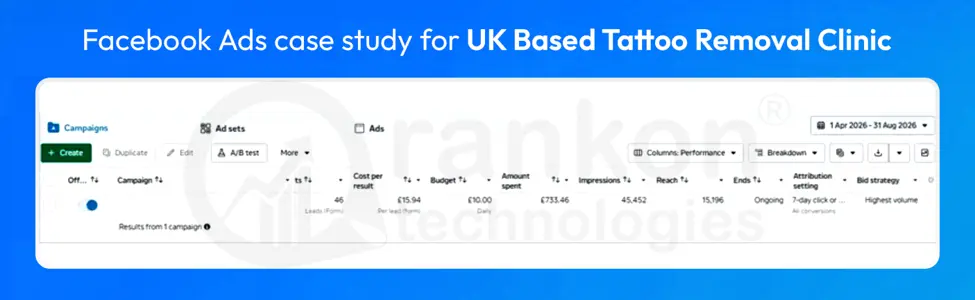
The agency account is billed in Indian rupees, and its rows cover 5 Aug 2023 to 5 Sep 2026, so they show lifetime totals for each campaign and not one month.
The table lists the eight campaigns with a clearly shown result type.
Result type | Results | Cost per result | Amount spent | Reach | Link clicks | Link click CTR |
Messaging conversations | 86 | ₹101.06 | ₹8,691.28 | 134,188 | 1,323 | 0.45% |
Messaging conversations | 72 | ₹70.29 | ₹5,060.68 | 85,118 | 738 | 0.47% |
Leads (form) | 48 | ₹184.54 | ₹8,857.83 | 37,836 | 393 | 0.51% |
Messaging conversations | 31 | ₹71.01 | ₹2,201.36 | 86,635 | 605 | 0.53% |
Leads (form) | 29 | ₹54.19 | ₹1,571.57 | 4,219 | 62 | 1.19% |
Leads (form) | 27 | ₹144.78 | ₹3,909.16 | 9,878 | 146 | 0.74% |
Leads (form) | 25 | ₹257.43 | ₹6,435.70 | 23,332 | 151 | 0.38% |
Leads (form) | 23 | ₹157.68 | ₹3,626.63 | 7,776 | 71 | 0.40% |
Meta Ads Manager, digital marketing agency account, 5 Aug 2023 to 5 Sep 2026.👇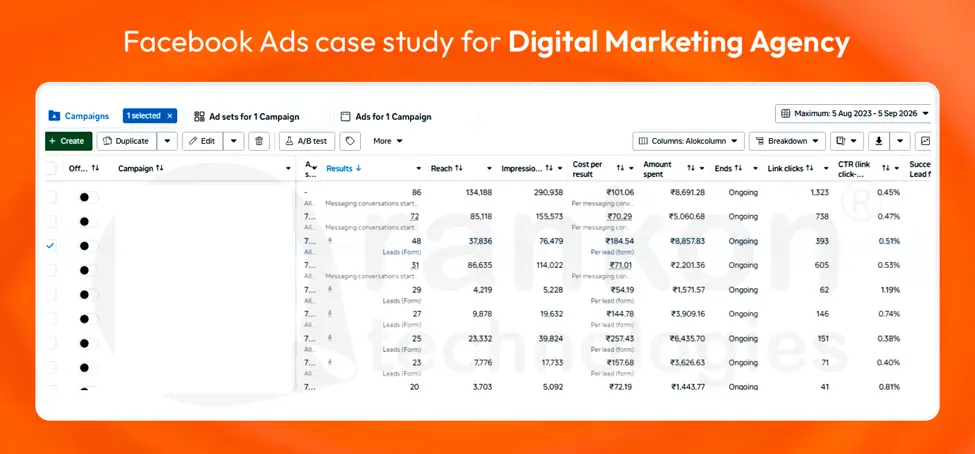
The public Facebook benchmark for cost per lead is $27.66 (LocaliQ data, US advertisers).
Our UK clinic lead cost was £15.94, and our agency lead costs ranged from ₹54.19 to ₹257.43. The spread inside one account is the real lesson. Creative, offer and audience decide Facebook results, so you must keep testing them.
What can we say, and what can we not say?
This data supports a clear but careful message. It shows how our campaigns performed. It does not prove that one platform is better than the other.
What the data shows | What the data does not show |
| Local appointment businesses can get conversions at a low cost on Google Search and Performance Max | That Google Ads beats Facebook Ads in general |
| Facebook lead forms can bring leads at a reasonable cost for a UK clinic | That the same cost will repeat for another business |
| Cost per result changes a lot between campaigns in the same account | Revenue, profit or return on ad spend |
| Campaign type and bidding setup affect cost per conversion | Whether every conversion became a paying customer |
For more on how we approach paid search, see our Google Ads case study for a dental clinic, our Google Ads case study for a skin clinic and all our case studies.
Which platform gives better results?
Google Ads usually gives faster, higher-intent leads, and Facebook Ads usually gives wider reach and cheaper first contact. Better depends on your goal.
In the Facebook Ads vs Google Ads results debate, intent explains most of the gap. Google traffic starts with a search, so the visitor already has a problem. That often means more calls and form fills from people ready to talk. Facebook traffic starts with an interruption, so your ad must earn attention first.
Because of this, each platform fits a different step of the buying journey.
Buying stage | What the customer thinks | Better platform |
Awareness | I did not know this existed | Facebook Ads |
Interest | This looks useful | Facebook Ads |
Consideration | Which option is best? | Both |
Decision | I want to buy or call now | Google Ads |
Return visit | I want more from this brand | Facebook retargeting |
Facebook leads are often less ready, so quick follow-up matters. A phone call or WhatsApp message within minutes can turn a curious lead into a buyer. A slow reply can lose the same lead to a competitor.
How does automation change the choice?
Facebook Ads vs Google Ads now includes a third factor, automation. Both platforms use it, so your data matters more than your manual settings. Good tracking and good creative feed the automation, and the automation then finds buyers.
Tool | Platform | What it does | What you control |
Performance Max | Runs one campaign across Search, YouTube, Shopping, Display, Maps, Gmail and Discover | Goals, creative, audience signals, budget | |
AI Max for Search | Widens the searches your ads can match | Negative keywords, brand settings, budget | |
Advantage+ | Meta | Picks audiences, placements and budget split | Creative, offer, budget |
Automation has limits. Independent tests of AI Max have shown mixed results, so review your search terms often. Performance Max shows less detail about where your ads ran, so check your conversion reports with care. In both cases, your offer, landing page and tracking decide the result, and AI cannot fix a weak page.
Meta also uses a learning phase, where the system tests your ad before it settles on a delivery pattern.
Platform rule of thumb | Value | Source note |
| Optimization events an ad set needs per week to leave learning | About 50 | Meta guidance. Please confirm in Meta Business Help Center before publishing. |
A tiny budget with rare conversions can stay stuck in learning. That is one more reason to choose a platform that matches your buyers.
Which platform fits your type of business?
Match the platform to how your customers buy. The table below is our suggested starting point, not a fixed rule.
Business type | Start with | Reason | Watch out for |
| Local services (plumber, dentist, lawyer) | Google Ads | Customers search when they need help | High click costs in busy cities |
| Online store with visual products | Facebook Ads, then Google Shopping | Photos and video sell the product | Rising costs near the holidays |
| B2B or software | Google Ads, plus Facebook for free guides | Buyers research problems on Google | Long sales cycles |
| New brand or new product | Facebook Ads | No search demand exists yet | Needs strong creative |
| Restaurants and events | Facebook Ads, plus Google Business Profile | Local offers suit social feeds | Short offer windows |
| Courses and coaching | Facebook Ads for leads, Google for brand search | Interest builds before people search | Lead quality varies |
Your website matters as much as your ads. A weak page wastes good clicks on any platform.
If you sell products online, see our e-commerce development and Shopify website development pages.
And if you run a local service, look at our plumber website development or law firm website development pages.
Should You Choose Facebook Ads vs Google Ads for a Small Business?
For Facebook Ads vs Google Ads in a small business, spend first where buyers already want your offer. That wastes the least money.
Picture a local plumber with a small monthly budget. A homeowner with a burst pipe searches Google and calls the first good result, so Google Ads fits. Now picture a new handmade candle brand. Nobody searches for it yet, so Facebook and Instagram can show the product to people who would love it.
Small budgets cannot afford to teach the whole market. If you are unsure, ask one question: would a stranger type my offer into a search box? If yes, start with Google. If no, start with Facebook.
Small business question | If yes | If no |
| Do people search for my offer? | Start with Google Ads | Start with Facebook Ads |
| Is my product easy to show in a photo or video? | Facebook and Instagram help | Google Search may fit better |
| Do I need leads this week? | Google Ads is usually faster | Facebook needs a learning period |
| Do I have strong images or video? | Facebook Ads can work well | Fix creative before you spend |
If you want help with the Meta side, our Facebook marketing and Instagram marketing services cover ad setup and creative. For small business websites, see our small business website development page.
Should you use both Facebook Ads and Google Ads?
Yes, you can use both once one platform works and you want to grow. Facebook creates demand and Google captures it.
Using Facebook Ads vs Google Ads together is common for this reason. Look at how one customer can move between the two.
Step | What happens | Platform |
1 | A video reaches a new customer | Facebook or Instagram |
2 | She visits your site but does not buy | Your website |
3 | A reminder ad brings her back | Facebook retargeting |
4 | She searches your brand name | Google Search |
5 | She clicks your search ad and buys | Google Ads |
Both platforms helped, but each one will try to claim the credit. Check the real result in Google Analytics 4 and in your own sales records. Do not trust only the numbers inside each ad platform.
When you start using both, a simple budget split gives you a test to learn from. This is our suggestion and not an official rule, so adjust it with your own data.
| Budget split to test (our suggestion) | Main platform | Second platform |
| Starting split | 70% | 30% |
| After the main platform works well | 60% | 40% |
| After both are clearly profitable | Move money to whichever gives the lower cost per customer |
How do you track results the right way?
In Facebook Ads vs Google Ads, track real customers and not only clicks. Without good tracking, both platforms learn from bad data and waste your money.
Tool | What it measures | Where it helps |
Google Analytics 4 | Visits, events and conversions on your site | Compare both platforms in one place |
Google Ads conversion tracking | Calls, forms and sales from Google ads | Feeds Google automation |
Meta Pixel | Actions on your site after a Facebook or Instagram ad | Feeds Meta automation |
Conversions API | Sends sales data from your server to Meta | Fills gaps when browsers block tracking |
Your own CRM or sales sheet | Which leads became paying customers | The final truth for your results |
Set this up before you spend on ads. A few hours of tracking work saves weeks of guessing.
Our Google Ads management services start with tracking for this reason.
How do you test the two platforms fairly?
A fair test uses the same offer, the same landing page and the same budget on both platforms. Then you compare cost per customer.
How to Run a Facebook Ads vs Google Ads Test Step by Step
Run your Facebook Ads vs Google Ads test with equal budgets and one clear goal. Compare cost per lead or sale, never clicks alone.
- Set your number. Work out the most you can pay for one customer and still make a profit.
- Fix tracking first. Install the Google tag and connect Google Analytics 4. On Meta, set up the Meta Pixel and the Conversions API.
- Pick one offer and one landing page. Use the same page on both platforms so the test stays fair.
- Split the budget evenly. Run both for the same dates.
- Count qualified leads, not clicks. Ask your sales team which leads were real buyers.
- Follow up fast. Call or message new leads within minutes, because slow replies waste good traffic.
- Keep the winner. Then test the other platform again with new ads or keywords.
| Test timeline (practical guideline, not a promise) | Time |
| Setup and tracking check | 2 to 3 days |
| Test run on both platforms | 2 to 4 weeks |
| Review and decision | 1 to 2 days |
| Second round with new ads | 2 to 4 weeks |
Which mistakes waste the most ad budget?
The most expensive Facebook Ads vs Google Ads mistake is judging a platform by cost per click. Cheap clicks that never buy are the costliest clicks.
Mistake | Why it hurts | Fix |
| No tracking | Automation cannot learn from sales | Set up tracking before launch |
| Sending traffic to the home page | Visitors get lost | Use a page built for one offer |
| One ad for everything | Facebook ads tire out quickly | Refresh creative often |
| Ignoring search terms | You pay for the wrong searches | Review search terms and add negative keywords |
| Quitting too early | Meta needs time to learn | Judge after enough data |
| Slow lead follow-up | Leads go cold within hours | Reply in minutes |
Do ads replace SEO?
No, ads and SEO do different jobs, and they work best together. Ads give fast traffic that stops when you stop paying, while SEO builds visibility that lasts.
Paid ads help you test an offer quickly. SEO then brings steady visitors for each keyword you win. Search engines and AI tools also read your content, so strong pages help both. Learn more in our SEO services, our local SEO services and our AI SEO guide to AEO, GEO and AI search.
How can RankON Technologies help?
RankON Technologies is a digital marketing company in India. We are a Google Partner, and our services cover SEO, Google Ads and PPC, social media marketing, website design and development, and online reputation management. We serve clients in India and in markets such as the US, UK, Canada, Australia, UAE and Singapore.
What we can help with | Service page |
| Google Ads setup and management | Google Ads management |
| Full paid search and PPC strategy | PPC services |
| Facebook and Instagram ad campaigns | Facebook marketing and Instagram marketing |
| Landing pages that turn clicks into leads | Website development |
| Plans and pricing options | PPC packages and SMM packages |
Our team sets up conversion tracking first. We then build campaigns around your cost-per-customer goal and report on leads and sales, not only clicks. We do not promise fixed results, because ad costs and competition change. You can read our client reviews or request a proposal to talk about your goals.
Final Thoughts
Facebook Ads vs Google Ads is not a fight, because each platform does a different job. Google answers people who are searching. Facebook introduces your business to people who are not.
If buyers already search for you, start with Google Ads. If they do not, start with Facebook Ads. Then fix your tracking, measure cost per customer, and add the second platform when the first one pays for itself. A small, clean test beats a large, blind budget every time.
Ready to pick the right platform for your business? Contact RankON Technologies for a free consultation, or explore our digital marketing services.
FAQs About Google Ads Vs Facebook Ads
Is Facebook Ads or Google Ads better for a small business?
In Facebook Ads vs Google Ads, neither is better for every small business. Choose Google Ads if customers search for your service, and Facebook Ads if you must create interest first. A local repair shop usually starts on Google, while a new boutique usually starts on Instagram and Facebook.
Which is cheaper, Facebook Ads or Google Ads?
In Facebook Ads vs Google Ads cost, Facebook is cheaper per click. Reports put Facebook clicks at about $0.70 to $1.92 and Google clicks at about $5.42. Google can still cost less per sale when its visitors are ready to buy, so compare cost per customer.
Which gets more leads, Facebook Ads or Google Ads?
Facebook often brings more leads at a lower price, while Google often brings leads that are ready sooner. More leads do not always mean more sales. Track how many leads turn into customers.
Can I run Facebook Ads and Google Ads together?
Yes. In Facebook Ads vs Google Ads, many businesses use both: Facebook to build interest and Google to capture people who search later. Use Google Analytics 4 and your sales records to see which platform really earned the sale.
Are Facebook Ads and Instagram Ads the same thing?
They run on the same system. You buy both through Meta Ads Manager, and one campaign can show on Facebook, Instagram and Messenger.
How much budget do I need to start?
Both platforms let you start small, but a very small budget gives too little data. Meta guidance says an ad set needs about 50 optimization events a week to leave the learning phase. Choose a budget that can produce enough conversions to judge.
How long before I see results?
Google Search ads can bring clicks within days. Facebook campaigns need a learning period, so give both about two to four weeks before you decide. This is a practical guideline, not a promise.
Do I still need SEO if I run ads?
Yes. Ads stop bringing traffic when you stop paying, while SEO keeps building visibility over time. Many businesses use ads for fast tests and SEO for steady growth.
Should I hire an agency to run these ads?
Hire help if you lack time to manage tracking, creative and weekly optimization. An agency should show you reports on leads and sales and explain its fees clearly. Ask for access to your own ad accounts so you always own your data.