
How much should you actually spend on PPC advertising in India? It is a question I hear from businesses that want faster leads, more inquiries, or online sales but are unsure how much budget they need to get started.
The confusion usually begins when businesses receive a PPC proposal. One agency quotes a monthly management fee, another offers a package, and a third recommends a percentage of the advertising budget. On top of that, there is the money you need to pay Google, Meta, or another advertising platform.
These are different expenses, and understanding them is essential before you commit to a campaign.
In my experience, the cost of PPC services depends less on a fixed industry rate and more on what the business expects the agency to manage. A single-location lead generation campaign requires a different level of work from a multi-platform campaign covering several cities, products, or customer segments.
So, how much do PPC services cost in India? At RankON Technologies, our PPC management plans range from ₹20,000 to ₹45,000 per month, depending on the plan. This management fee is separate from the advertising budget paid to the platforms.
However, the management fee is only one part of your total investment. In this guide, I will explain how PPC pricing works, what affects agency charges, which additional expenses to consider, and how to determine a budget that makes commercial sense for your business.
How Much Do PPC Services Cost in India?
PPC service costs in India generally depend on campaign complexity, advertising platforms, the number of campaigns, monthly ad spend, and the level of management required.
To understand the pricing, separate your investment into three categories:
- PPC management fee: The amount paid to an agency or freelancer for planning, managing, and optimizing campaigns.
- Advertising spend: The amount paid directly to platforms such as Google Ads, Meta Ads, or LinkedIn Ads to display advertisements.
- Additional campaign expenses: Costs related to landing pages, creative production, tracking implementation, tools, and other campaign requirements.
Here is how these expenses fit together:
| Cost component | What it covers |
| Agency management fee | Strategy, research, campaign setup, optimization, and reporting |
| Advertising spend | Clicks, impressions, leads, or other paid campaign activity |
| Creative production | Ad banners, images, videos, and other campaign assets |
| Landing page development | Pages designed to convert paid visitors into leads or customers |
| Tracking and analytics | Conversion tracking, analytics setup, and reporting integrations |
| Other tools | Call tracking, CRM integrations, or specialist software, where required |
For example, a business paying ₹25,000 per month for PPC management and allocating ₹50,000 to advertising has a minimum monthly campaign investment of ₹75,000, before any additional production or technology expenses.
This distinction matters because an agency’s management fee does not automatically include the advertising budget.
What Is Included in PPC Management Fees?
When you hire a PPC agency, you are not simply paying someone to create advertisements. You are paying for the planning, technical setup, monitoring, and ongoing decisions that influence how effectively your advertising budget is used.
The exact scope varies between agencies, but a comprehensive PPC management engagement may include the following activities.
1. Campaign Strategy and Business Research
Before launching advertisements, an agency needs to understand your business, products, services, customers, and competition. This research helps determine which advertising platforms, campaign types, and targeting methods are best suited to your objectives.
For example, a local dental clinic may benefit from location-specific search campaigns, while an eCommerce brand may need a combination of Shopping, Search, and remarketing campaigns. The strategy should reflect how customers discover and purchase the product or service.
2. Keyword and Audience Research
Keyword research helps identify what potential customers search for before making a purchase or making an inquiry. It also helps separate high-intent searches from queries that are unlikely to generate business.
Audience research serves a different purpose on platforms such as Meta and LinkedIn. It identifies relevant customer segments based on factors such as location, professional characteristics, interests, and previous interactions.
The depth of this research can influence the management cost, particularly when a business targets multiple customer groups or markets.
3. Campaign Setup and Ad Creation
Campaign setup involves selecting the right campaign objectives, organizing ad groups or audience segments, setting targeting parameters, defining budgets, and preparing advertisements.
The work may include:
- Creating search campaigns and organizing relevant keywords.
- Developing ad headlines, descriptions, and calls to action.
- Preparing display banners, video advertisements, or social media creatives.
- Configuring geographic, demographic, and device targeting.
- Setting bidding strategies and campaign schedules.
A campaign with multiple products, locations, and advertising formats usually requires more planning and execution than a basic single-campaign setup.
4. Conversion Tracking and Analytics
Tracking is one of the most important parts of PPC management because clicks alone do not tell you whether advertising is generating business.
Depending on the campaign, tracking may include form submissions, phone calls, purchases, bookings, qualified leads, and other meaningful actions.
An agency may need to configure Google Tag Manager, Google Analytics 4, platform pixels, conversion APIs, or CRM integrations. The complexity depends on the website, existing tracking infrastructure, and business requirements.
5. Ongoing Optimization
Campaign management does not end once advertisements go live. Performance needs to be reviewed regularly to identify where the budget is being spent and whether that spending is producing meaningful results.
Optimization can involve:
- Reviewing search terms and excluding irrelevant queries.
- Testing different advertisements and creative formats.
- Adjusting bids, budgets, and audience targeting.
- Reviewing device, location, and placement performance.
- Improving landing-page relevance and conversion rates.
- Evaluating lead quality and cost per acquisition.
This ongoing work is a major part of the management fee. An agency that only launches campaigns and sends monthly reports is not providing the same level of management as one that actively improves performance.
What Factors Affect PPC Agency Charges in India?
Two businesses can approach the same agency and receive different quotations. That does not necessarily mean one is being overcharged. The work involved may differ significantly.
Here are the main factors that influence PPC management costs.
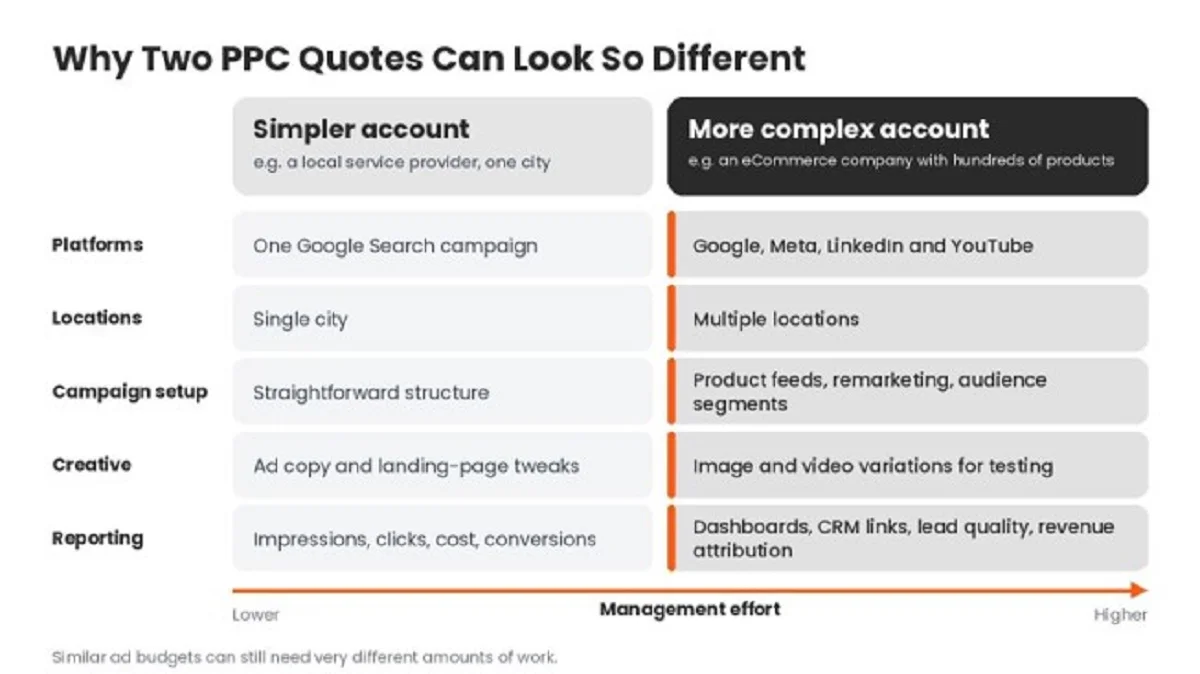
1. Number of Advertising Platforms
Managing one Google Search campaign is different from coordinating campaigns across Google, Meta, LinkedIn, and YouTube.
Each platform has its own campaign structure, targeting options, creative requirements, reporting systems, and optimization considerations. Managing multiple platforms also requires the agency to coordinate budgets and evaluate how each channel contributes to the overall customer journey.
If you are deciding where to allocate your advertising budget, read our guide on Facebook Ads vs. Google Ads. It explains how the two platforms differ in terms of audience intent, campaign objectives, and cost considerations.
2. Monthly Advertising Spend
Some agencies charge a fixed monthly fee, while others calculate their management fee as a percentage of advertising spend.
In a percentage-based model, the management fee increases as the advertising budget grows. This can be suitable for large accounts requiring substantial campaign oversight, but it may become expensive for businesses with smaller budgets.
A fixed monthly fee offers more predictable costs. However, you should check whether the agency’s scope remains sufficient as your campaigns expand.
3. Campaign Complexity
Campaign complexity is not determined by the advertising budget alone.
Consider two businesses:
- A local service provider running one campaign in a single city may have a relatively straightforward setup.
- An eCommerce company advertising hundreds of products across multiple locations may need product feed management, audience segmentation, remarketing, multiple campaign types, and more extensive reporting.
Even if both businesses have similar advertising budgets, the second account may require considerably more management time.
4. Industry Competition and Target Location
Advertising in a competitive market can require more research, testing, and budget management.
For instance, businesses operating in legal services, finance, healthcare, and real estate may compete with several advertisers for the same audience or search queries. Campaigns targeting major metropolitan areas may also require a different approach from those targeting smaller cities.
The agency’s management fee may increase when the work involves multiple locations, specialized audiences, extensive competitor analysis, or more frequent optimization.
5. Creative and Landing Page Requirements
An advertisement needs more than an attractive headline. Its message, visual presentation, and landing-page experience must work together.
A business running search advertisements may primarily need ad copy and landing page improvements. A brand running Meta or YouTube campaigns may need multiple image and video variations for testing.
If the agency is responsible for producing these assets, the additional creative workload may affect the quotation.
6. Reporting and Conversion Requirements
Basic campaign reporting may include impressions, clicks, cost, and conversions. Businesses with more advanced reporting requirements may need dashboards, CRM integrations, lead-quality analysis, and revenue attribution.
For example, a B2B company may want to know how many inquiries became qualified opportunities and how many eventually converted into customers. This requires more than checking the number of form submissions inside an advertising platform.
The more detailed the reporting requirements, the more work may be involved.
Common PPC Pricing Models Used by Agencies
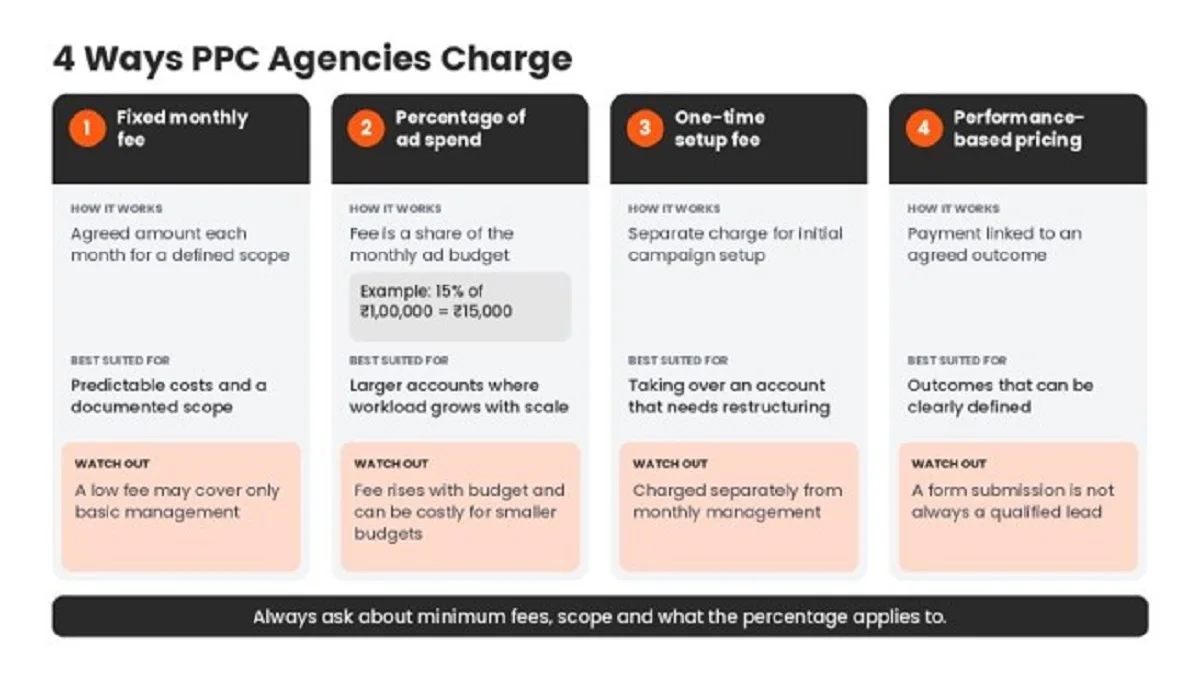
PPC agencies generally use a few common pricing models. Each has its advantages, but the right choice depends on your advertising requirements and the level of support you expect.
1. Fixed Monthly Management Fee
Under this model, you pay a fixed monthly fee for a defined set of PPC management activities.
It is suitable for businesses that want predictable monthly expenses and a clearly documented scope of work.
Before accepting a fixed-fee proposal, check how many campaigns, platforms, locations, and optimization activities are included. A low monthly fee may cover only basic management, while a more comprehensive engagement may include tracking, creative testing and detailed reporting.
2. Percentage of Advertising Spend
In this model, the agency charges a percentage of the monthly advertising budget.
For example, if an agency charges 15% of a ₹1,00,000 advertising budget, the management fee would be ₹15,000.
This model can work for larger advertising accounts, particularly when the agency’s workload grows with campaign scale. However, the percentage alone does not explain the quality or scope of the service.
Ask whether there is a minimum monthly fee and whether the percentage applies to the total media spend across all platforms.
3. One-Time Setup Fee
Some agencies charge a separate fee for initial campaign setup.
This may cover account audits, campaign structure, keyword research, conversion tracking, audience configuration, and initial ad creation.
A setup fee is particularly relevant when an agency is taking over an existing account that needs restructuring or when a new campaign requires substantial technical work.
4. Performance-Based Pricing
Under performance-based pricing, the agency’s payment is linked to an agreed outcome, such as qualified leads, sales, or revenue.
Although this model may sound attractive, the definition of a successful result must be clear. For example, a form submission is not necessarily a qualified lead, and a qualified lead is not automatically a paying customer.
Before agreeing to performance-based pricing, define the attribution method, lead validation process, reporting responsibilities, and payment conditions.
How Much Should You Budget for PPC Advertising?
Your PPC budget should be based on the business outcome you want to achieve, not simply on what competitors appear to be spending.
A practical starting point is to work backward from your target customer acquisition cost.
Consider this illustrative example:
A business wants to acquire 20 new customers every month. It estimates that 20% of its qualified leads become paying customers.
That means it needs approximately 100 qualified leads to reach its monthly customer target.
If the business can afford to spend ₹1,000 to acquire one qualified lead, its required advertising budget would be:
100 qualified leads × ₹1,000 = ₹1,00,000 in monthly ad spend
This is an example, not an industry benchmark or a guarantee of campaign performance.
The actual cost per lead will depend on the industry, offer, competition, targeting, landing page, and conversion rate.
How Much Do PPC Services Cost at RankON Technologies?
At RankON Technologies, we offer PPC management plans based on business size and campaign requirements.
Our plans are:
| PPC plan | Monthly management fee |
| Basic PPC Plan | ₹20,000 |
| Advanced PPC Plan | ₹30,000 |
| Enterprise PPC Plan | ₹45,000 |
These are management fees, not advertising budgets. The amount paid to Google, Meta, or another advertising platform is separate.
The plans differ in campaign scope, including the number of campaigns, ad groups, keyword coverage, and reporting requirements. They also include activities such as competitor analysis, keyword optimization, ad copy optimization, conversion tracking, and ROI analysis, depending on the selected plan.
However, standard packages may not cover every business requirement. A company managing multiple markets, complex product feeds, extensive creative production, or advanced CRM integrations may need a customized proposal.
We recommend evaluating a PPC plan based on the actual work included rather than choosing an agency solely for the lowest monthly fee.
How Can You Evaluate Whether Your PPC Investment Is Worth It?
A low management fee does not automatically mean better value. Similarly, a large advertising budget does not guarantee better results.
The right way to evaluate a PPC engagement is to look at what the campaign contributes to your business.
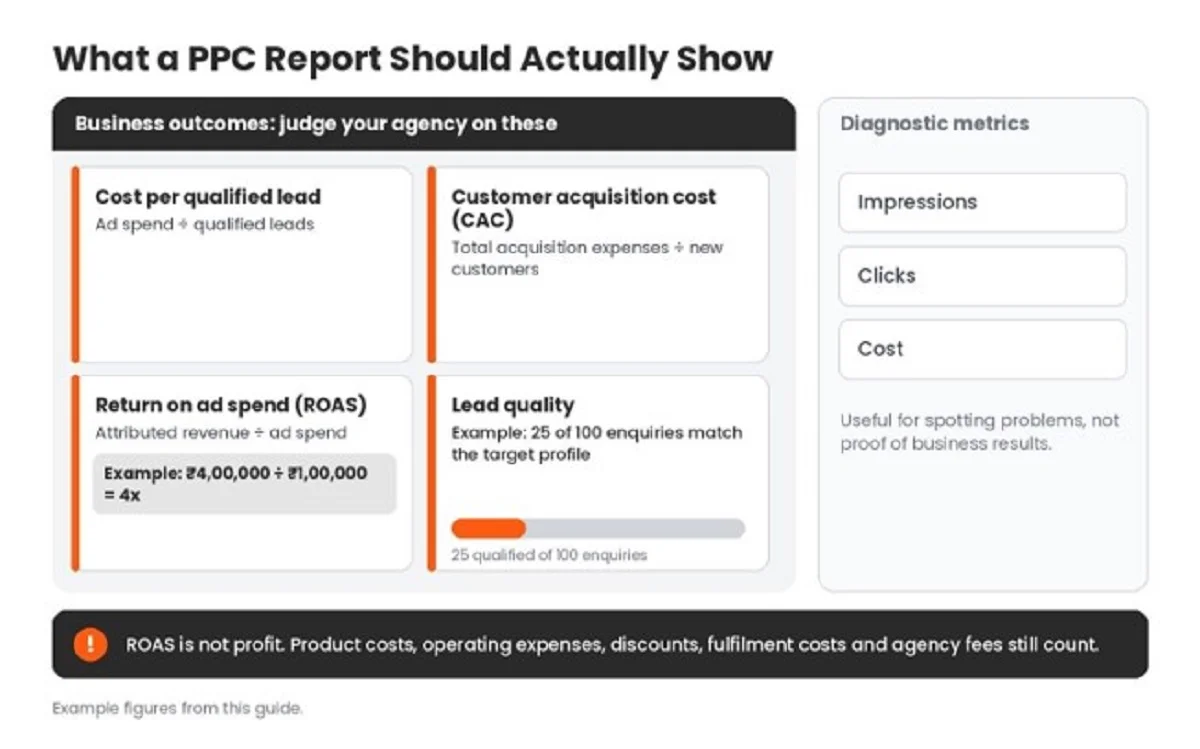
1. Measure Cost Per Qualified Lead
A campaign may generate a large number of inquiries, but not every inquiry will be relevant to your business.
For example, a B2B company may receive 100 inquiries but find that only 25 match its target customer profile. Measuring the cost per qualified lead provides a more useful picture than measuring the cost per form submission alone.
2. Track Customer Acquisition Cost
Customer acquisition cost (CAC) measures how much your business spends to acquire a new customer.
CAC = Total acquisition expenses ÷ Number of new customers acquired
Include relevant advertising and acquisition costs when calculating the figure. If you are evaluating an agency relationship, also account for the management fee.
3. Evaluate Revenue and Return on Ad Spend
Return on ad spend (ROAS) compares the revenue attributed to advertising with the amount spent on advertising.
ROAS = Advertising-attributed revenue ÷ Advertising spend
For example, if a campaign generates ₹4,00,000 in attributed revenue from ₹1,00,000 in ad spend, the ROAS is 4x.
However, ROAS is not the same as profit. Product costs, operating expenses, discounts, fulfillment costs, and agency fees still need to be considered.
4. Check Lead Quality and Sales Conversion
For businesses that depend on inquiries, campaign performance should be evaluated alongside the sales team’s feedback.
If advertisements generate inquiries but few convert into customers, the issue may lie in audience targeting, offer positioning, lead qualification, response time, or the sales process.
A good PPC partner should be willing to examine these factors rather than focus solely on the advertising platform’s reported conversions.
How to Avoid Paying More Than Necessary for PPC Services
Choosing the right agency is not about negotiating the lowest possible price. It is about making sure that the work being charged for has a clear purpose.
Here are a few things I recommend checking before signing a PPC agreement.
Ask for a Detailed Scope of Work
The proposal should explain which platforms, campaigns, and activities are included. It should also clarify whether the agency will handle ad copy, creative development, tracking, landing-page recommendations, and reporting.
A detailed scope reduces the possibility of unexpected charges later.
Keep Advertising Spend Separate
Ask the agency to clearly distinguish its management fee from the media budget.
Ideally, advertising accounts should remain under your business ownership, with appropriate access provided to the agency. This gives you visibility into actual platform spending and campaign performance.
Understand the Reporting Frequency
Monthly reporting is useful, but the report should explain what happened and what the agency plans to improve.
A meaningful report should connect campaign activity with business outcomes. It should not simply list impressions, clicks, and expenditure without explaining their relevance.
Check What Happens When You Increase Your Budget
A proposal should explain whether the management fee changes when advertising spend increases or when you add another platform, campaign, or location.
This is particularly important for businesses planning to scale. You should understand the commercial arrangement before increasing your investment.
Be Careful With Guaranteed Results
No agency can guarantee a fixed number of leads, sales, or a particular return on advertising. Campaign performance depends on several factors, including competition, market demand, website experience, pricing, and the quality of the offer.
An experienced agency should explain its strategy, measurement process, and optimization approach rather than promise unrealistic outcomes.
For more practical guidance, read our article on common Google Ads campaign mistakes, which explains how issues with tracking, targeting, and landing pages can affect campaign performance.
Why Choose RankON Technologies for PPC Management?
At RankON Technologies, we approach PPC as an ongoing performance activity rather than a one-time campaign setup.
Our work begins with understanding the business, its customers, and its commercial objectives. We then develop a campaign strategy around the platforms and advertising formats most relevant to those goals.
Our PPC management approach includes:
- Research-led planning: We evaluate business objectives, audience intent, competitors, and market opportunities before building campaigns.
- Campaign setup: We structure campaigns, prepare advertisements, and configure targeting and budgets in line with the agreed strategy.
- Conversion tracking: We focus on measuring meaningful actions so that campaign decisions are based on more than clicks and impressions.
- Continuous optimization: We review performance and make adjustments to improve targeting, ad relevance, conversion rates, and cost efficiency.
- Transparent reporting: We help businesses understand where their advertising budget is going and what the campaign data indicates.
Our experience includes managing campaigns for businesses across industries such as healthcare, legal services, education, automotive, hospitality, and eCommerce.
For example, one of our US-based dental clinic campaigns reported 91 conversions, while a UK skin clinic campaign improved its conversion rate from 3.6% to 11.40%. These results reflect individual campaign outcomes and should not be treated as guaranteed benchmarks for other businesses.
Our objective is to build PPC campaigns around measurable business requirements, with clear reporting and an optimization process that can adapt as those requirements change.
If you are evaluating PPC services for your business, the first step should be understanding your goals, expected customer acquisition cost, and available budget. From there, we can help identify a suitable campaign structure and management approach.
Final Thoughts
The cost of PPC services in India is not determined by a fixed industry rate. It depends on how much work your campaigns require, which platforms you use, the complexity of your targeting, and the level of management and reporting you expect.
Before choosing an agency, calculate your total investment by separating the management fee, advertising spend, and additional campaign expenses. Then evaluate the proposal based on its scope, tracking capabilities, optimization process, and relevance to your business goals.
At RankON Technologies, our PPC management plans start at ₹20,000 per month, excluding advertising spend. Whether you are a startup testing paid advertising or an established business looking to scale, the right approach begins with a realistic budget and a strategy built around measurable outcomes.
Looking to understand what PPC management could cost for your business? Connect with RankON Technologies to discuss your campaign requirements and get a proposal aligned with your goals.
FAQs About PPC Services Cost in India
1. How much do PPC services cost in India?
PPC management costs depend on the agency, campaign scope, advertising platforms, and level of ongoing support. At RankON Technologies, published standard PPC management plans range from ₹20,000 to ₹45,000 per month. Advertising spend is charged separately.
2. Is PPC management cost included in the advertising budget?
Not necessarily. Most agency arrangements separate the management fee from the advertising budget. The management fee covers campaign strategy, setup, optimization, and reporting, while the advertising budget is paid to the platform that displays your advertisements.
3. What is a reasonable starting budget for PPC advertising?
There is no universal starting budget for every business. It depends on your industry, target location, competition, average customer value, and expected conversion rate. Start by estimating how much you can afford to spend to acquire a qualified lead or customer.
4. Do PPC agencies charge a percentage of ad spend?
Some agencies charge a percentage of monthly advertising spend, while others use fixed monthly fees or customized pricing. Compare the scope of work and minimum fees before choosing a pricing model.
5. Which factors increase PPC management costs?
Multiple advertising platforms, complex campaign structures, multiple target locations, creative production, advanced conversion tracking, and detailed reporting requirements can increase the workload and affect management fees.
6. Is hiring a PPC agency better than managing campaigns in-house?
It depends on your internal expertise, available time, and campaign requirements. An in-house team may be suitable if you have experienced specialists and sufficient resources. An agency can provide access to a broader range of campaign management and optimization skills without the need to build an entire internal team.
7. Does a higher PPC management fee guarantee better results?
No. A higher fee does not guarantee more leads, sales, or better ROAS. Evaluate the agency’s experience, strategy, scope of work, tracking process, and reporting standards instead of relying on price alone.
8. Are landing pages included in PPC management fees?
It depends on the agency’s proposal. Some agencies include landing-page recommendations or basic optimization, while custom design and development may be charged separately. Always confirm what is included before signing an agreement.
9. How long does it take to see results from PPC campaigns?
Campaigns can start generating traffic shortly after launch, but meaningful performance evaluation requires sufficient data. The time needed depends on the campaign objective, conversion volume, sales cycle, competition, and budget.
10. Can a small business afford PPC advertising?
Yes. A small business can start with a focused campaign targeting a specific service, location, or customer group. The important part is choosing a realistic budget and tracking whether the inquiries generated are commercially valuable.
Written by:
Anand Kumar T.
I’m Anand, Founder and Director at RankON Technologies. Drawing on my experience in the digital marketing industry, I share practical insights, strategies, and perspectives to help businesses enhance their online presence and make informed digital marketing decisions. My focus is on creating informative, value-driven content that addresses real business challenges, explains evolving digital trends, and helps readers understand how effective digital marketing strategies can support sustainable growth. Through my articles, I aim to share actionable insights that empower businesses to navigate the evolving digital landscape with greater confidence.