

One of the first questions business owners ask me before investing in online advertising is, “How much does digital marketing cost in India?”
My answer is straightforward: it depends on what you want to achieve, how competitive your industry is, and how much work is required to get results.
A local service business trying to generate inquiries in one city has very different requirements from an eCommerce brand targeting customers across India. Similarly, a company that needs Google Ads management will have a different budget than a business investing in SEO, social media marketing, content creation, and paid advertising.
I have seen how important budget allocation, conversion tracking, keyword targeting, and continuous campaign optimization are to paid advertising performance. As a Google Ads-certified specialist at RankON Technologies, I have managed more than $600,000 in advertising spend.
This experience has reinforced an important principle for me: spending more on digital marketing does not automatically lead to better results. What matters is how effectively that money is invested.
In this guide:
I will break down digital marketing costs in India for 2026, explain the pricing of individual services, compare agency and freelancer costs, and show you how to determine a realistic budget for your business.
My goal is to help you understand what you should pay, what you should expect in return, and how to choose a digital marketing package that supports your business objectives.
RankON Technologie’s Digital Marketing Packages in India
Choose the right digital marketing package based on your business size and marketing goals. We offer three flexible monthly packages designed for startups, growing businesses, and enterprise brands.
Here is Quick Table:
Category | Package Name | Price | Billing |
|---|---|---|---|
Best for Startups | Startup Digital Marketing Package | 1,500 USD | Monthly |
Best for Growing Businesses | Established Business Digital Marketing Package | 2,500 USD | Monthly |
| Best for Enterprise Brands | Enterprise Digital Marketing Package | 3,500 USD | Monthly |
Our Digital Marketing Packages
How Much Does Digital Marketing Cost in India in 2026?
Digital marketing services in India can cost anywhere from ₹10,000 per month for limited, single-channel support to several lakh rupees per month for comprehensive campaigns.
For planning purposes, I recommend looking at the following indicative ranges. These are budgeting estimates, not fixed industry-wide rates, and the actual cost depends on the agency, scope, competition, and deliverables.
Published digital marketing pricing guides show considerable variation between entry-level packages and more comprehensive marketing programs.
Average Digital Marketing Cost in India by Business Size
| Business Type | Indicative Monthly Budget | Recommended Approach |
| Small local business | ₹15,000–₹40,000 | Focus on local SEO, Google Business Profile, or one paid advertising channel |
| Startup or new business | ₹25,000–₹60,000 | Build online visibility through SEO, targeted ads, or social media |
| Growing a small or medium business | ₹40,000–₹1,00,000 | Combine SEO, paid advertising, and conversion optimization where appropriate |
| Established business | ₹1,00,000–₹2,50,000 | Invest in multiple channels, content, remarketing, and lead generation |
| eCommerce or competitive brand | ₹1,00,000–₹5,00,000+ | Use performance marketing, shopping campaigns, SEO, creative production, and conversion optimization |
| Enterprise or multi-location company | ₹2,50,000–₹10,00,000+ | Develop integrated campaigns across locations, audiences, and marketing channels |
These figures are illustrative monthly planning budgets. They may include different combinations of agency fees, advertising spend, and production costs depending on the business. They should not be interpreted as standard agency fees or guaranteed minimum investments.
What Is Included in the Digital Marketing Budget?
Before comparing prices, I recommend separating your marketing budget into distinct categories.
Agency or freelancer fees
This is what you pay for: strategy, execution, campaign management, optimization, content production, and reporting, as outlined in your agreement.
Advertising spend
This is the money allocated to platforms such as Google Ads, Facebook, Instagram, or LinkedIn. It is generally separate from the agency’s management fee.
Website and landing page costs
You may need website development, landing page design, technical improvements, or conversion rate optimization to support your campaigns.
Content and creative production
This can include blog articles, graphics, advertising creatives, videos, product photography, and landing page copy.
Additional expenses
Depending on your campaign, you may also need marketing software, CRM integrations, email marketing tools, influencer partnerships, or other services.
For example, suppose an agency charges ₹25,000 per month to manage your Google Ads campaigns, and you allocate another ₹50,000 to advertising.
Your monthly budget would be:
| Expense | Monthly Digital Marketing Cost |
| Google Ads management | ₹25,000 |
| Advertising spend | ₹50,000 |
| Subtotal | ₹75,000 |
| GST on agency fee, if applicable, at 18% | ₹4,500 |
| Total monthly outlay | ₹79,500 |
This example assumes that the management fee is taxable at 18%, that the advertising spend is ₹50,000, and that no additional charges apply. Actual tax treatment and platform billing should be confirmed for your arrangement.
I always recommend asking an agency for a clear breakdown of its professional fees, advertising budget, taxes, and additional expenses before signing an agreement.
Digital Marketing Pricing in India by Service

Digital marketing is not a single service. It includes several disciplines, each requiring different skills, resources, and levels of ongoing work.
Below is a practical overview of the services businesses commonly purchase and their indicative pricing.
Digital Marketing Cost by Service
| Digital Marketing Service | Indicative Cost in India | Pricing Model |
| Search Engine Optimization (SEO) | ₹10,000–₹1,00,000+ | Monthly retainer or project |
| Local SEO | ₹5,000–₹30,000 | Monthly retainer |
| Google Ads management | ₹10,000–₹60,000+ | Monthly fee or percentage of ad spend |
| Social media marketing | ₹8,000–₹60,000+ | Monthly retainer |
| Meta Ads management | ₹10,000–₹40,000+ | Monthly fee or percentage of ad spend |
| Content marketing | ₹10,000–₹75,000+ | Monthly retainer or individual deliverables |
| Blog writing | ₹1,500–₹15,000+ per article | Per article |
| Email marketing | ₹5,000–₹35,000+ | Monthly retainer or project |
| Online reputation management | ₹10,000–₹40,000+ | Monthly retainer |
| Influencer marketing | ₹10,000–₹1,00,000+ | Per campaign, excluding or including creator fees as agreed |
| Website design and development | ₹15,000–₹2,00,000+ | One-time project |
| eCommerce website development | ₹40,000–₹5,00,000+ | One-time project |
| Landing page design | ₹5,000–₹50,000+ | Per page or project |
| Conversion rate optimization | ₹15,000–₹1,00,000+ | Monthly retainer or project |
| AI search optimization (GEO/AEO) | ₹10,000–₹50,000+ | Monthly retainer or project |
The ranges above are broad planning estimates, not a verified statistical survey of every Indian agency. They reflect the wide differences in scope and pricing visible in published agency rate cards and pricing guides. Actual quotes may fall outside these ranges.
Let’s examine what each service includes and when it makes sense to invest in it.
Search Engine Optimization (SEO) Cost in India
SEO helps businesses improve their organic visibility on search engines and attract people who are actively looking for their products or services.
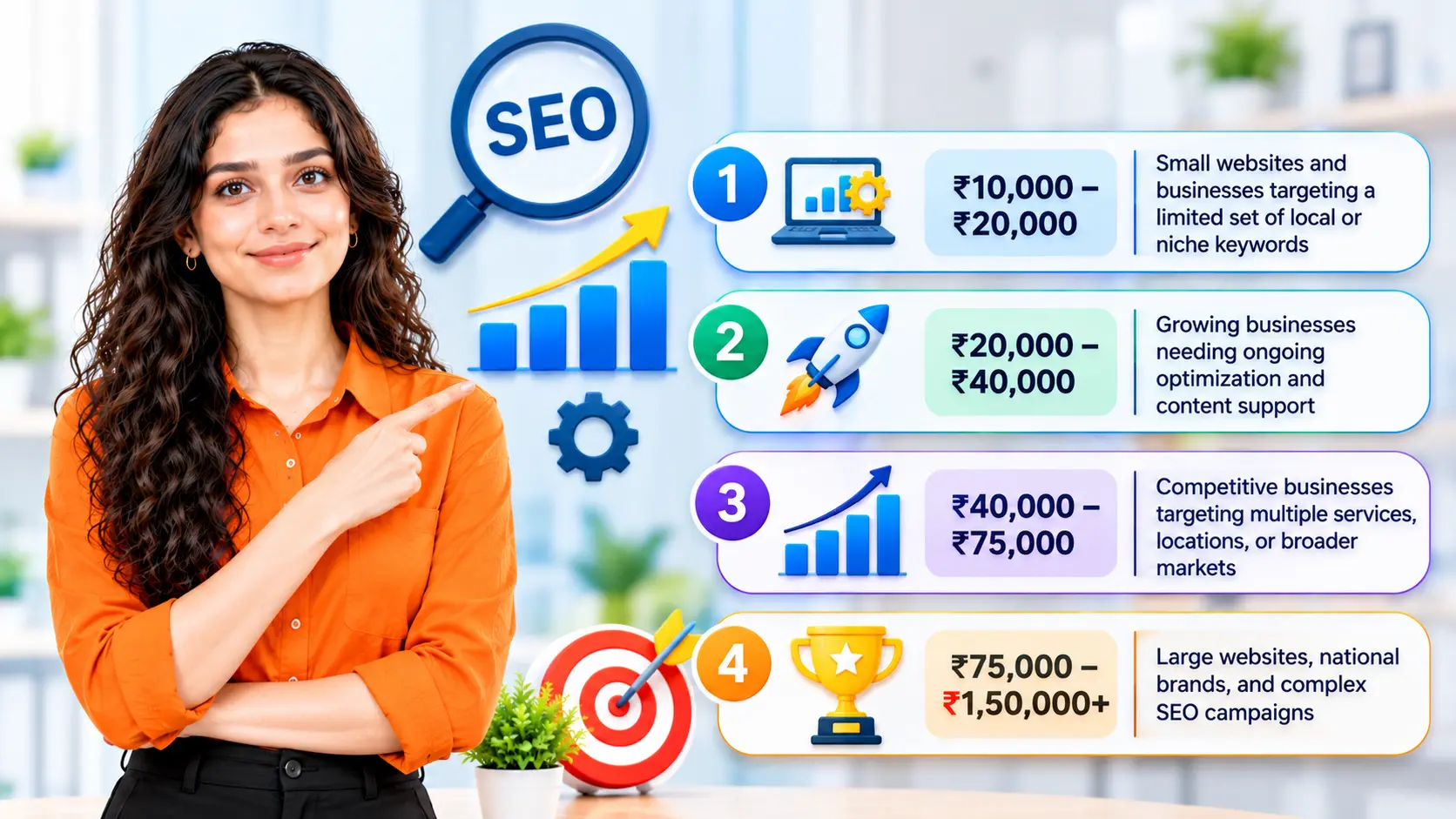
In India, SEO services can range from approximately ₹10,000 per month for limited local campaigns to ₹1,00,000 or more for competitive national or enterprise SEO programs.
The price depends on your website’s condition, industry competition, target keywords, content requirements, website size, and geographic coverage.
Typical SEO pricing:
| SEO Package | Indicative Monthly Cost | Suitable For |
| Basic SEO | ₹10,000–₹20,000 | Small websites and businesses targeting a limited set of local or niche keywords |
| Standard SEO | ₹20,000–₹40,000 | Growing businesses needing ongoing optimization and content support |
| Advanced SEO | ₹40,000–₹75,000 | Competitive businesses targeting multiple services, locations, or broader markets |
| Enterprise SEO | ₹75,000–₹1,50,000+ | Large websites, national brands, and complex SEO campaigns |
What Should an SEO Package Include?
A useful SEO package should be based on the website’s actual needs rather than a fixed promise to target a certain number of keywords.
Depending on the scope, it may include:
- Technical SEO audits and implementation support
- Keyword research and search intent analysis
- On-page optimization
- Website structure and internal linking improvements
- Content planning and optimization
- Local SEO and Google Business Profile optimization
- Competitor analysis
- Relevant off-page SEO activities
- Search performance monitoring
- Google Search Console and analytics reporting
A website with technical problems may need substantial work before content and authority-building activities can deliver their full value.
A larger website may also require more resources to manage its pages, indexation, internal links, and content quality.
I recommend asking the SEO provider which activities will actually be performed each month, what deliverables you will receive, and how progress will be measured.
My advice: Don’t evaluate SEO packages solely by the number of keywords or backlinks promised. Look at the quality of the strategy, the relevance of the work, and its connection to your business goals.
Google Ads Management Cost in India
Google Ads can help businesses reach potential customers through search advertising, shopping campaigns, YouTube, and other eligible placements.
Unlike SEO, paid search can begin generating traffic shortly after a campaign launches. However, traffic alone does not guarantee leads, sales, or profitability.
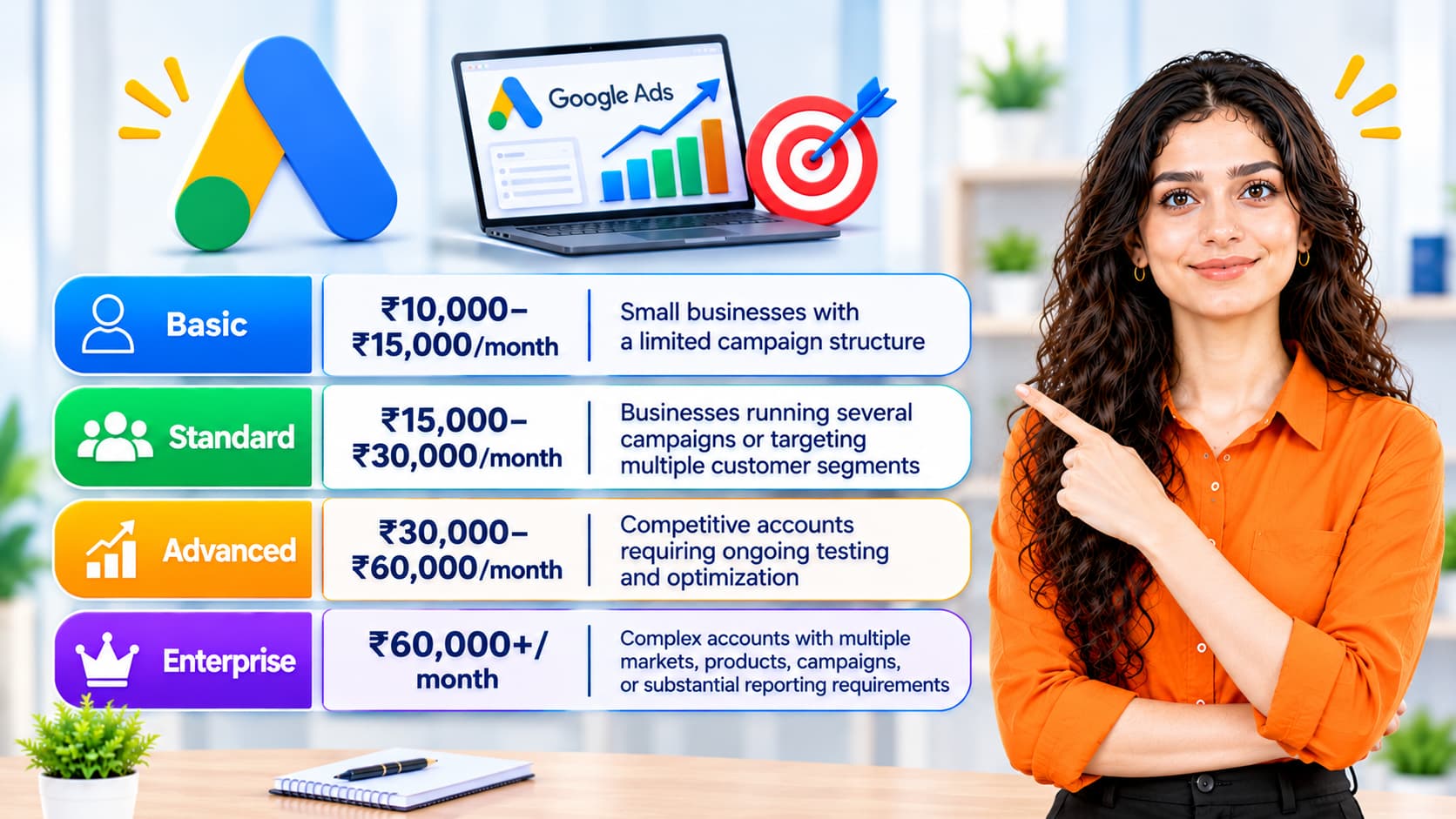
Google Ads management in India may cost approximately ₹10,000–₹60,000 or more per month, depending on campaign complexity and the pricing model.
Typical Google Ads Pricing
| Google Ads Management Package | Indicative Management Fee | Suitable For |
| Basic | ₹10,000–₹15,000/month | Small businesses with a limited campaign structure |
| Standard | ₹15,000–₹30,000/month | Businesses running several campaigns or targeting multiple customer segments |
| Advanced | ₹30,000–₹60,000/month | Competitive accounts requiring ongoing testing and optimization |
| Enterprise | ₹60,000+/month | Complex accounts with multiple markets, products, campaigns, or substantial reporting requirements |
These are management fees. Your advertising budget is generally additional.
Some agencies charge a fixed monthly fee, while others charge a percentage of advertising spend. A hybrid arrangement may combine a base fee with a variable component.
For example, an agency might charge 10%–20% of advertising spend, although the exact percentage depends on the agreement and the work involved.
What Does Google Ads Management Include?
Professional Google Ads management may cover:
- Campaign strategy and account structure
- Keyword research and search term analysis
- Audience research and targeting
- Ad copywriting and creative testing
- Conversion tracking setup and validation
- Budget allocation across campaigns
- Bid strategy and performance optimization
- Negative keyword management
- Landing page recommendations
- Remarketing where appropriate
- Performance reporting and recommendations
The scope matters because managing a small search campaign is different from managing a large account with multiple product categories, shopping feeds, remarketing audiences, and several conversion paths.
Example: How Much Should You Budget for Google Ads?
Suppose you are a service business looking to generate qualified inquiries.
Your initial monthly budget might look like this:
| Expense | Example Amount |
| Google Ads management | ₹20,000 |
| Google Ads spend | ₹50,000 |
| Landing page improvements | ₹5,000 |
| Total before applicable taxes | ₹75,000 |
The landing page cost is included here as a separate illustrative expense; it may not recur every month.
Before increasing your budget, I would evaluate the campaign’s search terms, conversion tracking, lead quality, cost per qualified inquiry, and the percentage of inquiries that turn into paying customers.
For example, a campaign generating 100 inquiries is not necessarily better than one generating 50. If the second campaign generates more qualified leads and more sales, it may deliver greater business value.
My advice: Choose a Google Ads management partner who understands conversion tracking, budget allocation, and business profitability, not just clicks and impressions.
Social Media Marketing Cost in India
Social media marketing helps businesses build brand awareness, engage with their audience, distribute content, and support customer acquisition.
The cost depends on the number of platforms, posting frequency, creative complexity, video requirements, community management, and whether paid advertising is included.
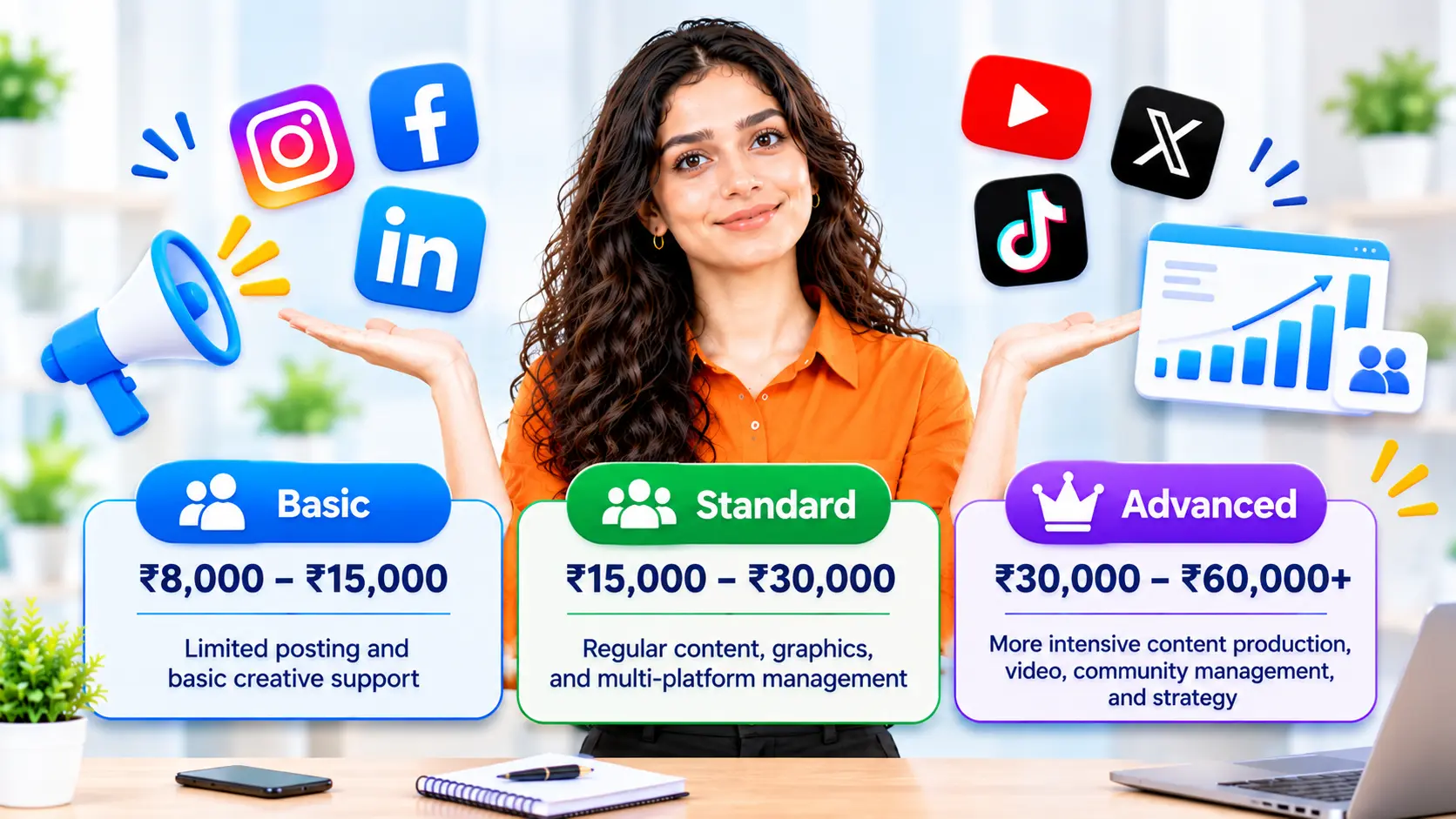
| Social Media Package | Indicative Monthly Cost | Typical Scope |
| Basic | ₹8,000–₹15,000 | Limited posting and basic creative support |
| Standard | ₹15,000–₹30,000 | Regular content, graphics, and multi-platform management |
| Advanced | ₹30,000–₹60,000+ | More intensive content production, video, community management, and strategy |
These ranges are indicative. A package focused on static posts will usually require different resources from one that includes professional video production, daily publishing, influencer coordination, and paid campaign management.
What Should Social Media Marketing Include?
Depending on the package, deliverables may include:
- Social media strategy and content calendars
- Audience and competitor research
- Graphic design and creative development
- Captions and post copywriting
- Scheduling and publishing
- Reels and short-form video production
- Community engagement
- Paid social campaign coordination
- Monthly reporting
One important distinction is that organic social media management and paid social advertising are not the same thing.
A business may pay an agency to publish content but needs a separate budget to promote that content through Facebook or Instagram advertising.
Before choosing a package, clarify the number of posts, videos, platforms, revisions, and community management hours included.
Content Marketing Cost in India

Content marketing helps businesses attract and educate potential customers through useful information.
It can include blog articles, website pages, case studies, guides, email content, and other resources that support the customer journey.
Indicative content marketing costs range from approximately ₹10,000 to ₹75,000 per month and may be higher.
| Content Marketing Service | Indicative Cost |
| Basic blog article | ₹1,500–₹4,000 per article |
| Specialized or research-intensive article | ₹4,000–₹15,000+ per article |
| Monthly blog content package | ₹10,000–₹40,000 |
| Comprehensive content marketing | ₹40,000–₹75,000+ per month |
Pricing depends on subject complexity, research depth, writer expertise, original interviews, editorial requirements, and the number of deliverables.
For businesses investing in SEO, content marketing should align with search intent and business objectives rather than simply increasing the number of published articles.
A well-researched service page that attracts qualified prospects may be more valuable than several articles that generate traffic without attracting potential customers.
Website Design and Development Cost
Your website influences how people perceive your business, evaluate your services, and decide whether to contact you.
Website costs vary based on design complexity, functionality, integrations, content requirements, and the platform used.
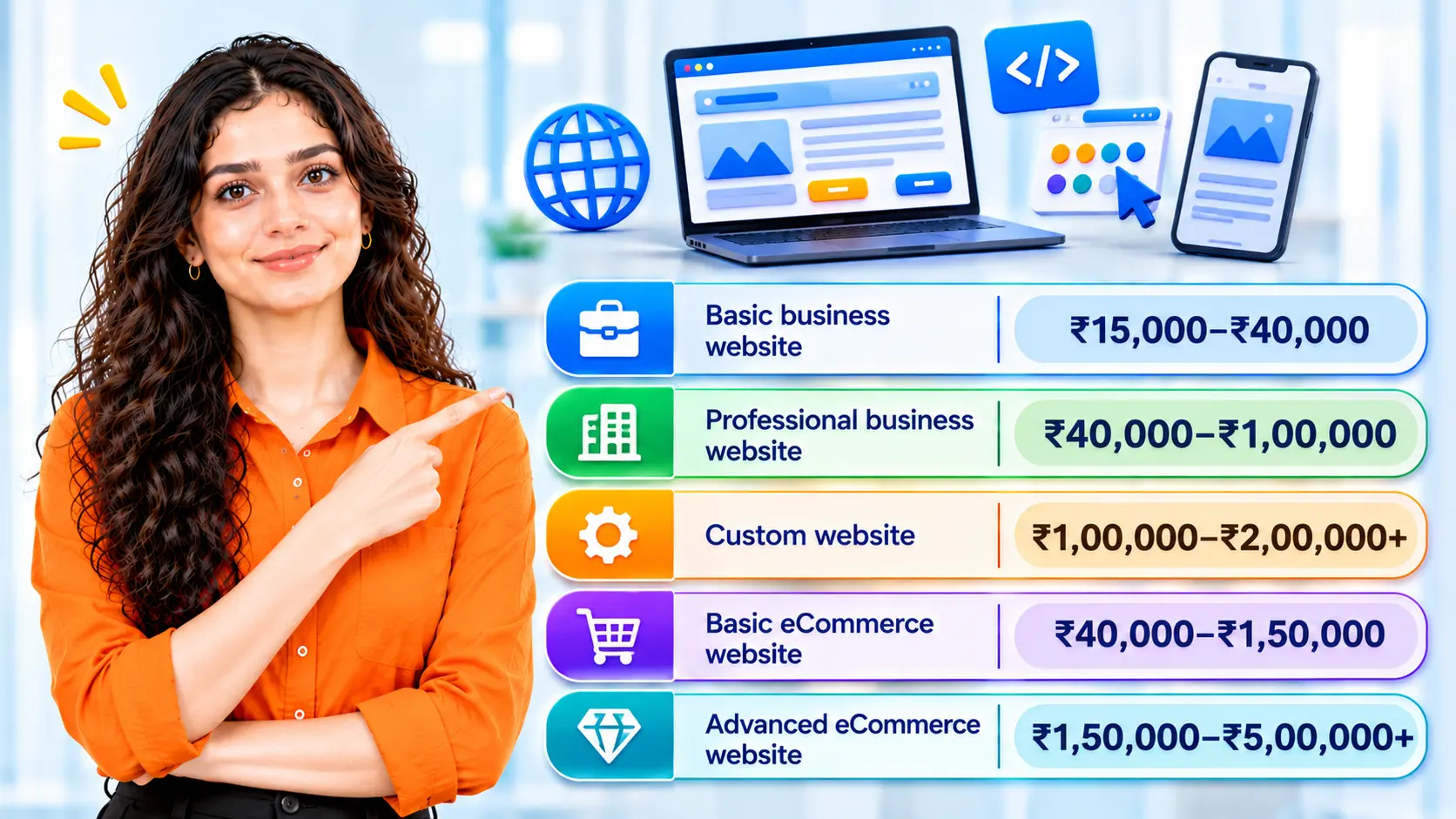
| Website Type | Indicative Project Cost |
| Basic business website | ₹15,000–₹40,000 |
| Professional business website | ₹40,000–₹1,00,000 |
| Custom website | ₹1,00,000–₹2,00,000+ |
| Basic eCommerce website | ₹40,000–₹1,50,000 |
| Advanced eCommerce website | ₹1,50,000–₹5,00,000+ |
These are broad project estimates. A small brochure website and a custom eCommerce platform have very different technical and design requirements.
When evaluating a website development quote, check whether it includes:
- Website planning and design
- Mobile responsiveness
- Content management functionality
- Basic technical SEO
- Contact forms and relevant integrations
- Analytics installation
- Security configuration
- Testing and launch support
- Training or documentation
Also confirm whether domain registration, hosting, premium plugins, maintenance, and future changes are included.
I recommend treating website development as a separate project cost unless the agency clearly explains how it is included in a bundled package.
Further Reading: Website Development Cost in India: Where Does Your Money Go?
Local SEO Cost in India
Local SEO is particularly useful for businesses serving a specific city, region, or service area.
Examples include clinics, restaurants, law firms, repair services, consultants, and home service providers.
Indicative local SEO pricing ranges from ₹5,000 to ₹30,000 per month, depending on competition and the number of locations.
A local SEO campaign may include:
- Google Business Profile optimization
- Local keyword research
- Location and service page optimization
- Business information consistency
- Review management guidance
- Local competitor analysis
- Relevant local link-building activities
- Local search performance reporting
A single-location business may need a relatively focused campaign. A company operating across 20 cities may need substantially more work because each location can have different competitors, search demand, and landing page requirements.
My advice: If your customers primarily come from one city, evaluate local SEO before investing in an expensive national campaign that targets areas you do not serve.
Email Marketing Cost in India
Email marketing allows businesses to nurture leads, communicate with existing customers, and encourage repeat purchases.
Pricing depends on list size, campaign frequency, automation requirements, segmentation, and the email platform.
A basic email marketing service may cost approximately ₹5,000–₹15,000 per month, while more advanced programs may cost ₹15,000–₹35,000 or more.
Typical activities include:
- Email campaign planning
- Newsletter creation
- Audience segmentation
- Automated welcome sequences
- Lead nurturing
- Promotional campaigns
- Performance reporting
Software subscriptions and large-scale migration or CRM integration projects may be charged separately.
For B2B businesses, email marketing can be particularly useful when prospects require several interactions before making a purchasing decision.
AI Search Optimization Cost in India
As businesses seek visibility in AI-generated search experiences, some agencies offer services called Generative Engine Optimization (GEO) or Answer Engine Optimization (AEO).
These services aim to improve how a business’s information is structured, understood, and represented across relevant search and AI discovery experiences.
Pricing varies considerably because the scope of these services is not standardized.
An illustrative budget might range from ₹10,000 to ₹50,000 per month, depending on whether the engagement includes technical SEO, structured data, entity research, content development, digital PR, and monitoring.
Potential activities include:
- Improving the clarity and accuracy of website information
- Strengthening relevant brand and entity signals
- Improving content structure and direct answers to user questions
- Reviewing structured data where appropriate
- Developing authoritative, useful content
- Monitoring relevant brand mentions and AI search visibility
- Improving consistency across important business profiles
Some of these activities overlap with traditional SEO, content marketing, and digital PR.
I would not recommend purchasing an AI SEO package simply because it uses new terminology.
Ask the provider to explain the actual work, the reporting methodology, and how the service complements your existing SEO strategy.
There are no guaranteed rankings or citations in AI-generated answers.
Digital Marketing Packages in India: What Should You Choose?

Many agencies offer predefined digital marketing packages to make services easier to understand and budget for.
However, a package is useful only when its deliverables match your business requirements.
A business that needs local inquiries may not benefit from the same package as an eCommerce company trying to increase online sales.
Here is an example of how businesses can structure their digital marketing budgets.
Digital Marketing Packages for Small Businesses
| Package | Illustrative Monthly Fee | Services | Best For |
| Starter | ₹15,000–₹25,000 | One primary channel, basic strategy, essential optimization, and reporting | Small local businesses |
| Growth | ₹25,000–₹50,000 | One or two channels, ongoing optimization, and supporting content or creative work | Growing businesses |
| Advanced | ₹50,000–₹1,00,000 | Multiple channels, more extensive content, conversion tracking, and performance reviews | Established small and medium businesses |
| Enterprise | ₹1,00,000+ | Integrated campaigns, advanced analytics, multiple markets, and dedicated strategic support | Larger and more complex businesses |
Important: These are illustrative service-fee tiers, not fixed market rates. Advertising spend, taxes, website development, and specialist production may be additional.
The precise inclusions should be documented in the proposal.
What Should a Starter Digital Marketing Package Include?
A starter package should focus on establishing a solid foundation rather than attempting to do everything at once.
Depending on your objectives, it could include:
- Initial digital presence and competitor assessment
- Selection of one primary marketing channel
- Basic campaign or optimization strategy
- Essential analytics and conversion tracking
- A defined set of monthly deliverables
- Performance reporting
For example, a local service business may prioritize local SEO, while a company that needs inquiries quickly may prioritize Google Ads.
The important thing is to select the channel that best fits the business objective.
What Should a Growth Digital Marketing Package in India Include?
A growth package may combine complementary services to improve customer acquisition.
For example, a business might invest in SEO to build organic visibility while using Google Ads to capture existing search demand.
A growth package could include:
- SEO or paid advertising management
- Content development
- Landing page recommendations
- Conversion tracking
- Ongoing optimization
- Monthly performance reviews
The precise mix should depend on the website’s current performance, the competitive landscape, and the resources available.
What Should an Advanced Digital Marketing Package Include?
An advanced package is more appropriate when a business has established its marketing foundations and needs a more coordinated strategy.
Possible deliverables include:
- Multiple marketing channels
- Advanced campaign segmentation
- More extensive content production
- Remarketing and audience development
- Conversion rate optimization
- CRM and analytics integration
- Lead quality analysis
- Regular strategic reviews
At this level, reporting should connect marketing activities to meaningful business outcomes wherever the available data allows.
I would rather see a business execute two complementary channels properly than spread its budget across six channels without enough resources to manage any of them effectively.
How Much Does Digital Marketing Cost for Different Industries?

The industry you operate in significantly influences the budget you need.
Some businesses serve a narrow geographic market and have relatively straightforward customer journeys. Others compete nationally, operate in expensive advertising markets, or require multiple interactions before a sale.
The following examples illustrate how I would approach budget planning for different types of businesses.
| Industry | Illustrative Monthly Marketing Budget | Potential Priorities |
| Local home services | ₹15,000–₹50,000 | Local SEO, Google Business Profile, and targeted search ads |
| Healthcare and clinics | ₹30,000–₹1,50,000 | Local search visibility, compliant advertising, content, and appointment inquiries |
| Legal services | ₹30,000–₹1,50,000 | Relevant search campaigns, authority-building content, and qualified inquiries |
| Accounting and professional services | ₹25,000–₹1,00,000 | SEO, B2B content, search advertising, and lead nurturing |
| Education and training | ₹40,000–₹2,00,000 | Search ads, social campaigns, landing pages, and lead follow-up |
| Real estate | ₹50,000–₹3,00,000+ | Location-based campaigns, paid advertising, lead qualification, and remarketing |
| eCommerce and D2C | ₹50,000–₹3,00,000+ | Shopping campaigns, paid social, SEO, product feeds, and conversion optimization |
| B2B technology | ₹50,000–₹2,50,000+ | SEO, specialist content, paid search, LinkedIn campaigns, and CRM integration |
These are illustrative starting points for planning, not measured industry averages. They represent potential marketing budgets that may combine agency fees and media spend. Actual requirements can be substantially lower or higher.
Why Do Industries Have Different Marketing Costs?
I consider five factors particularly important.
Customer acquisition costs
Some industries have expensive advertising auctions because several businesses compete for the same customers.
Customer lifetime value
A business that earns substantial revenue from a long-term customer may be able to justify a higher acquisition cost than a business selling a low-priced product once.
Sales cycle
A customer who purchases immediately may require less nurturing than a business buyer, who may need several meetings, approvals, and demonstrations.
Geographic competition
A company targeting one town may face different competition from a brand trying to acquire customers across multiple major cities.
Conversion requirements
Some businesses need only a phone call or an inquiry form. Others need product feeds, CRM integration, sales qualification, remarketing, and a more complex conversion journey.
My recommendation is to base your budget on your business’s economics rather than selecting a package simply because another company in your industry uses it.
Digital Marketing Agency vs Freelancer vs In-House Team

Another important budgeting decision is whether to hire an agency, work with a freelancer, or build an internal marketing team.
Each option has advantages and limitations.
Cost Comparison
| Hiring Model | Indicative Monthly Cost | Advantages | Limitations |
| Freelancer | ₹8,000–₹30,000 | Flexible, potentially affordable, direct communication | May have limited capacity or specialist coverage |
| Small digital marketing agency | ₹20,000–₹80,000 | Access to multiple disciplines and coordinated execution | Scope and team experience vary |
| Larger digital marketing agency | ₹80,000–₹3,00,000+ | Greater specialist capacity and resources for complex campaigns | Higher fees and potentially more complex account structures |
| In-house marketing specialist | ₹25,000–₹80,000+ per month | Direct involvement in company operations | Salary is only one component of employment costs |
| Small in-house marketing team | ₹1,00,000–₹3,50,000+ per month | Greater control and dedicated internal capacity | Recruitment, management, software, and training expenses |
These are broad planning estimates, not salary-survey results or universal agency rates. Actual costs depend on seniority, location, responsibilities, and team size.
When Should You Hire a Freelancer?
A freelancer may be a suitable choice when you need a specific task completed or have a relatively simple marketing requirement.
For example, you might hire a specialist to:
- Audit an advertising account
- Write a set of blog articles
- Optimize an existing campaign
- Fix specific SEO issues
- Create a landing page
A freelancer can be cost-effective when the scope is clear and does not require extensive coordination across multiple disciplines.
However, you should establish who will handle tasks related to the freelancer’s scope.
When Should You Hire a Digital Marketing Agency?
An agency can be a better option when your business needs several complementary services.
For example, a Google Ads campaign may require collaboration between an advertising specialist, a copywriter, a designer, a developer, and an analytics professional.
An agency can coordinate these activities under a single engagement, depending on its team and the scope of services.
At RankON Technologies, we work with clients across industries and have a team of more than 20 professionals. Our digital marketing agency has over 14 years of industry experience, holds Top Rated Plus status on Upwork, and has received recognition from Clutch and 50Pros.
These credentials provide useful context when evaluating an agency, but I would still recommend reviewing the proposed scope, the people who will handle your account, relevant case studies, and the reporting process.
When Does an In-House Team Make Sense?
An in-house team may be suitable when marketing is a substantial, ongoing business function that requires frequent collaboration with sales, product, customer service, and leadership.
For example, an established eCommerce company may need dedicated people handling paid media, content, creative production, analytics, and CRM operations.
However, hiring employees does not eliminate other costs. You may still need specialist agencies, external production, software subscriptions, and advertising budgets.
The right choice depends on the amount of work required and the capabilities your business needs to retain internally.
What Factors Affect Digital Marketing Pricing in India?
Two agencies can quote very different prices for what appears to be the same service.
In my view, the most useful way to understand the difference is to examine the work behind the quotation.
Your Business Goals
A campaign designed to generate local inquiries requires a different strategy from one designed to build national brand awareness or increase eCommerce revenue.
Clear objectives help determine the channels, resources, and reporting requirements.
Industry Competition
Competitive markets may require more research, more sophisticated targeting, additional content, stronger landing pages, and more intensive optimization.
In paid advertising, competition can also influence the cost of acquiring traffic.
Number of Marketing Channels
Managing one marketing channel is generally less resource-intensive than coordinating SEO, Google Ads, paid social, content, email marketing, and conversion optimization.
Every additional channel needs an appropriate strategy, execution plan, and measurement process.
Website Condition
An existing website may have technical problems, weak landing pages, poor mobile usability, or inaccurate conversion tracking.
Resolving these issues can add work to the initial project.
For example, increasing Google Ads spend before validating conversion tracking can make it difficult to determine which campaigns are generating valuable inquiries.
Content and Creative Requirements
A package that includes a few static graphics requires different resources from one that includes original video production, custom illustrations, detailed research, and multiple creative variations.
Always check the number and type of deliverables included in the quoted price.
Geographic Coverage
Targeting one city is different from targeting multiple regions or an entire country.
Multi-location businesses may need additional landing pages, local research, location-specific campaigns, and more extensive reporting.
Team Experience
The experience and capabilities of the people handling your marketing can influence both the fee and the quality of execution.
However, a higher price does not automatically indicate better service. Evaluate the proposed work, relevant experience, communication, and accountability.
Reporting and Analytics
Some packages provide a basic monthly report, while others include conversion analysis, lead quality reviews, detailed dashboards, and strategic recommendations.
More sophisticated measurement can require additional setup and ongoing work.
Contract Terms and Scope
A quote may appear inexpensive because it excludes important activities.
For example, the initial fee might not include conversion tracking, creative development, landing page changes, or ongoing technical support.
I recommend comparing proposals based on their complete scope rather than the headline price alone.
How Much Should You Spend on Digital Marketing?
There is no single budget that works for every business.
I prefer to approach this question by considering business objectives, available resources, and the economics of customer acquisition.
Here are three practical approaches.
Approach 1: Start With Your Business Objective
Begin by identifying the outcome you want to achieve.
For example:
- A local business may want more qualified phone calls.
- A professional services company may want more consultation bookings.
- An eCommerce store may want more profitable purchases.
- A B2B company may want qualified sales opportunities.
Your objective determines which marketing channels are worth testing.
Approach 2: Work Backward From Your Customer Acquisition Target
Let’s say your business wants to acquire 20 new customers per month.
You estimate that 20% of qualified inquiries become customers.
To generate 20 customers, you would need approximately:
20 customers ÷ 20% conversion rate = 100 qualified enquiries.
Now suppose your target cost per qualified inquiry is ₹1,000.
Your estimated acquisition budget would be:
100 enquiries × ₹1,000 = ₹1,00,000.
This gives you a starting media budget of ₹1,00,000, assuming the inquiry target and conversion assumptions are realistic.
You would then account for management fees, creative production, landing page work, and applicable taxes.
This is a planning model, not a guarantee that the campaign will generate 100 inquiries at the assumed cost.
The actual result will depend on market demand, campaign quality, competition, and the business’s ability to convert inquiries into customers.
Approach 3: Consider the Value of Each Customer
The cost of acquiring a customer should make sense in relation to the revenue and profit that customer generates.
Consider this simplified example:
| Metric | Example |
| Monthly marketing investment | ₹1,00,000 |
| New customers acquired | 20 |
| Marketing cost per customer | ₹5,000 |
| Revenue per customer | ₹15,000 |
| Gross margin | 40% |
| Gross profit per customer | ₹6,000 |
| Total gross profit from 20 customers | ₹1,20,000 |
In this example, the business generates ₹1,20,000 in gross profit from ₹1,00,000 in marketing investment.
That leaves ₹20,000 before other operating expenses and any costs not included in the calculation.
This is not necessarily a profitable campaign overall, but it illustrates why customer value and profit margins matter when evaluating marketing performance.
For businesses with repeat purchases, lifetime value may also be relevant. However, future revenue should be estimated realistically rather than assumed.
My recommendation: Set a budget you can sustain long enough to collect useful data, validate your assumptions, and make informed adjustments. Avoid committing to a large budget simply because a marketing provider promises rapid growth.
Digital Marketing Cost vs. Return on Investment (ROI)
When evaluating digital marketing expenses, I don’t recommend focusing exclusively on the monthly fee. I also want to understand what the business receives in return.
A campaign can generate thousands of clicks and still perform poorly if those visitors do not become customers.
Similarly, an SEO campaign may increase organic traffic without generating enough relevant inquiries to justify its cost.
This is why I believe businesses should evaluate marketing using metrics that reflect their objectives.
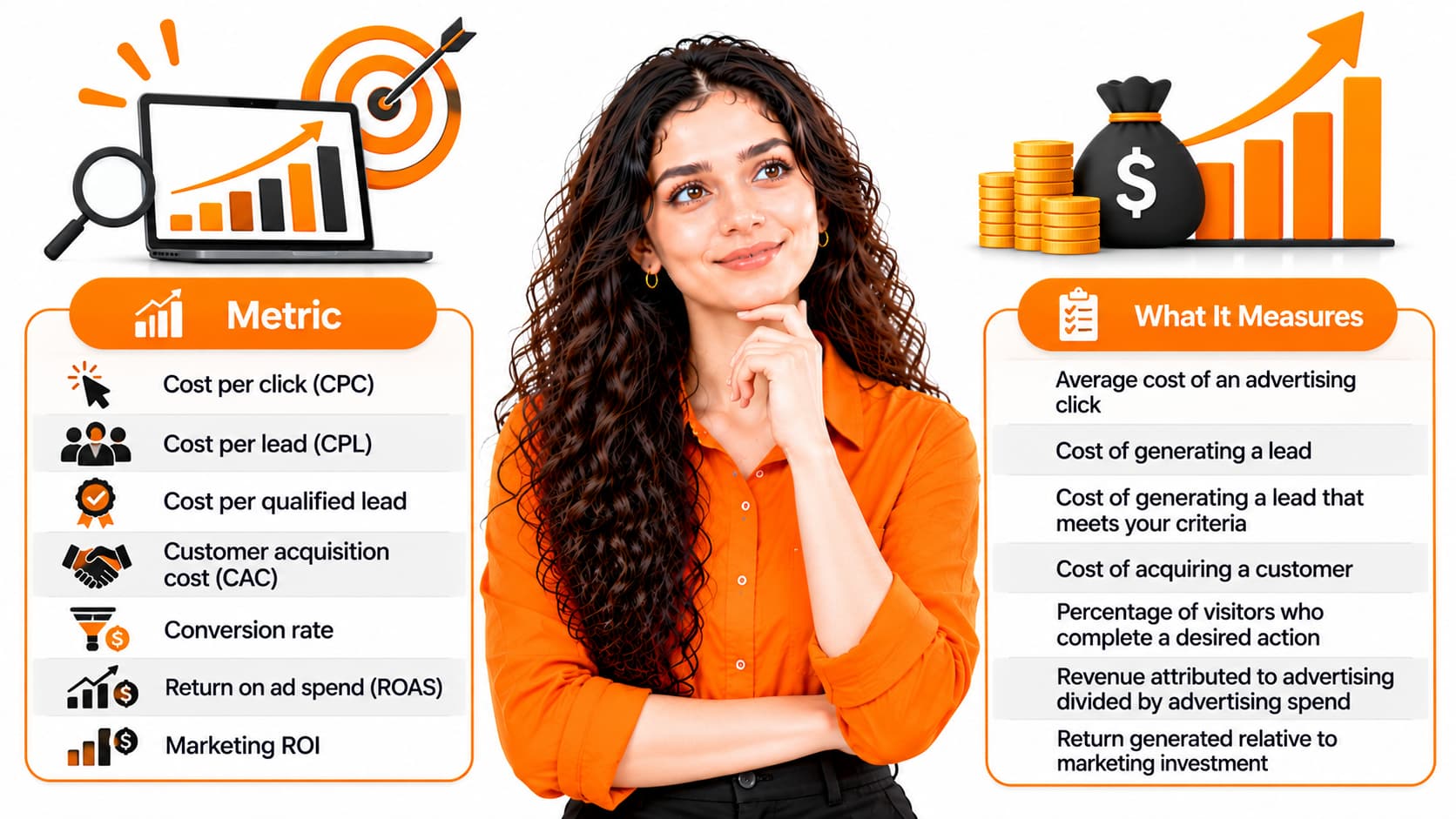
Important Digital Marketing Performance Metrics
| Metric | What It Measures | Why It Matters |
| Cost per click (CPC) | Average cost of an advertising click | Helps assess traffic acquisition costs |
| Cost per lead (CPL) | Cost of generating a lead | Helps evaluate lead generation efficiency |
| Cost per qualified lead | Cost of generating a lead that meets your criteria | Helps distinguish relevant prospects from low-quality inquiries |
| Customer acquisition cost (CAC) | Cost of acquiring a customer | Helps assess acquisition efficiency |
| Conversion rate | Percentage of visitors who complete a desired action | Helps identify opportunities to improve website performance |
| Return on ad spend (ROAS) | Revenue attributed to advertising divided by advertising spend | Helps assess advertising revenue relative to media costs |
| Marketing ROI | Return generated relative to marketing investment | Helps evaluate the broader financial impact of marketing |
Why Cheap Leads Can Become Expensive Customers
Suppose Campaign A generates 100 leads at ₹500 each, while Campaign B generates 50 leads at ₹800 each.
| Metric | Campaign A | Campaign B |
| Advertising spend | ₹50,000 | ₹40,000 |
| Leads generated | 100 | 50 |
| Cost per lead | ₹500 | ₹800 |
| Leads converted into customers | 5 | 10 |
| Customer acquisition cost | ₹10,000 | ₹4,000 |
Campaign A generates more leads at a lower cost per lead. However, Campaign B acquires twice as many customers despite generating fewer leads.
This illustrates why I consider lead quality and customer acquisition cost essential when evaluating advertising performance.
A good digital marketing strategy should help a business understand not just how many people respond to its campaigns, but also which activities contribute to commercially valuable outcomes.
Hidden Costs to Check Before Hiring a Digital Marketing Agency
One of the easiest ways to miscalculate your marketing budget is to overlook expenses that are not included in the initial quotation.
Before hiring an agency, I recommend checking the following items.
Advertising Spend
Confirm whether the quoted price includes advertising spend or only campaign management.
In most arrangements, the agency fee and platform budget are separate.
GST and Other Taxes
Ask whether the quotation includes applicable taxes.
For Indian businesses, agency fees may be subject to GST at the applicable rate. Confirm the treatment with your service provider.
Website Development and Maintenance
Your campaign may require landing page development, website changes, technical fixes, or ongoing maintenance.
Clarify whether these activities are included in the monthly retainer.
Content and Creative Production
Check the number of blog articles, graphics, videos, ad variations, and revisions included.
Professional photography, video shoots, and specialist creative work may require additional budgets.
Software and Third-Party Tools
Marketing automation, CRM platforms, analytics tools, email software, and other subscriptions may be billed separately.
Landing Page Testing
Conversion rate optimization can involve research, design changes, development, analytics, and experimentation.
Do not assume these activities are included in advertising management unless the proposal explicitly states so.
Influencer and Media Fees
Influencer compensation, sponsored placements, and other media purchases may sit outside the agency’s management fee.
Additional Locations or Campaigns
Adding new geographic markets, product categories, or advertising platforms can expand the scope of work.
Ask the agency to explain how additional requirements will be priced.
My advice: Request an itemized proposal that distinguishes recurring fees, one-time setup costs, advertising spend, optional services, and taxes. This makes it easier to compare agencies accurately and plan your cash flow.
How to Choose the Right Digital Marketing Agency in India

Choosing a digital marketing agency is not simply a matter of finding the lowest price.
You need a partner who understands your business objectives, communicates clearly, and explains how their work contributes to measurable outcomes.
Here are the factors I recommend evaluating.
1. Check Relevant Experience
Look for experience that relates to your industry, business model, and marketing objectives.
An agency with experience in local lead generation may be a suitable choice for a service business, while an eCommerce company may need a team familiar with shopping campaigns, product feeds, and online sales measurement.
2. Review Case Studies
Ask for examples of previous work that demonstrate the agency’s approach and results.
Look beyond impressive percentages and examine the starting point, campaign duration, budget, business objective, and methodology.
Make sure the results are relevant to your situation.
3. Understand the Deliverables
Ask exactly what the agency will do each month.
For SEO, this could include technical improvements, content optimization, and reporting.
For Google Ads, it might include campaign management, search term analysis, conversion tracking, and budget optimization.
A clear scope makes accountability easier.
4. Check Tracking and Reporting
Your agency should explain which metrics it tracks and how performance is reported.
For paid advertising, confirm that conversions are configured correctly and that you can access your advertising account.
For lead generation campaigns, ask whether lead quality and sales outcomes can be incorporated into reporting.
5. Confirm Account Ownership
Your business should retain appropriate ownership and access to its advertising accounts, analytics properties, website, and relevant marketing assets.
Clarify access arrangements before the engagement begins.
6. Evaluate Communication
Find out who will manage your account, how frequently you will receive updates, and how the agency handles questions or urgent issues.
Good communication is particularly important when campaigns require changes to budgets, landing pages, or business priorities.
7. Avoid Guaranteed Results
No responsible agency can guarantee specific search rankings, advertising costs, or revenue outcomes in every situation.
A credible provider should explain its strategy, assumptions, reporting process, and approach to optimization.
8. Compare Proposals Fairly
When comparing agencies, use the same criteria for each proposal.
For example, compare:
- Monthly professional fees
- Advertising budget
- Number of channels managed
- Monthly deliverables
- Creative and content inclusions
- Tracking and reporting
- Contract duration
- Additional charges
- Relevant experience
The lowest quotation is not always the best value, and the most expensive quotation is not automatically the best choice.
Questions to Ask Before Purchasing a Digital Marketing Package in India
Before signing a contract, I recommend asking your prospective agency these questions.
| Question | Why You Should Ask |
| What exactly is included in the monthly fee? | Helps you understand the scope of work |
| Is advertising spend separate? | Prevents confusion about the total budget |
| Are taxes included in the quotation? | Helps you calculate your actual expenses |
| Who will manage my account? | Clarifies responsibility and expertise |
| What deliverables will I receive each month? | Establishes expectations |
| How will performance be measured? | Ensures reporting reflects your objectives |
| Will I retain access to my accounts and data? | Protects your access to essential business assets |
| Are website changes and creative production included? | Identifies potential additional expenses |
| What is the minimum contract period? | Clarifies your financial commitment |
| How often will we review results? | Establishes a process for evaluating progress |
| What happens if we need to change the scope? | Explains how additional work will be handled |
| Can you show relevant case studies? | Helps you assess the agency’s experience |
These questions will not guarantee that you choose the perfect agency, but they can help you make a more informed decision.
How RankON Technologies Approaches Digital Marketing Campaign Investment
At RankON Technologies, we believe digital marketing should be planned around business objectives rather than a package price alone.
Our approach is to understand the business, identify its marketing priorities, and recommend services that fit its requirements.
With more than 14 years of industry experience, a team of over 20 professionals, and clients across multiple industries and markets, RankON Technologies provides digital marketing services designed to support businesses at different stages of growth.
Our credentials include Top Rated Plus status on Upwork and recognition from Clutch and 50Pros.
Depending on the client’s needs, our services can include SEO, technical SEO, content marketing, paid advertising, and other digital marketing activities.
How We Help Businesses Make Better Marketing Decisions
We start with your objectives.
Before recommending channels, we want to understand whether your priority is generating leads, increasing sales, improving organic visibility, or expanding into new markets.
We consider your current position.
Your website, existing campaigns, competition, and available resources influence what should happen first.
We focus on the right activities.
Rather than automatically recommending every available service, we identify the activities most relevant to your goals and budget.
We emphasize measurement.
Where the necessary data is available, we use performance metrics to understand what is working and where improvements may be needed.
We review and refine the strategy.
Marketing requirements can change as a business grows. Regular reviews help ensure that the strategy remains relevant.
For businesses investing in paid advertising, my focus as a Google Ads and PPC specialist is on campaign structure, keyword and audience targeting, conversion tracking, budget allocation, and ongoing optimization.
I am Google Ads-certified, hold Top Rated Plus status on Upwork with a 100% Job Success Score, and have managed more than $600,000 in advertising spend.
That experience informs how I approach campaign planning: the objective is not simply to spend the budget, but to use available data to make better decisions about where and how to allocate it.
If you are evaluating your digital marketing options, you can explore the services offered by RankON Technologies and identify which areas are most relevant to your business.
Conclusion: Choose a Digital Marketing Budget That Supports Your Business Goals
The cost of digital marketing in India varies widely because businesses have different objectives, audiences, competitive environments, and resource requirements.
A small local business may need only one focused service, while an established brand may benefit from a coordinated strategy involving SEO, Google Ads, social media, content marketing, and conversion optimization.
In my experience managing paid advertising campaigns, the most important budgeting decision is not simply how much to spend. It is how to allocate that investment, measure its effectiveness, and make informed decisions as results become available.
Before choosing a digital marketing package, I recommend defining your goals, understanding the total cost, reviewing the proposed deliverables, and agreeing on how performance will be measured.
You do not necessarily need the most expensive package to make progress. You need a strategy that matches your business, a team capable of executing it, and a realistic approach to evaluating the results.
If you are planning your digital marketing investment for 2026, start by identifying your highest-priority objective and selecting the services that can support it.
Need help planning your digital marketing budget? Explore RankON Technologies to learn more about our digital marketing services and discuss an approach suited to your business goals.
FAQs About Digital Marketing Cost in India
What is the average cost of digital marketing in India in 2026?
The cost depends on the services and scope involved. A small business may begin with a budget of ₹15,000–₹40,000 per month for focused marketing support, while businesses running multiple channels may need ₹50,000–₹1,00,000 or more. Advertising spend, taxes, and additional services may be charged separately.
These are planning estimates rather than universal market rates.
What is the minimum budget required for digital marketing?
There is no universal minimum budget.
A small business with a focused objective may begin with ₹10,000–₹20,000 per month for a limited service, depending on the provider and scope. However, this may not be sufficient for a comprehensive multi-channel campaign.
Your budget should reflect the amount of work required to pursue your objectives.
How much does a digital marketing agency charge per month in India?
Agency fees can range from approximately ₹15,000 per month for limited support to several lakh rupees for complex campaigns.
The price depends on the number of channels, content requirements, technical complexity, advertising account size, and reporting expectations.
Always confirm whether the quotation includes advertising spend and taxes.
Is advertising spend included in digital marketing packages?
Not necessarily.
Many agencies charge a separate management fee while the business pays the advertising platform for clicks or impressions.
For example, if your management fee is ₹20,000 and your advertising budget is ₹50,000, your starting monthly cost is ₹70,000 before applicable taxes and additional expenses.
Always check the contract to confirm the arrangement.
How much does SEO cost in India?
SEO may cost approximately ₹10,000–₹40,000 per month for many small and growing businesses, while competitive national campaigns and enterprise projects can cost considerably more.
The price depends on competition, website size, technical requirements, content production, and the number of locations or markets being targeted.
How much does Google Ads management cost in India?
Google Ads management may cost approximately ₹10,000–₹60,000 or more per month.
Some providers charge a fixed fee, while others charge a percentage of advertising spend or use a hybrid model.
Your advertising budget is generally separate from the management fee.
Is hiring a freelancer cheaper than hiring an agency?
A freelancer can be more affordable for a specific task or a focused marketing requirement.
An agency may be more suitable when your business requires several disciplines to work together, such as advertising, design, development, content, and analytics.
The best option depends on the scope of work and the capabilities required.
How much should a small business spend on digital marketing?
A small business might start with ₹15,000–₹40,000 per month for a focused campaign, though the appropriate amount varies widely.
I recommend starting with a clear objective, selecting the most relevant channel, and measuring the quality and commercial value of the results.
Increase the budget when the available evidence supports doing so.
How long does digital marketing take to produce results?
The timeline depends on the channel and campaign.
Paid advertising can begin generating traffic and inquiries soon after launch, provided there is sufficient demand and the campaign is configured correctly. However, profitability may take longer to achieve.
SEO typically requires sustained work over several months, and meaningful results depend on competition, website condition, content quality, and other factors.
No fixed timeline can be guaranteed.
Should I choose a cheap digital marketing package?
Not necessarily.
A low-cost package may be suitable if it provides the specific service your business needs. However, it may be inadequate if it excludes important activities such as technical implementation, conversion tracking, creative production, or meaningful reporting.
Compare the deliverables and expected work rather than choosing solely by price.
Is digital marketing worth the investment for small businesses?
It can be, provided the strategy fits the business and its financial objectives.
For example, local SEO may help a service business reach relevant customers, while targeted Google Ads may help capture existing search demand.
The value depends on execution quality, customer acquisition costs, and the business’s ability to convert prospects into paying customers.
What is the difference between digital marketing cost and advertising cost?
Digital marketing costs can include professional services such as SEO, campaign management, content creation, analytics, and website optimization.
Advertising cost refers to the money paid to platforms such as Google or Meta to distribute advertisements.
Some businesses need both, while others may invest primarily in organic marketing.
Can I combine SEO and Google Ads in one package?
Yes. Combining SEO and Google Ads can be useful when your business wants to pursue organic visibility while also capturing relevant paid search traffic.
The right approach depends on your objectives, competition, available budget, and current website performance.
Make sure the proposal explains the work assigned to each channel and how the results will be evaluated.
Are digital marketing packages billed monthly or annually?
Many ongoing services are billed monthly, while website development, audits, and other defined projects may be charged as one-time fees.
Some agencies require a minimum engagement period.
Before signing, confirm the billing schedule, renewal terms, cancellation policy, and how additional work will be handled.
How do I calculate the ROI of digital marketing?
Start by identifying the revenue or profit attributable to your marketing activity.
A simplified ROI formula is:
Marketing ROI = (Profit attributable to marketing − Marketing investment) ÷ Marketing investment × 100
For example, if an activity generates ₹1,50,000 in attributable profit against a marketing investment of ₹1,00,000, the simplified ROI is 50%.
For a reliable calculation, use consistent attribution methods and account for relevant costs. Revenue, gross profit, and profit after all business expenses are different measures and should not be treated as interchangeable.