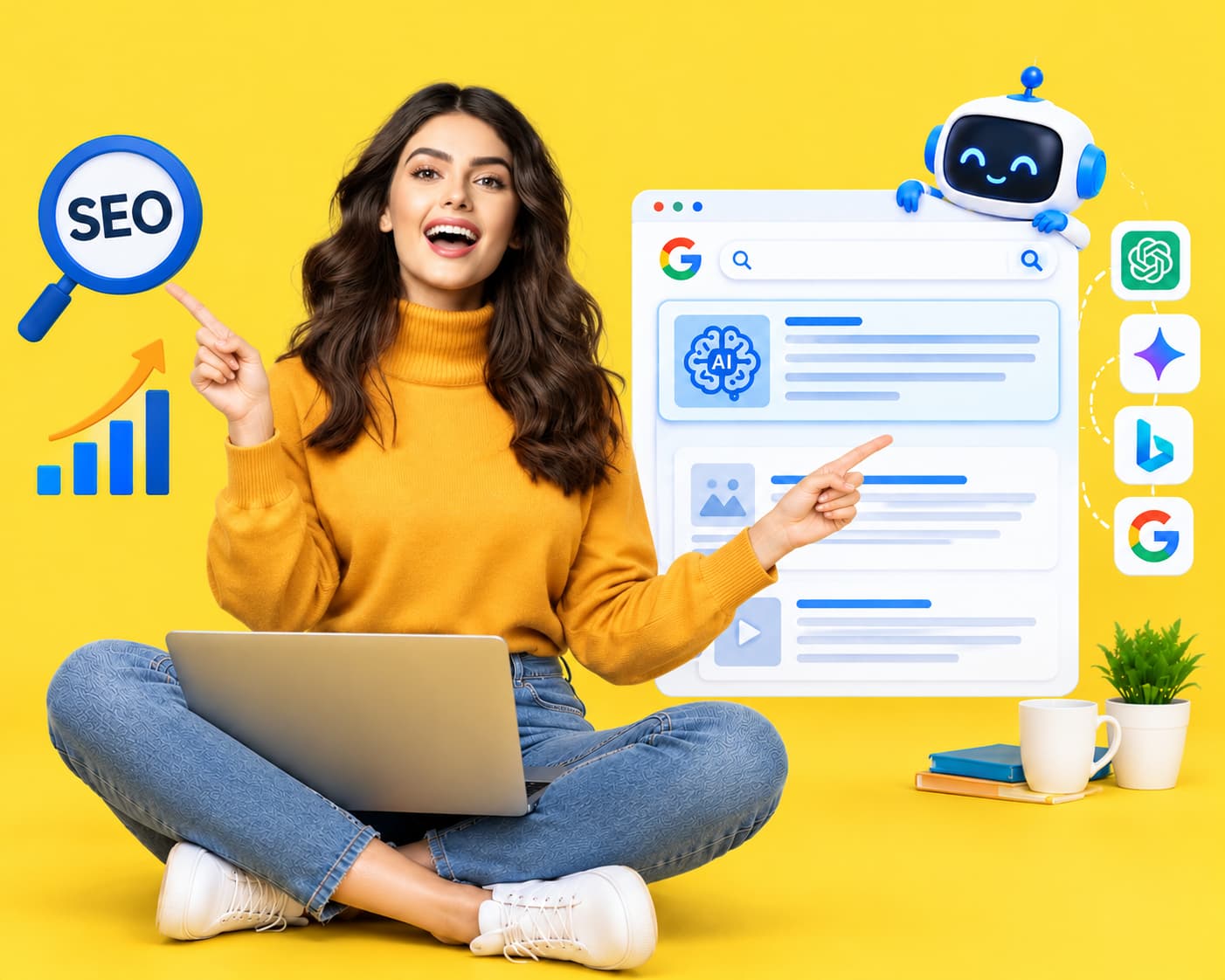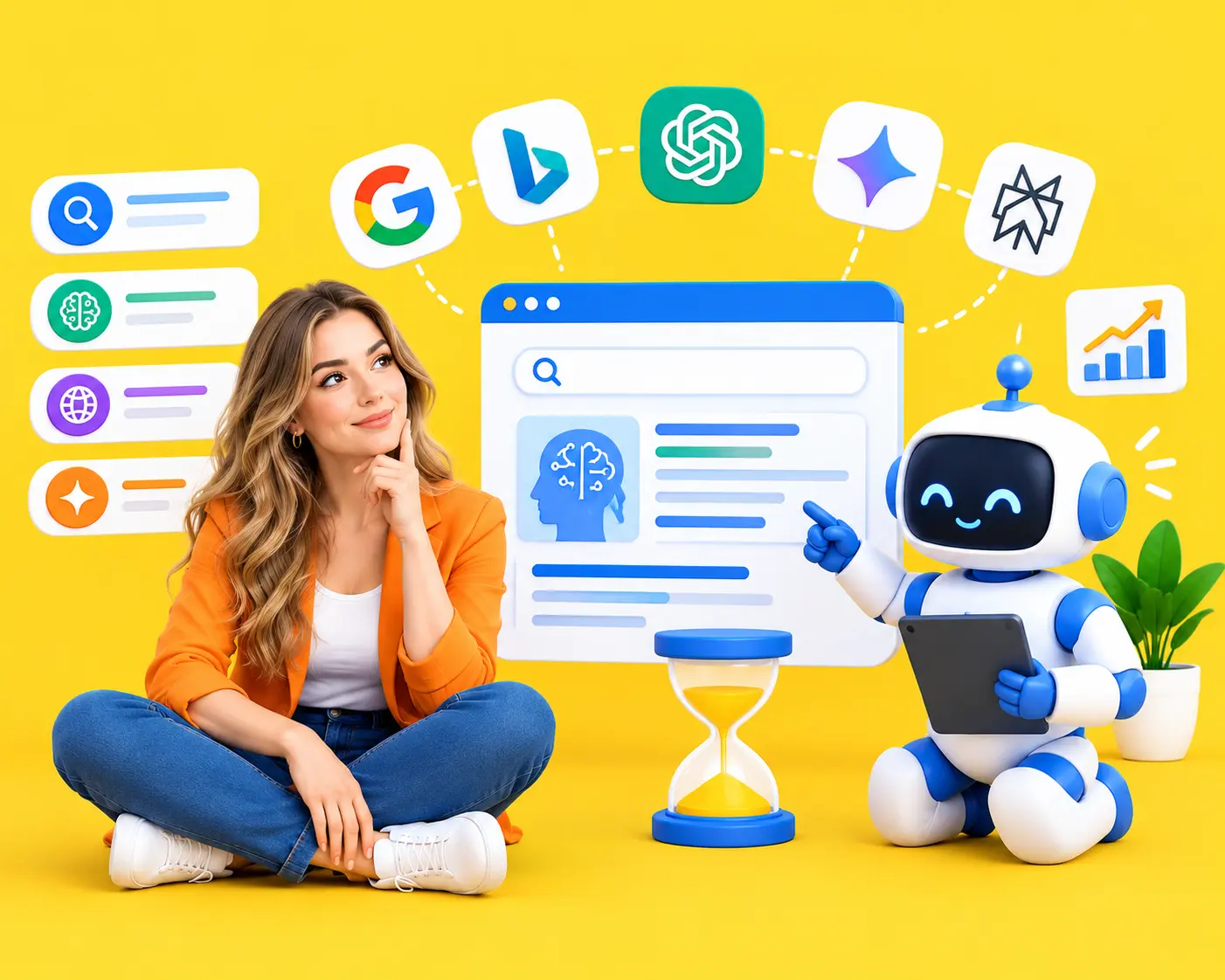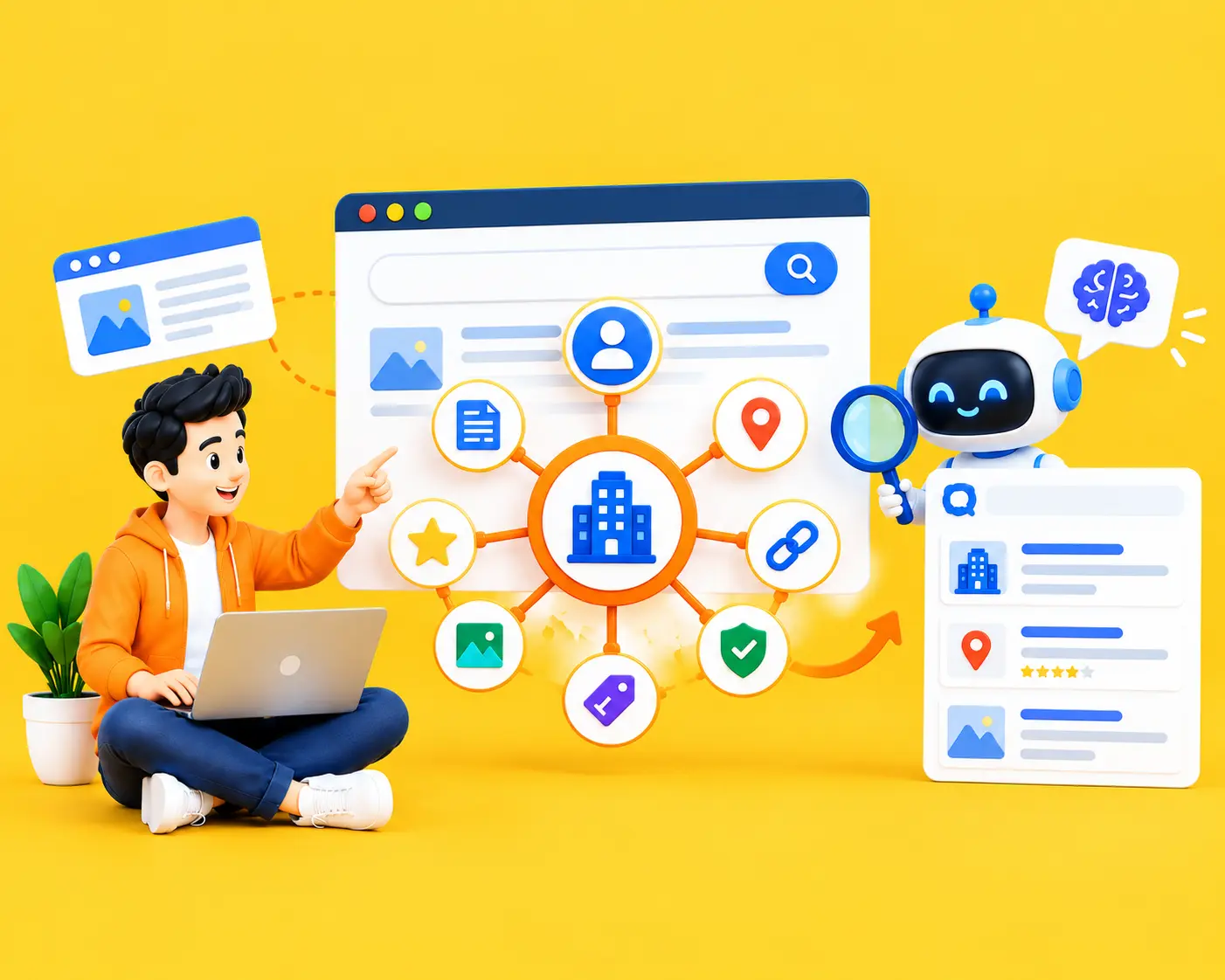

How to win zero-click search starts with changing what you ask for. Stop asking only how to get more clicks, and start asking how to become the answer people trust. Most Google searches now end on the results page, so the answer itself has become a place where brands win or lose. This article shows you how to be in that place.
At RankON Technologies, we wrote this guide for business owners, writers and SEO experts. You will get a simple method, a few templates you can copy and a clear way to check your progress.
Quick Overview
This guide explains how to win zero-click search when Google and AI tools answer questions without sending a visit. It gives you one simple method, called Found, Clear, Known, that links SEO, AEO and GEO.
You will also learn how to audit your existing pages and which questions to answer fully or keep for the click. At the end, you get a tracking template and a 30-day plan.
TL;DR
- Zero-click search means the user gets the answer and does not click. SparkToro found that 68.01% of US Google searches ended this way in early 2026.
- The goal changes from only getting clicks to being named inside the answer.
- Audit your existing pages first. Compare impressions, clicks and CTR, and inspect the search results before you write anything new.
- Be Found with strong SEO, be Clear with answer-first writing, and be Known with a trusted brand.
- Put a direct answer of about 30 to 50 words in the first sentence under each question heading.
- Answer simple questions in full, and save your deepest value for people who click.
- Test 20 customer questions every month in Google, ChatGPT, Gemini, Perplexity and Claude.
- No one can promise a citation, so build clear, honest and useful pages.
What Is Zero-Click Search?
A zero-click search is any search in which a person gets the answer without clicking a link to a website. Imagine asking a shopkeeper for the time. He tells you, you say thanks, and you walk away without buying anything. Google now plays the shopkeeper in most searches, using AI Overviews, featured snippets, maps and quick fact boxes, and your website is the shop that never sees the visit.
Here is the part many guides skip. Zero-click does not mean zero value. The answer still names sources, brands and places. Being one of those names is a real form of visibility, and it is the prize this article teaches you to win.
What Types of Zero-Click Results Can You Actually Win?
You can win the types that reward clear writing, trusted facts and good local data. Not every zero-click box is worth your time, so choose with care. The table below shows where effort pays off.
Result type | What the user sees | Can a business win it? | What helps |
AI Overviews and AI Mode | A written summary with source links | Sometimes | Helpful pages, clear answers, a strong SEO base |
Featured snippets | One short answer taken from one page | Yes | Answer-first writing, lists, tables |
People Also Ask | Related questions with short answers | Yes | Question headings with direct answers |
Local pack | Nearby businesses with ratings and hours | Yes | A complete Google Business Profile, honest reviews |
Knowledge panel | Facts about a brand, person or place | Partly | The same brand facts on trusted sites |
AI chat answers | Replies in ChatGPT, Gemini, Perplexity and Claude | Sometimes | Crawlable pages, trusted mentions |
Weather, time, scores | Instant facts | No | Skip these |
Pick two or three zero-click types that match your business. A clinic should care about the local pack and People Also Ask boxes. A software company should care about AI answers and comparison searches. A blogger should start with featured snippets, and everyone should care about clear brand facts.
How to Audit a Page for Zero-Click Search Opportunities
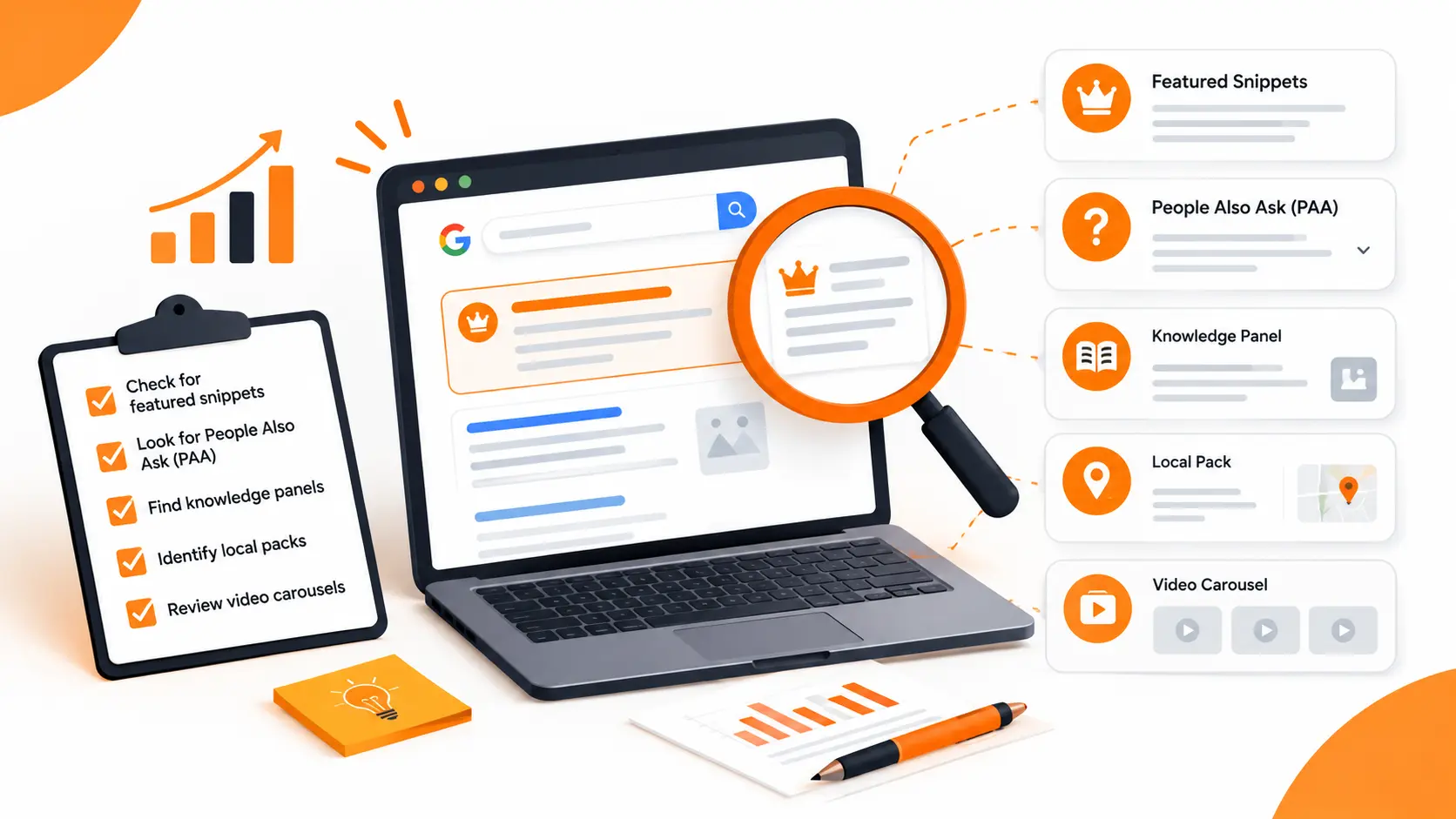
Before creating new content, check whether your existing pages already have opportunities to appear in search results that answer users’ questions directly. Google Search Console can help you identify relevant queries that receive impressions but relatively few clicks. However, a low click-through rate alone does not prove that a query is a zero-click search. Search intent, ranking position and the features shown in the search results also matter.
For example:
Imagine an SEO agency has published a guide about technical SEO. The page appears for questions such as ‘What is a canonical tag?’ and ‘Why is technical SEO important?’ Instead of immediately publishing more articles, the SEO specialist checks the current search results and evaluates whether the existing page answers these questions clearly.
A practical audit involves four steps:
- Review query data: Identify relevant queries with impressions and compare their clicks, CTR and average position.
- Inspect the search results: Check whether featured snippets, AI Overviews, People Also Ask or other answer features appear for those queries.
- Improve the page: Add accurate, direct explanations, relevant examples and useful internal links where they improve the reader’s experience.
- Track performance: Compare search metrics over time and separately record AI brand mentions and cited URLs where observable.
The purpose is to identify opportunities based on actual search behaviour rather than rewriting pages simply because zero-click search is becoming more popular.
This is an illustrative workflow:
Search query | Potential opportunity | Recommended action |
What is zero-click search? | Featured snippets or AI-generated answers | Give a clear definition and a relevant example |
How does AEO work? | Direct answers and related questions | Explain the process in simple steps |
Best SEO tools for small businesses | Comparison results and AI answers | Provide a transparent comparison of features, costs and limitations |
SEO agency near me | Local search visibility | Maintain an accurate Google Business Profile and business information |
How to measure AI visibility | Informational searches and AI citations | Offer a tracking template and explain the metrics |
The best opportunity depends on your audience, existing search performance and the results Google displays for a query. Prioritise topics that match your business expertise and allow you to provide useful information. A keyword with high search volume is not automatically the best choice if its intent does not match your services.
How Do You Win Zero-Click Search? The Found, Clear, Known Method
At RankON Technologies, we use the Found, Clear, Known framework to organise how to win zero-click search into three complementary activities.
Found focuses on SEO fundamentals that help search engines discover and index content. Clear focuses on answering user questions directly and accurately. Known focuses on building brand recognition, maintaining consistent business information, and earning credible third-party mentions that may help people and AI systems understand a business.
This is our own way of organising the work, not an official Google framework or a guarantee of search visibility.
Job | Main focus | What to monitor |
Found | SEO, crawlability, indexing and internal links | Indexed pages, impressions and relevant query performance |
Clear | Direct answers, helpful structure and supporting evidence | Featured snippet appearances and other observable search features |
Known | Brand consistency, author information and credible mentions | AI brand mentions, cited URLs and branded search demand |
These activities work together. A page needs a sound technical foundation, useful content and reliable information about the business behind it. No single activity guarantees a featured snippet, AI Overview appearance or citation.
Be Found: Fix the Base First (SEO)
Google says the same SEO basics apply to AI Overviews and AI Mode. Your page must be indexed, follow Search policies and offer helpful content written for people. Google also lists internal links as a way to help it find your pages. Skipping this base is like decorating a shop that has no door.
Run these checks first:
- Use Google Search Console to see which pages are indexed and how they perform.
- Use Screaming Frog to find broken links, redirect chains and missing titles.
- Use PageSpeed Insights to find slow pages.
- Use Ahrefs or Semrush to find the questions your audience asks.
Be Clear: Win Zero-Click Search With Answer-First Writing (AEO)
To win zero-click search, answer in the first sentence and the reasons after it. A machine cannot lift an answer hidden on the fifth line. A human reader also loves not having to hunt.
At RankON Technologies, we like answers of 30 to 50 words, which is our own rule of thumb and not a Google rule.
Use this answer block for every important question:
- Write the question as a heading.
- Answer it in the first sentence.
- Give the main reason in one or two short sentences.
- Add one example.
- Mention one exception, so you do not overpromise.
Here is a small before and after. A weak page says, ‘Page speed is a big topic, and many things matter.’ A strong page says, ‘Large images are a common cause of slow pages. Compress them and use a modern format such as WebP.’ The first sentence is a shrug, but the second is something a search box can lift without any editing.
Be Known: Build a Brand AI Tools Can Trust (GEO)
GEO means making it easy for AI tools to connect your brand with your topic. Use the same brand name, service names and contact details everywhere you appear. Show who wrote each page, when it was updated and where your facts come from.
Keep your Google Business Profile and Google Merchant Center accounts current, because Google guidance lists both as ways to improve how you appear in AI responses and other results.
Structured data helps machines read your page, but it must match the visible content and follow Google’s supported structured data guidelines. Use BlogPosting and Organization markup on pages that truly show that content, and add FAQPage markup only where a real FAQ appears on the page and the guidelines allow it. Adding markup does not guarantee AI citations, and FAQ markup is not a shortcut to AI visibility. Think of structured data as a clear label on a box and not a magic key.
Mentions on other trusted sites matter too. A brand that others name in the same context becomes easier to trust. Earn those mentions with useful research, helpful guest content and honest reviews. Never buy them.
How Can You Write a Page That AI Tools Want to Quote?
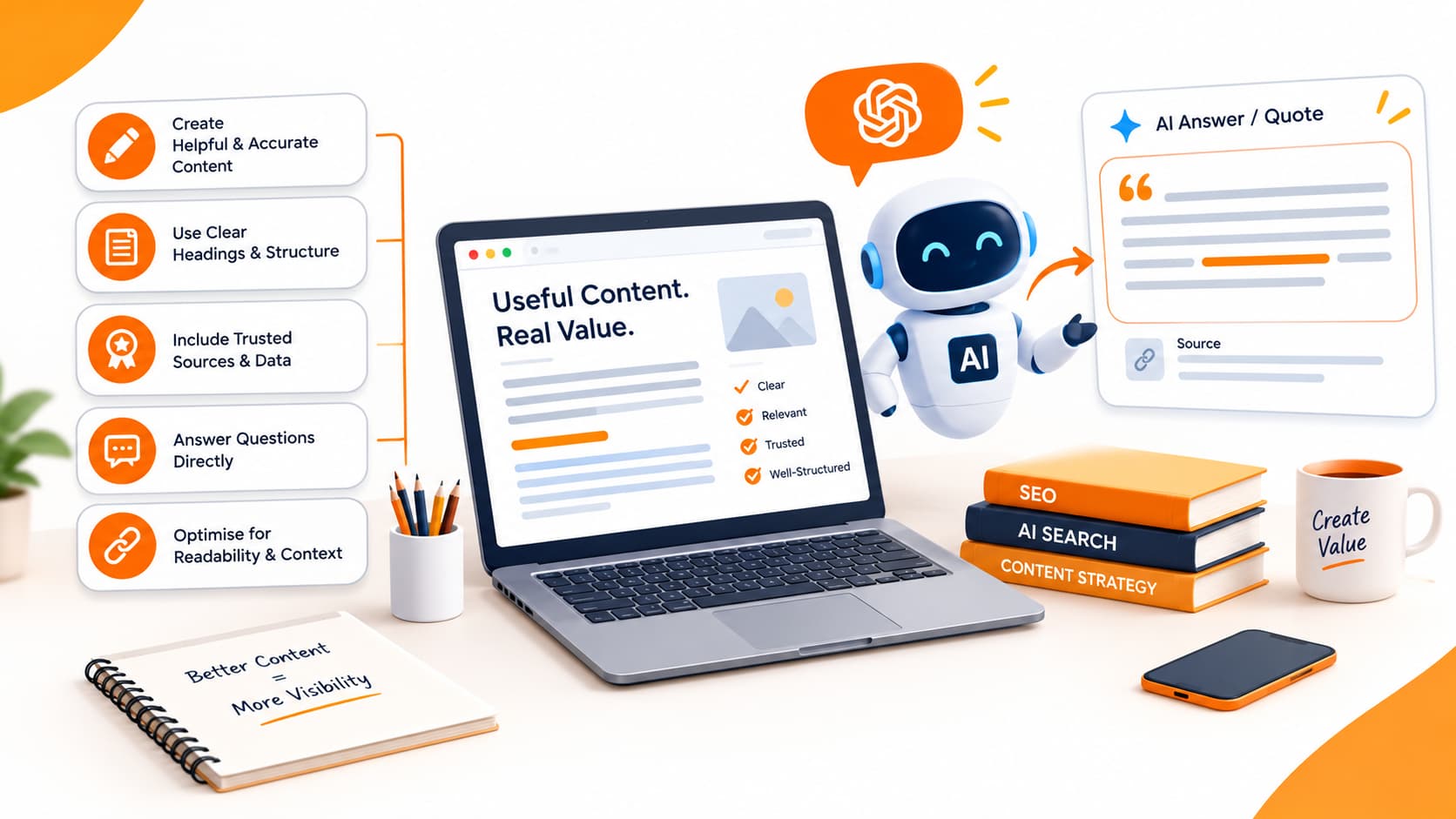
You write it by making every section useful on its own. A tool may lift one block and ignore the rest, so each block must make sense alone. Use the checklist below on every key page. Then test it by reading only the first sentence under each heading.
- A question heading that matches a real search.
- A direct answer in the first sentence.
- One short reason, one example and one exception.
- A list or table when the answer has steps or choices.
- A named source and a year beside every number.
- An author name and an update date.
- One thing only you can offer, such as your own data or your customers’ real questions.
That last point is where original content lives. Anyone can rewrite a definition. Only you know your customers’ real questions, your own search data and your own lessons. Share them, and you give people and AI tools a reason to choose your page over another copy of the same advice.
Think about query fan-out too. AI tools often split one big question into several small ones before they answer. A person who asks how to appear in AI search may trigger searches for what GEO is, which tools track citations and how to measure results. A page that answers these related questions clearly has more chances to be used, so plan around the family of questions and not one keyword.
Also check access. Make sure your robots.txt file does not block the search crawlers you want, such as OAI-SearchBot for ChatGPT search or PerplexityBot. Both names can change, so confirm them in each company’s own documentation. Google also lets you limit what it shows with nosnippet, data-nosnippet and max-snippet controls. Blocking by mistake is a quiet way to disappear.
Which Questions Should You Answer, and Which Should You Save for the Click?
Answer the simple questions in full, and save your deepest value for people who click. We call this the Answer or Pull choice. An answer question builds awareness and memory. A pull question needs a click, because the reader wants proof, tools or a decision.
Type | Example question | What to do | Goal |
Answer | What is a featured snippet? | Define it in 30 to 50 words | Be named and remembered |
Answer | What is zero-click search? | Give a clear definition and one example | Build brand visibility |
Pull | Which SEO tool suits a small team? | Give a short answer, then a full comparison page | Earn the click |
Pull | How do I audit my site for AI visibility? | Offer a checklist or template | Earn trust and leads |
Pew found that AI summaries appear most often for longer, question-style searches, yet people still click when they need detail. So never let an answer page be a dead end. Link each one to a deeper page, such as a tool, template, calculator or real case study. Build both kinds, and connect them.
How Do You Check Whether AI Tools Know Your Brand?
You check it by hand, once a month, with a simple test. Pick questions your customers really ask and run each one in Google, ChatGPT, Gemini, Perplexity and Claude. Record whether your brand or page appears, which sources appear instead and what the answer says about you. The template below shows how to keep those records.
AI Visibility Tracking Template
Use a simple tracking sheet to record how your brand appears when customers ask relevant questions across search engines and AI platforms.
Date | Platform | Customer query | Brand mentioned? | Your URL cited? | Notes |
| [Date] | Google Search / AI features | [Customer question] | Yes / No | Yes / No | [Record visible results] |
| [Date] | ChatGPT Search | [Customer question] | Yes / No | Yes / No | [Record cited sources] |
| [Date] | Perplexity | [Customer question] | Yes / No | Yes / No | [Record competitor mentions] |
| [Date] | Gemini | [Customer question] | Yes / No | Yes / No | [Record answer context] |
Start with 20 questions that reflect your customers’ real needs. Keep the questions consistent when repeating the test and record the date, platform and relevant context.
AI-generated answers can vary across runs, so a single result should not be treated as definitive evidence of visibility. Add a row for Claude or any other platform your customers use.
This template helps you identify patterns in brand mentions and source citations. It is a monitoring method, not a guarantee that every platform provides complete or consistent reporting.
How to Measure Zero-Click Search Without Inventing Results
You do not need to claim a traffic increase to explain how a zero-click strategy should be measured. Start by recording the current performance of the pages and queries you want to improve.
Use Google Search Console to monitor impressions, clicks, click-through rate and average position for relevant queries. Inspect the search results to identify features that may answer users’ questions without a website visit. Remember that low CTR can have several causes and does not, by itself, establish that a search was zero-click.
For AI search, maintain a separate record of brand mentions, cited URLs and competing sources across a consistent set of customer questions. Treat these checks as observations because AI answers can change between searches.
If you want to know about AI SEO checklist in 2027, read this guide:
Finally, monitor branded search demand, referral traffic, qualified leads and conversions. These metrics help you assess whether your search visibility is contributing to business goals, although they do not prove that a particular AI mention caused a conversion.
Record your starting point before making changes, document what you update and review the same metrics over time. Report observed results honestly, including when performance remains unchanged.
What Does This Look Like in Real Life?
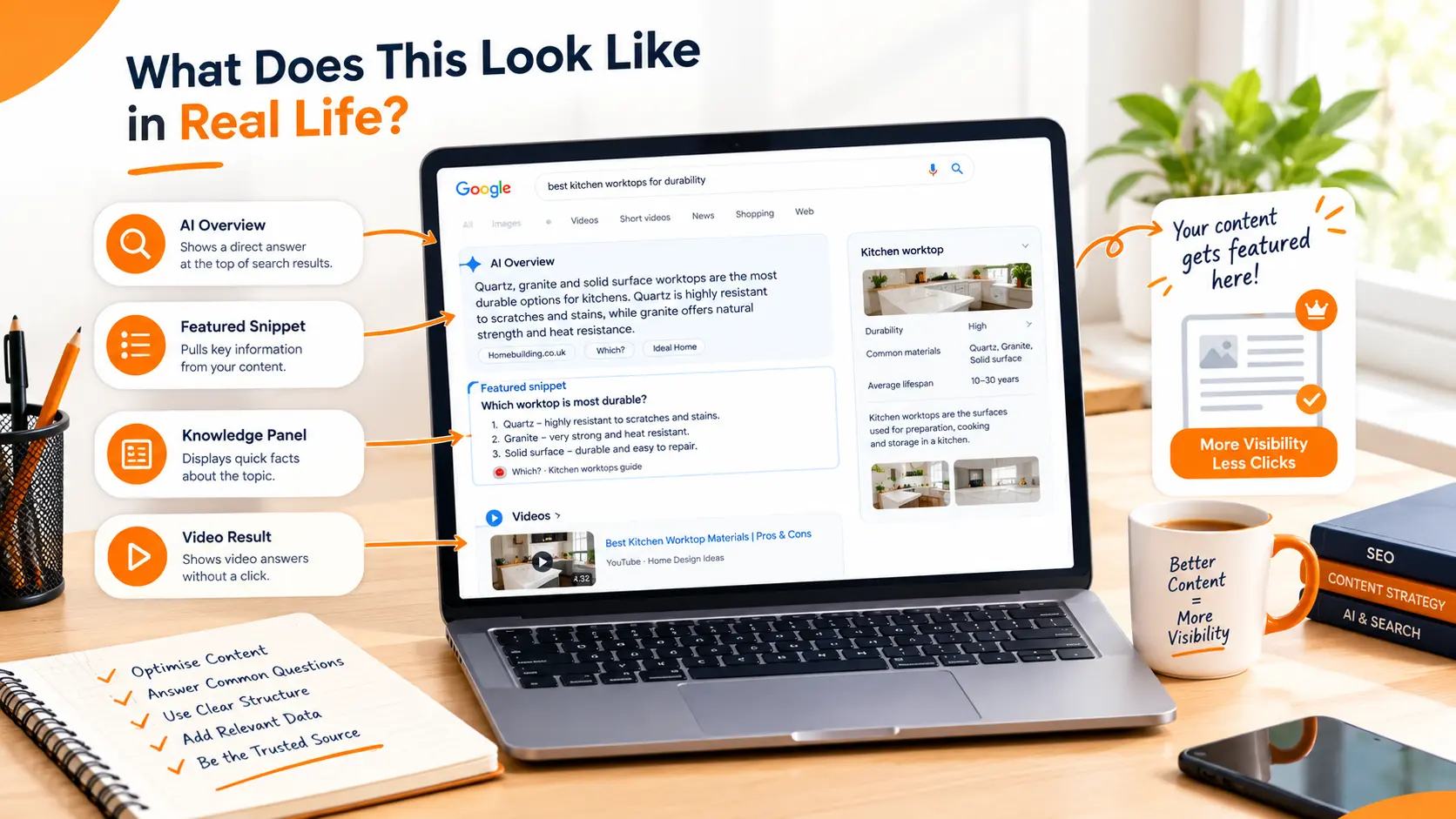
Here are three small scenarios that show the method at work. They are made-up examples to explain the steps, not real client results. Each one shows how a different business can handle zero-click search with the same three jobs. Use them as patterns for your own pages.
A local dental clinic. The clinic wants to appear when people ask about the cost of a root canal. It writes a page titled ‘How much does a root canal cost?’ and gives a clear price range based on its own fees in the first sentence. It adds what changes the price, a short table of treatments, and its real address and phone number. It also keeps its Google Business Profile up to date and asks happy patients for honest reviews.
A project software company. The company wants to be named when people ask for the best tools for small teams. It publishes a comparison table with real prices, features, and limits, and it also names its own weak points. It places a short answer at the top and links to detailed review pages. Honesty builds trust, and depth gives readers a reason to click.
An SEO blog. The blog wants to appear for questions about answer engine optimization. It rewrites its top ten posts so that each question heading has a 40-word answer right below it. It adds the author name, the date and two named sources to each post. Then it tests twenty questions in AI tools every month and records what it finds.
Notice the pattern. Each one gives a short answer first, proof second and depth third. None of them chase clicks alone, because in a zero-click world, both the answer and the visit matter. That balance is the real skill behind zero-click search.
What Mistakes Waste the Most Time?
The biggest waste is judging success in a zero-click search world by clicks alone. These are the others we see most often:
- Hiding the answer in the middle of a long paragraph, where zero-click boxes cannot lift it.
- Blocking search crawlers in robots.txt without knowing it.
- Using numbers without a named source, which hurts trust.
- Repeating the same keyword again and again.
- Writing many thin pages for tiny questions instead of one complete page.
- Adding structured data that does not match the visible page.
- Ignoring reviews, brand facts and your Google Business Profile.
How to Win Zero-Click Search in 30 Days: A Simple Action Plan
How to win zero-click search in 30 days is about doing a few things well and in the right order. You will not control every AI answer. You can, however, make your best pages clearer, more useful and easier to trust. Here is a zero-click plan you can start today.
Week 1: Be Found. Check indexing in Google Search Console. Fix broken links and slow pages. Confirm that robots.txt does not block the crawlers you want.
Week 2: Choose your pages. Pick your top 10 pages by impressions. Write down the questions each page should answer. Write the direct answer for each question in 30 to 50 words.
Week 3: Be Clear. Place each answer right under its question heading. Add one real example, one list or table and one named source to each page. Add FAQs only where readers truly ask those questions.
Week 4: Be Known and Measure. Update your Google Business Profile and author pages. Add structured data that matches the page. Run your 20 test questions and save the results as your starting point. Repeat every month.
Conclusion
How to win zero-click search is not a secret. Be found with strong SEO, be clear with answer-first writing, and be known with a brand that people and AI tools can trust. Then measure visibility and brand demand, not only clicks.
It can feel unfair to see impressions rise while clicks fall. Do not let that push you into panic or shortcuts. Pick your top 10 pages, rewrite the first sentence under each heading, and add one real source and one example. If you want a second pair of eyes on those pages, the RankON Technologies team is happy to take a look.
FAQs About How to Win Zero-Click Search
What is zero-click search?
A zero-click search is a search in which the user finds an answer on the results page without clicking any links. Common examples are AI Overviews, featured snippets, map listings and quick fact boxes. SparkToro found that 68.01% of US Google searches ended without a click in early 2026.
Is zero-click search bad for SEO?
Zero-click search lowers clicks for simple questions, but it does not end SEO. Google says the same SEO basics apply to its AI features. Your goal widens from getting clicks to also being seen, named and trusted.
Is SEO still worth it?
Yes. Google says its AI features sit on top of the same core quality and ranking systems as Search. SEO is the base, and AEO and GEO build on it.
What is the difference between AEO and GEO?
AEO is about writing short, direct answers that search tools can lift from your page. GEO is about making your brand and facts clear to AI tools so they can use and cite you. You need both, and both rest on solid SEO.
Does schema markup help me get cited by AI tools?
Schema helps machines understand your page, but it does not guarantee a citation. Use it only to describe content that people can already see, and follow Google’s structured data guidelines. FAQ markup is not a shortcut to AI visibility, so never add it for questions that do not appear on the page.
How long does it take to see results?
Some changes, such as fixing indexing problems, can show in Search Console within weeks. Brand mentions and trust take longer. We suggest checking your results monthly for at least three months before you change your plan.
How do I check whether AI tools mention my brand?
Write 20 questions your customers ask and run them in Google, ChatGPT, Gemini, Perplexity and Claude each month. Record whether your brand appears and which sources the tool uses instead. Repeat the same list every month so you can compare.
Can a small business win zero-click search?
Yes. A small business can win by being very clear about what it does, where it works and who it helps. A complete Google Business Profile, honest reviews and a few strong answer-first pages can put a local brand inside answers. Start with the questions your customers already ask you.