
Search engine optimization is changing rapidly. For years, website owners focused primarily on ranking higher on Google, earning backlinks, optimizing keywords, and attracting organic traffic.
These fundamentals remain important, but the growing use of artificial intelligence in search is creating another opportunity: getting your website cited, referenced, or recommended in AI-generated answers.
Google AI Overviews, AI Mode, ChatGPT search, Microsoft Copilot, and other AI-powered discovery tools are changing how people find information, compare services, and make purchasing decisions.
Instead of clicking through multiple websites, users can increasingly get summarized answers directly from AI systems, sometimes with links to supporting sources.
For website owners, this creates a new challenge. It is no longer enough to ask whether your website ranks in search results.
You also need to consider whether AI systems can understand your content, trust your expertise, and identify your pages as useful sources for answering questions.
As we approach 2027, an effective SEO Content Strategy for AI Visibility should combine traditional SEO, high-quality content, technical accessibility, brand authority, and clear information architecture.
It should also account for the differences between AI search platforms, because appearing in one AI-generated answer does not guarantee visibility in another.
“This AI SEO checklist for 2027 explains what website owners should prioritize, which technical and content improvements matter, and how to build a website that is easier for search engines and AI systems to discover, understand, and potentially cite.”
What Is AI SEO, and Why Does It Matter in 2027?
AI SEO is the practice of optimizing a website’s content, technical structure, and overall online presence to improve its visibility across AI-powered search experiences and answer engines.
Traditional SEO generally focuses on helping web pages appear in search results for relevant queries. AI SEO builds on those principles while paying closer attention to how systems interpret questions, retrieve relevant information, synthesize answers, and select sources to reference.
For example, a traditional search query might be:
“Best SEO agency for a healthcare website.”
An AI-powered search query might be:
“How should a healthcare business choose an SEO agency that understands medical content, patient privacy, and local search?”
The second question requires a more detailed answer involving multiple considerations. A website that explains these considerations clearly, demonstrates relevant experience, and supports its claims with trustworthy information may be a useful source for an AI-generated response.
AI SEO does not mean abandoning traditional search optimization. Crawlability, indexing, relevant content, website performance, internal links, backlinks, and search intent still matter. The difference is that website owners must also consider how their information can be retrieved and used in conversational answers.
Curious about how AI is changing search? Explore our AI SEO Guide to understand how businesses can improve their visibility in AI-powered search results.
AI SEO vs. Traditional SEO: What’s the Difference?
Area | Traditional SEO | AI SEO |
Primary visibility goal | Rankings in organic search results | Visibility in AI-generated answers, citations, and recommendations |
Content approach | Match search intent and satisfy users | Answer specific questions clearly and provide useful, verifiable information |
Authority signals | Relevant backlinks, expertise, reputation, and quality | The same foundations, alongside clear entity information and corroborated brand details |
Technical focus | Crawling, indexing, site structure, and performance | The same foundations, plus accessibility to relevant AI search and retrieval systems |
Measurement | Rankings, clicks, impressions, conversions | Citations, AI referral traffic, brand mentions, assisted conversions, and traditional SEO metrics |
The distinction is not absolute. Many of the practices that improve traditional SEO can also help AI systems find and interpret useful information.
The objective for 2027 is to build a search strategy that serves people first while making your content accessible, understandable, and credible across multiple discovery channels.
The Complete AI SEO Checklist for 2027
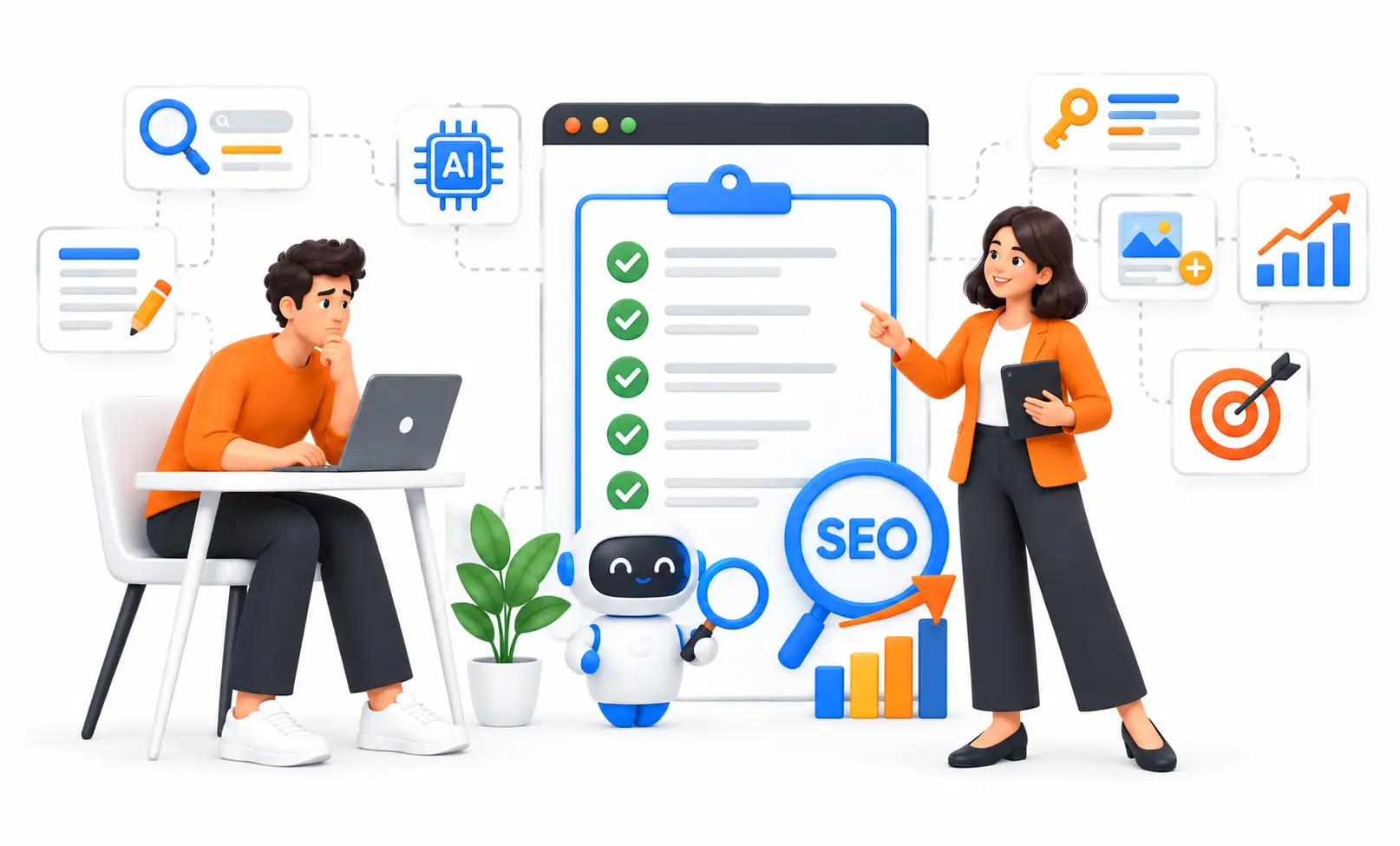
Use the following checklist to assess whether your website is prepared for AI-powered search. Prioritize the fundamentals first, then improve the content, authority, and measurement systems that support long-term visibility.
Website owner checklist
1. Technical SEO and AI crawler accessibility
- Check that important pages are crawlable and indexable.
- Verify that your XML sitemap is current and submitted.
- Review robots.txt, CDN rules, firewalls, and security plugins for accidental crawler blocks.
- Make important page content available as readable text, not only inside images or inaccessible scripts.
- Check canonical tags, redirects, HTTP status codes, and duplicate URLs.
- Test important pages with Google Search Console URL Inspection.
2. Content quality and answer optimization
- Identify the primary search intent for every important page.
- Answer the main question near the beginning of the page.
- Use descriptive headings that reflect genuine user questions.
- Include useful explanations, examples, comparisons, and actionable steps.
- Add original insights, first-hand experience, research, or case studies.
- Verify factual claims and cite reliable sources where appropriate.
- Remove outdated, redundant, thin, and overlapping content.
3. E-E-A-T and brand authority
- Publish accurate author biographies and relevant credentials.
- Show genuine experience through examples and documented results.
- Create clear About, Contact, and company information pages.
- Keep business name, services, location, and contact details consistent.
- Earn relevant editorial mentions, backlinks, reviews, and industry references.
- Update important content when facts, products, or guidance change.
Wondering how experience, expertise and trust influence search visibility? Read our E-E-A-T in SEO Guide to understand why credibility matters for your website.
4. Structured data and information architecture
- Implement relevant Schema.org markup correctly.
- Keep structured data consistent with visible page content.
- Use descriptive internal links and logical category structures.
- Connect related articles, service pages, authors, and business entities.
- Use descriptive image alt text and provide relevant video context.
- Avoid adding irrelevant or misleading structured data.
5. AI search measurement
- Record baseline organic impressions, clicks, rankings, and conversions.
- Track citations and linked mentions across relevant AI platforms.
- Segment referral traffic from AI tools in analytics.
- Monitor branded searches, qualified leads, and assisted conversions.
- Recheck priority questions and pages periodically.
- Use findings to update content and technical priorities.
1. Make Sure Search Engines and AI Search Systems Can Access Your Website
Before investing in content production or AI optimization, make sure your website can be discovered and processed.
A useful article cannot become a reliable search source if the relevant crawler cannot access it or the page is not eligible to appear in search results.
Google’s official guidance confirms that its AI search features rely on established Search fundamentals.
There is no separate set of mandatory AI-specific SEO requirements for appearing in AI Overviews or AI Mode. Pages must meet the applicable technical requirements and be eligible to appear in Google Search.
Technical checks to complete
- Check crawling and indexing: Use Google Search Console to inspect your most important service pages, blog posts, product pages, and landing pages. Confirm that they are indexable and that Google can access their primary content.
- Review robots.txt rules: Check whether your robots.txt file, CDN, firewall, or security configuration blocks relevant crawlers. Do not assume that allowing Googlebot automatically allows every other AI search crawler.
- Check canonical URLs: Each important page should have a clear preferred URL. Incorrect canonical tags, redirect chains, and duplicate pages can make it harder for search engines to identify the intended source.
- Keep your XML sitemap updated: Include important, indexable URLs and ensure the sitemap reflects the actual website structure.
- Make essential content accessible as text: Important information should not exist exclusively in an image, video, or interactive element that crawlers cannot readily process. Use HTML headings, paragraphs, lists, and tables where appropriate.
Should you allow AI crawlers?
If visibility in ChatGPT search is part of your strategy, review OpenAI’s crawler documentation and check whether your website blocks OAI-SearchBot.
OpenAI identifies OAI-SearchBot as the crawler used to help surface websites in ChatGPT search results. It is separate from GPTBot, which is associated with collecting content that may be used to improve generative AI foundation models. These settings serve different purposes.
Website owners should decide which access permissions suit their publishing and business objectives.
For example: A business that wants its educational articles to be discovered through ChatGPT search may choose to allow OAI-SearchBot while separately evaluating its policy for GPTBot.
Do not assume that allowing a crawler guarantees a citation. It simply helps remove one potential accessibility barrier.
2. Write Content That Directly Answers User Questions
One of the most practical AI SEO improvements is to make your content more useful and easier to interpret.
People increasingly ask detailed questions rather than entering only short keywords. AI-powered search systems can also explore related subquestions to build a more complete response. Google’s documentation describes this process as query fan-out.
Your content should therefore address the main topic and the important supporting questions that naturally arise from it.
Put the answer before the explanation
Consider a page targeting the keyword “How long does SEO take to work?”
A weak introduction might spend several paragraphs describing the history and importance of SEO before addressing the question.
A stronger introduction would say:
“SEO often takes several months to produce meaningful results, although the timeline depends on website condition, competition, content quality, authority, and the resources invested. Technical improvements may be processed sooner, while competitive rankings and business outcomes usually require sustained work.”
The article can then explain the factors affecting the timeline, provide realistic examples, and discuss how to measure progress.
This structure helps readers find the answer quickly and makes the key information easier to interpret. It does not guarantee that an AI system will quote or cite the page.
Use a question-led content structure
Organize important pages around the questions your audience needs answered.
For an SEO service at RankON Technologies, a useful structure might include:
- What is SEO, and how does it work?
- How much does professional SEO cost?
- How long does SEO take to produce results?
- What should an SEO audit include?
- How can a business measure SEO performance?
- How should businesses evaluate an SEO agency?
These questions should appear only where they serve the reader. Avoid creating dozens of nearly identical pages simply to target variations of the same keyword.
Make each section useful on its own
A practical content section often contains four elements:
- A descriptive heading that identifies the topic.
- A direct explanation of the main point.
- Supporting detail, evidence, or an example.
- A practical takeaway or next step.
For example: A section about technical SEO should explain which issues matter, how to identify them, and how to fix them. Merely repeating that technical SEO is important adds little value.
The goal is not to write for an AI algorithm at the expense of people. It is to make genuinely useful information easier for both people and search systems to understand.
3. Publish Original Insights Instead of Rewriting Existing Articles
Content originality is one of the most important long-term priorities for AI SEO in 2027.
AI-generated answers can already summarize common information. A website that publishes another generic explanation of a familiar topic may have little to distinguish it from competing sources.
Google’s generative AI guidance specifically encourages publishers to create valuable, non-commodity content with original perspectives and first-hand experience rather than simply recycling information available elsewhere.
What counts as original content?
Original content does not always require a large research budget. Depending on your industry, it can include:
- Case studies showing the problem, actions taken, and measurable outcomes.
- First-hand product testing and comparisons.
- Expert commentary based on real client experience.
- Original surveys, interviews, or research findings.
- Screenshots and examples that explain a process.
- Detailed explanations of mistakes and how to avoid them.
- Industry-specific insights that generic articles overlook.
For example: An SEO agency could publish a case study explaining how it diagnosed indexing problems, improved internal linking, consolidated overlapping pages, and measured the results over time.
The agency should distinguish its own work from other contributing factors and avoid promising that the same results will occur for every business.
This is more informative than publishing a generic article that simply lists ten SEO tips.
Can you use AI to write SEO content?
Yes. AI tools can assist with research organization, outlines, editing, summarization, and content planning. The important question is whether the finished content is accurate, useful, original, and created to serve the intended audience.
Avoid publishing large volumes of lightly edited AI-generated articles that repeat existing information, introduce factual errors, or target numerous near-identical queries.
A better workflow is to use AI to improve efficiency while retaining human judgment, expert review, original insights, and fact-checking.
4. Demonstrate Experience, Expertise, Authoritativeness, and Trustworthiness
AI SEO is not just a content formatting exercise. Your website must give readers and search systems good reasons to trust the information it provides.
Google’s quality guidance emphasizes helpful, reliable, people-first content and the importance of demonstrating experience and expertise where relevant.
These principles are particularly important for topics involving health, finance, legal services, safety, and other consequential decisions.
Add clear author biographies
Important articles should identify who wrote or reviewed them.
A useful author bio can explain:
- Relevant professional experience.
- Areas of specialization.
- Qualifications or credentials, where applicable.
- Practical experience related to the article.
- Links to professional profiles or other work.
Do not invent credentials or imply that an author has personally performed work they have not done.
Create detailed About and Contact pages
Your website should clearly communicate who operates the business, what it does, whom it serves, and how users can contact it.
For service businesses, consider including:
- Company history and mission.
- Leadership and team profiles.
- Relevant qualifications and industry experience.
- Service areas and business contact details.
- Client examples, testimonials, and case studies.
- Policies and disclosures relevant to your industry.
These details help establish a consistent understanding of your business and give potential customers reasons to evaluate your credibility.
Keep information consistent across the web
Your website should agree with credible external references about important facts such as your company name, founders, services, location, and areas of expertise.
Maintain accurate business profiles, professional biographies, and relevant industry listings. Earn genuine mentions from reputable publications, professional organizations, and industry websites where appropriate.
The objective is not to manufacture mentions everywhere. It is to build a verifiable, consistent brand presence that reflects the actual business.
5. Structure Content So AI Systems Can Understand It Easily
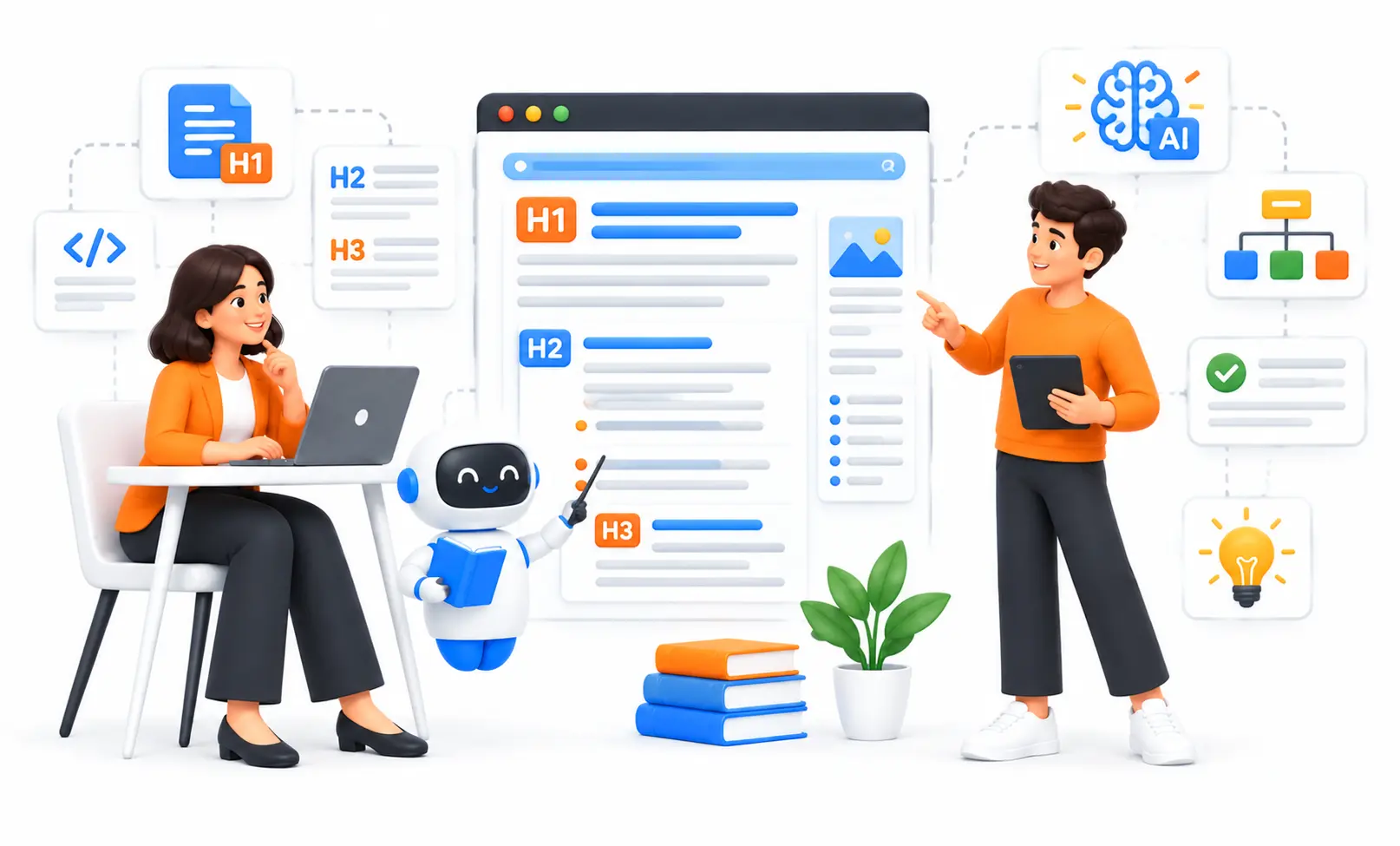
Clear information architecture benefits both human readers and search systems.
When a page uses meaningful headings, concise explanations, descriptive links, and logical sections, its main ideas are easier to locate and interpret.
Use a logical heading hierarchy
Organize each page with one clear primary heading, followed by relevant H2 sections and H3 subsections where needed.
In this screenshot showing headings hierarchy👇
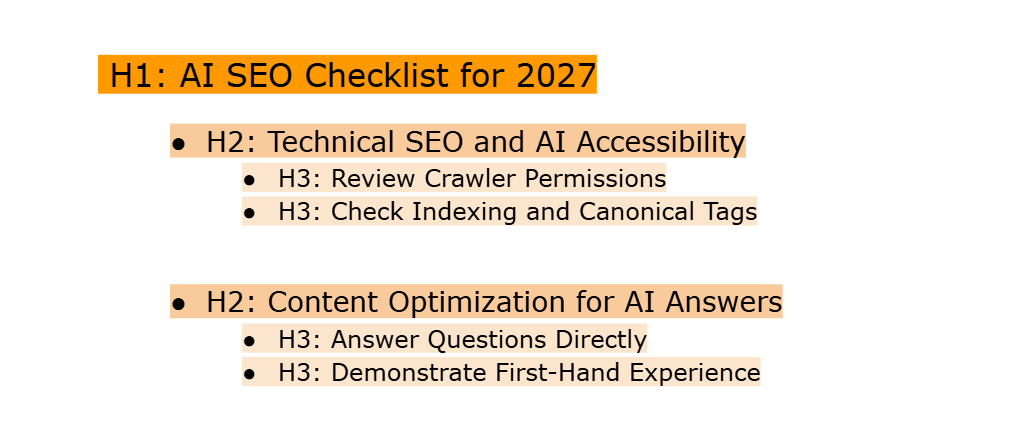
Headings should describe the content that follows rather than exist solely to insert keywords.
Use tables, lists, and examples appropriately
A table is useful for comparing SEO tools, service options, costs, or technical requirements. A numbered list is appropriate for sequential instructions. A short paragraph is often better for explaining a concept.
These formats make information easier to scan and help readers identify the parts relevant to their questions.
Do not turn every paragraph into a bullet list or reduce a complex subject to a series of superficial one-line answers.
Strengthen internal linking
Link related pages using descriptive anchor text.
For example, an article about AI SEO could link to a detailed guide on technical SEO, a page explaining content marketing, or a service page describing an agency’s SEO process.
Read our own guide on Internal Linking in SEO: What Are The Benefits?.
Internal links help users navigate your website and help search engines discover relationships between pages. They also support a clearer topical structure.
Add useful images and videos
Use original screenshots, diagrams, product images, demonstrations, or explanatory videos when they genuinely improve understanding.
Write descriptive alt text for meaningful images, provide useful captions, and ensure videos have relevant titles and supporting descriptions or transcripts when appropriate.
Do not add images merely to make an article look longer. Every visual element should contribute to the reader’s understanding.
6. Implement Relevant Schema Markup Correctly
Structured data provides search engines with standardized information about the content of a page.
Depending on your website, useful schema types may include:
Schema type | Typical use |
Organization | Describes a company or organization |
Person | Describes an author, expert, or other individual |
Article | Describes an editorial article or blog post |
BreadcrumbList | Describes a page’s position in a website hierarchy |
LocalBusiness | Describes a qualifying local business |
Product | Describes a product and its relevant attributes |
Choose schema types that accurately reflect your page and business. Validate your markup, check for errors, and keep it consistent with the visible content.
However, schema markup is not a shortcut to AI citations. Google explicitly states that no special AI-specific Schema.org markup is required to appear in AI Overviews or AI Mode.
Structured data can clarify information, but it cannot compensate for weak content, blocked crawling, misleading claims, or a lack of credibility.
Also, do not assume that implementing FAQ schema guarantees an FAQ rich result. Google’s supported search features and eligibility rules can change.
What about llms.txt?
Some website owners publish an llms.txt file to provide AI-oriented descriptions or pointers to important website content.
It may be useful for workflows or systems that choose to consume it, but it should not be treated as a requirement for Google AI visibility.
Google’s documentation states that llms.txt is not needed for Google Search and does not improve or harm visibility or rankings there.
Prioritize accessible pages, quality content, and correct technical implementation before investing in optional AI-specific files.
If you want to know more about llms.txt. Read my guide on What is llms.txt? Everything You Should Know.
7. Build Topical Authority Around Your Core Services
Publishing one excellent article is useful, but a well-organized collection of related content can provide much more value.
Topical authority is a practical SEO concept describing the depth, relevance, and consistency of a website’s coverage of a subject. It is not a single publicly documented score that guarantees AI citations.
For website owners, the aim is to demonstrate that the website provides comprehensive, useful information about the topics most relevant to its audience.

Supporting articles should link naturally to relevant guides and service pages.
Each cluster should answer a distinct set of questions while linking to related resources.
For example: A technical SEO cluster might include guides on crawl budget, indexing errors, Core Web Vitals, canonical tags, and website migrations.
The result is a more useful content ecosystem rather than a collection of disconnected blog posts.
Avoid keyword cannibalization
Before creating another article, check whether your website already has a page addressing the same intent.
If two pages compete for substantially the same topic, consider consolidating them, clarifying their different purposes, or improving internal links.
More pages do not automatically mean greater topical authority. Useful coverage and clear relationships matter more than publishing volume.
8. Earn High-Quality Backlinks and Independent Brand Mentions
Your website is not the only place where your expertise and reputation are represented.
Other credible websites may reference your business, quote your experts, review your products, link to your research, or mention your services in relevant discussions.
These references can help establish your brand’s presence and create additional discovery paths.
How to strengthen your off-page SEO
Prioritize activities such as:
- Publishing original research that other websites may reference.
- Contributing useful expert commentary to relevant publications.
- Earning editorial links through genuinely valuable resources.
- Participating in relevant industry events and professional communities.
- Encouraging authentic customer reviews on appropriate platforms.
- Building partnerships that produce meaningful references.
For example: An accounting firm might publish a detailed guide to small-business tax recordkeeping. An industry publication could then reference that guide in an article about financial compliance.
That mention can introduce the firm to new audiences and provide a useful reference for its expertise.
Avoid purchasing large volumes of low-quality links or manufacturing brand mentions solely to manipulate search systems. There is no reliable formula that converts a particular number of mentions into AI citations.
Curious about how backlinks and brand mentions support website authority? Explore our Off-Page SEO Services to learn more about building a credible online presence.
9. Optimize Your Business Information for Local and Commercial AI Searches
For businesses that serve specific locations, AI visibility also depends on having clear, accurate information about the business and its services.
A user might ask an AI assistant:
- Which SEO agencies work with healthcare businesses?
- What should I look for when choosing a web development company in London?
- Which plumbing companies serve my area?
- What is the difference between two accounting services?
To help potential customers evaluate your business, make sure your website provides the information they need.
Local SEO checklist
- Keep your Google Business Profile accurate where applicable.
- Maintain consistent business name, address, phone number, and operating hours.
- Create useful location pages for areas you genuinely serve.
- Clearly explain your services, qualifications, and service limitations.
- Collect authentic customer reviews and respond professionally.
- Use relevant local business structured data where appropriate.
- Keep contact details and service information up to date.
Do not create hundreds of nearly identical location pages with only the city name changed. Each location page should offer meaningful, accurate information relevant to that area.
Ecommerce and product websites
Online retailers should also maintain accurate product information, including prices, availability, product specifications, shipping policies, returns, images, and relevant structured data.
Where applicable, keep product feeds and Merchant Center information up to date.
Clear product details help users compare options and support search systems that retrieve product information. They do not guarantee that a product will be recommended by an AI assistant.
10. Measure AI Search Visibility Instead of Guessing
One of the biggest mistakes in AI SEO is making changes without measuring whether they improve visibility or business outcomes.
AI-generated answers can vary by query, platform, location, available sources, and time. A website that appears in one response may not appear in another.
That makes repeatable measurement important.
Track these AI SEO metrics
Metric | What it tells you |
AI citations and linked mentions | Whether relevant AI answers reference your website |
AI referral sessions | How many visits arrive from identifiable AI platforms |
Qualified leads and conversions | Whether AI-driven visitors contribute to business outcomes |
Organic impressions and clicks | How your visibility in conventional search is changing |
Branded search demand | Whether more people are searching for your company |
Content-level performance | Which pages attract visibility, engagement, and conversions |
Use Google Search Console
Monitor indexing, impressions, clicks, search queries, and page performance.
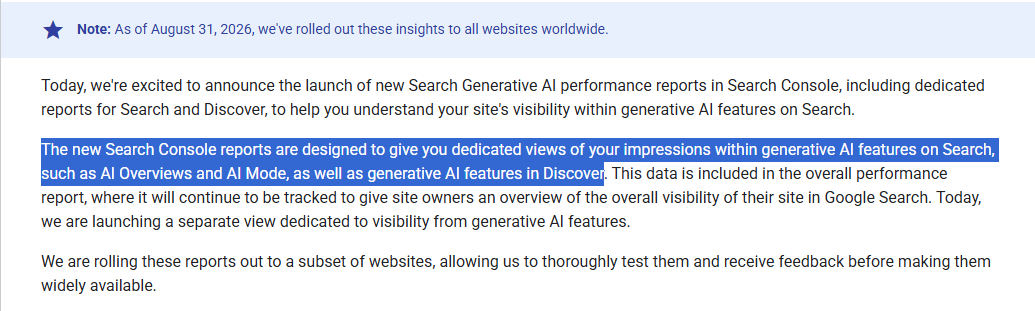
As of August 2026, Google had also rolled out dedicated Search Console reporting for visibility in generative AI features across Search and Discover. Website owners can use the available reports to examine impressions, URLs, countries, and other supported dimensions.
The precise reporting options may evolve, so check the current documentation for your property.
In this screenshot👇
Use Google Analytics 4
Review referral traffic from AI platforms and assess engagement and conversions.
For ChatGPT search, OpenAI documents the use of utm_source=chatgpt.com in referral URLs, which can help identify incoming visits in analytics tools.
Not every AI-assisted visit will be identifiable. Users may see an AI answer, remember your brand, and visit your website later through a different channel.
Run repeatable AI citation tests
Build a small set of questions relevant to your business and test them periodically across the AI platforms your audience uses.
For example, an SEO agency could monitor:
- How should a small business choose an SEO agency?
- What should an SEO audit include?
- Which factors affect local SEO performance?
- How can a business improve its visibility in AI search?
- What should a company look for in an AI SEO service?
Record the date, platform, exact question, whether your brand appeared, which URL was cited, and which competitors appeared.
Repeat the same questions over time, while recognizing that responses are not perfectly deterministic.
The goal is to identify patterns and opportunities- not to treat one AI-generated answer as definitive proof of visibility.
11. Make Your Website Easy for AI Agents to Navigate
AI-powered discovery is expanding beyond answering questions. Some systems can also help users research products, compare services, and interact with websites.
That makes usability and accessibility increasingly relevant.
Review whether your website’s important functions are understandable and usable, including:
- Navigation menus and internal links.
- Search and filtering controls.
- Contact forms and booking processes.
- Product selection and checkout.
- Descriptive labels for interactive elements.
- Accessible buttons, form fields, and navigation controls.
Use semantic HTML and appropriate ARIA attributes where needed. Ensure that important content and functionality do not depend on inaccessible interactions.
This is not simply an AI SEO tactic. A website that is easier to navigate is also better for users with disabilities, mobile visitors, and people using assistive technologies.
For businesses that depend on leads or sales, a clear and accessible conversion process can be just as important as attracting additional visitors.
12. Keep Your Content Fresh, Accurate, and Maintained
Outdated information can undermine the usefulness of an otherwise strong article.
This is particularly important for topics involving software features, search engine policies, pricing, regulations, product specifications, and industry developments.
Create a content maintenance schedule based on how quickly information changes and how important the page is to your business.
During each review:
- Verify factual claims and external references.
- Update information that is no longer accurate.
- Add relevant examples or developments where they improve the article.
- Remove redundant or misleading sections.
- Check internal links, redirects, and technical errors.
- Update the displayed publication or modification date only when appropriate.
Do not change a publication date simply to make an article appear fresh. A genuine update should improve the accuracy, usefulness, or completeness of the page.
For an article about AI SEO in 2027, for example, reviewing official search documentation regularly is more valuable than repeatedly changing the year in the title without updating the content.
Explore: AI in SEO: How It’s Changing SEO in 2026
AI SEO Myths Website Owners Should Avoid in 2027
Not every popular AI optimization recommendation is supported by evidence. Focus your resources on practices that improve content quality, accessibility, and credibility.
Myth | What website owners should understand |
| You must have an llms.txt file to rank in AI search. | Google says this file is not required for Google Search AI visibility. |
| Adding a special AI schema guarantees citations. | There is no special AI-specific schema required for Google AI Overviews or AI Mode. |
| Publishing more AI-generated content automatically increases visibility. | Large volumes of repetitive or low-value content can be ineffective and may violate spam policies. |
| Every AI platform uses the same ranking signals. | Platforms use different systems, data sources, and retrieval methods. |
| High keyword density improves AI citations. | Keywords should appear naturally in useful, relevant content. |
| Ranking first on Google guarantees an AI citation. | Conventional rankings and AI citations are not interchangeable guarantees. |
| A single AI visibility test proves success or failure. | Responses can vary, so repeated testing and broader measurement are more reliable. |
The best strategy is to evaluate optimization recommendations against official documentation, real performance data, and the needs of your audience. Google’s own guidance emphasizes established SEO fundamentals and valuable, distinctive content rather than special-purpose AI tricks.
A Practical 90-Day AI SEO Action Plan
Website owners do not need to overhaul everything at once. A phased plan makes it easier to identify technical problems, improve important pages, and measure the impact of changes.
Days 1–30: Audit and establish a baseline
Technical SEO, crawling, and measurement
- Audit indexing, robots.txt, canonicals, sitemaps, and internal links.
- Check access for the relevant AI search crawlers.
- Identify your most important service, product, and informational pages.
- Record baseline search performance, AI citations, referral traffic, and conversions.
Days 31–60: Improve content and authority
Content quality, expertise, and structure
- Rewrite weak introductions and unclear sections on priority pages.
- Add original examples, expert insights, and reliable sources.
- Improve author biographies, company information, and relevant schema.
- Strengthen internal links and consolidate overlapping articles.
Days 61–90: Test, measure, and refine
AI citations, traffic, and business results
- Recheck priority queries across relevant AI platforms.
- Review changes in search impressions, clicks, and AI referral traffic.
- Identify pages and topics where competitors are cited instead.
- Update content based on evidence and prioritize the next round of improvements.
This schedule is a starting point, not a guarantee of results within 90 days. The pace of progress depends on the website’s current condition, competition, content quality, industry, and available resources.
Conclusion: Prepare Your Website for the Future of Search
AI-powered search is changing how people discover information and evaluate businesses. Website owners who prepare for 2027 should look beyond rankings alone and build websites that provide reliable answers, demonstrate genuine expertise, and make important information easy to discover.
The most effective approach is to combine strong technical SEO with original content, clear website architecture for SEO, credible brand information, relevant authority signals, and consistent performance measurement.
Start with the fundamentals. Make sure search systems can access your important pages, improve the content that matters most to your audience, and measure whether those improvements lead to meaningful visibility and business outcomes.
There is no guaranteed shortcut to AI citations. Sustainable visibility comes from making your website a useful, credible, and accessible source of information that deserves to be discovered and referenced.
At RankON Technologies, our approach to SEO focuses on combining technical improvements, content quality, website authority, and measurable business goals.
If you want to understand where your website stands, a structured SEO audit can help identify the issues and opportunities to prioritize as search continues to evolve.
Ready to improve your website’s search visibility? Explore RankON Technologies’ SEO Services to see how technical SEO, content optimization and authority building can support your business goals.
FAQs About AI SEO in 2027
How do I get my website cited in Google AI Overviews?
Start by ensuring your pages are crawlable, indexable, and eligible to appear in Google Search. Publish useful, original content that directly addresses user questions, demonstrate expertise, improve internal linking, and keep technical SEO in good condition.
Google does not require special AI-specific markup to appear in AI Overviews. Following best practices improves your eligibility and content quality, but no strategy guarantees a citation.
Is traditional SEO still important for AI search?
Yes. Technical accessibility, indexing, relevant content, internal links, site structure, and trustworthy information remain important foundations for AI-powered search experiences.
AI SEO should extend your existing SEO strategy rather than replace it.
What is the difference between AEO, GEO, and AI SEO?
Answer Engine Optimization (AEO) generally focuses on making content useful for direct answers. Generative Engine Optimization (GEO) focuses on visibility within generative AI responses. AI SEO is a broader term that can encompass these practices alongside technical SEO, content optimization, authority building, and measurement.
These terms overlap, and their definitions are not standardized across the industry.
Does AI-generated content hurt SEO?
Not automatically. AI can be used to support content creation, but the finished content should be accurate, useful, original where appropriate, and created primarily to help people.
Publishing large volumes of repetitive, low-value content to manipulate search rankings can violate Google’s spam policies, regardless of whether AI or humans produced it.
Do I need to allow ChatGPT crawlers on my website?
If you want your pages to be discoverable through ChatGPT search, review your robots.txt rules and ensure that OAI-SearchBot is not unintentionally blocked.
Allowing the crawler can help your pages be considered for search visibility, but it does not guarantee that they will be cited. GPTBot has a separate purpose related to potential model training, so assess that setting independently.
Does schema markup improve AI visibility?
Relevant structured data can help search engines interpret information about a business, article, product, or other entity. However, there is no special AI schema that guarantees inclusion in Google AI Overviews or AI Mode.
Prioritize accurate markup that reflects the visible content of your pages.
How can I track AI SEO performance?
Use Google Search Console for organic search performance and any available AI-specific reporting, and use Google Analytics 4 to track identifiable AI referral sessions and conversions.
You can also maintain a repeatable testing log for relevant AI-generated answers, including citation URLs, brand mentions, and competitor visibility.
How long does AI SEO take to show results?
There is no universal timeline. Technical corrections may be processed relatively quickly, while improvements in rankings, brand recognition, citations, and qualified traffic can take longer.
Evaluate progress over time using multiple measurements rather than expecting immediate citations after publishing or updating an article.