
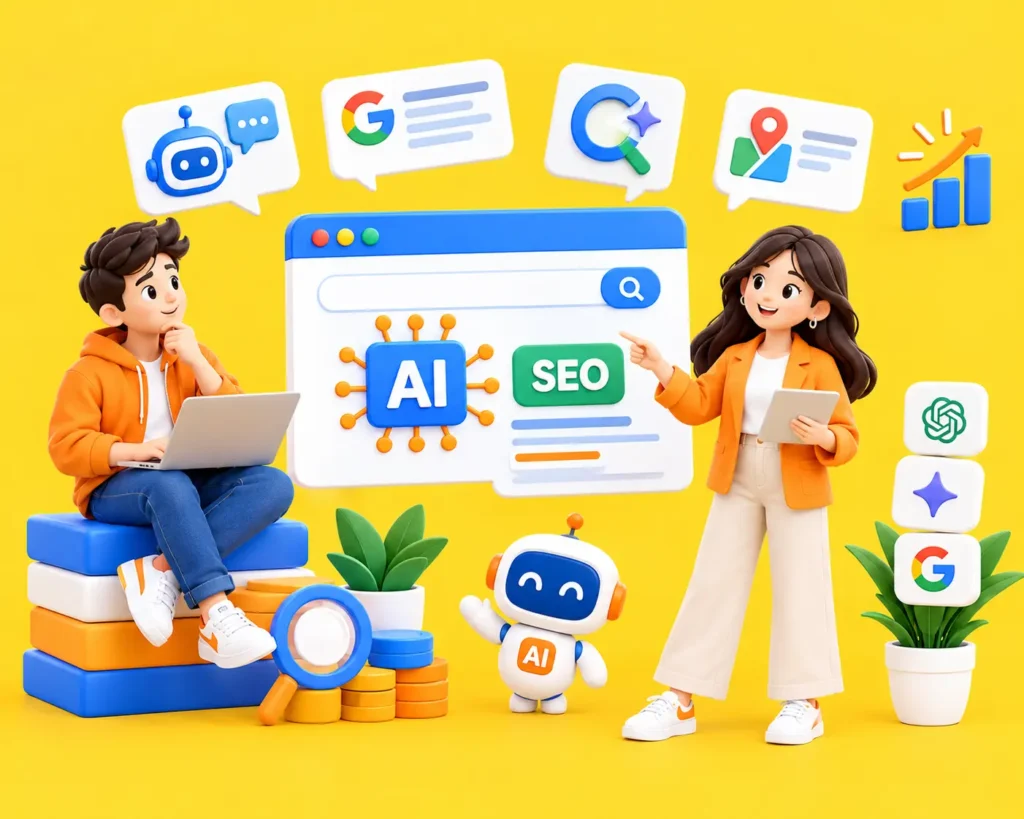
What are AI SEO services? They are SEO services that help your brand show up in AI answers on Google, ChatGPT, Gemini, and Perplexity, not just in blue links.
Here is the short version: People still use Google, but many now read an AI-written answer first. If that answer names your competitor and skips you, a page one rank will not save the sale. AI SEO services fix that gap.
I wrote this guide the way we explain it to clients at RankON Technologies.
It gives you a plain definition, the facts from Google and from real studies, the exact work an agency should do, and the limits nobody should hide from you.
Read the first two sections if you are in a hurry. Read all of it if you plan to hire.
Quick Overview: AEO and GEO inside AI SEO services
AEO (Answer Engine Optimization) means shaping your page so search engines and AI tools can pick your answer directly. The page gives the answer in the first line, uses clear definitions, and builds FAQs from real questions.
This helps you appear in Google AI Overviews, featured snippets and voice answers.
GEO (Generative Engine Optimization) means getting your brand mentioned or cited inside answers written by ChatGPT, Gemini, Perplexity and Claude. Facts, original data, named authors, and mentions on trusted websites help here.
In one line:
“AEO is about answering the question, and GEO is about getting your name inside the AI answer. Both sit under AI SEO services, and both stand on normal SEO.”
Key Takeaways: AI SEO Service
- AI SEO services are the bigger umbrella. AEO, GEO, and AI Overviews work sit inside it.
- Google says a page needs to be indexed and snippet-eligible to appear in its AI features. No special schema or llms.txt is needed.
- Pew Research (March 2025, US data) found that people clicked a link 8% of the time when an AI summary was shown, compared with 15% when no summary was shown.
- Kevin Indig found that 44.2% of ChatGPT citations came from the first 30% of a page, so put your best answer first.
- The Princeton GEO paper found that citations, quotes, and statistics can lift visibility by up to 40%. Keyword stuffing gave no gain.
- Each AI tool selects sources differently, so no single platform is enough to track them.
- Check that AI crawlers can reach your site before anything else.
- Track mentions and citations separately.
- No agency can promise results. Technical fixes can show sooner, and content and authority usually take three to six months.
What Are AI SEO Services?
AI SEO services improve how often and how correctly your brand appears in AI-generated answers, while keeping your normal search rankings strong.
The work covers Google AI Overviews, Google AI Mode, ChatGPT, Gemini, Perplexity, Claude and Microsoft Copilot. Your Google rankings stay the same because these tools still pull from the same open web.
Think of two doors:
“The old door is the list of ten blue links. The new door is the answer box that sits above them. AI SEO services work on both doors at once, so a buyer finds you whichever way they ask.”
What is the simple difference from normal SEO?
Normal SEO tries to rank your page in a list. AI SEO aims to get your brand named and linked in the answer while still maintaining your ranking. The base stays the same: pages that search engines can crawl, content that helps people, and trust that is earned.
Our own guide on how AI is changing SEO in 2026 goes deeper into the shift. If you want the wider basics first, start with our AI SEO guide and then come back here.
What Do AEO, GEO, AIO, and LLMO Mean?
These four short names describe different roles within one larger job. AEO helps you become the direct answer. GEO helps you get cited in AI-written responses. AIO, in this guide, means Google AI Overviews. LLMO helps language models accurately describe your brand.
A word of care about AIO. Some people use AIO to mean AI optimization, while others use it to refer to Google AI Overviews.
In this article, AIO always means the Google feature. When a person says AIO to you, ask what meaning they have in mind.
Term | Full name | What does it mean in plain words |
| SEO | Search Engine Optimization | The base. Crawlable, helpful, trusted pages. |
| AEO | Answer Engine Optimization | Shape a page so it can be the direct answer. |
| GEO | Generative Engine Optimization | Get cited inside AI-written responses. |
AIO | Google AI Overviews | The AI summary Google shows above many results. |
LLMO | Large Language Model Optimization | Help AI models understand your brand correctly. |
Mention | – | The AI says your brand name. |
Citation | – | The AI links to your page as a source. |
Zero-click search | – | The user reads the answer and never opens a site. |
Here is how they connect. “SEO is the foundation. AEO, GEO, and work for AI Overviews are special areas on top of it. LLMO is the brand-clarity part. Most of the work overlaps, so we run it as one program, not four.”
Is This Different From Normal SEO According to Google?
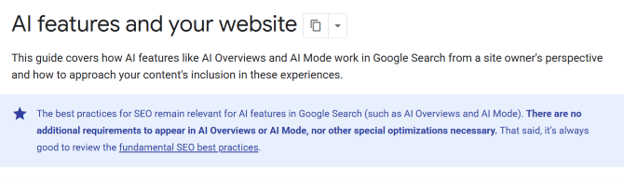
No. Google says optimizing for its AI features is still SEO. In its guide to generative AI search, last updated on 10 July 2026, Google Search Central says AI Overviews and AI Mode are rooted in its core ranking and quality systems. It also says the best practices for SEO remain relevant.
In this screenshot: “Google confirms that AEO and GEO are part of SEO, as optimizing for AI search is still SEO. “

Google adds two rules for eligibility. A page must be indexed and eligible to appear with a snippet. The AI features page says there are no additional technical requirements. It also warns that meeting every rule does not guarantee that Google will crawl, index, or show a page.
In the above screenshot: “Google confirms that existing SEO best practices apply to AI Overviews and AI Mode, with no additional optimization required.”
Google also lists things you can ignore for Google Search. These are llms.txt files, special markup, chopping content into tiny chunks, rewriting content only for AI, and chasing fake mentions. Google says structured data is not required for AI features, though it still helps with rich results.
If you want to know about llms.txt in detail. Here is my own guide to What is llms.txt”? Everything You Should Know.
This matters to you as a buyer. Google tells owners to check third-party AEO and GEO advice against its own guidance. So a good agency should never sell you a magic file or a secret trick.
According to RankON Technologies: “We say the same thing to every client: we fix the foundation first, then we add the extra work that other AI tools reward.”
Why Do Businesses Need This Kind of Help Now?
Because buyers now get answers before visiting websites, and data show that click patterns have changed. Four facts show how big the shift is.
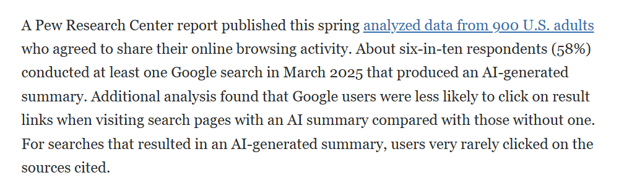
First, the Pew Research Center studied the browsing activity of 900 US adults and 68,879 Google searches from March 2025. Users clicked a normal result in 8% of visits when an AI summary was shown, and in 15% when it was not.
They clicked a link inside the summary in only 1% of visits. Remember, this is US data from March 2025, so treat it as a direction, not a law.
Second: Google says the scale is huge. At Google I/O in May 2026, “CEO Sundar Pichai said AI Overviews has more than 2.5 billion monthly users, and AI Mode has passed 1 billion,” as reported by Puck and OnMSFT.
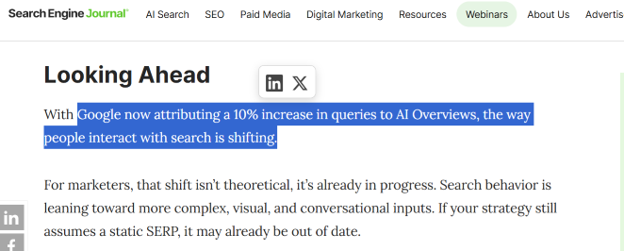
Third, Google also says AI features make people search more. On its Q2 2025 earnings call, “Pichai said AI Overviews drive over 10% more queries for the types of searches that show them, mostly in big markets such as the US and India” (TechCrunch, Search Engine Journal). That is a company claim, so read it with care.
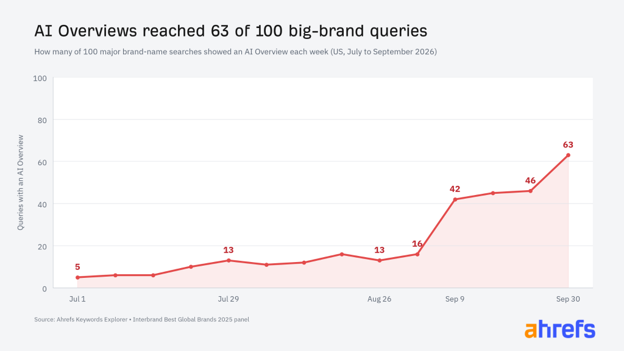
Fourth, even your own brand name is affected. Ahrefs found AI Overviews on 82.91% of US desktop branded searches on 29 September 2026. In a smaller panel of 100 big brands, 63 had an AI Overview on 30 September, and 48 of those sat in position one. Most of the outside sources in those answers were Wikipedia, YouTube, and LinkedIn.
So the first story about your brand is often written by AI, using places you do not own. That is the real reason to invest.
How Does AI Decide What to Quote?
AI tools split your question, fetch pages, pick short passages, and then write one answer with links. Google calls the first step query fan-out. It means the tool sends many related searches at the same time, not just the one the user typed.
Google gives a clear example. For a question about fixing a lawn full of weeds, the extra searches may include best herbicides, removing weeds without chemicals, and preventing weeds. Your page may win on one of these side questions even if it does not rank for the main one.
This explains a surprising fact from Ahrefs. In a test of 15,000 long-tail prompts, only about 12% of links cited by ChatGPT, Gemini and Copilot also ranked in Google’s top 10 for the same prompt. Perplexity was the outlier, with 28.6%. Ahrefs reports an average overlap of about 11% between the top 10 results on Google and Bing. A rank helps, but it is not the whole picture.
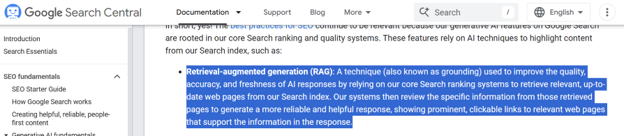
The second step is retrieval. Google calls its version retrieval-augmented generation, or RAG. The tool pulls real pages, reads them, and builds the answer from what it found.
The third step is picking passages, and position matters. Kevin Indig studied 18,012 verified ChatGPT citations (Search Engine Land). He found that 44.2% came from the first 30% of the page text, 31.1% from the middle 30%, and 24.7% from the last 30%. Also, 78.4% of citations tied to questions came from headings.
Please note that this study is about ChatGPT, not Google AI Overviews. The lesson is simple. Put the answer first, and use clear question headings. Do not hide your best point under a long introduction.
Does Writing for AI Really Change Results?
Yes, in a measurable way, but not through tricks. The Princeton paper GEO: Generative Engine Optimization, presented at KDD 2024, tested nine content methods. Adding citations, expert quotes, and statistics raised source visibility by up to 40% in generative answers. The same paper found that keyword stuffing gave little or no gain.
So the winning habit is plain. Make a clear claim, back it with a number, name the source, and let the reader check it. This is the same habit that Google calls helpful, reliable, people-first content.
What Will an Agency Actually Do for You?
A good AI SEO service has nine parts, each with a clear, visible output. Here is the full list, with the reason for each part.
1. AI visibility audit
We write the prompts your buyers really ask, run them across the main AI tools, and record who is mentioned, who is cited, and why. This gives you a starting line. Without it, nobody can prove that the work moved anything.
2. Entity and brand clarity
AI describes what it understands. So your business name, services, locations, authors, and profiles must tell one story everywhere. We add schema where it fits, and we make sure it matches the visible text, as Google asks.
3. Answer engine optimization
We shape pages so a direct answer appears in the first lines. Then we add detail under question-style headings, short FAQs, comparison tables, and clear definitions. These pieces can be lifted into snippets, People Also Ask boxes,s and voice answers.
4. Generative engine optimization and content engineering
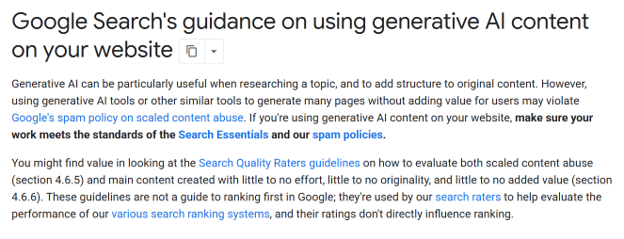
We build pages that are easy to quote. That means clear claims, original examples, named expert authors,rs and sources a reader can open. A person reviews every piece before it goes live. Google asks for manual fact-checking of AI-assisted content, and its guidance on generative AI content says mass pages with no added value may break its scaled content abuse policy.
5. Technical AI readiness
First, the basics: crawl access, indexing, text-based content, internal links,s and speed. A page that is not indexed cannot be shown in Google AI Overviews. Our technical SEO service covers this base.
6. Authority and citation building
AI tools lean on what others say about you. We earn real mentions, expert quotes, reviews,ws and links from trusted sites in your field. Google warns that fake mentions are not helpful, so we only chase real ones. This builds on our off-page SEO and link building.
7. Local and reputation signals
For local firms, AI answers lean on reviews, profiles, and clean listings. Google also says an up-to-date Business Profile helps your visibility in AI responses. We manage your Google Business Profile, local citations, and review plan as part of local SEO.
8. Platform-specific tuning
Each AI tool picks sources in its own way. So we test what works for the tools your buyers use, and we do not assume.
9. Monitoring and reporting
We track visibility every month and explain what moved, in plain words. We report results as ranges because AI answers change from day to day.
Can AI Crawlers Reach Your Website?
Not always. Many sites block AI crawlers without knowing it. A security plugin, a CDN setting, or an old robots.txt rule is often the cause. Before any content work, we check whether the platforms you care about can reach and read your pages.
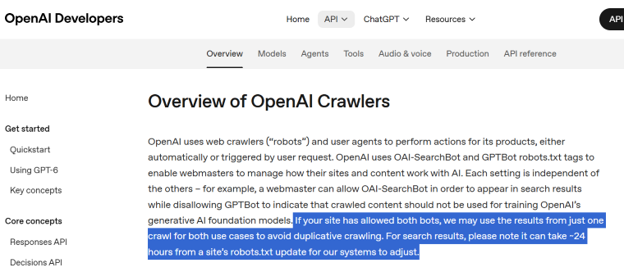
Search crawlers and training crawlers are different. OpenAI explains that OAI-SearchBot is used to surface sites in ChatGPT search, and it recommends allowing it. GPTBot is a separate setting about training data. A site can allow one and block the other. OpenAI also says a robots.txt change can take about 24 hours to take effect for search.
Crawler | What it does | If you block it |
Googlebot | Feeds Google Search, AI Overviews, and AI Mode | You lose rankings and AI features |
Bingbot | Powers Bing, which Copilot draws on | Weaker presence in Bing and Copilot |
OAI-SearchBot | Find pages for ChatGPT search | Less visible in ChatGPT answers |
PerplexityBot | Index pages for Perplexity | Fewer Perplexity citations |
GPTBot | Collects data for OpenAI model training | No direct effect on search visibility. Your choice. |
Google-Extended | Limits training and grounding in some other Google systems | It does not control Google Search. Googlebot does. |
Two more things trip people up. Pages that depend on JavaScript may look empty to a crawler, so keep key text in plain HTML. Also, firewall or CDN rules sometimes shut out bots by default.
We also set up Bing Webmaster Tools. Microsoft added an AI Performance report there in February 2026, in public preview. It shows when your site is cited in answers from Microsoft Copilot, Bing AI summaries, and selected partners. We add IndexNow too, which tells participating search engines about new or changed pages. Google does not use IndexNow, so Google still finds pages through sitemaps and links.
How Do Different AI Platforms Pick Sources?
They do not pick the same way, and the methods change often. That is why we test with real prompts rather than repeating old advice. The table shows the safe, known facts.
Platform | What is known | Our focus |
Google AI Overviews and AI Mode | Use Google’s own index. A page must be indexed and snippet-eligible. | Indexing, helpful content, entity, and reputation signals |
ChatGPT | Can search the web and cite sources. Uses OAI-SearchBot for search. | Open search crawler, quotable pages, real third-party mentions |
Perplexity | It has its own index and crawler. Shows sources beside each answer. | Answer-first pages, original data, clear citations |
Gemini | Built on Google’s ecosystem. | Same index basics plus consistent brand and profile data |
Claude and Microsoft Copilot | Can search the web when needed. Copilot draws on Bing. | Pages indexed in Bing as well as Google, with clear sourcing |
What Is Your Page Probably Missing?
Usually proof. Most service pages describe the work in general terms, so they sound like every other page. If a page has nothing new, an AI tool has no reason to quote it.
Google says the same. Its guide asks for content with a unique point of view and calls generic advice “commodity content.” A first-hand review beats a summary of what others already said.
Use this yes-or-no check on your key pages. If you answer no to most rows, you have found your gap.
Proof check | Yes or No |
| A named expert author with a profile found elsewhere | – |
| First-hand experience (who did the work and what they did) | – |
| Original data or real results that a reader can check | – |
| Real screenshots (Search Console, analytics) with client permission | – |
| Real photos of your team and work, not stock | – |
| A short video or a founder talking about the topic | – |
| Reviews on Google and other sites that match your claims | – |
| Third-party mentions of your brand | – |
Why does your social presence matter?
An AI tool cannot tell whether a screenshot is real. But it can check whether the same facts about you appear in multiple places. If your site says you helped 1,000 clients and nothing else on the web agrees, that claim stands alone.
This is where YouTube and LinkedIn matter. The Ahrefs study above found that they were among the top outside sources for brand-name AI Overviews.
So keep your LinkedIn page full and current, and publish short videos that match your website. When we ran our own brand audit.
We saw AI answers pulling facts from competitors, directories, forums, and blogs, but not from our own site. We shared that story in our AI SEO journey.
Where does entity SEO fit in?
Entity SEO makes AI see your brand as one clear thing, not a pile of pages. Use the same brand name, description,n and contact details everywhere. Link your site to your official profiles. Keep author pages complete. Build a Wikipedia or Wikidata page only if your brand is truly eligible. Our guide on E-E-A-T in SEO explains how trust signals connect to this work.
How Do You Measure AI Visibility?
There is no single AI ranking, so we track five signals together. AI answers change by user, by day,y and by platform, so one screenshot proves nothing.
- AI citation rate: how often your pages are cited across a fixed set of buyer prompts.
- Share of voice: how often you are mentioned compared with your rivals.
- AI referral traffic: visits that come from AI platforms, seen in your analytics.
- Branded search: growth in people searching your name, tracked in Search Console.
- Leads and sales: the business result, because visibility only matters if it brings customers.
Use the free tools first. Google’s Search Console has a generative AI performance report, and Bing Webmaster Tools has its AI Performance report. Google also warns against third-party tools that claim to use its internal metrics because no external tool can access them. We test the same prompt set repeatedly and report a range, so you see real movement rather than a lucky answer.
How Long Does It Take to Work?
Results vary by site, industry, authority, and platform, so there is no fixed date. Technical fixes can show up sooner. Content and authority signals usually take longer to build up. As a working example, many businesses start to see movement in three to six months.
Here is a rough path. Treat it as a guide, not a promise.
- Month 1: audit, then fix crawling, indexing,g and brand details.
- Months 2 to 3: new and updated pages go live, and prompt tests show the first changes.
- Months 3 to 6: reviews and mentions add up, and changes in citations are easier to see.
- After six months, gains build on each other, and we keep testing.
A new website or a crowded market can take longer. If anyone promises results in two weeks, think twice.
What Are AI SEO Services Not Meant to Do?
They are not meant to guarantee anything, and a good agency says so. Nobody outside the AI companies controls what gets cited. Here is what we will not do.
- Guarantee citations or rankings. Nobody can.
- Sell special AI markup as a magic fix. Google says no special markup or file is needed for its AI features.
- Publish unreviewed AI content at scale. Google calls for manual fact-checking before publishing.
- Buy fake reviews or invent author profiles. They damage the trust AI relies on.
- Hide text or tricks for crawlers. It is a risk and the opposite of helpful content.
- Show one lucky screenshot as a result. You get repeatable measurements, or nothing.
What Mistakes Should You Avoid?
Most mistakes come from rushing. Avoid these six, and you are ahead of most sites.
- Blocking the wrong crawler. Check robots.txt, your CDN,N and your security plugin first.
- Burying the answer. Start each section with the direct answer.
- Using claims with no source. Name the study and link it.
- Copying what everyone says. Add your own data, examples,es and views.
- Treating AI as a one-time job. Answers change, so you must test again.
- Judging by rank alone. The Ahrefs data shows that rank is only part of the citation.
Which Businesses Need This Most?
Any business whose buyers ask questions before buying can benefit from it. Some fields need more care than others. Health and finance are held to a higher bar, so your sources must be stronger.
- Healthcare and clinics: trust matters most. We have worked with skin, dental,l and hearing clinics, as shown in our healthcare SEO services and case studies. Read how doctors and hospitals can rank in AI results.
- Local and multi-location firms: we keep every branch profile, listing, and review in sync, so AI recommends the right branch.
- Ecommerce: we help AI tools understand products, reviews and policies, building on our ecommerce SEO work.
- SaaS and IT companies: buyers ask AI to compare tools. See our guide on AI SEO for IT companies.
- B2B and professional services: we help you appear when buyers ask AI for a shortlist.
- Agencies and freelancers: add AI visibility to your own offer through our white-label SEO packages or GoWhiteLabelSEO.
How Much Does AI Search Work Cost in India?
At RankON technologies, AI SEO is built into our SEO plans. It is not a separate guaranteed package. The price depends on website size, goals, competition,ion and how much work is needed across normal and AI search.
Our current SEO plans start at ₹25,000 (300$ for small businesses).
The Advanced plan starts at 40,000 ($500) for a mid-size business.
The eCommerce plan starts at ₹55,000 ($700) per month. See all options on our SEO packages page.
Here is the table of SEO packages – RankON Technologies
Plan | Best for | Monthly cost |
Basic SEO | Small businesses | ₹25,000 / $300 |
Advanced SEO | Mid-size businesses | ₹40,000 / $500 |
eCommerce SEO | Online stores | ₹55,000 / $700 |
“These plans can include AI retrieval-ready content, entity work, brand mention building, authority work and AI visibility tracking, fitted to your goals.”
If you need a custom scope, call the RankON Technologies Team.
What Results Has RankON Technologies Seen?
We can share our SEO results, and we are clear about what they measure. We have a team with 14+ years of experience, 1,000+ projects completed, and a 4.9-star Google rating across 140+ reviews. We are a Google Partner and recognized by Clutch.
Two traffic results from our case studies show the basis on which we build. A flight school targeting the USA and Canada grew organic traffic by 121.35% in a few months, as shown in the Pilot Academy case study. A car inspection business grew its organic traffic by 177.34%. These are organic search results, not AI citation counts. Browse more in our SEO case studies.
Why Do Teams Choose RankON Technologies?
They choose us for clarity. We fix the SEO foundation first, we tell you what we can and cannot influence, and we explain results in plain words. Experts review everything we publish. You get one named contact, and we work around your time zone.
If you want to see where your brand stands today, we can check whether AI tools mention, cite, or ignore you. Talk to our team, and we will walk you through the audit.
Conclusion
So, what are AI SEO services? They are SEO services that make your brand easy to find, easy to trust,t and easy to quote in AI answers, while your Google rankings stay strong. Google says it is still SEO. The studies say rank alone is not enough. Both are true, and the smart plan uses both.
Start small. Let the right crawlers in, put your answers first, add real proof, and keep your brand facts the same everywhere. Then test with real buyer prompts and track the change. If you want a partner, ask any agency for the audit first, and ask what they will not promise.
FAQs About AI SEO Services
What are AI SEO services?
AI SEO services help your brand appear in AI-generated answers such as Google AI Overviews, AI Mode, ChatGPT, Gemini and Perplexity. They combine normal SEO with answer-first content, brand clarity, and real authority building.
What is the difference between AI SEO, GEO, AEO,AIO and LLMO?
AEO makes you the direct answer, GEO gets you cited in AI-written responses, and LLMO helps language models understand your brand. They overlap a lot, so we run them as one program on top of strong SEO. Google says that, from its side, this is still SEO.
Does AI SEO replace traditional SEO?
No. AI tools use the same open web, so crawlable pages, helpful content, and trust still decide who gets chosen. AI SEO builds on top of SEO.
Can anyone guarantee my brand will appear in ChatGPT or Google AI Overviews?
No, and be careful with anyone who says yes. Google itself says indexing and serving are never guaranteed. We improve what you control, content, technical health, brand clarity, and authority, and we measure the results honestly.
Do I need llms.txt or a special schema to appear in AI answers?
Not for Google. Google says you do not need new machine-readable files, AI text files, or special markup for AI Overviews and AI Mode, and it says Google Search ignores llms.txt. Structured data can still help with rich results, so we add it where it fits.
Should I allow GPTBot and OAI-SearchBot?
They are two different choices. OpenAI recommends allowing OAI-SearchBot if you want to appear in ChatGPT search. GPTBot is related to training data, so whether to allow it is your decision.
How long does AI SEO take?
Many businesses see movement in three to six months, and technical fixes can show up sooner. Content and authority take longer to build up. Treat it as a typical window, not a promise.
How do you measure AI visibility?
We track citation rate, share of voice, AI referral traffic, branded search, a nd leads using a fixed set of prompts that we test repeatedly. We then report the range of results.
Is AI-generated content safe for SEO?
It can be safe when a subject expert reviews, fact-checks, and improves it. Google says AI output may contain errors, and it asks you to review all of it before publishing. Mass-produced content with no added value is the real risk.