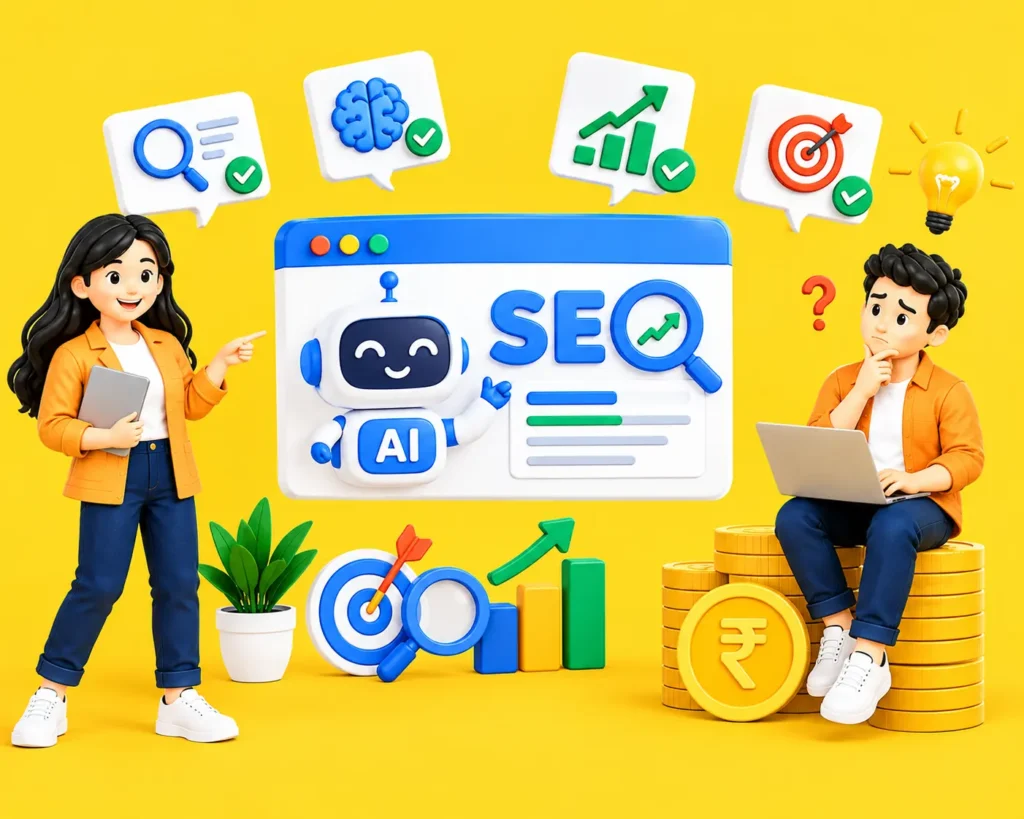
People still search Google, but a majority of them now read an AI-written answer first, whether it appears in Google AI Overviews or AI Mode, or comes from asking ChatGPT, Gemini, Perplexity, Claude, or Copilot.
Even today, ranking on page one still matters because AI tools lean on the same web your SEO already works on. But the work now is a bit more extensive to make your brand understood, trusted, and easy to quote, and that’s where AI SEO comes in!
Want to know how search is changing in detail? Check out our guide on how AI is changing SEO in 2026.
What are AI SEO Services?
AI SEO services improve how often and how accurately your brand appears in AI-generated answers while sustaining the search rankings, which form the foundation for everything.
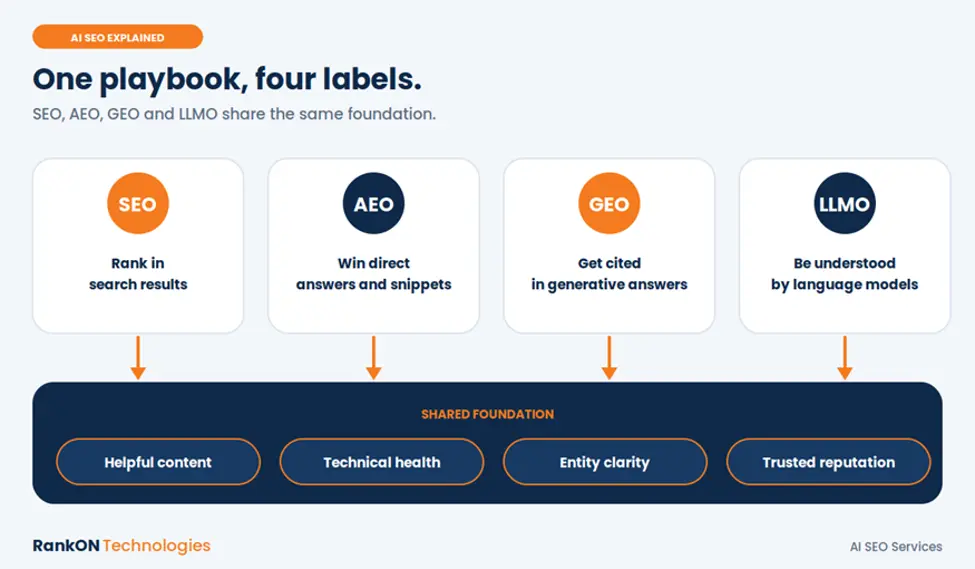
Here are a few labels that primarily share the same foundation, i.e., creating helpful, people-first content on a technically healthy site, which is
Term | What it means |
AEO (Answer Engine Optimization) | Shaping your pages so you become the direct answer |
GEO (Generative Engine Optimization) | Getting cited inside AI-written responses |
LLMO (LLM Optimization) | Helping language models understand your brand correctly |
AIO | Used for AI Optimization, but also short for Google’s AI Overviews, so ask which one someone means |
Mention | AI says your brand name |
Citation | AI links to your page as a source |
Zero-click search | The user reads the answer and never opens a website |
Want to learn more about what AI SEO is and how it works? Take a look at our detailed AI SEO guide.
How Does AI Decide What to Quote
When someone types a question into an AI tool, it doesn’t just pull one answer out of thin air. A few things happen in the background.
First, the question gets split up. Say someone asks for the best AI SEO agency in India. The tool may quietly search for pricing, reviews, case studies, and services separately. This is called query fan-out.
Next, it fetches web pages. The technical name is retrieval, and it’s the “R” in RAG (Retrieval-Augmented Generation).
Then it picks passages. Most of the time, it takes one clear paragraph, not your whole article. So each section on your page has to make sense even when read alone.
Finally, it writes the answer and links to the sources it leaned on. That’s where citations come from.
So if your page skips the sub-questions or hides the answer under a long intro, the tool just moves to the next page.
Why Do You Need AI SEO Services?
If any of these scenarios fit you or you find them relatable, then it’s high time you got AI SEO Services!
- You’re ranking on Google, but failing to earn mentions or citations in AI search.
- Your competitors are being recommended by AI, while your brand is barely mentioned.
- Your content ranks well, but it isn’t establishing itself as a trusted source for AI-generated answers.
People’s Way Of Exploring Businesses Has Changed
Some Stats You Mustn’t Ignore: AI SEO Services
- AI Overviews are driving a 10% increase in Google usage, showing that users are increasingly drawn to AI answers and choose them for research repeatedly.
- Users clicked traditional search results in just 8% of visits when an AI summary appeared, compared with 15% when no AI summary appeared.
- AI Overviews now reach 2.5B+ monthly active users, while AI Mode has surpassed 1B monthly active users.
Our AI SEO Services
Bringing Visibility Through Every Possible Way
Just like our SEO services, which are grounded in data and numbers, our AI SEO services are not about vanity metrics. It is backed by proven strategies and powerful tools to increase your visibility across the AI-driven search ecosystem!
1. AI Visibility Audit
We write the prompts your buyers actually ask, test them across the major AI platforms, and record who gets mentioned, who gets cited, and why.
It’s the baseline most agencies skip, and without it, you can’t tell whether anything worked.
2. Entity and Brand Optimization
AI systems describe what they understand. We make sure your business name, services, locations, authors, and profiles tell one consistent story across your site and the web, and add schema where it genuinely helps.
3. Answer Engine Optimization (AEO)
We structure pages so a direct answer appears in the first lines, then support it with detail. That means question-led headings, FAQs, comparison pages and clear definitions that can be lifted into snippets, People Also Ask boxes and voice answers.
4. Generative Engine Optimization (GEO) and Content Engineering
We build and refine pages designed to be quoted, including clear claims, original examples, named expert authors, and sources a reader can check. Every piece is reviewed by a person before it goes live because experience, expertise, and trust matter just as much in AI answers.
5. Technical AI Readiness
Google says a page must be indexed and eligible to appear with a snippet to be shown in AI Overviews or AI Mode, with no extra technical requirements. So we start with the basics: crawlability, indexation, text-based content, internal links, and speed.
6. Authority and Citation Building
AI tools trust what other credible sources say about you. We earn mentions, expert quotes, reviews, and relevant links from trusted sites in your industry. This builds on our off-page SEO and link building, aimed at the sources AI actually cites.
7. Local and Reputation Signals
For businesses that serve local customers, AI answers lean on reviews, profiles, and consistent listings. We manage your Google Business Profile, local citations, and review strategy as part of our local SEO services.
8. Platform-Specific Optimization
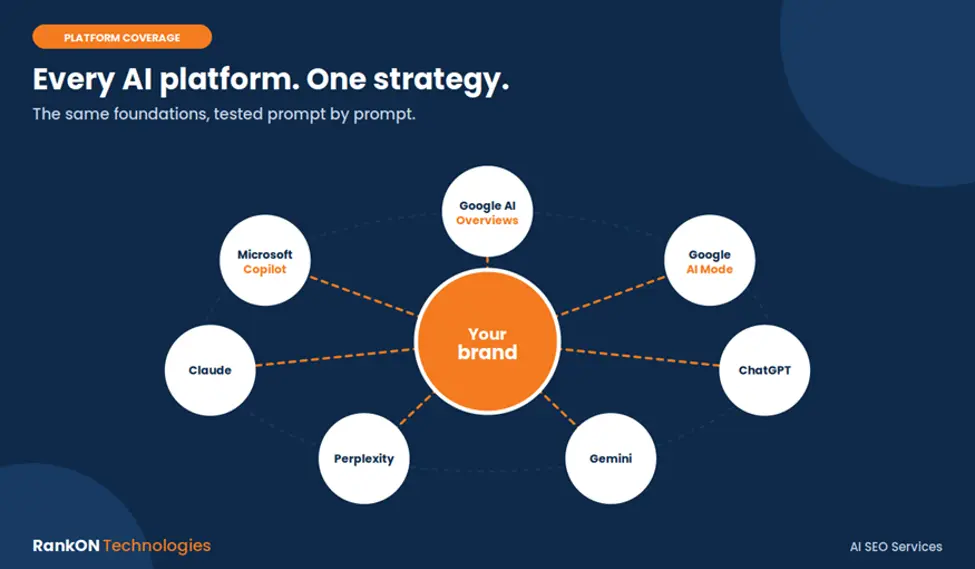
Google AI Overviews, Google AI Mode, ChatGPT, Gemini, Perplexity, Claude and Microsoft Copilot don’t all pick sources the same way. We tune your approach to the platforms your buyers actually use, and we confirm what works by testing, not by assumption.
9. AI Visibility Monitoring and Reporting
We track your visibility every month and explain what moved and why, in plain language. It’s the same standard we apply to all of our work.
How AI Platforms Find Sources, and What We Do About It
Platform | How it tends to pick sources | Our focus |
Google AI Overviews and AI Mode | Show supporting links from Google’s own index. Google says pages need to be indexed and snippet-eligible, with no special markup required. | Indexability, helpful content, entity, and reputation signals |
ChatGPT | Can search the web and cite sources when it answers. | Unblocked search crawlers, quotable pages, third-party mentions |
Perplexity | Shows its sources prominently beside each answer. | Answer-first pages, original data, credible citations |
Gemini | Google’s assistant, built on Google’s ecosystem. | The same index foundations plus consistent entity and profile data |
Claude and Microsoft Copilot | Search the web when needed. Copilot draws on Bing. | Pages indexed in Bing as well as Google, with clear sourcing |
These systems change often, which is why we confirm behavior through prompt testing rather than repeating old advice.
First Check: Can AI Crawlers Even Reach Your Site?
A surprising number of sites block AI crawlers without knowing it. A security plugin, a CDN setting, or an old robots.txt rule is often the reason.
Crawler | What it does | If you block it |
Googlebot | Feeds Google Search, AI Overview,s and AI Mode | You lose rankings and AI features |
Bingbot | Powers Bing, which Copilot draws on | Weaker presence in Copilot |
OAI-SearchBot | Finds pages for ChatGPT search | Less visible in ChatGPT answers |
PerplexityBot | Indexes pages for Perplexity | Fewer Perplexity citations |
GPTBot | Collects data for OpenAI model training | No direct effect on visibility, it’s your call |
Google-Extended | Controls Gemini training use | Doesn’t affect Search or AI Overviews |
Two more things trip people up. Pages that depend heavily on JavaScript may look empty to a crawler, so important text should sit in plain HTML. And firewall or CDN rules sometimes shut out bots by default.
We go through your robots.txt, CDN, and rendering, set up Bing Webmaster Tools, and add IndexNow so new pages get picked up faster. Whether to allow training crawlers is your decision, and we’ll walk you through both sides.
The RankON AI Visibility Framework
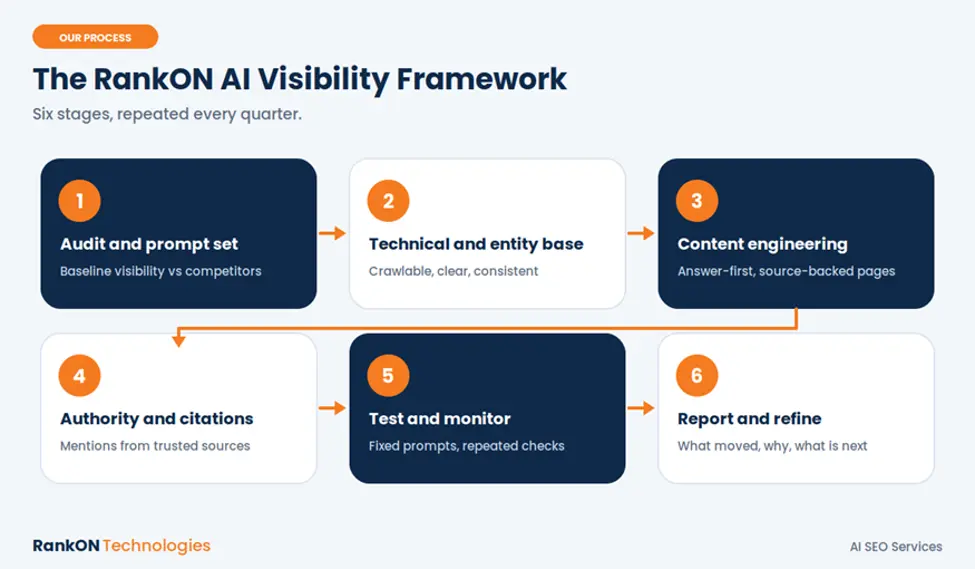
Our framework for boosting AI visibility is simple and clear. It includes six steps, which we repeat as per the scenario:
- Auditing & Prompting
We understand your current online visibility against your competitors by asking questions that a real buyer would ask.
- Technical and Entity Foundation
We ensure that your site is easily crawlable and brand-consistent so AI systems can understand you.
- Content engineering
We publish answer-first, source-backed pages reviewed by a subject expert.
- Authority and citations
We earn the third-party mentions that make you a credible source.
- Test and monitor
We re-run a fixed set of prompts on a regular schedule and track the changes.
- Report and refine
We explain what moved, what didn’t, and what we’ll do next.
How We Measure AI Visibility
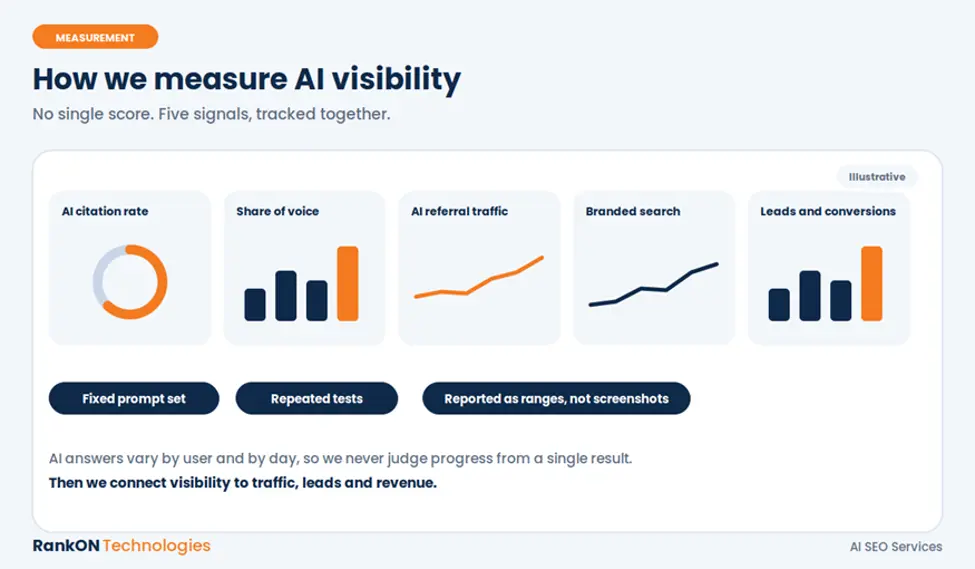
There’s no single “AI ranking” to check. AI answers change by user, by day, and by platform, so one screenshot proves nothing. We track five signals together:
- AI citation rate: To understand how often your pages are cited across a fixed set of buyer prompts.
- Share of voice: To know how often you’re mentioned compared with your competitors.
- AI referral traffic: To understand visits from AI platforms, track them in your analytics.
- Branded search: To analyze growth in people searching for you by name, tracked in Search Console.
- Leads and conversions: To learn the business result, because visibility only matters if it brings customers.
We test the same prompt set repeatedly and report results as ranges, so you see real movement instead of lucky answers.
AI SEO vs Traditional SEO: What Changes and What Doesn’t
At RankON Technologies, we combine traditional SEO with AI-focused optimization to help businesses stay visible as search continues to evolve.
This means creating content that is technically accessible, useful to users, easy for search engines and AI systems to understand, and supported by credible brand signals.
By bringing these elements together, businesses can build visibility across traditional search results as well as AI-generated answers.
Traditional SEO | AI SEO | |
Main goal | Rank higher in search results | Be cited and recommended in AI answers, and still rank |
Content | Keyword-focused, comprehensive pages | Answer-first, factual, citation-ready pages |
Authority | Backlinks and domain strength | Backlinks plus brand mentions and third-party credibility |
Key signals | Keywords, links, technical health | Entities, consistent brand facts, E-E-A-T, clear structure |
Success metrics | Rankings, clicks, organic traffic | AI citations, share of voice, AI referrals, plus traffic and leads |
What Affects AI SEO Visibility
Two businesses can put in the same amount of work and still get different results. That’s because AI visibility depends on several things, and a few of them aren’t fully in your hands.
Here’s what makes the biggest difference:
- Technical health: If your pages aren’t indexed or crawlers can’t read them, nothing else counts. This is the first thing we check.
- Content quality: Pages that answer the question early, back their claims with sources, and are written by someone who knows the subject get picked more often.
- Brand consistency: When your name, services, and address change from one site to another, AI gets confused about who you are.
- Mentions on other sites: Reviews, directory listings and articles that talk about you carry real weight.
- Competition: If your competitors have been building their presence for years, you start a few steps behind.
- Your industry: Topics like health and finance are held to a higher standard, so your sources need to be stronger.
- The platform: ChatGPT, Gemini and Perplexity don’t pick sources the same way, so one approach rarely fits all.
- Age of your website: A new domain usually takes longer to be trusted than one that’s been around for years.
Some of these can be fixed quickly, like technical issues. Others, like reviews and mentions, build up slowly. That’s why we start with an audit and work out what to fix first.
What Your Pages Are Missing, and Why AI Skips Them
When someone searches your brand name today, there’s a good chance an AI summary shows up before your website does. Ahrefs found that AI Overviews appeared for about 83% of branded queries in US desktop results as of September 29, 2026. So the first version of your brand story is often written by AI, not by you.
Now, the part most owners miss. Where does that summary get its facts? In the same Ahrefs study, Wikipedia, YouTube and LinkedIn were the most common outside sources cited for branded AI Overviews. In other words, a lot of what AI says about you comes from places you don’t own.
Ranking well doesn’t fix this on its own. Ahrefs later found that only about 38% of URLs cited in AI Overviews also appeared in the top 10 results for the same query. And for AI assistants like ChatGPT, Gemini, Copilot and Perplexity, Ahrefs Brand Radar data showed that only around 11% of citations overlapped with the top 10 of Google and Bing. A page one rank helps, but it’s not the full picture.
So what are most pages missing? Usually, proof. Look at your key pages and ask:
- Real experience: Does the page say who did the work and what they actually did, or does it only describe the service in general terms?
- Real results: Do you show what you’ve achieved, with numbers a reader can check?
- Real screenshots: Analytics, Search Console, rankings or reports, with client permission.
- Real images: Your team, your office, your work. Not stock photos.
- Audio and video: Client feedback, short explainers, a founder or expert talking about the topic.
- Named people: An author or reviewer with a profile that can be found elsewhere.
If most of these are missing, the page sounds like every other page on the topic. There’s nothing in it worth quoting.
Why your social presence matters here
When an AI tool searches live, it breaks one question into smaller ones and looks at many places. Let’s be clear about one thing: it can’t tell whether a screenshot is genuine. What it can do is check whether the same facts about you show up in more than one place. If your website says you’ve helped 1,000 clients and nothing else on the web backs it up, that claim stands alone.
If you’re not active on LinkedIn or YouTube, or your profiles are half-filled, you’re giving AI fewer places to confirm who you are. A short video, a client review on Google or a LinkedIn post about the same project all add weight.
Where entity SEO comes in
This is what we call entity SEO. The goal is for AI to see your brand as one clear, known thing, not a scattered set of pages. That means:
- Using the same brand name, description and contact details everywhere
- Linking your website to your official profiles, and adding schema where it fits
- Keeping author pages and bios complete and consistent
- Building a Wikidata or Wikipedia presence only where your brand is eligible
- Making sure reviews and listings tell the same story as your site
One more fix: put the answer first
AI often lifts the opening part of a page. A study of 1,000 queries by The Stacc found that 44.2% of AI Overview citations came from the first 30% of a page. If your answer sits under a long introduction, it may never get picked. Lead with the answer, then add the detail.
We start with a simple audit of your key pages and profiles, mark what proof is missing, and fix the gaps in order of impact.
How Long Does AI SEO Take
Most businesses see some movement within three to six months. Technical fixes can show results sooner, while content and authority take more time. Here’s a rough idea of how it usually goes:
- Month 1: We run the audit and fix the basics, like crawling, indexing and brand details.
- Months 2 to 3: New and updated pages go live. Prompt tests start showing the first changes.
- Months 3 to 6: Reviews and mentions begin to add up. This is when changes in citations and share of voice become easier to spot.
- After six months: Gains build on each other, and we keep testing and refining.
Treat this as a guide, not a promise. A new website or a crowded industry can take longer, and AI answers keep shifting, so we report results as ranges. If anyone promises you results in two weeks, think twice.
What’s Not Covered in Our AI SEO Services
AI SEO is new and still evolving. If you find an agency that claims to guarantee results, know they’re making false promises.
At RankON, we focus on strategies that can be implemented, measured, and supported by what we know about how search and AI platforms work.
That also means being clear about what AI SEO should not involve. Here’s what we won’t do:
- Guarantee citations or rankings: Nobody outside the AI companies controls what gets cited.
- Sell “special AI markup” as a magic fix: Google says no special markup or file is needed to appear in AI Overviews or AI Mode, so we won’t charge you for one.
- Publish unreviewed AI content at scale: Google’s own guidance calls for manual review of AI-generated material before it goes live.
- Buy fake reviews or invent author profiles: They damage the trust AI systems rely on.
- Hide text or tricks aimed at AI crawlers: It’s risky, and it’s the opposite of helpful content.
- Report one lucky screenshot as a result: You get repeatable measurements, or nothing.
Do You Need AI SEO Services For Your Industry?
- Healthcare and clinics: Health is a trust-sensitive topic, so AI systems need clear expertise and reliable sourcing. We’ve supported skin, dental, and hearing clinics for years, as shown in our healthcare SEO case studies and services.
- Local and multi-location businesses: We keep every location’s profile, listings, and reviews consistent, so AI answers recommend the right branch.
- Ecommerce: We help AI tools understand your products, reviews and policies, building on our ecommerce SEO work.
- SaaS and IT companies: Buyers ask AI to compare tools, so we build comparison, use-case, and documentation content.
Want to know how this works for IT businesses? See our guide on how IT companies can appear in AI search results.
- B2B and professional services: We make sure you show up when buyers ask AI for shortlists of agencies, consultants and providers.
- Agencies and freelancers: Add AI visibility to your own offer through our white-label SEO services or GoWhiteLabelSEO.
Proof Of Our AI SEO Success With RankON Technologies
We’ve spent 14+ years helping businesses grow through search, with 1,000+ SEO projects completed, a 4.9-star Google rating across 130+ reviews, Google Partner certification and Clutch recognition. AI visibility builds on that foundation, and you can see it in the results:
- Pilot Academy: International SEO for a flight school targeting the USA and Canada. Organic traffic grew 121.35% in a few months. Read the Pilot Academy case study.
- Car inspection business: 177.34% organic traffic growth. Browse more in our SEO case studies.
Curious how we did it for our own agency? Read the full story of our AI SEO journey.
How Much Do AI SEO Services Cost in India?
AI SEO pricing depends on your website’s size, your business goals, the level of competition, and the level of optimization required across traditional and AI search.
At RankON, our SEO plans start at ₹25,000 ($300) per month for small businesses. The Advanced SEO Plan is priced at ₹40,000 ($500) per month for mid-size businesses, while our eCommerce SEO Plan starts at ₹55,000 ($700) per month.
SEO Plan | Best For | Monthly Investment |
Basic SEO | Small businesses | ₹25,000 / $300 |
Advanced SEO | Mid-size businesses | ₹40,000 / $500 |
| eCommerce SEO | eCommerce businesses | ₹55,000 / $700 |
AI SEO can be incorporated into your broader SEO strategy, tailored to your website and visibility goals. This can include optimizing content for AI retrieval, strengthening entity signals, improving brand mentions, building authority, and tracking visibility across AI search platforms.
Rather than treating AI SEO as a separate set of shortcuts, RankON focuses on strengthening the SEO foundation while adapting it to how search is evolving.
Ready to build stronger visibility across search engines and AI platforms? Partner with RankON to create an SEO strategy designed around your business goals, industry, and growth opportunities. Get in touch with our team to discuss your requirements and find the right plan for your business.
Why Do Teams Choose RankON Technologies for AI SEO Services?
There’s not yet an AI SEO agency in India that talks about real numbers over vague approaches. But at RankON Technologies, we stand apart from other AI SEO agencies through clarity and transparency. Check out the reasons that make us better than the rest!
- SEO first, AI second: We fix the foundation AI tools rely on instead of selling a separate gimmick.
- Clarity about limits: We tell you what we can influence and what we can’t.
- Reports you can use: We explain what moved and why, not just show a dashboard.
- Real people behind the content: Experts review everything we publish.
- One named contact: You always know who is working on your account.
- Global support: We work around your time zone and adjust our hours to match.
Boost AI Visibility For Your Website With Tailored AI SEO Services from RankON Technologies
See where your brand stands in AI search. Find out whether AI platforms mention, cite, or ignore your brand today and what to do about it. Get in touch with us and let’s get started on boosting your AI visibility!
FAQs on AI SEO Services
What are AI SEO services?
AI SEO services help your brand appear in AI-generated answers, such as Google AI Overviews, AI Mode, ChatGPT, Gemini and Perplexity. They combine traditional SEO with answer-focused content, entity clarity, and authority building.
What’s the difference between AI SEO, GEO, AEO and LLMO?
AEO aims to make you the direct answer, GEO aims to get you cited in AI-written responses, and LLMO aims to make language models understand your brand. They overlap heavily, so we run them as one program on top of strong SEO.
Does AI SEO replace traditional SEO?
No. AI tools rely on the same web, so crawlable pages, helpful content, and trust still decide who gets chosen. AI SEO builds on top of traditional SEO.
Can you guarantee my brand will appear in ChatGPT or Google AI Overviews?
No, and be wary of anyone who does. We can improve the factors you control, such as content, technical health, entity clarity, and authority, and we measure the result honestly.
How long does AI SEO take to work?
Most businesses see movement within three to six months, and technical fixes can show up sooner. Content and authority take longer to compound.
Do I need llms.txt or a special schema to appear in AI answers?
Google says no special markup or file is required for AI Overviews and AI Mode. Structured data can still help with clarity and rich results, so we add it where it fits, but we don’t treat it as a shortcut.
How do you measure AI visibility?
We track citation rate, share of voice, AI referral traffic, branded search, and leads across a fixed set of prompts that we test repeatedly, then report the range of results.
Is AI-generated content okay for SEO?
It can be when a subject expert reviews, fact-checks, and improves it. Mass-produced, unreviewed content is the real problem.