

Digital advertising is constantly evolving, and businesses are no longer relying exclusively on traditional search and social media advertising to reach potential customers.
While platforms like Google Ads and Meta Ads remain important parts of digital marketing strategies, advertisers are increasingly exploring alternative channels to expand their reach, attract new audiences, and generate additional conversions.
One such channel gaining attention is native advertising.
Unlike traditional display advertisements that often interrupt the browsing experience, native ads are designed to blend naturally with the content of the websites where they appear.
They typically look like recommended articles, sponsored stories, or suggested content, making them less intrusive and more relevant to users.
This approach allows businesses to introduce their products, services, and content to audiences as they read articles, browse news websites, or consume online content.
This growing interest in native advertising has brought platforms like Taboola into the spotlight. Taboola is a content discovery and native advertising platform that helps advertisers promote their content across a network of publisher websites.
Its advertisements commonly appear under sections such as “Recommended for You,” “You May Also Like,” or “Around the Web” on popular news, entertainment, and informational websites.
For businesses, Taboola offers an opportunity to reach audiences beyond conventional search and social media platforms. Instead of waiting for users to search for a particular product or service, advertisers can introduce their offerings to relevant audiences while they consume online content.
This makes Taboola particularly interesting for businesses focused on brand awareness, audience acquisition, content promotion, lead generation, and product discovery.
From a PPC and performance marketing perspective, I believe Taboola deserves attention as more than just another traffic acquisition channel. Its real value depends on how effectively advertisers use audience targeting, campaign optimization, creative testing, landing page experiences, and conversion tracking to turn content discovery into measurable business results.
At RankON Technologies, Anand Kumar brings PPC and digital advertising experience to the discussion, helping businesses understand how different paid advertising channels fit into their overall growth strategies.
In this guide, I will explain Taboola advertising from a practical advertiser’s perspective, including how the platform works, its major benefits, potential limitations, and the factors that influence advertising costs.
Whether you are a business owner exploring new advertising opportunities, a marketer looking to diversify paid traffic sources, or an advertiser comparing Taboola with Google Ads and Meta Ads, this guide will help you understand what Taboola offers and whether it deserves a place in your digital marketing strategy.
In this guide, we will cover:
- What Taboola Ads are and how the platform works.
- How native advertising campaigns reach potential customers.
- The major benefits of advertising with Taboola.
- Different Taboola ad formats and targeting options.
- How much does Taboola advertising cost?
- Factors that influence campaign performance and advertising expenses.
- The challenges and limitations advertisers should understand.
- Best practices for creating and optimizing successful Taboola campaigns.
By the end, you should have a clearer understanding of how Taboola works, what kind of businesses can benefit from it, and how to approach it as part of a performance-driven advertising strategy.
1. What Are Taboola Ads?
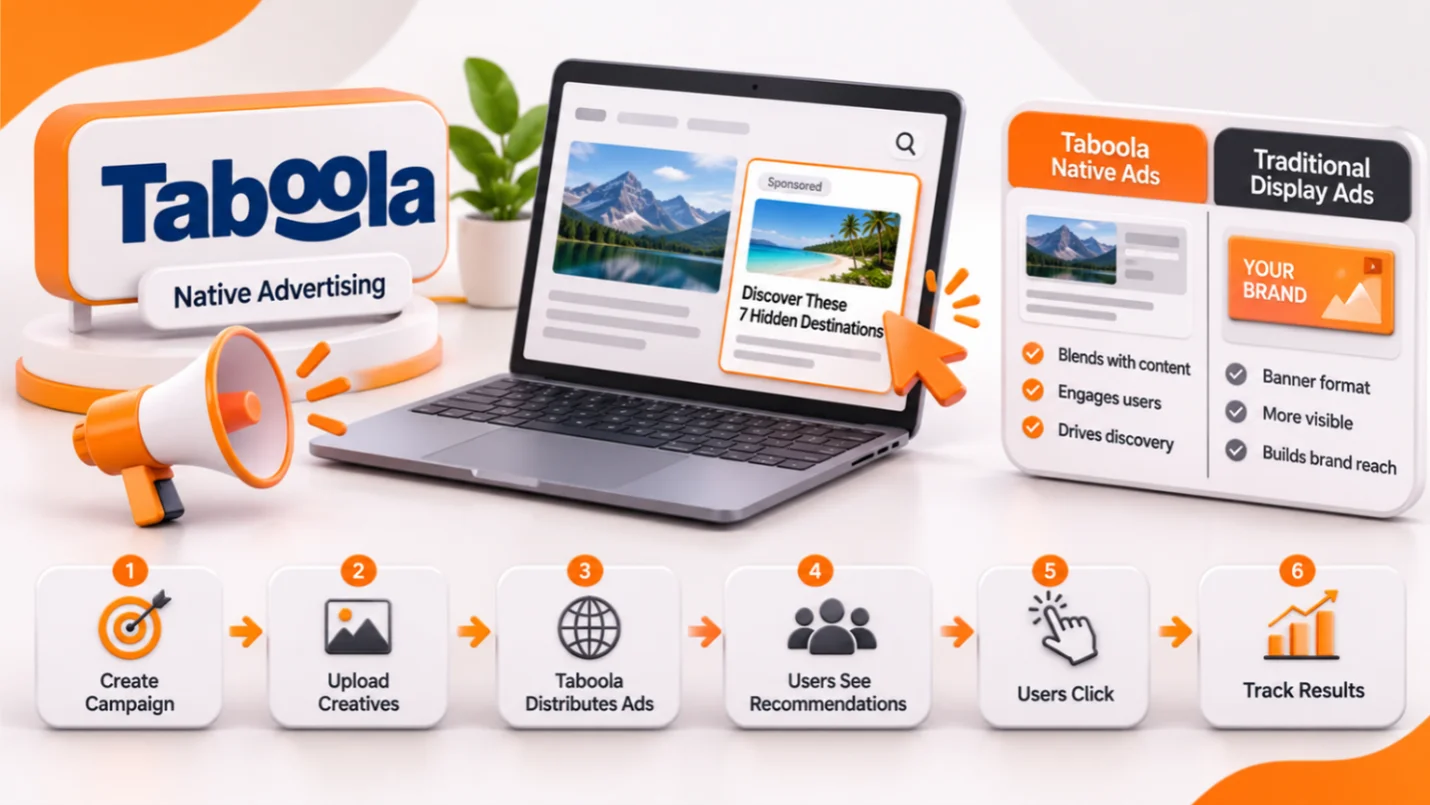
Taboola Ads are a form of native advertising that allows businesses to promote their products, services, articles, and other content across third-party publisher websites. Instead of appearing as conventional banner advertisements, these ads are displayed as recommended content, often alongside editorial articles, news stories, and other website recommendations.
For example, when you finish reading an article on a news website, you might notice a section titled “Recommended for You,” “You May Also Like,” or “Sponsored Stories.” This section often contains images, headlines, and links promoting content from different advertisers. Some of these recommendations are powered by Taboola.
The primary idea behind Taboola advertising is simple: reach potential customers while they are already consuming online content. Rather than interrupting their browsing experience with an unrelated advertisement, advertisers can present relevant recommendations that encourage users to discover something new.
From a PPC advertising perspective, this creates a different approach to paid traffic acquisition. Google Search Ads generally target users based on their search queries, while Taboola focuses more on content discovery and reaching audiences as they browse publisher websites.
1.1 How Does Native Advertising Work?
Native advertising works by placing sponsored promotional content within the natural layout and design of a website or digital platform. The advertisement adopts a format similar to the surrounding content, although it should remain clearly identifiable as sponsored or promoted content.
Here is how a typical Taboola advertising campaign works:
- Advertiser creates a campaign: A business creates an advertising campaign through Taboola Ads Manager and selects its campaign objectives, budget, targeting preferences, and bidding strategy.
- Ad creatives are uploaded: The advertiser adds images, headlines, descriptions, and destination URLs to create promotional advertisements.
- Taboola distributes ads based on campaign settings, targeting, and its advertising delivery system, displaying eligible advertisements across its publisher network.
- Users encounter advertisements while browsing participating websites, where they may see sponsored recommendations alongside editorial content.
- Users click on the ads: Interested visitors click the recommendation and land on the advertiser’s website, article, product page, or landing page.
- Advertisers measure performance by monitoring impressions, clicks, click-through rates (CTR), cost per click (CPC), conversions, and other campaign metrics to evaluate results and optimize performance.
The process is particularly useful for businesses that want to introduce their offerings to people who may not be actively searching for them.
1.2 Where Do Taboola Advertisements Appear?
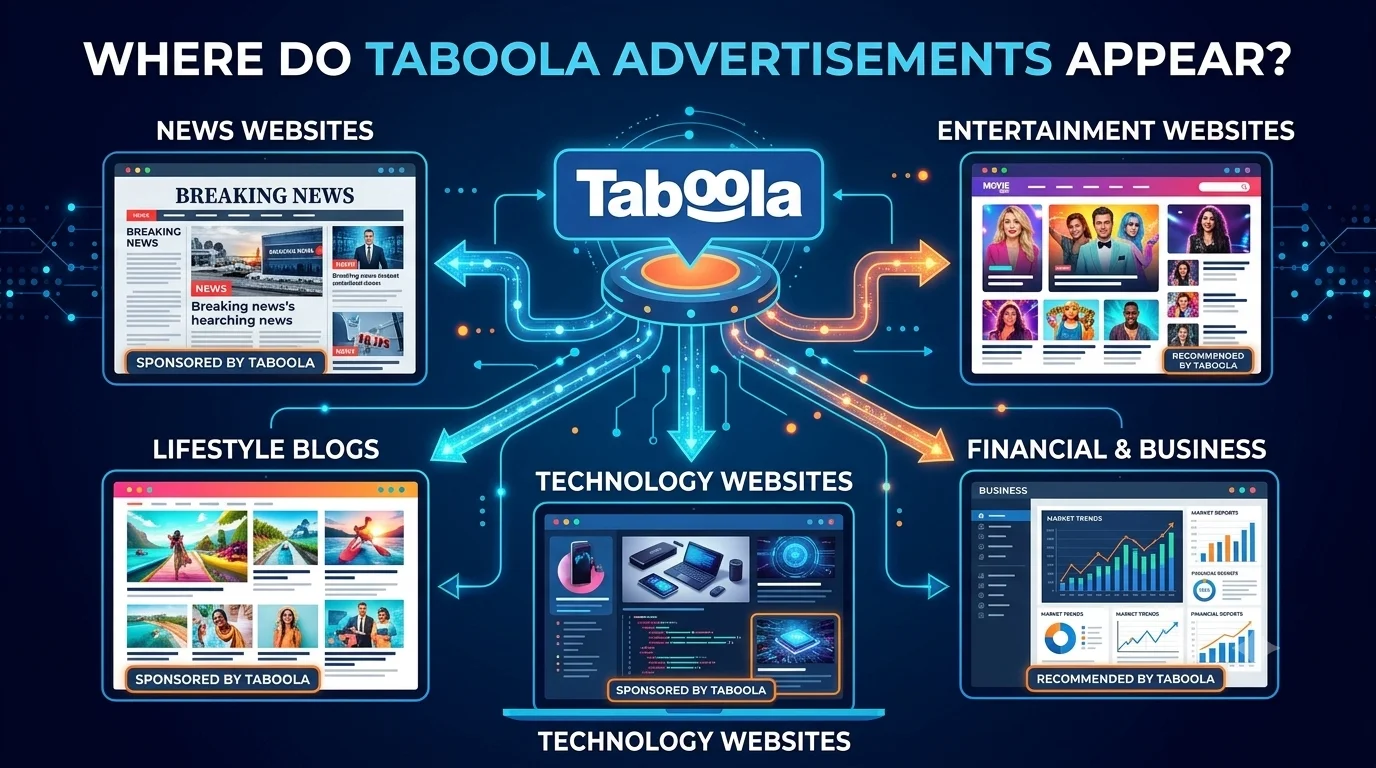
One of Taboola’s biggest attractions is its publisher network. Rather than displaying advertisements exclusively on one platform, Taboola distributes sponsored content across participating third-party websites.
Depending on campaign eligibility, targeting, and publisher inventory, advertisements may appear on:
- News websites: Sponsored recommendations alongside breaking news, business updates, political coverage, and other editorial articles.
- Entertainment websites: Promotional content displayed alongside celebrity news, lifestyle stories, and entertainment articles.
- Lifestyle blogs: Advertisements related to health, fitness, travel, fashion, home improvement, and personal interests.
- Technology websites: Sponsored articles, software recommendations, technology products, and industry-related content.
- Financial and business publications: Advertisements promoting financial services, business resources, educational content, and professional solutions.
The exact websites where an advertisement appears depend on Taboola’s available publisher inventory, campaign targeting, geographical settings, and other delivery factors.
1.3 Examples of Taboola Ads on Publisher Websites
To understand how Taboola advertisements look in practice, consider a few common examples.
Example 1: News Website Recommendations
A user reads an article about business trends and notices a sponsored recommendation titled “10 Business Ideas You Can Start With a Small Investment.” Clicking it takes the user to an advertiser’s blog or landing page.
Example 2: Travel and Lifestyle Websites
Someone reading a travel article sees an advertisement promoting “Discover These 7 Hidden European Destinations.” The advertiser uses an attractive image and engaging headline to generate interest and website visits.
Example 3: Product and E-commerce Recommendations
A visitor reading a technology review sees a sponsored recommendation for a new laptop, software product, or consumer gadget. Clicking the advertisement takes them to a product page where they can explore the offering.
These examples illustrate how native advertising can introduce products, services, and informational content to users in different browsing environments.
The actual appearance and placement depend on the publisher’s website design and the available Taboola advertising formats.
Taboola also supports different advertising placements, including in-feed recommendations, homepage placements, and mid-article advertisements.
1.4 Difference Between Native Ads and Traditional Display Ads
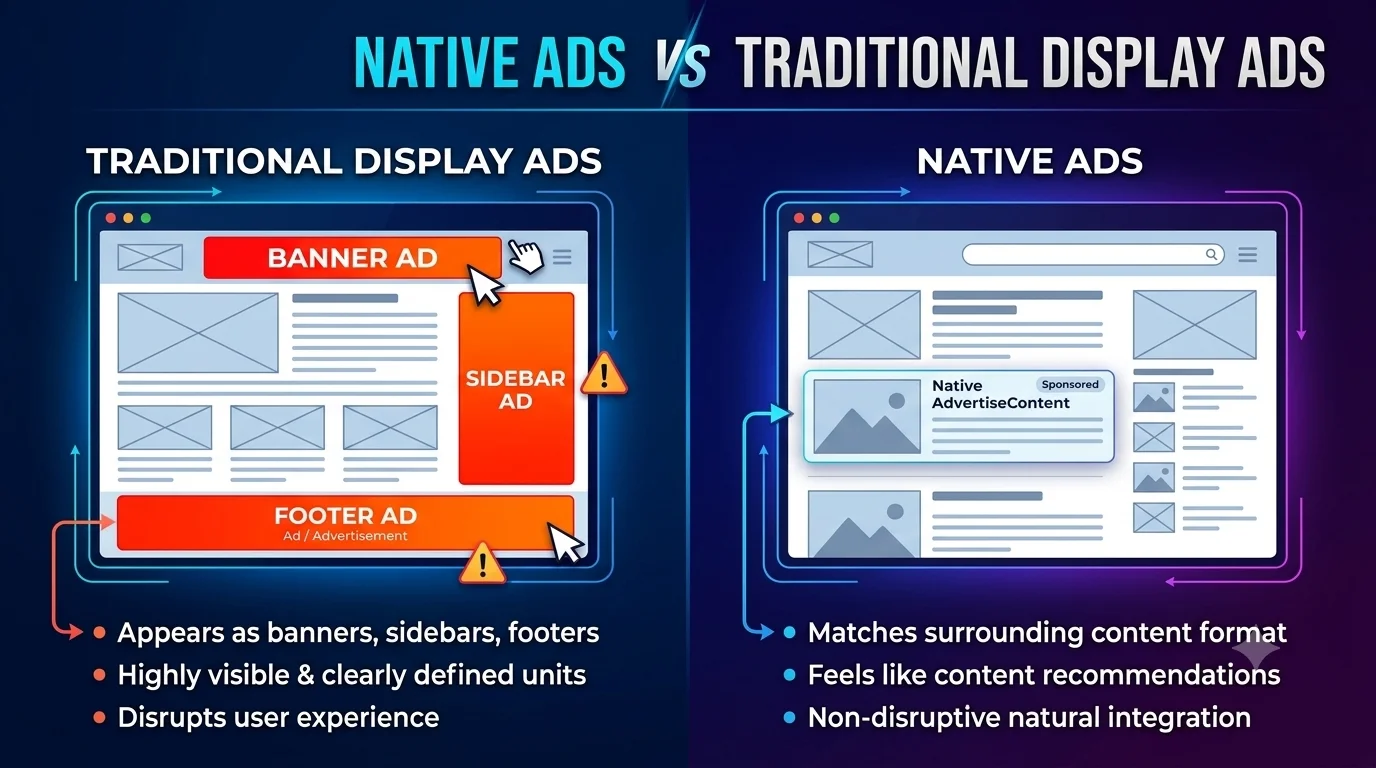
Although both native advertising and traditional display advertising help businesses promote their offerings online, their presentation and user experience are different.
Traditional display ads generally appear as banners, rectangular graphics, or other clearly defined advertising units. They are commonly positioned in website headers, sidebars, footers, and other designated advertising spaces.
Native advertisements, on the other hand, are designed to match the format and visual structure of the surrounding content.
This makes them feel more like content recommendations than conventional advertisements, while still being identified as sponsored content.
Here is a comparison:
| Comparison | Taboola Native Ads | Traditional Display Ads |
| Appearance | Resembles recommended content | Usually banner-style graphics |
| Placement | Within content feeds and recommendation sections | Headers, sidebars, footers |
| Ad format | Images, headlines, videos, and content recommendations | Static images, GIFs, animations, and banners |
| User experience | Blends with the browsing experience | More visually distinct |
| Primary approach | Content discovery and audience engagement | Visual promotion and brand exposure |
| Creative strategy | Engaging headlines and relevant images | Attractive graphics and promotional messages |
| Common objective | Traffic acquisition, awareness, and conversions | Brand awareness, reach, and conversions |
Which Advertising Format is Better?
Neither format is universally better. The right choice depends on your campaign objectives, target audience, advertising budget, and creative strategy.
For example, if you want to promote an informative article, generate interest in a new product, or attract visitors who enjoy discovering new content, native advertising can be a suitable option.
However, if your primary objective is to build visual brand recognition through banners, product graphics, or promotional creatives, traditional display advertising may be more appropriate.
From my PPC perspective, I would not evaluate these formats based on clicks alone. I would also compare post-click engagement, lead quality, conversion rates, and overall customer acquisition cost.
A campaign generating inexpensive clicks is not necessarily profitable if those visitors do not take meaningful action.
The key takeaway: Taboola makes native advertising accessible to businesses by connecting advertisers with audiences across third-party publisher websites.
Its content-discovery approach offers an alternative to traditional display advertising and search-based campaigns, particularly for businesses looking to expand their audience reach.
For further understanding, refer to Taboola’s official resources:
2. How Do Taboola Ads Work?
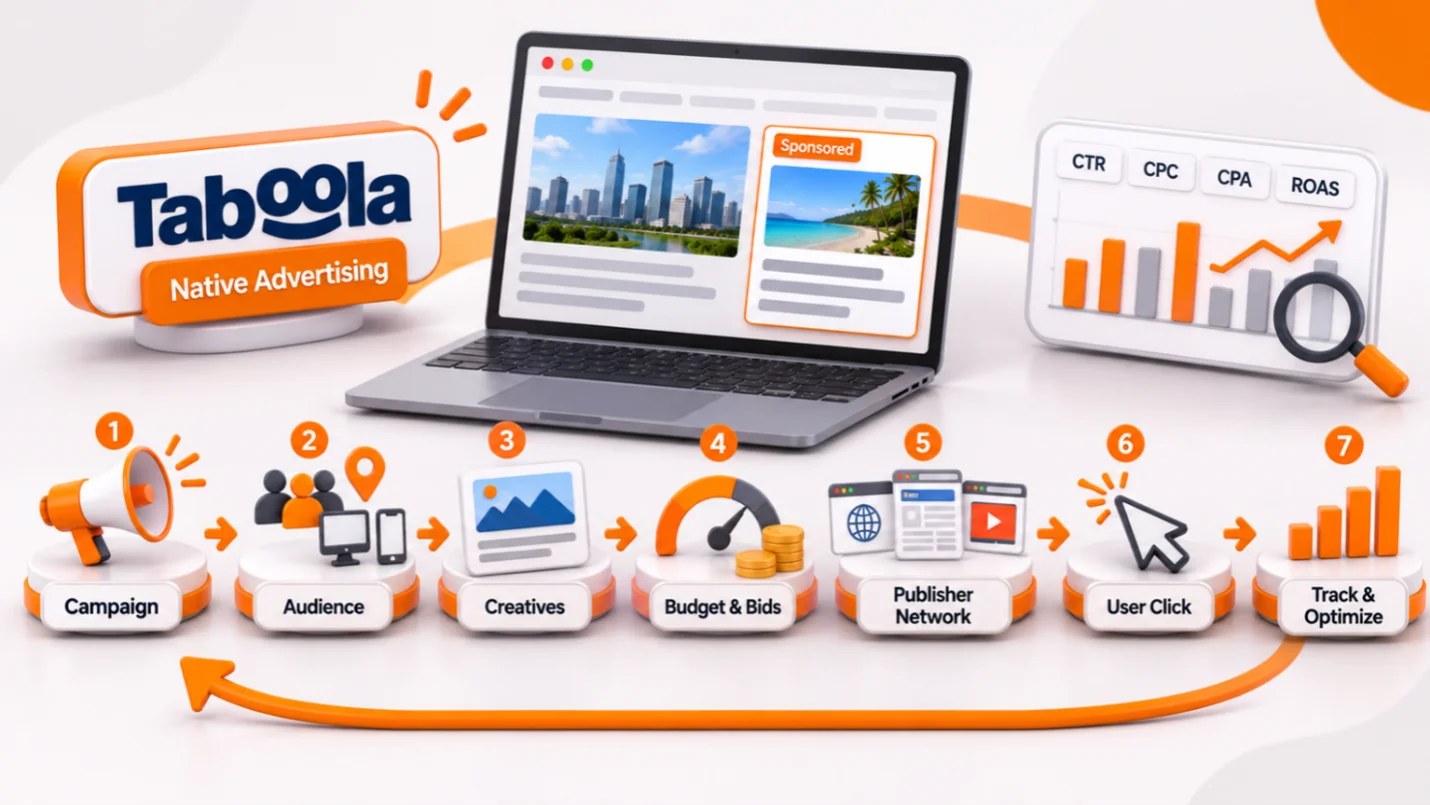
Taboola advertising works by connecting businesses that want to promote their products, services, or content with publishers whose audiences are actively consuming online content. Advertisers create campaigns, upload their promotional creatives, define their target audiences, and allocate advertising budgets.
Taboola then distributes eligible advertisements across its publisher network, where users can discover and interact with them.
Unlike traditional search advertising, where businesses typically compete to appear when someone searches for a particular keyword, Taboola focuses on content discovery. It helps advertisers reach potential customers while they read articles, browse news websites, or explore other online content.
From a PPC management perspective, the process is similar to running campaigns on Google Ads or Meta Ads, including campaign setup, budgeting, targeting, creative testing, and performance tracking.
However, the advertising environment and user intent are different.
Let’s understand the complete Taboola advertising process step by step.
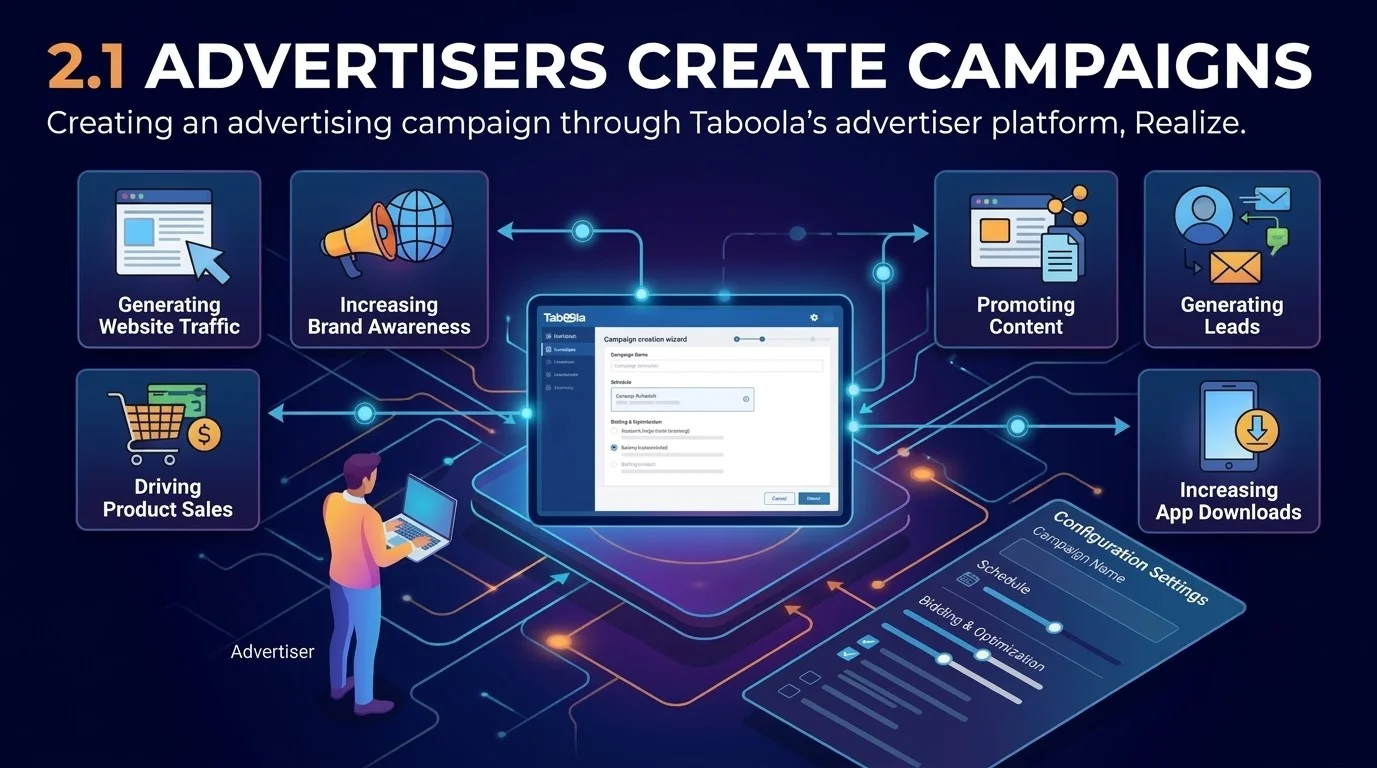
2.1 Advertisers Create Campaigns
The first step is creating an advertising campaign through Taboola’s advertiser platform, currently known as Realize.
Advertisers begin by defining what they want to achieve from their campaigns. Common advertising objectives include:
- Generating website traffic.
- Increasing brand awareness.
- Promoting blog articles and other content.
- Generating leads and inquiries.
- Driving product sales and purchases.
- Increasing app downloads or other desired actions.
After selecting an appropriate objective, advertisers configure their campaign settings, including campaign name, schedule, advertising preferences, and optimization goals.
For example, a healthcare company might create a campaign to promote an educational article about dental implants, while an e-commerce business might launch a campaign to generate traffic to a product category page.
The campaign objective is important because it influences how advertisers should approach targeting, bidding, landing pages, and performance measurement.
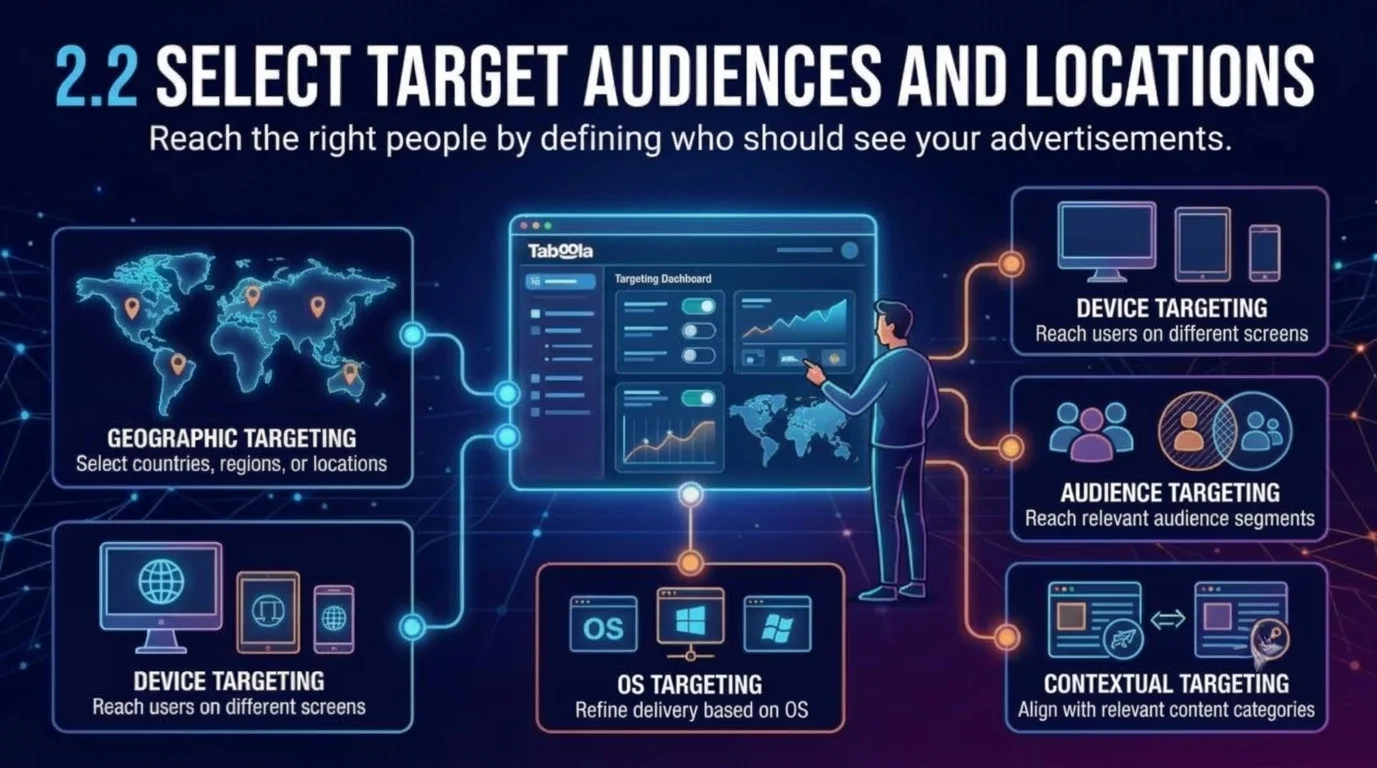
2.2 Select Target Audiences and Locations
Once the campaign is created, advertisers need to decide who should see their advertisements.
Taboola offers targeting options that help businesses reach audiences based on different characteristics and campaign requirements.
Some important targeting considerations include:
- Geographic targeting: Select the countries, regions, or locations where advertisements should appear.
- Device targeting: Reach users browsing through desktop computers, tablets, or mobile devices.
- Operating system targeting: Refine delivery based on supported operating systems.
- Audience targeting: Reach relevant audience segments based on available audience data and targeting options.
- Contextual targeting: Align advertisements with relevant content categories and browsing environments.
For example, if a company offers digital marketing services in the United States, it may choose to target users in selected US locations rather than spending its entire budget on worldwide traffic.
Similarly, an e-commerce business selling mobile accessories may want to focus on mobile users who are more likely to explore and purchase products through their smartphones.
My PPC recommendation: Avoid targeting everyone simply because a platform offers a large audience. Start with locations, devices, and audience segments that align with your actual customers.
You can gradually expand targeting once you identify which segments deliver meaningful results.
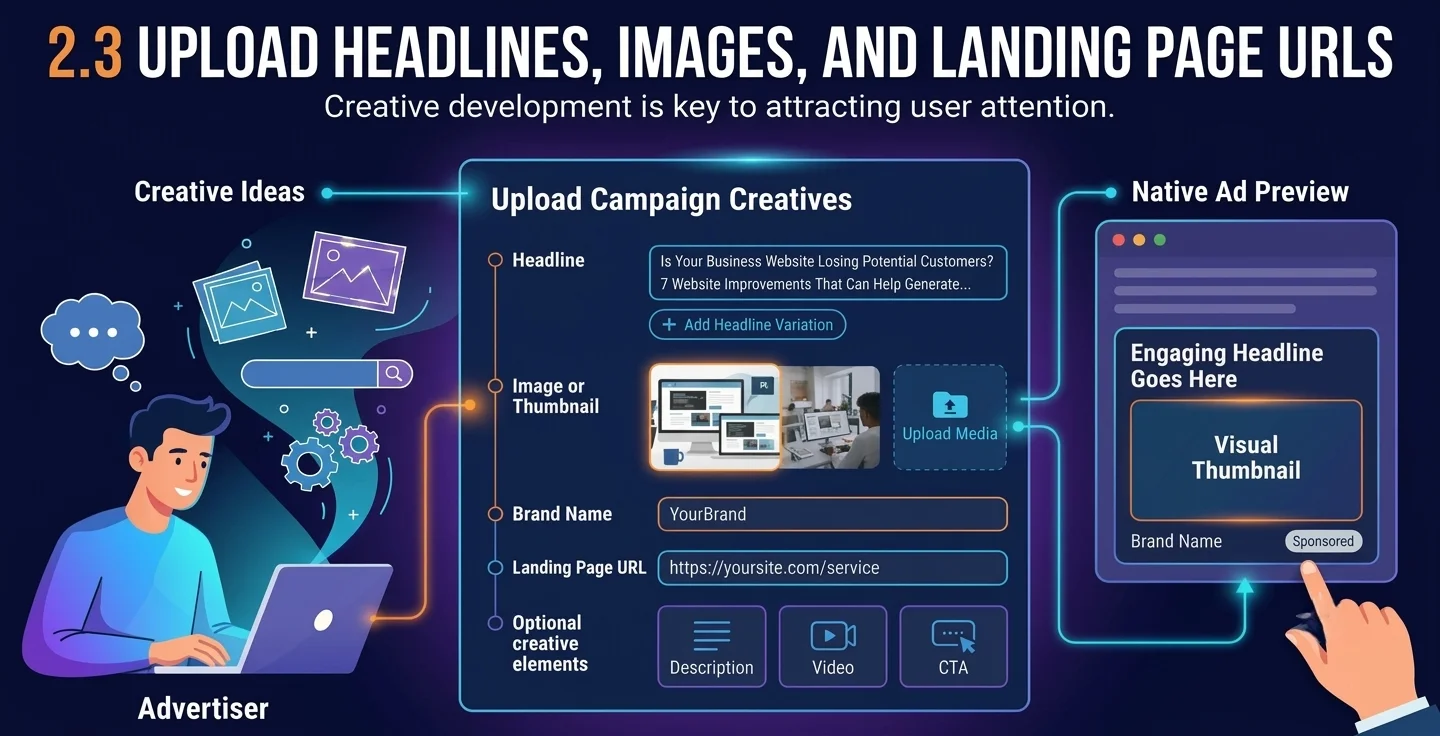
2.3 Upload Headlines, Images, and Landing Page URLs
Creative development is one of the most important parts of a Taboola campaign.
Since native advertisements appear alongside editorial content, their headlines and images need to attract attention without looking completely disconnected from the surrounding content.
Typically, advertisers provide:
- Headline: A short, engaging title that encourages users to explore the advertised content.
- Image or thumbnail: A relevant visual that communicates the subject of the advertisement.
- Brand name: The advertiser’s business or brand identification.
- Landing page URL: The destination users visit after clicking the advertisement.
- Optional creative elements: Depending on the available format, advertisers may also use descriptions, videos, or calls to action.
For example, a business promoting website development services might test headlines such as:
- Is Your Business Website Losing Potential Customers?
- 7 Website Improvements That Can Help Generate More Leads.
- What Should You Look for in a Professional Website Development Company?
Each headline could be paired with a relevant image and a landing page explaining the service.
Advertisers should also create multiple creative variations rather than relying on a single advertisement.
This allows them to compare headlines, images, and messaging to identify which combinations generate better engagement.
Before launching, the landing page should be relevant to the advertisement, mobile-friendly, fast-loading, and designed around the campaign objective.
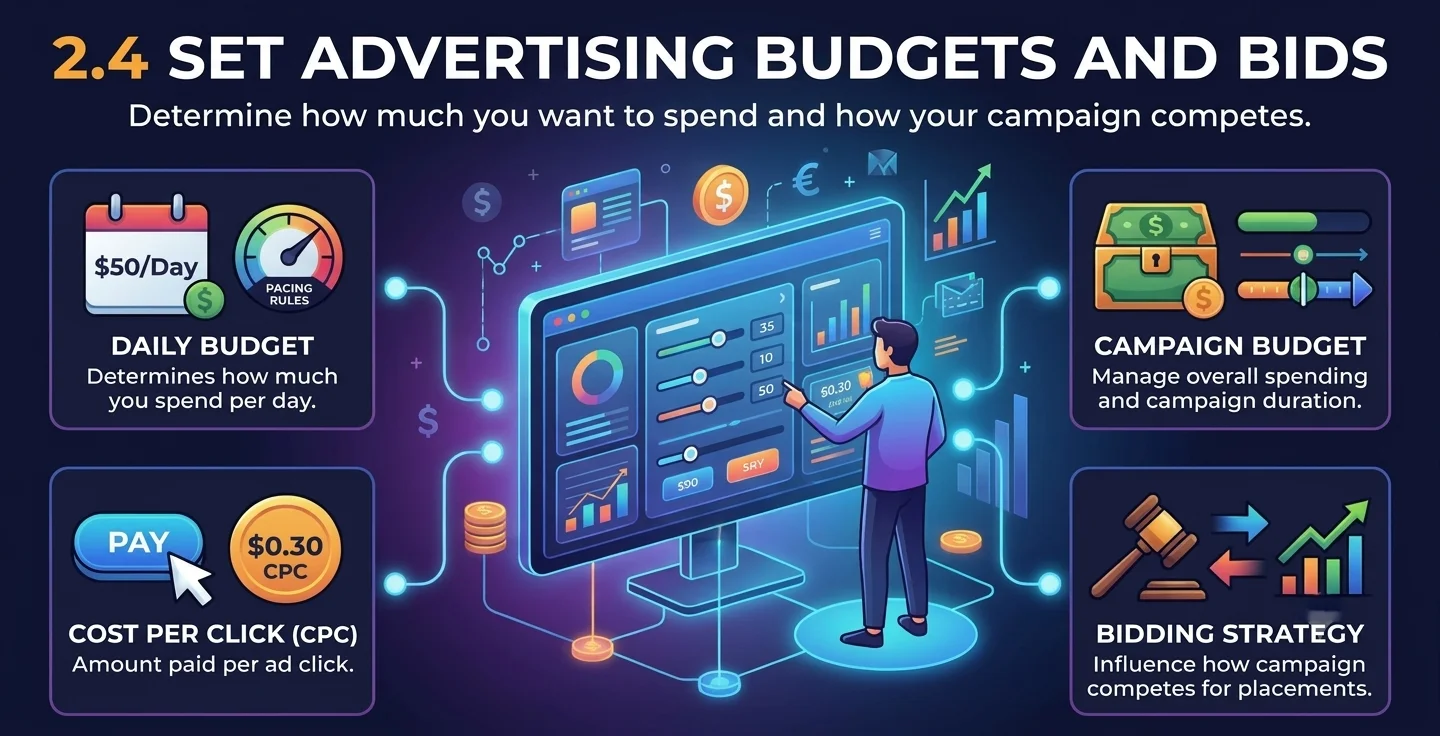
2.4 Set Advertising Budgets and Bids
After preparing the creatives and targeting settings, advertisers need to decide how much they want to spend on their campaigns.
Taboola provides budget and bidding controls that help advertisers manage advertising expenditure and influence how their campaigns compete for available placements.
Some important budget and bidding considerations include:
- Daily Budget
The daily budget determines how much an advertiser is willing to spend per day. For example, if a business sets a daily budget of $50, it is allocating approximately $50 per day to its campaign, subject to the platform’s budget and pacing rules.
- Campaign Budget
Advertisers can also manage their overall campaign spending based on the available budget and campaign duration.
- Cost Per Click (CPC)
CPC is the amount an advertiser pays per ad click. For example, if the average CPC is $0.30 and the campaign generates 1,000 clicks, the estimated advertising cost would be $300.
- Bidding Strategy
Advertisers can select from available bidding and optimization strategies depending on their campaign objectives. These may include manual or automated bidding approaches designed to help achieve traffic or conversion goals.
For example, an advertiser focused on website traffic may prioritize click volume, while a business generating leads may prefer a conversion-focused bidding strategy.
It is important to understand that setting a higher bid does not automatically guarantee better campaign performance.
Actual delivery depends on factors such as available inventory, targeting, competition, and predicted user engagement.
My PPC recommendation: Don’t focus exclusively on getting the lowest possible CPC. A cheaper click is not necessarily a valuable click.
I would rather pay slightly more for visitors who engage with the website, submit inquiries, or become customers than generate thousands of inexpensive visits without meaningful conversions.
2.5 Taboola Distributes Ads Through Its Publisher Network
Once the campaign is configured and approved, Taboola starts distributing eligible advertisements across its publisher network.
This is where Taboola’s content discovery technology plays an important role.
When a user visits a participating publisher’s website, Taboola identifies available advertising opportunities and evaluates eligible advertisements based on factors such as campaign settings, targeting requirements, and predicted engagement and conversion performance.
The platform then determines which advertisements are suitable for the available placements.
For example:
- A user reading a business article might see an advertisement promoting a business management guide.
- Someone browsing a technology publication might discover an advertisement for a software product.
- A visitor exploring a lifestyle website might see sponsored content related to travel, fitness, or home improvement.
The objective is to connect advertisements with relevant users and content environments.
Advertisers do not need to manually contact every publisher or negotiate individual advertising placements. Taboola manages the distribution process through its advertising technology and publisher network.
2.6 Users Interact With Advertisements
After an advertisement appears on a publisher’s website, users can interact with it.
Depending on the creative and placement, users may:
- View the sponsored recommendation.
- Click the headline or thumbnail.
- Visit the advertiser’s landing page.
- Read a promoted article or guide.
- Explore a product or service.
- Complete an inquiry form or make a purchase.
For example, imagine someone reading an article about small business marketing. They notice a Taboola advertisement titled “How to Get More Customers Through Digital Marketing.”
The headline attracts their attention, and they click the advertisement. They are redirected to the advertiser’s website, where they can read the article, explore the company’s services, or submit an inquiry.
However, not every click results in a conversion. Some visitors may leave immediately, while others may explore multiple pages before taking action.
This is why advertisers should evaluate the complete user journey rather than considering clicks as the only measure of success.
2.7 Advertisers Track Clicks, Conversions, and Campaign Performance
The final and arguably most important part of the advertising process is performance tracking and optimization.
Taboola provides campaign reporting tools that allow advertisers to understand how their advertisements perform across campaigns, creatives, publishers, locations, and devices.
Some important performance metrics include:
| Metric | What It Measures |
| Impressions | Number of times an advertisement is displayed |
| Clicks | Number of times users click an advertisement |
| CTR | Percentage of impressions that result in clicks |
| CPC | Average cost paid per click |
| Conversions | Number of desired actions completed by users |
| CPA | Average cost of acquiring a conversion |
| Conversion Rate | Percentage of visitors who complete a desired action |
| ROAS | Revenue generated compared with advertising expenditure |
To measure conversions accurately, advertisers can implement the Taboola Pixel or use supported server-side tracking integrations.
For example, an online store may track purchases, while a service-based business may track contact form submissions, phone inquiries, or consultation bookings.
Conversion tracking is particularly important because it helps advertisers identify which campaigns, advertisements, and audience segments generate actual business results.
Here is a practical example:
Suppose a business launches a Taboola campaign to generate leads for its digital marketing services.
Illustrative campaign performance
Advertising spend
$500
Total impressions
100,000
Total clicks
2,000
Average CPC
$0.25
Leads generated
40
Cost per lead
$12.50
CALCULATED CAMPAIGN METRICS
Click-through rate (CTR)
2%
Conversion rate
2%
Cost per lead (CPL)
$12.50
These are hypothetical figures for explaining campaign calculations, not actual Taboola benchmarks or guaranteed results.
By analyzing these metrics, advertisers can identify opportunities to improve their campaigns. For instance, they may pause advertisements generating clicks but no leads, increase investment in better-performing creatives, or refine targeting to attract more relevant visitors.
This optimization process should continue throughout the campaign rather than stopping after the initial launch.
2.8 Continuous Campaign Optimization
Launching a Taboola campaign is only the beginning. Like other paid advertising platforms, successful campaigns require continuous monitoring, testing, and optimization.
As a PPC professional, I recommend focusing on the following activities:
- Creative testing: Experiment with different headlines, images, and messaging to identify advertisements that attract relevant visitors.
- Publisher optimization: Review publisher-level performance and identify placements that generate valuable traffic.
- Audience refinement: Analyze location, device, and audience performance to improve targeting.
- Bid optimization: Adjust bids based on campaign objectives, competition, and conversion performance.
- Landing page improvements: Improve page speed, content relevance, navigation, and conversion opportunities.
- Budget allocation: Shift spending towards campaigns and advertising variations that deliver better business results.
The objective is not simply to increase impressions or clicks. It is to improve the efficiency of advertising expenditure and generate more value from every campaign.
Complete Taboola Advertising Process at a Glance
- Create an advertising campaign
Define the advertising objective and campaign settings. - Choose your target audience
Select relevant locations, devices, and audience segments. - Upload ad creatives
Add headlines, images, brand information, and landing page URLs. - Set budgets and bids
Decide how much to spend and select an appropriate bidding strategy. - Distribute advertisements
Taboola delivers eligible ads across its network of participating publishers. - Generate user engagement
Visitors discover advertisements and click through to the advertiser’s website. - Track and optimize performance
Measure clicks, conversions, CPA, and other campaign metrics to improve results.
My final take: Taboola should not be treated as a platform where you simply upload an image, write a headline, and wait for traffic. It requires the same strategic approach as other PPC channels. Campaign structure, audience selection, creative quality, conversion tracking, and ongoing optimization all contribute to advertising performance.
Businesses that understand these elements can use Taboola as an additional channel for traffic acquisition and performance marketing, rather than relying entirely on search and social media advertising.
For additional technical guidance, refer to Taboola’s official resources:
- Setting Up a New Campaign
- Understanding Campaign Settings
- Taboola Advertiser Quick-Start Guide
- Conversion Tracking Guide
3. What Are the Different Types of Taboola Ads?
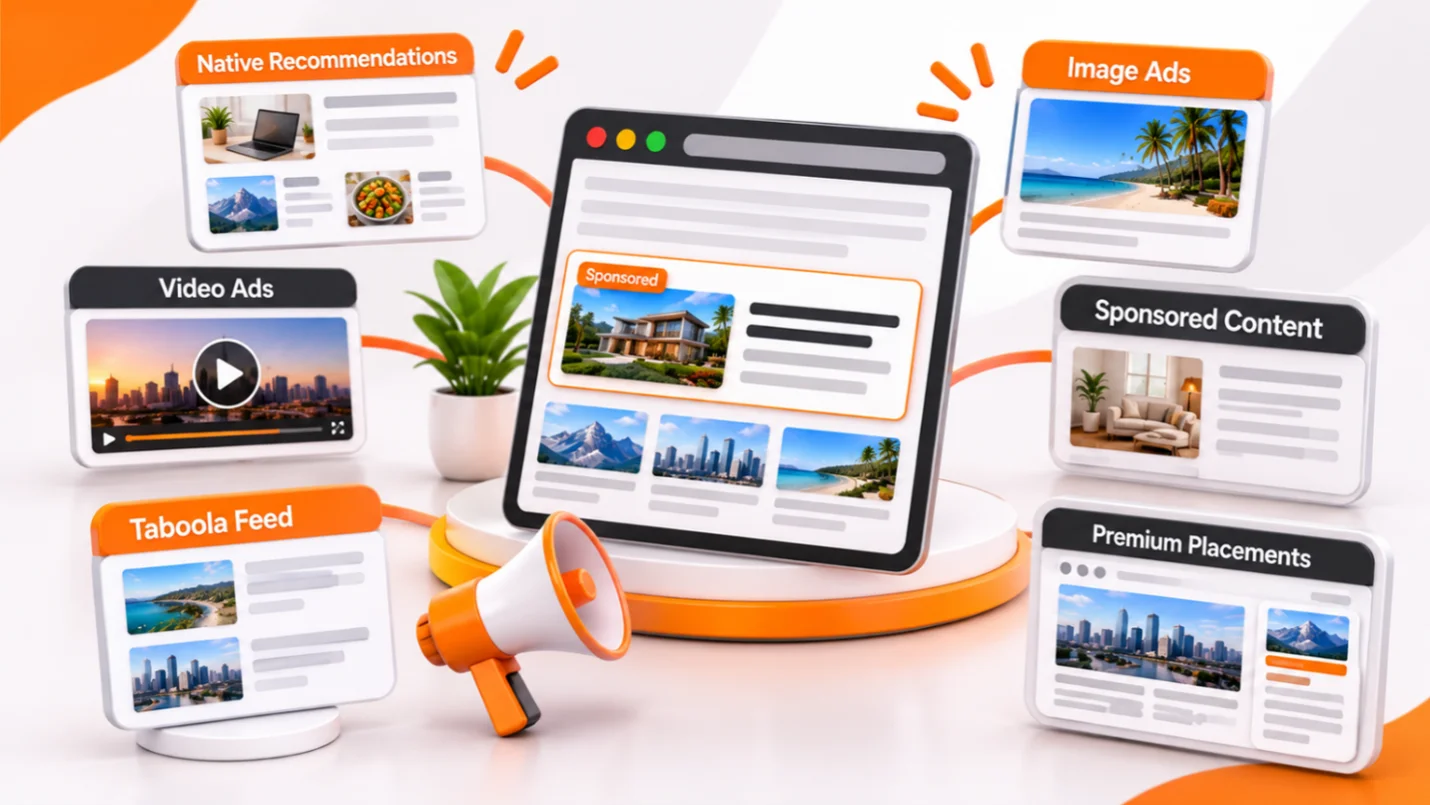
Taboola offers different advertising formats and placements that allow businesses to promote their products, services, and content across publisher websites.
These formats are designed to fit naturally into the browsing experience, helping advertisers reach users while they read articles, explore news stories, watch videos, or discover recommended content.
Unlike traditional advertising platforms that primarily focus on banner advertisements, Taboola emphasizes content discovery through native advertising placements.
Advertisers can use images, headlines, videos, and sponsored content to attract attention and encourage users to visit their websites.
Choosing the right advertising format is important because different formats serve different marketing objectives.
For example, an image-based native advertisement may work well for generating website traffic, while video advertisements can help communicate a product’s features or build brand awareness.
Let’s explore the major Taboola advertising formats and placements.
3.1 Native Content Recommendation Ads
Native content recommendation ads are among the most recognizable advertising formats associated with Taboola.
These advertisements appear as recommended articles or sponsored content on publisher websites. They generally include an image thumbnail, an engaging headline, and the advertiser’s brand information.
For example, imagine someone reading an article about personal finance on a news website. Below the article, they see recommendations such as:
- 7 Financial Mistakes You Should Avoid in Your 30s.
- How to Save Money Without Changing Your Lifestyle.
- Discover These Investment Strategies for Beginners.
Some of these recommendations may be sponsored advertisements delivered through Taboola.
When users click on these recommendations, they are redirected to the advertiser’s landing page, blog article, product page, or another destination.
Best suited for:
- Blog and article promotion.
- Website traffic generation.
- Brand awareness.
- Content marketing campaigns.
- Lead generation through educational content.
From a PPC perspective, I consider this format particularly useful for businesses with valuable content that need distribution beyond organic search and social media.
3.2 Image-Based Advertisements
Image-based advertisements use visual creatives to attract users’ attention within native advertising placements.
These ads typically combine an image with a short headline and brand identification. Unlike conventional display banners, their presentation is designed to resemble the recommended content surrounding them.
The image plays an important role because it gives users an immediate idea of what the advertisement is promoting.
For example:
- A real estate company might use an image of a modern residential property.
- A travel agency might promote a holiday package using destination photography.
- An e-commerce brand might showcase a popular consumer product.
- A digital marketing agency might use a visual highlighting its marketing services.
However, advertisers should not select images simply because they look attractive. The creative should communicate the advertisement’s message and match the landing page experience.
Best suited for:
- Product promotion.
- E-commerce advertising.
- Website traffic campaigns.
- Brand discovery.
- Content and service promotion.
My PPC recommendation: Test multiple images with different headlines. Sometimes a simple, relevant image can attract more qualified visitors than an overly designed promotional graphic. The important thing is to evaluate the quality of traffic, not just the click-through rate.
3.3 Video Advertisements
Video advertisements enable businesses to promote their products, services, and brand messages through video placements across Taboola’s publisher network.
Instead of relying only on static images and headlines, advertisers can use moving visuals, product demonstrations, storytelling, and short promotional videos to capture users’ attention.
Taboola supports different video advertising placements, including:
- In-feed video ads: Videos displayed within content recommendation feeds, where users can discover sponsored and editorial content.
- In-article video ads: Video advertisements that appear within or around editorial content as users read an article.
- In-widget video ads: Video recommendations integrated into traditional content recommendation widgets.
- Floating or slider video ads: Video players that appear in smaller floating placements, depending on the publisher’s implementation.
These formats allow advertisers to communicate more information than a standard image-based advertisement.
For example, a software company can use a short demonstration video to explain how its product works.
Similarly, a real estate developer can showcase property features, while an e-commerce brand can demonstrate how customers can use a particular product.
Best suited for:
- Product demonstrations.
- Brand awareness campaigns.
- Product launches.
- Storytelling and promotional campaigns.
- Businesses with visually engaging products or services.
My PPC recommendation: Keep video advertisements short, deliver the main message early, and ensure they are understandable without sound by including captions or subtitles.
Always test whether video traffic drives meaningful engagement and conversions, rather than judging performance solely by video views.
Taboola’s publisher documentation describes in-feed, in-line, slider, and in-widget video placements.
3.4 Sponsored Content
Sponsored content is promotional content created or funded by an advertiser to communicate information about a product, service, brand, or topic.
On Taboola, sponsored content is commonly distributed through native recommendation placements. It may resemble an editorial article recommendation, but it is paid promotional content and should be clearly identified as sponsored.
For example, a digital marketing agency might promote an article titled:
- How Professional SEO Services Help Businesses Generate More Leads.
- 10 Digital Marketing Strategies Every Small Business Should Know.
- What Should You Look for When Hiring an SEO Agency?
When users click these recommendations, they are taken to an article or landing page where the advertiser can provide useful information, demonstrate expertise, and introduce its services.
Sponsored content can be particularly effective when businesses want to educate potential customers before presenting a product or service.
For instance, rather than directly advertising an expensive software subscription, a company might first promote an educational guide explaining how the software solves a particular business problem.
Best suited for:
- Content marketing.
- Educational campaigns.
- B2B marketing.
- Thought leadership.
- Brand awareness.
- Lead generation through informative content.
My PPC recommendation: Make sponsored content genuinely useful. Avoid creating articles that are nothing more than sales pitches. A well-structured educational article can build interest and trust before encouraging visitors to take the next step.
3.5 Feed-Based Advertising Placements
Feed-based advertising is another important part of Taboola’s advertising ecosystem.
With Taboola Feed, advertisements and content recommendations appear in a continuous scrolling experience, similar to the feeds users are familiar with on social media platforms.
These placements allow users to discover sponsored recommendations while browsing through a combination of editorial content and promotional material.
For example, after reading a news article on a publisher’s website, a visitor may encounter a scrolling feed containing:
- Recommended news articles.
- Sponsored product recommendations.
- Promoted blog posts.
- Video advertisements.
- Brand and service promotions.
Advertisers can use these placements to reach users who have already demonstrated an interest in consuming online content.
Taboola Feed can appear in different publisher implementations, including below-article sections and other integrated feed placements.
Best suited for:
- Increasing content discovery.
- Promoting articles and blogs.
- Driving website traffic.
- Product discovery.
- Video advertising.
- Building brand awareness.
My PPC recommendation: Feed-based advertising provides opportunities to test different creative combinations and reach users in content-rich environments.
However, advertisers should monitor individual publisher and placement performance to identify where their budget generates the best results.
3.6 Other High-Impact Advertising Placements
In addition to standard native recommendation formats, Taboola offers premium advertising placements that provide brands with greater visibility across publisher websites.
Some notable placements include:
- Homepage placements: Advertisements displayed in prominent positions on publisher homepages, helping brands reach visitors upon arrival.
- Section-front placements: Ads displayed on specific sections of a website, such as business, technology, lifestyle, or entertainment pages.
- Mid-article placements: Advertisements positioned within editorial content, reaching users while they are actively reading.
- Mobile-integrated news placements: Advertising opportunities within supported mobile news experiences.
These placements are particularly useful for advertisers looking to increase brand visibility and reach audiences in premium editorial environments.
Availability depends on the publisher, advertising product, market, and access to campaigns.
3.7 Comparison of Different Taboola Advertising Formats
Here is a quick comparison to help businesses understand which advertising format may be appropriate for their marketing objectives.
| Ad Format | Primary Purpose | Suitable For |
| Native content recommendations | Content discovery | Blogs and website traffic |
| Image-based ads | Visual engagement | E-commerce and product promotion |
| Video ads | Visual storytelling | Brand awareness and product demonstrations |
| Sponsored content | Education and engagement | B2B and content marketing |
| Feed-based placements | Continuous content discovery | Traffic and audience acquisition |
| High-impact placements | Increased brand visibility | Brand awareness and large campaigns |
Note: These categories are not entirely separate. For example, an image-based advertisement can also appear as a native recommendation within Taboola Feed. The format describes the creative, while the placement describes where the advertisement appears.
Which Taboola Advertising Format Should You Choose?
The right advertising format depends on your business model, target audience, campaign objective, and available creative resources.
As a PPC advertising professional, I would approach format selection based on the following considerations:
- If your objective is to promote blog articles, start with native content recommendation ads.
- If you sell physical products, experiment with image-based advertisements.
- If your product requires demonstrations, consider video advertising.
- If you operate a B2B business, use sponsored educational content to introduce your expertise.
- If you want to increase content discovery, explore feed-based placements.
- If brand visibility is your priority, investigate premium homepage and mid-article placements.
I would also recommend testing multiple creative formats wherever possible. The best-performing format is not necessarily the one that generates the most clicks. It is the one that delivers the right audience at an acceptable acquisition cost.
4. Benefits of Using Taboola Ads
Businesses are constantly looking for new ways to reach potential customers, increase brand visibility, and generate quality website traffic.
While Google Ads and Meta Ads are popular choices for paid advertising, relying entirely on these platforms can limit opportunities to reach audiences in different online environments.
This is where Taboola advertising can offer an additional advantage.
Taboola helps businesses distribute their advertisements across a network of publisher websites, allowing them to reach people as they consume news, articles, entertainment, and other online content.
Its native advertising approach provides an alternative to conventional banner advertisements and creates opportunities for brands to introduce their products and services to new audiences.
However, the benefits of Taboola go beyond traffic generation. Depending on the campaign strategy, businesses can use the platform to improve brand awareness, promote educational content, attract potential customers, and support their overall digital marketing objectives.
Let’s explore the major benefits of using Taboola Ads and why businesses should consider adding native advertising to their paid marketing strategy.
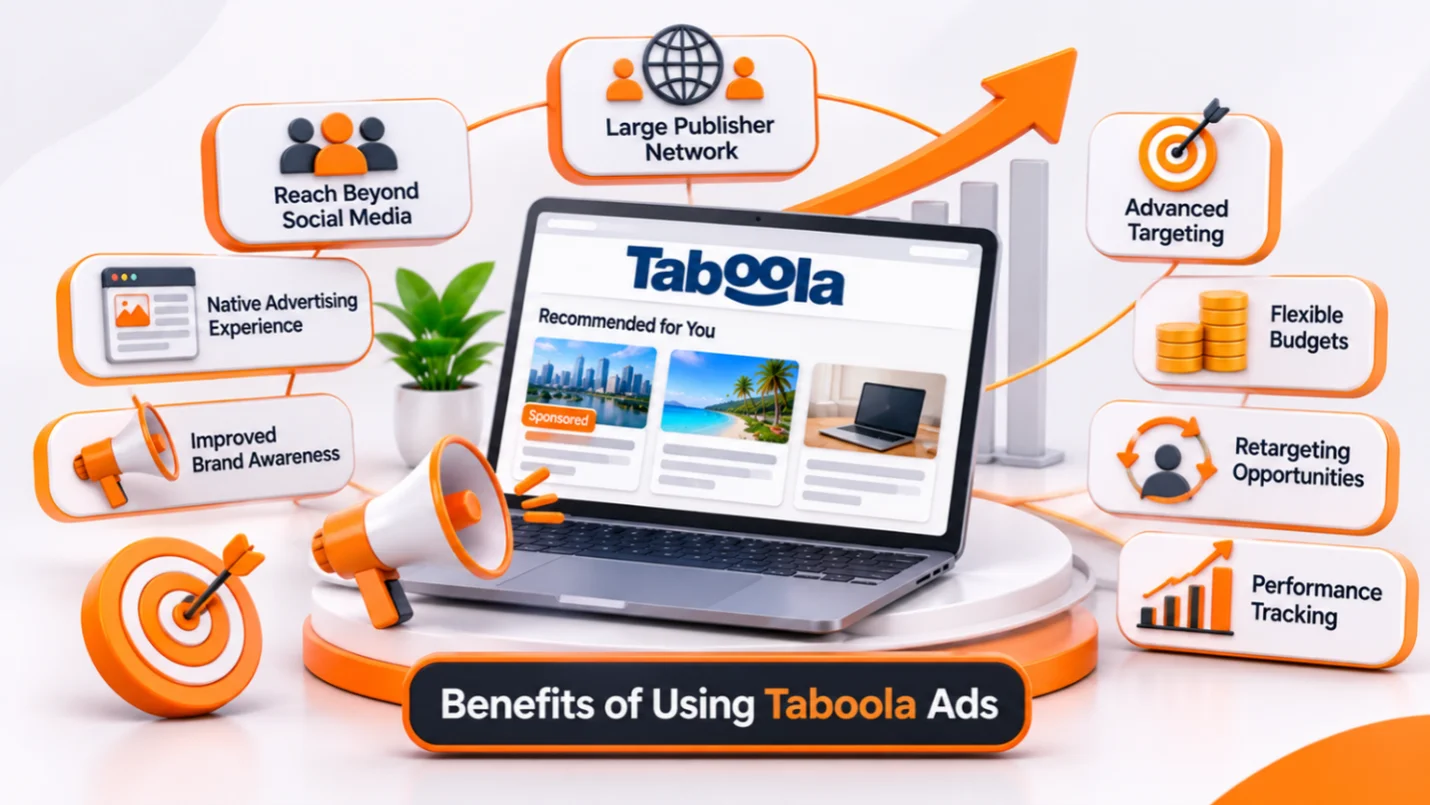
4.1 Access to a Large Publisher Network
One of the biggest advantages of Taboola is its access to a broad network of digital publishers. Instead of advertising on a single website, businesses can distribute their promotional content across participating publishers’ websites through a single advertising platform.
These publishers include news publications, entertainment websites, lifestyle platforms, technology publications, and other content-driven websites.
This gives advertisers an opportunity to reach audiences across multiple online environments without having to negotiate advertising arrangements with each publisher individually.
For example, consider a financial services company that wants to promote an educational article about retirement planning. Through Taboola, it may reach users reading personal finance articles, business news, or related content on participating websites.
Similarly, an e-commerce business can promote its products to audiences browsing technology, lifestyle, or product-related content.
Why this matters for advertisers:
- Expands advertising reach beyond a single website.
- Creates opportunities to connect with audiences across different publisher categories.
- Helps businesses promote content in relevant browsing environments.
- Reduces the need to manage individual publisher relationships.
- Provides additional opportunities for website traffic and brand discovery.
The actual reach depends on available publisher inventory, geographical targeting, campaign settings, and advertising budget.
4.2 Reach Audiences Beyond Social Media Platforms
Another important benefit of Taboola is that it provides an additional advertising channel beyond traditional social media platforms.
Businesses commonly use Facebook, Instagram, LinkedIn, and other social networks to reach potential customers. Although these platforms offer valuable advertising opportunities, they are not the only places where people discover products, services, and brands.
Millions of users also consume content through online newspapers, business publications, blogs, entertainment websites, and other digital publishers.
Taboola allows advertisers to reach audiences in these environments.
For example, a person might not be actively browsing Facebook or Instagram when they discover a sponsored advertisement. Instead, they may encounter it while reading a business article or exploring a technology website.
This creates an opportunity for advertisers to diversify their traffic acquisition strategy.
For businesses already investing heavily in Meta Ads or Google Ads, Taboola can serve as an additional channel to experiment with new audience sources.
Why this matters for advertisers:
- Reduces dependence on a limited number of advertising platforms.
- Provides access to audiences consuming editorial and informational content.
- Creates additional opportunities for customer acquisition.
- Helps businesses experiment with alternative traffic sources.
- Supports a more diversified paid advertising strategy.
However, diversification does not automatically mean better results. Advertisers should compare traffic quality, conversion rates, and customer acquisition costs before shifting significant budgets to a new platform.
4.3 Native Advertising Creates a More Natural User Experience
Traditional display advertisements often appear as separate banners that are visually different from the content users are reading.
Over time, some internet users have become accustomed to ignoring these advertisements, a behavior commonly known as banner blindness.
Native advertising takes a different approach.
Taboola advertisements are designed to fit into the content recommendation areas of publisher websites. They typically use images, headlines, and sponsored labels that resemble the format of other recommended articles.
For example, someone reading an article about website development might see a sponsored recommendation titled “How to Choose the Right Website Development Company.”
Because the advertisement relates to the content being consumed, it may attract the attention of users already interested in the subject.
Some potential advantages include:
- Advertisements fit naturally into content discovery environments.
- Promotional messages can feel less disruptive than conventional banners.
- Relevant headlines can encourage users to explore new content.
- Businesses can introduce their products and services through informative articles.
- Advertisers have opportunities to engage audiences throughout their content-consumption journey.
However, native advertising should not be confused with organic editorial recommendations. Sponsored advertisements must be appropriately identified, and their promotional nature should remain clear to users.
4.4 Improved Brand Awareness
Brand awareness is another important reason businesses consider Taboola advertising.
When a company promotes its content across multiple publisher websites, it gets opportunities to introduce its brand to people who may not have previously encountered its products or services.
For example, imagine a newly launched SaaS company that wants to introduce its project management software to small businesses.
Instead of relying exclusively on Google Search Ads to reach people searching for project management tools, the company can use Taboola to promote educational content on topics such as:
- How to Manage Multiple Business Projects Efficiently.
- Common Project Management Challenges for Small Businesses.
- Best Ways to Improve Team Productivity.
These articles can introduce the company to potential customers and create opportunities for further engagement.
Taboola can support brand awareness through:
- Repeated exposure across participating publisher websites.
- Sponsored content that introduces a brand to new audiences.
- Image and video advertisements that communicate brand messaging.
- Campaigns targeting relevant content categories and audience segments.
- Opportunities to reach users outside conventional social media environments.
One important consideration is that brand awareness cannot be measured through impressions alone.
Advertisers should also consider metrics such as reach, frequency, engagement, branded searches, and changes in brand consideration, where available.
4.5 Targeting and Audience Segmentation
Reaching the right audience is essential for any successful advertising campaign. Even an attractive advertisement may yield poor results if it reaches people with little interest in the product or service being promoted.
Taboola offers targeting capabilities that help advertisers refine campaign delivery based on different audience and contextual signals.
Depending on the available targeting options, advertisers can consider:
- Geographic Targeting
Businesses can select specific countries and regions where they want their advertisements to appear.
For example, a company offering accounting services exclusively in the UK can focus its campaigns on relevant UK audiences rather than paying for traffic from unrelated locations.
- Device Targeting
Advertisers can optimize their campaigns for desktop, mobile, and tablet users.
This is useful because user behavior and conversion rates may differ across devices.
- Contextual Targeting
Contextual targeting helps advertisers reach users in relevant content environments.
For example, a fitness equipment company may want its advertisements to appear alongside fitness, exercise, and health-related content.
- Audience-Based Targeting
Taboola offers audience solutions that can use available first-party data and audience signals to help advertisers reach relevant user groups.
Depending on eligibility and configuration, these solutions may include audience segments, custom audiences, and similar-audience approaches.
- Campaign Exclusions
Advertisers can use available exclusion controls to avoid unsuitable locations, audiences, or publisher placements.
The objective is to improve advertising relevance and reduce unnecessary spending.
My PPC recommendation: Start with a clearly defined target audience rather than combining too many targeting options at once. Analyze campaign data, identify segments that generate qualified visitors, and refine targeting based on actual conversion performance.
4.6 Flexible Advertising Budgets
Another advantage of Taboola is that advertisers have budget and bidding controls to manage their campaigns according to their marketing requirements.
Businesses do not necessarily need to begin with large advertising investments. They can plan their budgets based on their objectives, available resources, campaign duration, and expected acquisition costs.
Some important budget management features include:
- Daily campaign budget controls.
- Campaign spending limits.
- Bid management.
- Budget adjustments based on campaign performance.
- The ability to pause or restart campaigns.
- Opportunities to allocate more budget to better-performing campaigns.
For example, a small business might begin with a limited daily budget to test its advertisements, landing pages, and audience response.
Once it identifies which combinations generate valuable traffic and conversions, it can gradually increase investment.
Consider this illustrative budget allocation:
| Campaign | Daily Budget |
| Campaign A – Blog Promotion | $20 |
| Campaign B – Product Promotion | $30 |
| Campaign C – Lead Generation | $50 |
| Total Daily Budget | $100 |
This approach allows the advertiser to compare different campaign objectives before deciding where to invest more money.
However, budget flexibility does not mean that every budget will generate meaningful results. Advertisers should account for competition, available inventory, conversion costs, and the time needed to collect sufficient performance data.
4.7 Retargeting Opportunities
Not every visitor who clicks on an advertisement becomes a customer immediately.
Some users may visit a website, explore a product, read an article, or check service details without completing a purchase or submitting an inquiry.
This is where retargeting becomes valuable.
Retargeting allows businesses to reconnect with eligible users who have previously interacted with their website or advertising content.
For example, imagine someone visits an online store via a Taboola advertisement, views a particular product, but does not purchase it.
With appropriate tracking implementation, audience eligibility, and consent requirements in place, the business may be able to include that visitor in a remarketing audience and show relevant advertisements again.
Common retargeting opportunities include:
- Website visitors who did not convert.
- Users who viewed specific product pages.
- Visitors who started but did not complete an inquiry form.
- Previous customers who may be interested in additional products.
- Users who engaged with specific website sections.
Advertisers can use the Taboola Pixel and supported audience integrations to build and activate eligible audiences.
Why is retargeting useful?
- Reconnects businesses with previous website visitors.
- Helps maintain brand visibility after the first interaction.
- Creates additional opportunities to generate conversions.
- Supports campaigns targeting different stages of the customer journey.
- Allows advertisers to deliver more relevant follow-up messages.
My PPC recommendation: Separate new audience acquisition campaigns from retargeting campaigns wherever practical.
Someone visiting your website for the first time may need educational content, while someone who has already viewed your pricing page may respond better to a consultation offer or product-specific advertisement.
Retargeting availability and audience size depend on tracking setup, privacy requirements, platform eligibility, and the data collected.
4.8 Performance Tracking and Campaign Optimization
One of the most important benefits of using Taboola is the ability to monitor advertising performance and make data-driven campaign decisions.
Running advertisements without measuring their results can lead to unnecessary spending. Advertisers need to understand which campaigns generate clicks, which advertisements attract engagement, and which visitors complete valuable actions.
Taboola provides campaign reporting and performance insights to help advertisers evaluate their results.
Some important metrics include:
| Performance Metric | Why It Matters |
| Impressions | Measures advertisement exposure |
| Clicks | Shows how many users interact with ads |
| CTR | Measures the percentage of impressions resulting in clicks |
| CPC | Helps evaluate traffic acquisition costs |
| Conversions | Measures completed business objectives |
| CPA | Shows the average cost of acquiring a customer or lead |
| Conversion Rate | Evaluates the effectiveness of website traffic |
| ROAS | Measures revenue generated relative to advertising spend |
Advertisers can use these insights to identify underperforming campaigns, test new creatives, adjust bids, and allocate budgets more effectively.
For example, if one advertisement generates 1,000 clicks but very few inquiries, while another generates 300 clicks and 20 qualified leads, the second advertisement may offer greater business value.
This is why I recommend evaluating Taboola campaigns beyond traffic volume.
From a PPC management perspective, the real objective should be to improve conversion efficiency, not simply maximize clicks.
Taboola’s current advertiser platform, Realize, emphasizes performance optimization, conversion-focused advertising, and campaign control.
4.9 Potential to Generate Website Traffic and Leads
Ultimately, businesses invest in advertising because they want measurable results. These may include website visitors, inquiries, product purchases, subscriptions, or other valuable customer actions.
Taboola can support these objectives by distributing promotional content across publisher websites and introducing businesses to audiences who may be interested in their offerings.
Consider how different businesses can use the platform:
For service-based businesses
A digital marketing agency can promote an educational article about SEO, PPC, or website development. Interested readers can visit its website to explore its services and submit an inquiry.
For e-commerce businesses
An online retailer can promote product recommendations and direct interested users to relevant product pages.
For SaaS companies
A software company can promote educational content that explains how its solution addresses common business challenges and encourages users to sign up for a free trial.
For educational institutions
A training institute can promote informational articles about professional courses, certifications, or career opportunities to attract potential students.
However, generating traffic and generating quality leads are two different things.
A campaign may attract thousands of visitors without producing meaningful inquiries. This can happen when advertisements are too broad, landing pages are poorly optimized, or the audience is not aligned with the business offering.
To improve lead generation, advertisers should focus on:
- Creating advertisements that accurately represent their offerings.
- Sending users to relevant landing pages.
- Including clear calls to action.
- Optimizing landing pages for mobile devices.
- Implementing conversion tracking.
- Measuring lead quality and actual customer acquisition costs.
The most valuable outcome is not simply attracting more visitors. It is attracting visitors who have a genuine possibility of becoming customers.
4.10 Summary: Why Should Businesses Consider Taboola Ads?
Here is a quick overview of the major benefits discussed in this section.
| Benefit | Business Advantage |
| Large publisher network | Expands potential advertising reach |
| Beyond social media | Diversifies traffic acquisition |
| Native advertising | Creates content-integrated ad experiences |
| Brand awareness | Introduces businesses to new audiences |
| Audience targeting | Helps reach relevant users |
| Flexible budgets | Provides control over advertising expenditure |
| Retargeting | Re-engages eligible previous visitors |
| Performance tracking | Supports data-driven optimization |
| Traffic and lead generation | Creates opportunities for customer acquisition |
My Expert Perspective: Are Taboola Ads Worth Considering?
From my perspective, Taboola is worth considering for businesses that want to diversify their paid advertising strategies and reach audiences beyond conventional search and social media platforms.
However, I would not recommend treating it as a direct replacement for Google Ads or Meta Ads. Each platform serves different advertising purposes and reaches users in different contexts.
For example, someone searching Google for “best accounting software for small businesses” may already have a specific purchase intention.
Someone discovering an accounting software advertisement while reading a business article may still be researching available solutions.
Both audiences can be valuable, but the advertising approach should be different.
I would evaluate Taboola based on three important factors:
- Traffic quality: Are visitors genuinely interested in the products, services, or content being promoted?
- Conversion efficiency: Are campaigns generating inquiries, purchases, or other meaningful actions at an acceptable cost?
- Scalability: Can the business increase advertising investment while maintaining sustainable acquisition costs?
If these three factors align with business objectives, Taboola can become a useful addition to an integrated PPC and digital marketing strategy.
For businesses considering native advertising, the best approach is to start with a clearly defined objective, test different creatives, implement proper conversion tracking, and scale campaigns based on measurable results.
5. How Much Do Taboola Ads Cost?
One of the most common questions businesses ask before starting a Taboola advertising campaign is: How much does it cost to advertise on Taboola?
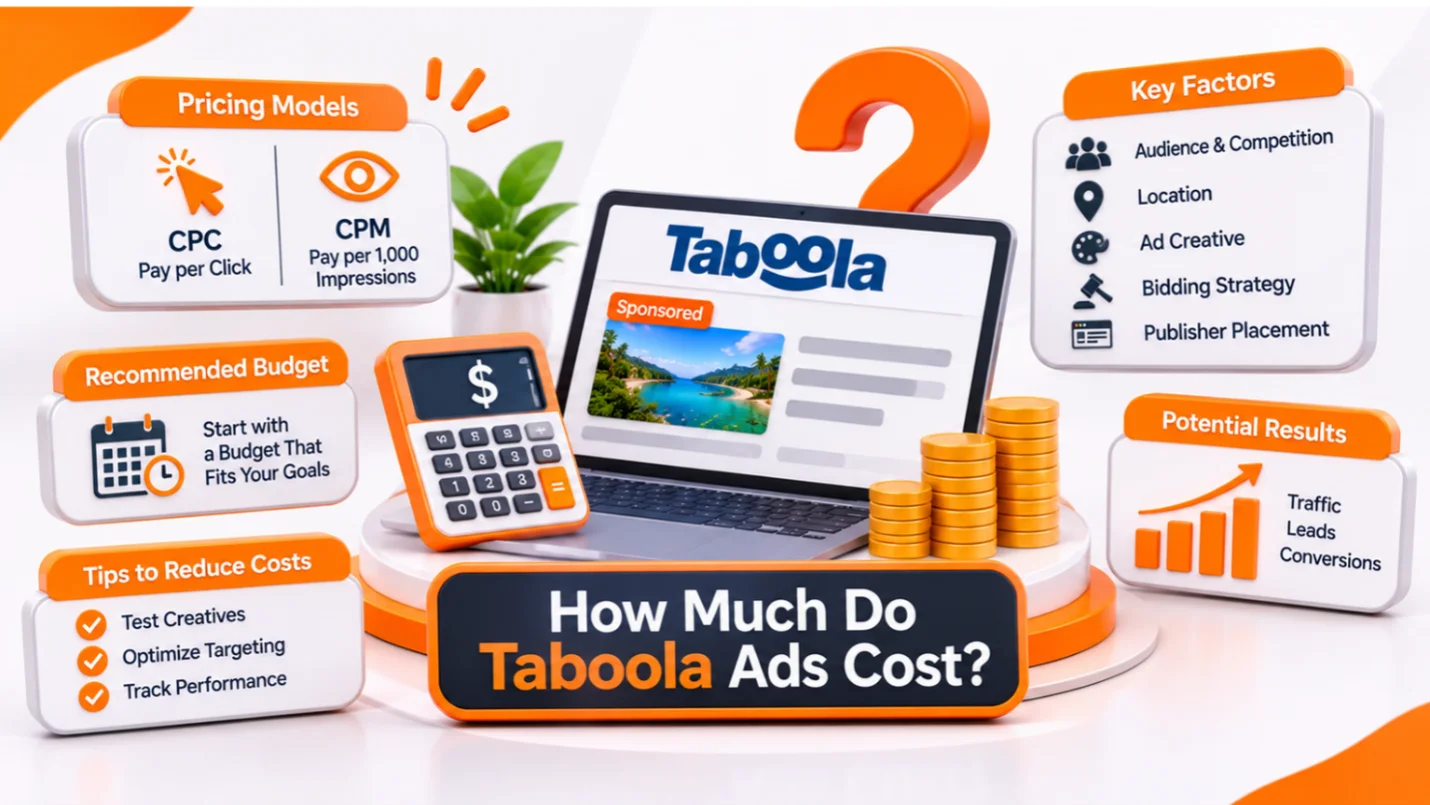
The answer depends on several factors, including your advertising budget, bidding strategy, target audience, geographical location, industry competition, and campaign performance.
Unlike platforms with fixed advertising packages, Taboola uses an auction-based advertising model. Advertisers generally pay based on their selected bidding and campaign optimization approach.
This means the actual cost of advertising can vary depending on campaign settings and competition for available publisher placements.
For businesses considering native advertising, understanding these pricing models is important before allocating a marketing budget.
From a PPC management perspective, I recommend looking beyond the initial cost per click (CPC).
Your actual advertising costs should also be evaluated against website traffic quality, conversion rates, cost per lead (CPL), and return on ad spend (ROAS).
Let’s understand how Taboola advertising costs work and what businesses should consider when planning their budgets.
5.1 Taboola CPC (Cost Per Click)
Cost Per Click (CPC) is one of the most commonly used pricing metrics in Taboola advertising.
Under a CPC-based bidding approach, advertisers pay when users click on their advertisements rather than simply when the advertisements are displayed.
For example, suppose you launch a Taboola campaign with an average CPC of $0.25.
If your advertisement generates 2,000 clicks, your estimated advertising expenditure would be:
\[ 2,000 \times \$0.25 = \$500 \]
This means you would spend approximately $500 to generate 2,000 clicks.
However, actual CPC rates are not fixed. They can vary depending on factors such as:
- Target audience and geographical location.
- Industry and advertiser competition.
- Publisher inventory and placement.
- Campaign bidding strategy.
- Creative performance and predicted engagement.
- Overall advertising demand.
Is CPC advertising suitable for businesses?
CPC-based advertising can be useful for businesses primarily interested in generating website traffic, promoting articles, attracting potential customers, or testing different advertising creatives.
However, inexpensive clicks do not necessarily translate into profitable campaigns. Advertisers should also evaluate what visitors do after reaching the website.
5.2 Taboola CPM (Cost Per Thousand Impressions)
CPM stands for Cost Per Mille, which means the cost of generating 1,000 advertisement impressions.
Unlike CPC, where the advertiser focuses on clicks, CPM-based pricing focuses on advertisement exposure.
This model can be useful for businesses that want to increase brand awareness and reach a larger audience.
CPM is particularly relevant when evaluating the cost efficiency of awareness campaigns.
It is important to distinguish between CPM as a performance metric and the actual buying model.
Taboola’s available bidding and optimization options may vary by campaign type. Advertisers should check the pricing and bidding options available in their current account rather than assume every campaign is purchased on a CPM basis.
When should you consider CPM?
- When your primary objective is brand exposure.
- When you want to reach a large audience.
- When promoting a new brand or product.
- When measuring advertising efficiency through impressions and reach.
5.3 What Is the Minimum Advertising Budget for Taboola?
Taboola does not have a universal minimum advertising budget that applies to all advertisers and campaigns.
The recommended budget depends on your campaign objective, bidding strategy, target CPA, and the amount of traffic needed to generate meaningful performance data.
According to Taboola’s current advertiser guidance, the recommended budget varies by bidding approach.
For example:
- Conversion-focused campaigns: For campaigns using Enhanced CPC or Fixed Bid, Taboola recommends starting with a daily budget of at least 5 times your target CPA and a monthly budget of at least 150 times your target CPA.
- Traffic-focused campaigns: For campaigns not optimizing towards conversions, Taboola recommends aiming for approximately 100–200 clicks per day. The required daily budget depends on your CPC bid.
For example, if your CPC bid is $0.50, a daily budget of 100 would support approximately 100–200 clicks.
Illustrative starting budget calculations
| Campaign objective | Example assumption | Suggested daily budget |
| Traffic generation | $0.50 CPC × 100 clicks | $50 |
| Traffic generation | $0.50 CPC × 200 clicks | $100 |
| Lead generation | $20 target CPA × 5 | $100 |
| Lead generation | $50 target CPA × 5 | $250 |
Examples based on Taboola’s published budgeting recommendations, not mandatory account minimums.
Does Taboola require a large advertising investment?
Not necessarily. Smaller businesses can explore native advertising with controlled budgets, provided their account setup and campaign eligibility allow it. However, the budget should be sufficient to generate enough traffic and performance data to evaluate the campaign.
I recommend starting with a budget that you can comfortably afford to test, measuring the results, and increasing investment only when the campaign demonstrates acceptable performance.
5.4 Factors Affecting Taboola Advertising Costs
There is no fixed CPC or CPM that applies to every Taboola advertiser. Your actual advertising expenditure depends on several factors that influence campaign delivery and auction performance.
Here are the major factors businesses should understand before launching a campaign.
1. Industry and Audience Competition
The industry you operate in can influence your advertising costs.
For example, industries such as finance, insurance, healthcare, technology, and legal services can attract significant competition from advertisers. When multiple advertisers compete for similar audiences and placements, bidding costs may increase.
On the other hand, some niche industries may have less competition for particular audience segments or publisher placements.
Consider these examples:
- Finance: Advertisers promoting loans, investment services, and financial products may compete for valuable audiences.
- Healthcare: Clinics and healthcare businesses may target specific geographical and interest-based audiences.
- Technology: SaaS companies may compete for the attention of business owners, professionals, and technology enthusiasts.
- E-commerce: Retailers may compete for audiences interested in particular product categories.
However, industry alone does not determine CPC. The specific audience, campaign settings, publisher inventory, and bidding strategy also matter.
2. Geographic Targeting
Your target location can significantly influence advertising costs.
Different geographical markets have different levels of advertising demand, publisher inventory, and competition.
For example, targeting audiences in the United States, the United Kingdom, Canada, or Australia may incur different costs than targeting audiences in India or other markets.
Consider a company offering digital marketing services in multiple countries. Its campaigns may have different CPCs depending on the target country.
Geographic targeting can also affect the size of your available audience. A narrowly targeted location may limit delivery, while broader targeting may provide more inventory but potentially attract less relevant traffic.
My PPC recommendation: Compare campaign performance separately by country and region. Do not assume that the location generating the cheapest clicks will necessarily deliver the best leads or customers.
3. Ad Creative Quality and Campaign Performance
Your advertising creatives play an important role in attracting users and influencing campaign performance.
A compelling headline paired with a relevant image can encourage more people to interact with your advertisement. Conversely, an unclear headline or irrelevant image may generate fewer clicks and weaker engagement.
For example, compare these two headlines for a website development company:
- “Professional Website Development Services”
- “Is Your Business Website Losing Potential Customers?”
The second headline introduces a problem that may resonate with the target audience, while the first communicates a straightforward service offering.
This does not mean that the second headline will always perform better. Actual performance depends on audience relevance, creative quality, publisher context, and the landing page experience.
Some important creative considerations include:
- Use relevant and high-quality images.
- Write clear and engaging headlines.
- Test multiple creative variations.
- Maintain consistency between the advertisement and landing page.
- Avoid misleading claims and clickbait.
- Monitor CTR, CPC, and conversion performance.
Taboola also uses campaign optimization and automated bidding to improve ad delivery. For example, its Enhanced CPC strategy can adjust bids based on available performance signals.
4. Bidding Strategy
Your bidding strategy determines how Taboola approaches advertising delivery and campaign spending.
Depending on the campaign setup, advertisers may have access to options such as:
- Fixed Bid: Advertisers set a specific bid amount.
- Enhanced CPC: The platform can adjust bids to pursue better performance.
- Conversion-focused automated bidding: Campaigns can optimize towards conversion objectives using available tracking signals.
For example, an advertiser using manual CPC bidding may set a bid of $0.30, while another advertiser may use an automated bidding approach to optimize towards conversions.
The actual costs can differ because the bidding approaches have different optimization objectives.
Advertisers should choose a strategy based on the value of the action they want users to complete, not simply the desire to obtain the cheapest clicks.
5. Publisher Placement and Available Inventory
The websites and advertising placements where your advertisements appear can also influence campaign costs.
Some publisher environments may attract greater advertiser demand than others. Similarly, certain content categories may have more competition for available advertising inventory.
For example, an advertisement appearing alongside premium business or financial content may face different auction conditions than one appearing on a general entertainment website.
Advertisers should regularly review publisher-level performance to understand which placements deliver valuable traffic.
6. Audience Size and Targeting Restrictions
Highly specific targeting can limit the number of users eligible to see your advertisements.
For example, targeting only business owners in a particular city may provide a smaller audience than targeting business professionals across an entire country.
A smaller audience does not automatically mean higher CPC, but limited inventory and competition can affect campaign delivery and costs.
Advertisers should balance audience relevance with sufficient reach to generate meaningful results.
5.5 How to Calculate Taboola Advertising Costs
Understanding a few basic advertising formulas can help businesses estimate their Taboola campaign expenditure before launching.
Here are three useful calculations.
- Calculating CPC (Cost Per Click)
For example:
- Total advertising spend: $500
- Total clicks: 2,000
CPC = 500/2000 = $0.25
Your average CPC would be $0.25.
- Calculating CPM (Cost Per Thousand Impressions)
For example:
- Advertising spend: $500
- Impressions: 100,000
Your CPM would be $5.
- Calculating Estimated Clicks
If you know your advertising budget and expected average CPC, you can estimate how many clicks your campaign might generate.
For example, if your advertising budget is $1,000 and your expected CPC is $0.25:
You could potentially generate approximately 4,000 clicks.
5.6 Taboola Advertising Budget Example
Let’s look at a hypothetical advertising budget to understand how spending and CPC assumptions affect estimated traffic.
| Advertising Budget | CPC Assumption | Estimated Clicks |
| $500 | $0.20 | 2,500 |
| $1,000 | $0.25 | 4,000 |
| $2,000 | $0.30 | 6,667 |
These are hypothetical calculations, not official Taboola rates. Actual costs depend on campaign settings, competition, targeting, and auction performance.
Estimated Clicks by Advertising Budget
Illustrative traffic projections using the CPC assumptions in the table.
These figures demonstrate how different budgets and CPC assumptions affect estimated traffic. However, actual campaign performance may vary, and advertisers should not treat these projections as guaranteed results.
5.7 How Can Businesses Reduce Taboola Advertising Costs?
Getting the most value from your advertising budget requires more than simply lowering your CPC bids. Businesses should focus on improving campaign efficiency and attracting visitors who are more likely to convert.
Here are some practical recommendations:
- Test multiple headlines and images: Experiment with different creative combinations to identify advertisements that attract relevant visitors.
- Optimize geographical targeting: Focus on locations that generate qualified traffic and conversions.
- Monitor publisher performance: Identify placements that generate valuable visitors and review or exclude consistently underperforming inventory where controls are available.
- Improve landing page experience: Ensure your landing pages are relevant, mobile-friendly, and fast-loading.
- Implement conversion tracking: Use the Taboola Pixel and supported integrations to measure leads, purchases, and other valuable actions.
- Review bidding strategies: Choose an appropriate bidding approach based on campaign objectives and conversion value.
- Allocate budgets strategically: Invest more in campaigns that consistently deliver acceptable acquisition costs.
- Avoid misleading advertisements: Focus on attracting genuinely interested visitors rather than generating clicks through exaggerated headlines.
My PPC recommendation: I would rather optimize a campaign to generate 50 qualified leads at a sustainable cost than spend the same budget generating thousands of visitors who never convert.
5.8 Is Taboola Advertising Expensive?
Taboola advertising is not inherently expensive or inexpensive. Its affordability depends on the business, target market, campaign objectives, and the value generated from advertising expenditure.
For example, a SaaS company acquiring customers with high lifetime value may be comfortable paying more per qualified lead than a small e-commerce business operating on relatively low product margins.
Similarly, a local service provider should evaluate Taboola against the value of the inquiries it generates, rather than comparing its CPC directly with Google Ads.
Before investing, businesses should consider:
- How much are they willing to pay for a qualified lead?
- What is the average value of a new customer?
- What conversion rate can their landing page achieve?
- How much advertising budget can they allocate to testing?
- Can they measure the revenue generated by their campaigns?
These questions will help determine whether Taboola is a financially viable advertising channel.
From my PPC perspective, I recommend starting Taboola advertising with a clearly defined acquisition target rather than setting a budget at random.
For example, if your business can afford a $25 cost per qualified lead, your campaign should be evaluated against that target. You can then experiment with different headlines, publisher placements, audience segments, and bidding strategies to improve performance.
The objective should always be to generate profitable business outcomes, not simply to spend less per click.
Note: Taboola’s billing arrangements, including automatic billing, prepayment, and monthly invoicing, are separate from the minimum campaign budget recommendations. Confirm the available payment options and account-specific requirements before launching.
6. Taboola Ads vs Google Ads vs Facebook Ads
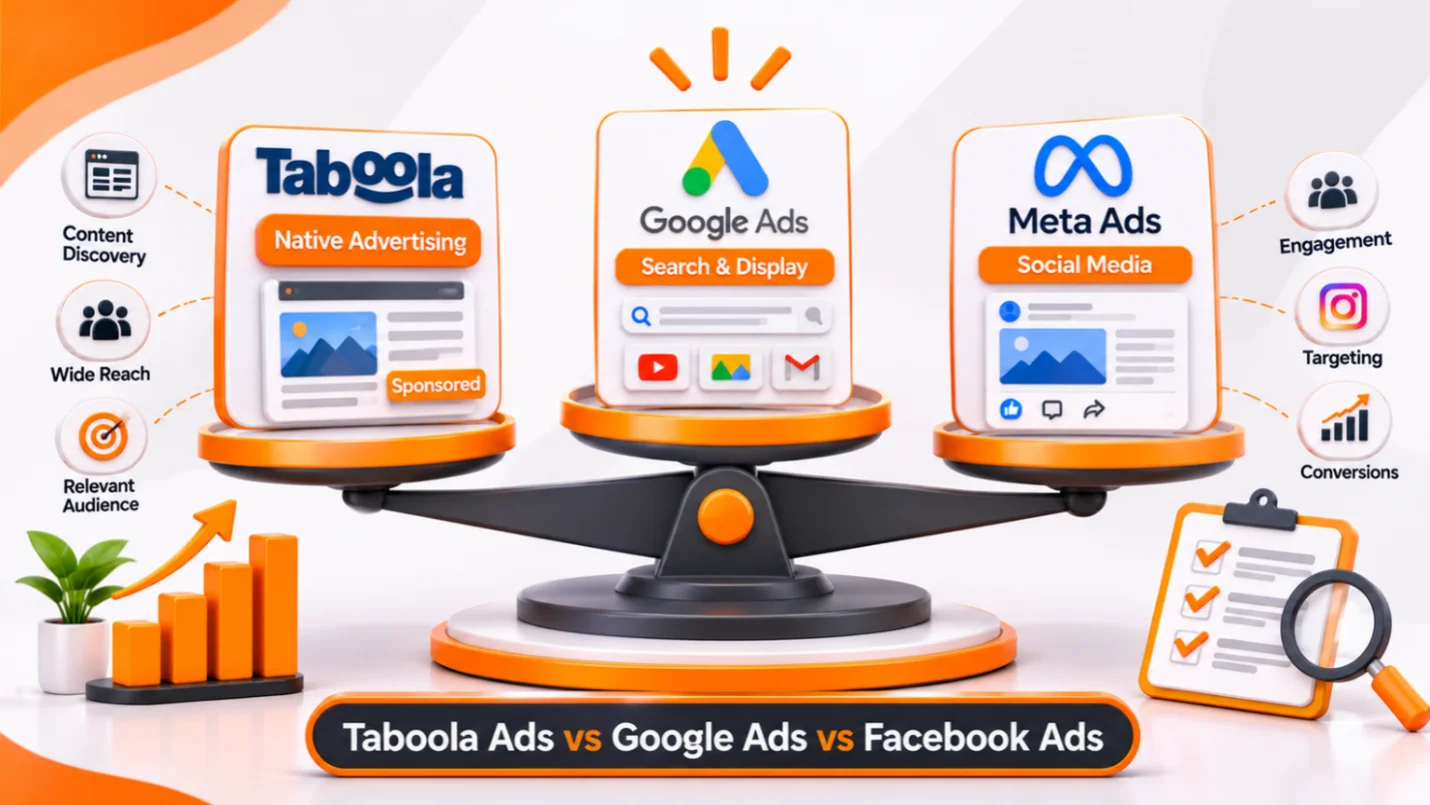
When choosing an online advertising platform, businesses often compare Taboola Ads, Google Ads, and Facebook Ads to determine which channel can deliver the best marketing results.
All three platforms help businesses reach potential customers, promote products and services, and generate website traffic. However, their advertising approaches, audience behavior, targeting capabilities, and campaign objectives differ significantly.
The biggest difference is how these platforms connect advertisers with potential customers.
- Taboola Ads helps businesses reach audiences through native advertisements and content recommendations across publisher websites.
- Google Ads: Helps businesses reach people through search results, display placements, YouTube, and other Google advertising channels, often targeting users based on search intent or audience signals.
- Facebook Ads (Meta Ads): Helps businesses reach audiences across Facebook, Instagram, Messenger, and other eligible Meta placements, primarily through interest-, demographic-, behavioral-, and audience-based targeting.
For example, someone searching Google for “best accounting software for small businesses” may already be looking for a solution. Someone scrolling through Facebook may discover an ad for accounting software tailored to their interests. Meanwhile, someone reading a business article may discover a sponsored recommendation for accounting software through Taboola.
All three approaches can generate customers, but they reach people at different stages of the buying journey.
Let’s compare these advertising platforms across the most important factors.
6.1 Taboola Ads vs Google Ads vs Facebook Ads: Quick Comparison
Taboola Ads
Content discovery and native advertising
Reaches audiences through sponsored recommendations and publisher websites.
Google Ads
Search and multi-channel advertising
Reaches audiences through search, display, video, shopping, and other placements.
Facebook Ads
Social media and audience-based advertising
Reaches audiences across Facebook, Instagram, and other eligible Meta placements.
| Comparison Factor | Taboola Ads | Google Ads | Facebook Ads |
| Advertising format | Native recommendations, images, videos | Search ads, display, video, shopping | Image, video, carousel, reels, stories |
| Audience reach | Publisher websites | Google properties and partner inventory | Meta platforms |
| Targeting | Geographic, device, contextual, and audience options | Keywords, locations, demographics, audiences | Interests, demographics, behaviors, custom audiences |
| Primary strength | Content discovery | Capturing search demand | Audience discovery and engagement |
| Common objectives | Traffic, awareness, leads | Sales, leads, traffic, awareness | Awareness, engagement, leads, sales |
| Cost structure | CPC and other available buying models | CPC, CPM, and other bidding models | CPM, CPC, and other optimization models |
| User intent | Often discovery-oriented | Can capture active search intent | Often interest- and discovery-oriented |
| Best suited for | Content promotion and audience expansion | Search-driven customer acquisition | Social engagement and audience building |
Note: Advertising formats, targeting features, and bidding options vary by campaign type, account eligibility, and market.
6.2 Comparison Based on Advertising Format
The advertising format is one of the biggest differences between these three platforms.
Taboola Ads
Taboola primarily focuses on native advertising and content discovery. Its advertisements appear as sponsored recommendations within publisher websites, although its current platform, Realize, also supports additional formats such as display, video, and social-style creatives.
Google Ads
Google offers a wider range of advertising formats, including:
- Search text advertisements.
- Display banner advertisements.
- YouTube video advertisements.
- Shopping advertisements.
- App promotion advertisements.
- Performance Max campaigns.
Facebook Ads
Facebook Ads, managed through Meta Ads Manager, focuses on visual and social advertising formats, including:
- Single-image advertisements.
- Video advertisements.
- Carousel advertisements.
- Stories and Reels advertisements.
- Collection advertisements.
- Lead generation advertisements.
Which platform wins?
There is no universal winner. Google is particularly versatile for search-driven advertising, Meta offers strong social and visual advertising capabilities, and Taboola provides additional opportunities through publisher-based content discovery.
6.3 Comparison Based on Audience Reach
All three platforms provide access to large audiences, but they reach people in different online environments.
| Platform | Where You Reach Audiences |
| Taboola | News websites, publisher websites, digital publications, mobile apps, and other partner properties |
| Google Ads | Google Search, YouTube, websites, and apps across eligible advertising networks |
| Facebook Ads | Facebook, Instagram, Messenger,r and other eligible Meta placements |
Taboola’s main advantage is its access to audiences outside the traditional search and social media ecosystems. Google connects advertisers with users across its own properties and partner inventory, while Meta provides access to people using its social platforms.
According to Taboola, its advertising platform reaches more than 600 million daily active users across its network. This is a platform-reported figure, not a guarantee of unique reach for an individual advertiser.
6.4 Comparison Based on Targeting Capabilities
Targeting determines who sees your advertisements. Each platform uses different signals and targeting approaches.
| Targeting Method | Taboola | Google Ads | Facebook Ads |
| Geographic targeting | Yes | Yes | Yes |
| Device targeting | Yes | Yes | Yes |
| Keyword targeting | Not like Search Ads | Yes | Not traditional search keywords |
| Interest-based targeting | Available audience options | Available audience segments | Yes |
| Contextual targeting | Yes | Available in relevant campaign types | Limited compared with its audience targeting |
| Remarketing | Yes, with eligible audiences | Yes | Yes |
| Customer data audiences | Supported options | Customer Match | Custom Audiences |
My recommendation: Choose targeting based on how customers discover your products or services.
For example, Google Search is particularly useful when customers actively search for specific services. Meta can help identify potential customers based on interests and audience signals. Taboola can introduce your brand to people consuming relevant content across publisher websites.
6.5 Comparison Based on Advertising Objectives
Although all three platforms support multiple advertising objectives, their strengths differ.
Taboola Ads
Strong fit for content discovery
- Promoting blog articles and educational content.
- Expanding audience reach.
- Generating website traffic.
- Supporting lead generation.
- Promoting products through native placements.
Google Ads
Strong fit for capturing search demand
- Generating leads from search queries.
- Driving online sales.
- Promoting local businesses.
- Reaching audiences through YouTube and Display.
- Promoting applications and products.
Facebook Ads
Strong fit for social discovery and engagement
- Building brand awareness.
- Generating social engagement.
- Collecting leads.
- Promoting products and services.
- Driving website conversions and purchases.
Google Search campaigns are particularly useful for reaching people actively searching for products and services.
6.6 Comparison Based on Advertising Costs
All three platforms use auction-based advertising systems, but their pricing and optimization options vary.
| Cost Factor | Taboola Ads | Google Ads | Facebook Ads |
| CPC | Available | Available | Available |
| CPM | Available buying options | Available in relevant campaigns | Available |
| Automated bidding | Yes | Yes | Yes |
| Manual bidding | Available options | Available options | Depends on campaign setup |
| Fixed advertising package | Not generally the model | Not generally the model | Not generally the model |
| Actual cost | Depends on inventory, bidding,g and targeting | Depends on keywords, competition, and campaign type | Depends on the audience, competition, and auction performance |
One important point: you should not compare these platforms solely by their average CPC.
For example, a Google Ads campaign might generate clicks at $2 per click, while a Taboola campaign generates clicks at $0.30 per click. At first glance, Taboola appears considerably cheaper.
However, if Google generates more qualified leads and customers, its higher CPC may still produce a better return on investment.
Also Read: Google Ads Campaign Types and Their Benefits
Similarly, Meta Ads might generate inexpensive engagement but fewer qualified inquiries.
My PPC recommendation: Compare cost per qualified lead, cost per acquisition, conversion rate, and ROAS across platforms. These metrics provide a more meaningful understanding of advertising profitability than CPC alone.
6.7 Best Use Cases: When Should You Choose Each Platform?
The right advertising platform depends on your business model, customer acquisition strategy, and campaign objectives.
Choose Taboola Ads when:
- You want to promote blogs and educational content.
- You want to reach audiences beyond search and social media.
- You want to experiment with native advertising.
- You want additional traffic acquisition channels.
- You have content that can attract and educate potential customers.
Choose Google Ads when:
- Customers actively search for your products or services.
- You want to capture high-intent search traffic.
- You want to generate inquiries and direct sales.
- You want to promote local services.
- You want to advertise through YouTube, Display, or Shopping.
Choose Facebook Ads when:
- You want to build brand awareness on social media.
- You have visually appealing products.
- You want to reach interest-based audiences.
- You want to generate leads through social campaigns.
- You want to promote products through Instagram and Facebook.
6.8 Can You Use Taboola, Google Ads, and Facebook Ads Together?
Absolutely. In fact, combining these platforms can help businesses build a more diversified advertising strategy.
Rather than relying on one advertising channel, businesses can use each platform for a different stage of the customer journey.
For example, consider a company selling project management software.
Example: Integrated advertising strategy
Discovery
Taboola Ads
Promote educational articles such as “7 Project Management Challenges Small Businesses Face” to introduce the brand to new audiences.
Consideration
Facebook / Instagram Ads
Use product videos, customer testimonials, and feature-based advertisements to build interest and encourage further engagement.
Conversion
Google Ads
Reach users searching for project management software and related solutions, and direct them to a product or pricing page.
This is an illustrative strategy, not a mandatory funnel. In reality, customers can discover, research, and purchase through any of these platforms, and all three can support multiple stages of the buying journey.
For effective cross-platform measurement, businesses should implement conversion tracking, consistent campaign naming, and appropriate attribution methods.
Also Read: AI in Google Ads
6.9 Final Verdict: Which Advertising Platform Is Best?
There is no single advertising platform that is best for every business.
My recommendation is to select the platform based on your immediate marketing objective and expand to additional channels when you have the budget and resources to manage them effectively.
| Business Objective | My Recommendation |
| Capture people actively searching for services | Google Ads |
| Promote blog content and articles | Taboola Ads |
| Build a social media presence | Facebook Ads |
| Promote visually appealing products | Facebook / Instagram Ads |
| Reach audiences beyond search and social | Taboola Ads |
| Generate local service inquiries | Google Ads |
| Build a diversified paid advertising strategy | All three |
From my experience with PPC and paid advertising strategies, I would never recommend selecting an advertising platform simply because it offers cheaper clicks or a larger audience.
The important question is whether that platform can reach the right people and generate measurable business results.
For businesses already running Google Ads or Meta Ads, Taboola can provide an additional opportunity to reach audiences through publisher websites and content discovery placements.
My suggestion is to test it with a clearly defined campaign objective, track conversions properly, and compare its acquisition costs with your existing advertising channels before scaling the budget.
7. How to Create a Taboola Advertising Campaign: A Step-by-Step Guide
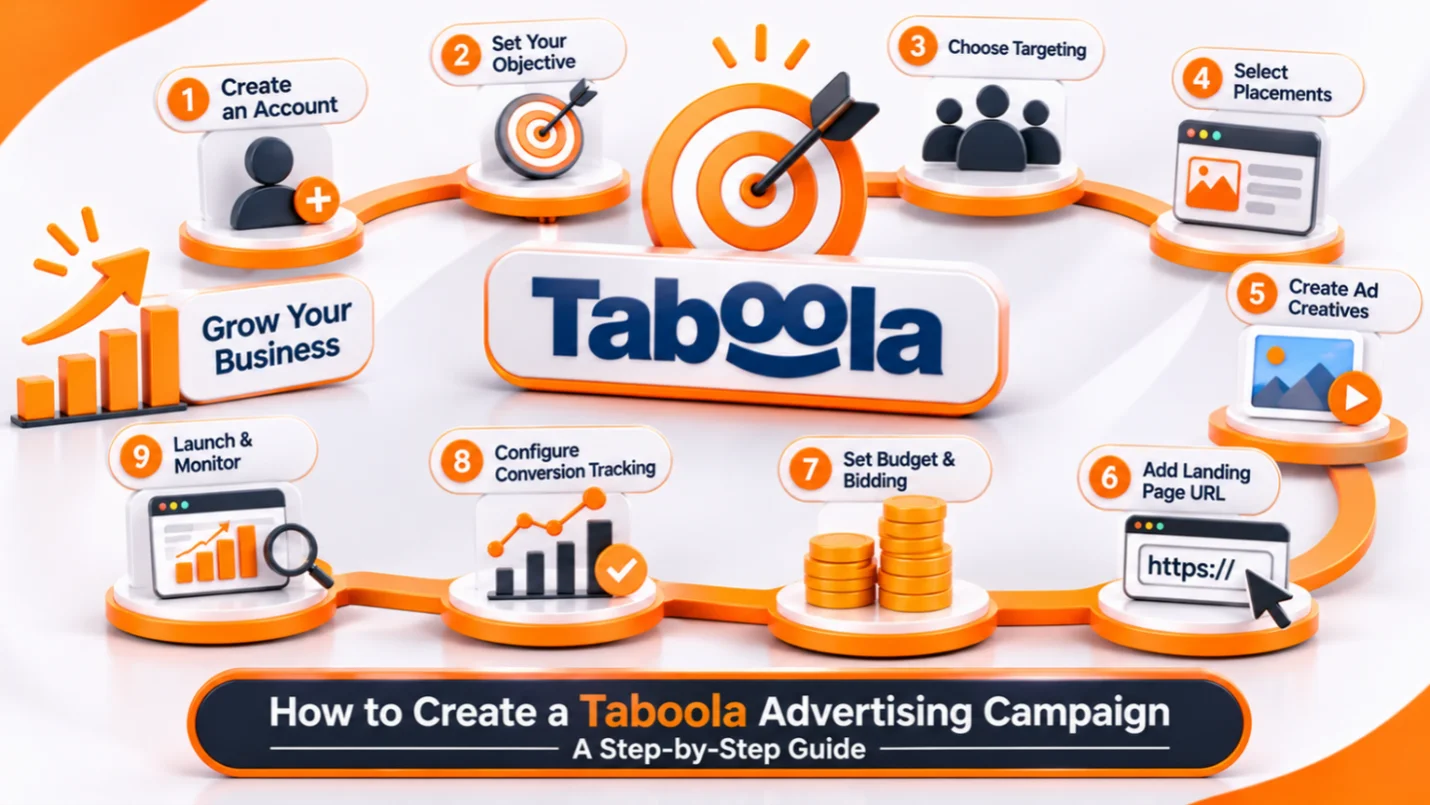
Creating a Taboola advertising campaign involves more than uploading an image and writing an attractive headline. To get meaningful results, you need to define the right objective, understand your target audience, select suitable placements, create relevant ad creatives, and configure conversion tracking before spending your budget.
Taboola provides an advertiser platform called Realize, where businesses can set up campaigns, manage advertising creatives, configure targeting, and monitor performance. The exact options available may vary depending on your account, campaign type, and market.
Here is a step-by-step process to help you create and launch your first Taboola advertising campaign.
Step 1: Create a Taboola Advertiser Account
The first step is to create an advertiser account with Taboola. Visit the official Taboola website and navigate to its advertising or advertiser registration section.
During registration, you may need to provide details such as:
- Business or company name
- Website URL
- Business email address
- Country and contact information
- Advertising objectives
- Basic billing information
Once your account is created and approved, you can access the advertiser platform and start configuring your campaigns.
Before moving forward, make sure your website is ready to receive paid traffic. It should load properly on mobile devices, clearly explain your product or service, and provide an easy way for visitors to take action.
PPC expert tip: I recommend checking your website’s landing pages before launching any paid campaign. Sending visitors to an incomplete, slow, or confusing page can waste your advertising budget, even if your ads generate many clicks.
Step 2: Set Your Campaign Objective
After accessing your advertiser account, create a new campaign and select an objective that matches your business goals.
Your campaign objective determines what you want to achieve through Taboola advertising. Common objectives include:
- Website traffic: Bring visitors to your website, blog, or landing page.
- Brand awareness: Introduce your business, product, or service to a wider audience.
- Lead generation: Encourage visitors to submit inquiry forms, request consultations, or register for offers.
- Sales and conversions: Generate purchases, subscriptions, bookings, or other valuable actions.
- Content promotion: Increase readership for articles, guides, and other informational resources.
For example, if you run a digital marketing agency, you might use Taboola to promote an article about SEO strategies and attract relevant website visitors. If your goal is to generate inquiries, you could promote a dedicated landing page that offers a free consultation.
Choose your objective carefully, as it influences how you structure the campaign, select creatives, and measure performance.
Step 3: Select Geographic and Audience Targeting
The next step is to decide who should see your advertisements.
Taboola provides targeting options that can help advertisers reach audiences based on factors such as location, device, and available audience or contextual signals. The exact targeting capabilities depend on the campaign and account.
Consider the following targeting factors:
Geographic targeting
Select the countries, regions, or locations where you want your advertisements to appear.
For example:
- A local service provider may target a particular city or region.
- A US-based e-commerce store may focus on selected US states.
- A global SaaS company may target multiple countries where its service is available.
Device targeting
Consider whether your audience is more likely to browse your website using smartphones, desktops, or tablets. You can use device-level performance data to identify which devices your campaigns perform best on.
Audience targeting
Where supported, use relevant audience segments or available first-party audience data to reach people who may be interested in your products or services.
Contextual targeting
Contextual targeting helps align advertising with the type of content a person is viewing. For example, a travel company may want its advertisements to appear alongside travel-related articles rather than unrelated content.
My recommendation is to start with a clearly defined audience instead of targeting everyone. Once you collect enough performance data, you can expand targeting based on clicks, conversions, and visitor quality.
Step 4: Choose Your Advertising Placements
Taboola advertisements can appear across participating publisher websites and content discovery placements. Depending on campaign settings and available inventory, your ads may be delivered in different environments.
Some common placement environments include:
- Below-article recommendations: Sponsored content appears alongside recommended articles at the end of an editorial page.
- In-feed placements: Ads appear within content recommendation feeds.
- In-article placements: Sponsored content may appear between sections of an article.
- Homepage or section placements: Ads may appear in prominent areas of participating publishers’ websites, where available.
- Mobile placements: Native ads are displayed within mobile content experiences.
Not every placement is necessarily available to every advertiser. Availability depends on publisher inventory, campaign settings, and the advertising product being used.
If you are new to Taboola, begin with the placements available through your campaign settings. Monitor placement-level performance where reporting allows, and identify which environments bring relevant visitors and conversions.
Step 5: Create Your Ad Headlines and Visuals
Your ad creative is one of the most important parts of a Taboola campaign. Since native advertisements compete for attention alongside editorial content, your headline and image need to encourage users to explore your offer without misleading them.
A typical native ad creative includes:
- Headline: A short, engaging message that communicates the value of your content or offer.
- Image: A relevant visual that attracts attention and supports the headline.
- Brand name: Your business or brand identity.
- Destination URL: The page users visit after clicking the advertisement.
For example, if you are promoting website maintenance services, you could test headlines such as:
| Headline | Creative direction |
| Is Your Website Losing Customers? | Website performance or analytics visual |
| 7 Website Maintenance Tasks Businesses Should Never Ignore | Website maintenance checklist |
| How Regular Website Maintenance Protects Your Business | Professional website dashboard |
Best practices for Taboola ad creatives:
- Write headlines that clearly communicate the benefit of clicking.
- Use high-quality images that are relevant to your offer.
- Test multiple headline and image combinations.
- Avoid exaggerated claims, misleading visuals, or clickbait.
- Make sure the advertisement is consistent with the landing page.
- Follow Taboola’s current advertising policies and creative specifications.
I recommend starting with at least three to five creative variations, if your budget allows. This gives you an opportunity to compare performance and identify which messaging attracts the most qualified visitors.
Step 6: Add Your Landing Page URL
Once your creatives are ready, add the destination URL where users will land after clicking your advertisement.
This could be:
- A product page
- A service landing page
- A blog article
- A lead generation page
- A special offer or promotional page
- A registration or sign-up page
Your landing page should match the promise made in the advertisement.
For example, if your headline promotes a guide to website maintenance, visitors should land on a page containing that guide, not a generic homepage.
Before submitting your campaign, check the following:
- The landing page loads correctly on desktop and mobile.
- The page content matches the advertisement.
- Your main message is visible without excessive scrolling.
- The call-to-action (CTA) is clear.
- Forms and other conversion elements work properly.
- The page loads quickly and contains no broken links.
PPC expert tip: A high click-through rate does not automatically mean a successful campaign. If visitors click your ads but leave immediately, the problem could be poor audience relevance, a misleading headline, or an ineffective landing page.
Step 7: Set Your Campaign Budget and Bidding Strategy
Now decide how much you want to spend and how you want Taboola to manage your bids.
Your budget should be based on your advertising objective, expected cost per acquisition, and how much you can comfortably invest in testing.
You may be able to configure:
- Daily budget: The amount allocated for advertising each day.
- Campaign budget: The total spending allocation, where supported.
- Bid strategy: The approach used to determine how much you are willing to pay for traffic or conversions.
Depending on the campaign and account, available bidding options may include fixed bidding, Enhanced CPC, and conversion-focused automated bidding strategies.
How should you decide your initial budget?
If you are testing Taboola for the first time, avoid committing a large amount before understanding traffic quality. Start with a controlled budget that provides enough data to evaluate the campaign, then increase spending as performance justifies it.
Step 8: Configure Conversion Tracking
This is one of the most important steps in creating a performance-focused Taboola campaign.
Without conversion tracking, you may know how many impressions and clicks your advertisements generate, but you may not know whether those visitors become customers or leads.
Taboola supports conversion measurement through its tracking solutions, including the Taboola Pixel and supported integration options.
You can configure tracking for valuable actions such as:
- Form submissions
- Product purchases
- Phone inquiries, when properly integrated
- Newsletter registrations
- Account registrations
- Consultation bookings
- Other important website actions
For example, if you are running a campaign to generate leads for an SEO agency, you should track successful inquiry form submissions rather than counting every landing page visit as a conversion.
Once tracking is configured, test it before launching the campaign. Confirm that the relevant event fires when a user completes the intended action.
You should also ensure that your tracking setup follows applicable privacy requirements, cookie consent rules, and data protection policies.
Why does conversion tracking matter?
Consider two hypothetical campaigns:
| Performance metric | Campaign A | Campaign B |
| Advertising spend | $500 | $500 |
| Clicks | 2,000 | 1,500 |
| Leads generated | 20 | 40 |
| Cost per lead | $25 | $12.50 |
Although Campaign A generates more clicks, Campaign B delivers twice as many leads at half the cost per lead.
This is why I recommend evaluating Taboola campaigns based on business outcomes rather than traffic volume alone.
Step 9: Launch and Monitor Your Campaign
Once you have completed the campaign setup, review all settings and submit your campaign for review.
Check these details before launch:
- Campaign objective
- Geographic and audience targeting
- Available placements
- Headlines and images
- Destination URLs
- Daily and total budget
- Bidding strategy
- Conversion tracking
After the campaign is approved and starts delivering, monitor its performance regularly.
Some important metrics to track include:
| Metric | What It Tells You |
| Impressions | How many times were your advertisements displayed |
| Clicks | How many users clicked your advertisements |
| CTR | The percentage of impressions that resulted in clicks |
| CPC | Average cost paid for each click |
| Conversions | Number of desired actions completed |
| Conversion Rate | Percentage of visitors who converted |
| CPA | Average cost of acquiring a conversion |
| ROAS | Revenue generated relative to advertising spend |
Do not make major optimization decisions based on a handful of clicks. Allow campaigns to collect sufficient data while keeping an eye on spending and tracking accuracy.
What should you optimize after launch?
- Pause creatives that consistently underperform.
- Test new headlines and images.
- Review publisher or placement performance where available.
- Refine geographic and audience targeting.
- Improve landing page content and conversion elements.
- Adjust bids and budget based on performance.
- Increase investment in campaigns that demonstrate sustainable results.
Campaign optimization should be continuous. Even if a campaign starts well, performance can change as audience behavior, competition, and available inventory change.
My Perspective as a PPC Expert
From a PPC perspective, I believe the most important part of launching a Taboola campaign is connecting advertising activity with actual business results.
At RankON Technologies, we approach paid advertising with a focus on campaign objectives, audience relevance, creative testing, landing page experience, and conversion measurement. These elements work together to determine whether advertising spend is generating meaningful value.
My recommendation is to treat your first Taboola campaign as a structured testing exercise. Start with a defined objective, test different creative approaches, monitor the quality of incoming traffic, and use conversion data to guide your next decisions.
A successful Taboola campaign is not simply one that generates thousands of clicks. It is one that reaches the right audience and contributes to measurable business growth.
8. Best Practices for Getting Better Results from Taboola Ads
Launching a Taboola advertising campaign is only the beginning. Getting consistent results requires regular testing, performance analysis, and optimization.
Even if your campaign generates a good number of impressions and clicks, it may not deliver meaningful business results unless the right audience visits your website and takes the desired action.
From a PPC perspective, I recommend treating Taboola advertising as an ongoing optimization process rather than a one-time campaign setup.
Your headlines, visuals, targeting, landing pages, and bidding strategy should work together to attract relevant visitors and convert them into customers.
Here are some practical best practices to help improve your Taboola advertising performance.
8.1 Write Attention-Grabbing but Relevant Headlines
Your headline is one of the first things users notice when they see a Taboola native advertisement. It needs to attract attention while giving users a clear idea of what they will find when they click.
Unlike traditional search advertisements, where users are actively looking for a solution, Taboola ads often reach people as they read articles, browse news, or consume other online content. Therefore, your headline should create curiosity and communicate relevance.
For example, if you are promoting website maintenance services:
| Weak headline | Improved headline |
| Website Maintenance Services | 7 Website Maintenance Tasks Every Business Should Know |
| Hire Our Web Developers | Is Your Website Performing as Well as It Should? |
| Best Website Maintenance Company | What to Look for Before Choosing a Website Maintenance Company |
The improved headlines focus on user interests and provide a reason to click.
Headline writing tips:
- Highlight a problem your target audience wants to solve.
- Use numbers and specific benefits where appropriate.
- Ask relevant questions to encourage curiosity.
- Keep the message simple and easy to understand.
- Avoid exaggerated promises and clickbait.
- Make sure the landing page delivers what the headline promises.
My recommendation is to create multiple headline variations and compare their performance, rather than assuming your first idea will be the most effective.
8.2 Use High-Quality Images and Videos
Visual content plays an important role in native advertising because users often decide whether to explore an advertisement based on its headline and image.
A relevant image can help communicate your message quickly, make your advertisement more noticeable, and encourage users to learn more about your offer.
For example, if you are advertising an online fitness program, you could test:
- A professional fitness training image.
- A visual showing a workout environment.
- A short video demonstrating an exercise.
- A customer-focused lifestyle visual, where you have the appropriate rights and permissions.
Best practices for visual creatives:
- Use clear, high-resolution images.
- Choose visuals that directly relate to your headline.
- Avoid excessive text within images.
- Test different image styles and compositions.
- Use video when it helps demonstrate a product or explain a service.
- Follow Taboola’s current creative specifications and advertising policies.
Avoid using misleading before-and-after images, fake notifications, or visuals that create unrealistic expectations.
Remember that an image generating more clicks is not necessarily the best-performing image. You should also evaluate the quality of visitors and the conversions they attract.
8.3 Create Dedicated Landing Pages
One common mistake advertisers make is sending all Taboola traffic to their website homepage.
Although this may work for certain brand-awareness campaigns, it is not always the best approach for lead generation or sales campaigns. A dedicated landing page can provide a more focused experience by connecting the advertisement’s message directly with the visitor’s needs.
For example, suppose you are promoting an SEO audit service through Taboola.
Instead of sending users to your agency homepage, create a dedicated landing page explaining:
- What your SEO audit includes.
- Which website problems can it identify?.
- How the audit helps businesses.
- Why is your agency qualified to provide the service?
- How visitors can request an audit.
Elements of an effective landing page:
| Landing page element | Purpose |
| Clear headline | Matches the promise made in the advertisement |
| Relevant content | Explains the product, service, or offer |
| Strong CTA | Encourages visitors to take action |
| Trust signals | Builds confidence through reviews, testimonials, or credentials |
| Simple forms | Makes lead submission easier |
| Mobile-friendly design | Provides a better experience on smartphones |
| Fast loading speed | Reduces unnecessary visitor drop-offs |
Your landing page should also make it easy for visitors to understand what happens after they submit a form or complete a purchase.
PPC expert tip: If your ads generate clicks but your conversion rate remains low, review your landing page before increasing your ad budget. The problem may not be your ad creative; it could be the experience visitors receive after clicking.
8.4 Test Multiple Ad Variations
Creative testing is one of the most useful ways to improve Taboola campaign performance.
A headline or image that works well for one audience may not perform equally well for another. Instead of relying on assumptions, test different combinations and use campaign data to identify what works.
For example, if you are promoting a financial planning service, you could test these headline approaches:
| Variation | Headline approach |
| Ad A | Problem-focused: “Are You Making These Common Financial Planning Mistakes?” |
| Ad B | Educational: “5 Financial Planning Tips Every Business Owner Should Know” |
| Ad C | Benefit-focused: “How Better Financial Planning Can Help Your Business Grow” |
You can also test different images with the same headline to understand whether the visual affects performance.
What should you test?
- Headlines and messaging.
- Images and video creatives.
- Calls to action.
- Landing page headlines.
- Different audience segments.
- Available placements.
- Ad combinations and formats.
Try to change one major variable at a time when you want to understand what caused a performance difference. Also, give tests enough time and traffic to produce useful evidence.
Do not automatically select an advertisement just because it has the highest CTR. Check whether it also generates relevant traffic, leads, or sales.
8.5 Monitor CPC, CTR, and Conversion Rate
Regular campaign monitoring helps you understand how effectively your advertisements attract visitors and drive business outcomes.
Three important metrics to monitor are CPC, CTR, and conversion rate.
- Cost Per Click (CPC)
CPC tells you how much you pay, on average, per click.
For example, if you spend $300 and receive 1,000 clicks:
CPC=$300/1,000=$0.30
Your average CPC is $0.30.
- Click-Through Rate (CTR)
CTR measures the percentage of impressions that result in clicks.
If your advertisement receives 2,000 clicks from 100,000 impressions, its CTR is 2%.
- Conversion Rate
Conversion rate measures the percentage of visitors who complete a desired action.
If 1,000 people click your advertisement and 30 submit an inquiry form, your conversion rate is 3%.
Other metrics worth monitoring:
| Metric | Why it matters |
| CPA | Measures the cost of acquiring a lead or customer |
| ROAS | Measures revenue generated relative to advertising spend |
| Bounce or engagement indicators | Help evaluate the quality of landing page visits |
| Lead quality | Shows whether inquiries are relevant to your business |
| Publisher performance | Helps identify placements delivering better outcomes, where reporting is available |
Do not evaluate these metrics in isolation. A low CPC may look attractive, but if those clicks do not generate qualified leads, the campaign may still be unprofitable.
8.6 Use Conversion Tracking and Retargeting
Conversion tracking helps you understand what happens after someone clicks your advertisement.
By configuring the Taboola Pixel or supported tracking integrations, you can measure key website actions, such as purchases, registrations, form submissions, and other conversions.
This information helps you identify which campaigns, creatives, and audiences are generating valuable results.
Retargeting can further improve your advertising strategy by allowing you to reconnect with eligible previous website visitors.
For example, consider an e-commerce business:
- A visitor clicks a Taboola advertisement and visits a product page.
- The visitor explores the product but does not purchase.
- The business records the relevant website activity through its tracking setup.
- The advertiser creates an eligible retargeting audience, subject to platform requirements.
- The business uses an appropriate follow-up campaign to encourage the visitor to return.
Retargeting can be useful for:
- Visitors who viewed specific product pages.
- People who visited the service pages.
- Users who started but did not complete a registration.
- Visitors who abandoned a shopping cart.
- Previous customers who may be interested in related products.
However, retargeting depends on audience eligibility, available platform features, sufficient audience size, and applicable privacy and consent requirements.
My recommendation: Set up conversion tracking before launching your campaign. If you wait until after you’ve spent your budget, you may miss important performance data that could have guided optimization from the beginning.
8.7 Optimize Campaigns Based on Actual Performance
Campaign optimization should be based on measurable results rather than assumptions.
After your Taboola campaign starts generating data, review its performance to identify which elements are working and which need improvement.
For example, imagine you are running two campaigns for a business service.
| Metric | Campaign A | Campaign B |
| Spend | $500 | $500 |
| Clicks | 2,000 | 1,500 |
| Average CPC | $0.25 | $0.33 |
| Leads | 15 | 40 |
| Cost per lead | $33.33 | $12.50 |
Campaign A generates more clicks at a lower CPC. However, Campaign B generates more than twice as many leads at a substantially lower cost per lead.
If lead quality is comparable, Campaign B is the stronger campaign from a lead-generation perspective.
Areas to optimize regularly:
- Pause consistently underperforming creatives.
- Allocate more budget to campaigns generating qualified conversions.
- Review geographic and device-level performance.
- Identify placements that deliver valuable traffic.
- Test new headlines and visual combinations.
- Improve landing page experience.
- Adjust bidding strategies based on campaign objectives.
- Review conversion quality, not just conversion volume.
Avoid making sudden changes based on limited data. Evaluate performance over a meaningful period and consider conversion delays, attribution, and the volume of available data before making decisions.
8.8 Avoid Misleading Advertising Claims
Attracting clicks should never come at the expense of advertising credibility.
Some advertisers use exaggerated headlines, unrealistic promises, or sensational images to increase engagement. While such tactics may generate initial interest, they can damage brand trust, disappoint visitors, and create policy compliance problems.
For example, avoid headlines such as:
- “Earn $10,000 Every Month Without Doing Anything!”
- “This Secret Guarantees First-Page Google Rankings!”
- “Lose 10 Kg in Just 7 Days!”
- “Every Business Owner Must Buy This Product Today!”
Instead, focus on clear, accurate, and supportable messaging.
Follow these guidelines:
- Make claims that you can substantiate.
- Avoid guaranteed results unless they are genuinely guaranteed and clearly qualified.
- Do not use fake testimonials or fabricated reviews.
- Ensure images accurately represent the advertised product or service.
- Disclose important conditions, limitations, and pricing details.
- Follow Taboola’s advertising policies and applicable industry regulations.
Trust is particularly important for industries such as healthcare, finance, legal services, and education, where misleading claims can have serious consequences.
A credible advertisement may not always generate the most clicks, but it helps attract visitors with more realistic expectations.
8.9 Build an Optimization Routine
Rather than checking your Taboola campaigns randomly, establish a regular review process. This makes it easier to identify performance changes and take timely action.
Here is a practical campaign optimization schedule:
| Frequency | What to review |
| Daily | Spending, campaign delivery, tracking issues, unusual performance changes |
| Weekly | CPC, CTR, conversions, CPA, creative performance, placements |
| Biweekly | Audience segments, landing page performance, bidding strategy |
| Monthly | Overall profitability, ROAS, budget allocation, campaign scalability |
The frequency of optimization should depend on your campaign’s spending level and conversion volume. Smaller campaigns may need more time to generate meaningful data, while higher-spending campaigns may require closer monitoring.
My PPC Perspective: Focus on Conversion Quality, Not Just Clicks
In my experience with PPC campaign strategy, one of the biggest mistakes advertisers can make is treating traffic generation as the final objective.
Taboola can introduce your business to audiences who may not have been actively searching for your product or service. However, turning that attention into leads or sales requires a relevant message, a good landing page, accurate tracking, and continuous optimization.
At RankON Technologies, our approach to paid advertising focuses on understanding campaign objectives and using performance data to guide decisions.
My advice is simple: Don’t increase your Taboola advertising budget just because your campaign is generating clicks. Increase it when the campaign consistently attracts relevant visitors and delivers valuable business outcomes.
This approach helps businesses make better use of their advertising budgets while building a more sustainable paid advertising strategy.
9. Common Taboola Advertising Mistakes to Avoid
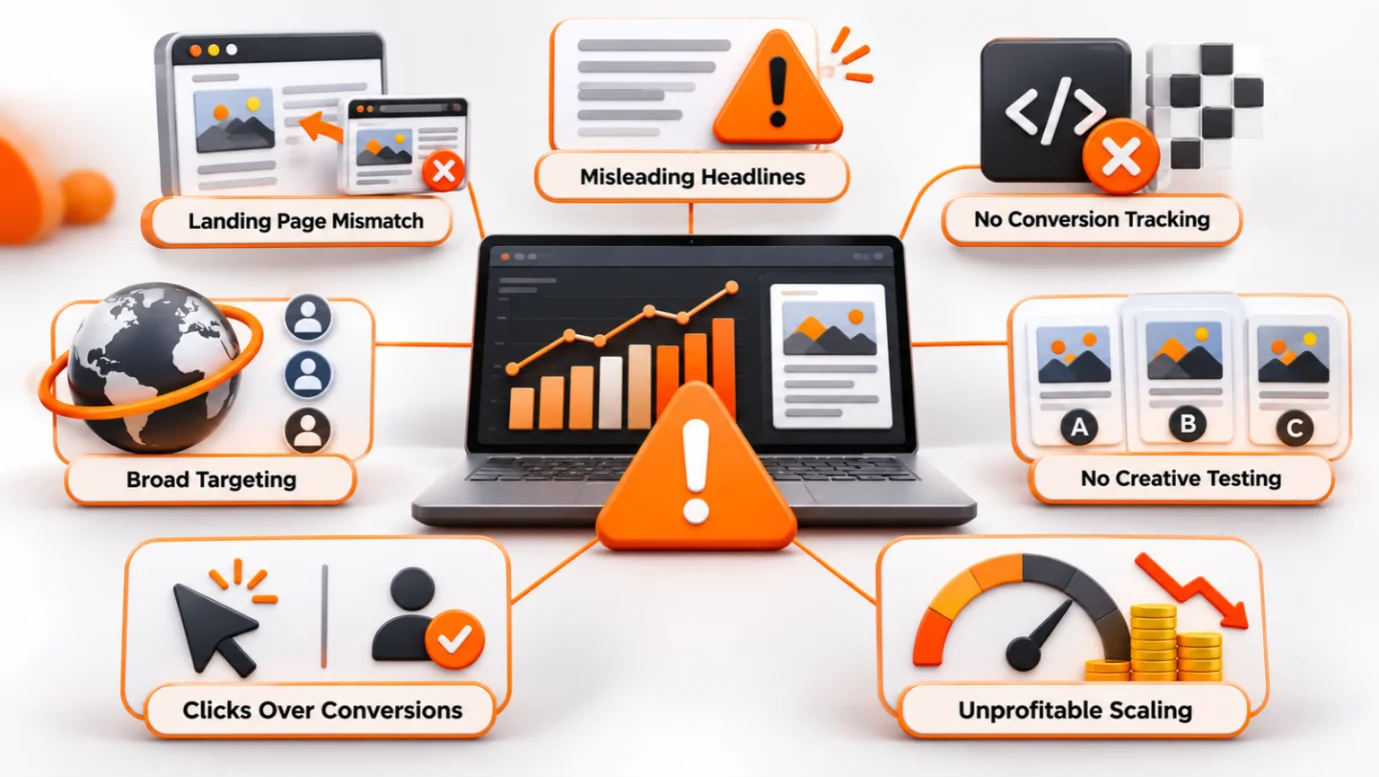
Taboola advertising can help businesses reach new audiences, promote content, and generate leads or sales. However, simply launching a campaign does not guarantee good results. Many advertisers struggle because of avoidable mistakes in targeting, creative development, landing page selection, tracking, and campaign optimization.
From a PPC perspective, I believe understanding what not to do is just as important as knowing how to create a successful campaign. Even a well-funded advertising campaign can waste money if it attracts irrelevant visitors or fails to measure meaningful business outcomes.
Here are seven common Taboola advertising mistakes advertisers should avoid.
9.1 Sending Traffic to Irrelevant Landing Pages
One of the most common mistakes is sending users to a landing page that does not match the advertisement they clicked.
Remember that Taboola users often discover advertisements while reading articles or browsing publisher websites. When they click an ad, they expect the destination page to deliver the information, product, or offer promised in the headline.
For example, imagine you are promoting a blog titled “10 Website Maintenance Tips Every Business Should Follow.”
If users click the advertisement and land on a generic agency homepage without finding the promised information, they may leave immediately.
This creates a poor user experience and can reduce campaign effectiveness.
How to avoid this mistake:
- Match your landing page content with the advertisement.
- Create dedicated landing pages for different products or services.
- Keep the main message consistent between the headline and landing page.
- Make your CTA clear and relevant.
- Ensure the page works properly on mobile devices.
- Improve loading speed and remove unnecessary distractions.
Your landing page should continue the conversation started by your advertisement rather than forcing visitors to search for the information themselves.
9.2 Using Misleading Headlines
Some advertisers focus too heavily on increasing CTR and use sensational headlines to attract clicks.
Although curiosity-driven headlines can be effective in native advertising, misleading messaging can attract the wrong audience and damage brand credibility.
For example:
| Misleading headline | Better alternative |
| This SEO Trick Guarantees No. 1 Google Rankings! | SEO Strategies That Can Improve Your Website’s Search Visibility |
| Every Business Is Making This Website Mistake! | 7 Common Website Mistakes That Can Affect Business Performance |
| Earn Thousands Online Without Any Effort! | Practical Ways to Explore Online Business Opportunities |
The better headlines still encourage curiosity but avoid unrealistic promises.
How to avoid this mistake:
- Write headlines that accurately represent your offer.
- Avoid guaranteed results unless they are genuinely supportable.
- Do not use fake urgency or fabricated statistics.
- Ensure your headline matches the landing page.
- Follow Taboola’s advertising policies.
A good advertisement should attract the right visitors, not simply the most clicks.
9.3 Ignoring Conversion Tracking
Another major mistake is launching a Taboola campaign without configuring conversion tracking.
Without proper tracking, you may know how many people clicked your advertisements, but you may not know how many completed a purchase, submitted an inquiry, registered for a service, or performed another valuable action.
Consider this example:
| Performance metric | Campaign A | Campaign B |
| Advertising spend | $500 | $500 |
| Clicks | 2,000 | 1,500 |
| Leads | 20 | 50 |
| Cost per lead | $25 | $10 |
If you only look at clicks, Campaign A appears to perform better. However, Campaign B generates more leads at a significantly lower cost.
This is why conversion tracking is essential for performance-focused advertising.
How to avoid this mistake:
- Install and configure the Taboola Pixel or an appropriate supported tracking integration.
- Track important actions such as purchases and form submissions.
- Test conversion events before launching campaigns.
- Use consistent tracking parameters, such as UTM tags, where appropriate.
- Compare campaign performance using CPA, conversion rate, and ROAS.
- Check that conversions are being attributed and recorded correctly.
Conversion tracking helps you understand which campaigns are contributing to business growth and where your advertising budget should be allocated.
9.4 Targeting Audiences Too Broadly
Taboola provides access to audiences across participating publisher websites. However, reaching a large audience does not necessarily mean reaching the right audience.
Some advertisers make the mistake of targeting too many countries, devices, or audience segments from the beginning.
For example, a local web development company operating in the United States may not benefit from spending its entire advertising budget on visitors from countries where it does not provide services.
Similarly, an e-commerce business selling products in selected markets should avoid paying for traffic from locations it cannot serve.
How to avoid this mistake:
- Start with locations where your business operates.
- Define your ideal customer profile.
- Use relevant audience and contextual targeting options where available.
- Review device-level performance.
- Exclude irrelevant segments where the platform supports exclusions.
- Expand targeting gradually based on actual campaign data.
My recommendation is to start with a focused audience and expand only when you have evidence that broader targeting yields valuable results.
9.5 Not Testing Different Creatives
Running a single advertisement throughout a campaign limits your ability to understand what attracts your audience.
A headline that performs well initially may become less effective over time. Similarly, one image may generate clicks but fail to attract visitors who are genuinely interested in your offer.
This is why creative testing is important.
For example, if you are promoting an online digital marketing course, you could test:
| Ad variation | Headline approach | Visual |
| Ad A | Problem-focused | Person working on a marketing dashboard |
| Ad B | Benefit-focused | Digital marketing training environment |
| Ad C | Educational | Marketing strategy infographic |
By comparing these variations, you can identify which combination generates better engagement and conversion performance.
How to avoid this mistake:
- Prepare multiple headline variations.
- Test different images and videos.
- Compare creative performance over a meaningful period.
- Review conversion quality, not just CTR.
- Replace consistently underperforming advertisements.
- Continue testing new ideas as audience behavior changes.
Avoid changing too many variables simultaneously if you want to understand why one creative performs better than another.
9.6 Focusing Only on Clicks Instead of Conversions
High traffic numbers can make an advertising campaign look successful, but clicks alone do not generate revenue.
For example, imagine two Taboola campaigns:
Illustrative campaign comparison
CAMPAIGN A
5,000
Clicks
25
Conversions
0.5% conversion rate
CAMPAIGN B
2,000
Clicks
60
Conversions
3% conversion rate
Illustrative figures only. Conversion rate is calculated using conversions divided by clicks.
Campaign A generates more than twice the traffic, but Campaign B produces more conversions with a much higher conversion rate.
This demonstrates why advertisers should evaluate campaign performance based on business objectives rather than traffic volume.
How to avoid this mistake:
Monitor metrics such as:
- Conversion rate
- Cost per lead (CPL)
- Cost per acquisition (CPA)
- Revenue generated
- Return on ad spend (ROAS)
- Lead quality
- Customer acquisition cost
If your objective is lead generation, focus on qualified inquiries. If your objective is e-commerce sales, focus on purchases and revenue.
9.7 Scaling Campaigns Without Analyzing Profitability
Another costly mistake is increasing the advertising budget simply because a campaign is generating clicks or conversions.
Before scaling, you need to understand whether those conversions are generating sufficient revenue or business value.
Consider this hypothetical e-commerce campaign:
| Metric | Campaign A | Campaign B |
| Advertising spend | $1,000 | $1,000 |
| Revenue | $2,000 | $4,000 |
| ROAS | 2x | 4x |
| Gross margin | 30% | 50% |
| Gross profit | $600 | $2,000 |
| Profit after ad spend | -$400 | $1,000 |
In this example, Campaign A generates twice its advertising spend in revenue, but its gross profit is not sufficient to cover the advertising cost. Campaign B delivers a stronger financial outcome.
This highlights an important point: ROAS alone does not always tell you whether a campaign is profitable. You should also consider product costs, fulfillment, discounts, taxes, agency fees, and other operating expenses.
How to avoid this mistake:
- Calculate your break-even CPA or ROAS.
- Review revenue and profit margins.
- Evaluate lead quality and customer value.
- Identify campaigns delivering consistent results.
- Increase budgets gradually rather than making sudden jumps.
- Monitor performance after every significant budget adjustment.
Scaling should be based on sustainable profitability, not temporary improvements in traffic or conversion volume.
Quick Summary: Taboola Advertising Mistakes and Their Solutions
| Common mistake | Recommended solution |
| Irrelevant landing pages | Match landing pages with ad messaging |
| Misleading headlines | Use accurate, benefit-focused headlines |
| No conversion tracking | Configure and test conversion events |
| Overly broad targeting | Start with relevant audience segments |
| No creative testing | Test multiple headlines and visuals |
| Focusing only on clicks | Measure conversions, CPA, and ROAS |
| Scaling without profitability analysis | Review revenue, margins, and acquisition costs |
Anand Kumar’s PPC Perspective: Avoid Optimizing for Vanity Metrics
In my view, one of the biggest mistakes advertisers make is confusing campaign activity with campaign success.
Impressions, clicks, and CTR are useful indicators, but they do not necessarily tell you whether your advertising is helping your business grow.
When managing PPC campaigns, I believe every important optimization decision should be connected to a measurable objective. If the goal is lead generation, evaluate lead quality and cost per qualified lead. If the goal is sales, analyze revenue, acquisition costs, and profitability.
At RankON Technologies, our approach focuses on using campaign data to make informed decisions rather than increasing budgets based on surface-level performance.
My advice is to avoid chasing cheap clicks. Focus on attracting the right audience, delivering a relevant landing page experience, accurately tracking conversions, and scaling only when the numbers support it.
10. Is Taboola Advertising Right for Your Business?
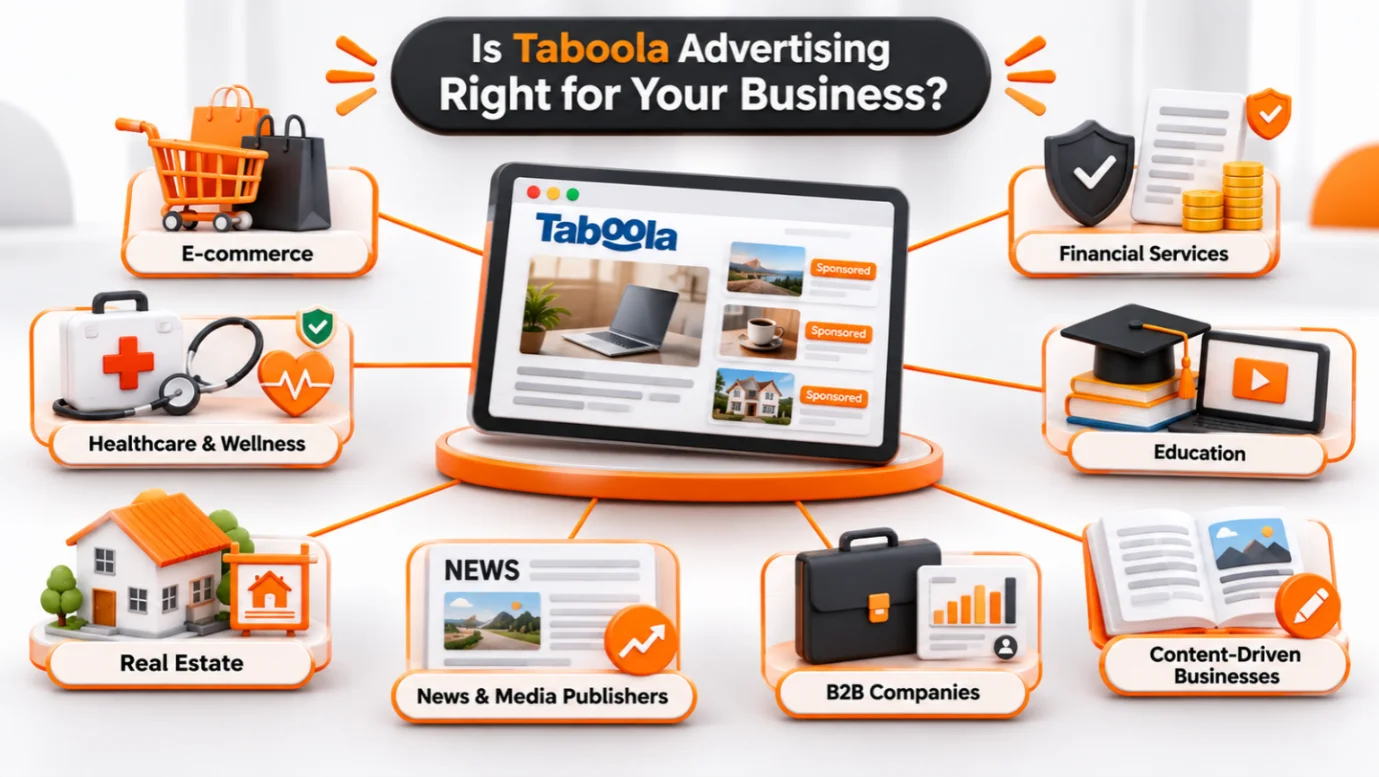
Taboola can be a valuable advertising channel for businesses that want to reach audiences beyond traditional search and social media platforms. Its native advertising approach helps brands introduce products, services, and content to people while they browse articles and other publisher content.
However, Taboola is not equally suitable for every business. Its effectiveness depends on your target audience, advertising objectives, product or service, landing page experience, and ability to convert visitors into customers.
Let’s look at the types of businesses that may benefit most from Taboola advertising and when it might not be the right choice.
10.1 E-commerce Businesses
E-commerce businesses can use Taboola to introduce products to new audiences, promote special offers, and bring potential customers to product pages.
Unlike search advertising, which often reaches people actively searching for a product, Taboola can help build product awareness among users who may not yet know the product exists.
For example, an online store selling home improvement products could promote an article titled “7 Smart Home Accessories That Make Everyday Life Easier” and introduce relevant products within the content.
How e-commerce businesses can use Taboola:
- Promote new product collections.
- Introduce products to potential customers.
- Drive traffic to product and category pages.
- Promote seasonal offers and special deals.
- Retarget eligible previous website visitors.
- Support product discovery and brand awareness.
For better results, use relevant product images, clear pricing information, compelling product descriptions, and a straightforward checkout experience.
10.2 Financial Services
Financial services companies can use Taboola to promote educational content, financial guides, and relevant service offerings.
Potential advertisers include financial planning firms, insurance providers, investment education businesses, and other financial service companies.
For example, an insurance provider could promote an educational article titled “What Should You Consider Before Choosing Health Insurance?”
This approach can introduce the brand to readers researching financial topics who may eventually need professional assistance.
Potential campaign objectives include:
- Promoting financial education resources.
- Generating inquiries for eligible financial services.
- Increasing awareness of insurance products.
- Attracting visitors to financial planning resources.
- Building audiences for future marketing campaigns.
Financial advertising requires particular care. Advertisers should avoid misleading claims, unrealistic return promises, unsupported savings claims, and incomplete disclosures. They must also comply with applicable financial advertising regulations and Taboola’s current advertising policies.
10.3 Healthcare and Wellness Brands
Healthcare and wellness businesses can use native advertising to distribute educational information and introduce relevant services to potential audiences.
Examples include healthcare providers, wellness brands, fitness businesses, and eligible health-related service providers.
A healthcare organization might promote an article explaining preventive healthcare practices or provide information about a particular service.
Possible uses include:
- Promoting health education articles.
- Increasing awareness of healthcare services.
- Introducing wellness programs.
- Driving traffic to relevant service pages.
- Encouraging eligible appointment inquiries.
However, healthcare advertising is a sensitive area. Advertisers should ensure that medical information is accurate, that claims are properly supported, and that campaigns comply with applicable healthcare advertising and privacy requirements. Some health-related products and services may face additional platform restrictions.
10.4 Education and Online Learning Businesses
Education companies can use Taboola to promote learning resources, online courses, professional training programs, and educational services.
For example, an online learning platform offering digital marketing courses could promote an article titled “5 Digital Marketing Skills Worth Learning for Your Career.”
Readers interested in the topic may visit the website to explore available courses.
How education businesses can use Taboola:
- Promote online courses and training programs.
- Generate inquiries for educational institutions.
- Increase registrations for webinars.
- Distribute educational guides and resources.
- Introduce professional certification programs.
- Attract prospective students to course pages.
Education advertisers should make course details, eligibility requirements, fees, and expected outcomes clear. Avoid misleading claims about guaranteed jobs, salaries, or career success.
10.5 Real Estate Companies
Real estate businesses can use Taboola to introduce property listings, promote location-based content, and generate inquiries from potential buyers or tenants.
For example, a real estate company could promote an article titled “What Should First-Time Homebuyers Know Before Purchasing a Property?”
The article could provide useful information while introducing relevant property listings or consultation opportunities.
Potential applications include:
- Promoting residential and commercial properties.
- Generating property inquiry leads.
- Increasing awareness of new developments.
- Sharing property investment education.
- Promoting location-specific real estate content.
- Retargeting eligible visitors who viewed property listings.
Real estate advertisers should use accurate property information, genuine images, transparent pricing where applicable, and clear details about location and availability.
10.6 News and Media Publishers
News organizations and digital publishers can use Taboola differently from traditional advertisers.
While businesses generally use Taboola to purchase advertising placements, publishers may work with Taboola to monetize their website traffic through content recommendation and advertising solutions.
For example, a news website may display recommended articles and sponsored content alongside its editorial content.
Potential benefits for publishers include:
- Monetizing website traffic.
- Displaying sponsored content recommendations.
- Increasing content discovery.
- Introducing readers to relevant articles.
- Generating advertising revenue through eligible placements.
Publishers should maintain a clear distinction between editorial content and sponsored recommendations to protect reader trust.
10.7 B2B Companies
Business-to-business companies can use Taboola to reach professionals, decision-makers, and organizations that may be interested in their products or services.
For example, a SaaS company selling project management software could promote an article titled “How to Improve Project Management Across Remote Teams.”
Readers who find the topic relevant may explore the software or request a product demonstration.
B2B applications include:
- Promoting industry research and reports.
- Generating leads for software products.
- Driving registrations for webinars.
- Distributing case studies and whitepapers.
- Increasing awareness of business services.
- Supporting remarketing campaigns for eligible audiences.
For B2B advertisers, lead quality is especially important. A campaign generating fewer but more relevant business inquiries may deliver better results than one attracting a large volume of unqualified visitors.
10.8 Content-Driven Businesses
Content-driven businesses are among the natural candidates for Taboola because the platform is designed around content discovery and recommendations.
Businesses that regularly publish useful articles, guides, reports, and educational resources can use native advertising to bring their content in front of new audiences.
Examples include:
- Digital marketing agencies.
- Business and finance blogs.
- Technology publications.
- Travel websites.
- Lifestyle publishers.
- Industry research companies.
- Professional consultants and coaches.
For example, a digital marketing agency could promote an article titled “Technical SEO Issues That Could Affect Your Website’s Performance.”
The campaign may attract readers interested in SEO, introduce them to the agency’s expertise, and create opportunities for future inquiries.
Why content-driven businesses may benefit:
Instead of immediately asking visitors to purchase a service, businesses can first offer useful information. This can help build awareness and introduce their brand to audiences who may become potential customers later.
11. Which Businesses Are Most Suitable for Taboola Advertising?
| Business type | Potential Taboola objective | Suitability |
| E-commerce | Product discovery and sales | High potential |
| Financial services | Education and qualified inquiries | Conditional |
| Healthcare and wellness | Educational content and service awareness | Conditional |
| Education | Course promotion and registrations | High potential |
| Real estate | Property awareness and inquiries | High potential |
| News and media publishers | Content discovery and monetization | High potential |
| B2B companies | Lead generation and brand awareness | High potential |
| Content-driven businesses | Article promotion and audience growth | High potential |
These are general suitability assessments, not guaranteed performance rankings. Actual results depend on the offer, audience, market, campaign setup, and applicable advertising policies.
When Is Taboola Advertising Not the Right Choice?
Although Taboola can support several marketing objectives, there are situations where another advertising channel may be more appropriate.
- When customers are actively searching for an immediate solution
If your audience is already searching for a specific product or service, Google Search Ads may be a more direct way to reach that demand.
For example, someone searching for “emergency plumber near me” has a clear, immediate need. A native content recommendation may not be the most direct advertising approach for that situation.
- When you have a very limited testing budget
Taboola campaigns need enough budget and traffic to generate useful performance data. If your available budget is too small to meaningfully test creatives, targeting, and conversions, you may struggle to evaluate the channel.
- When your website or landing page is not ready
Sending paid traffic to a slow, confusing, incomplete, or poorly designed website can waste money. Improve the landing page experience before investing heavily in advertising.
- When your product or service is restricted
Some products, services, and industries face strict advertising restrictions. If your business operates in a regulated or restricted category, review Taboola’s current advertising policies before planning a campaign.
- When you need highly specific, immediate purchase intent
Native advertising generally introduces content or offers while users are browsing other material. If your primary goal is to reach people actively searching for a specific product, search advertising may be a better starting point.
- When you cannot measure campaign results
If you cannot track leads, sales, registrations, or other important actions, it becomes difficult to determine whether Taboola is delivering business value.
Anand Kumar’s PPC Perspective: Choose Taboola Based on Your Marketing Objective
I believe businesses should evaluate Taboola based on what they want to achieve rather than adopting another advertising platform simply because it is popular.
For example, Google Ads may be a stronger starting point for capturing existing search demand, while Taboola can provide an additional opportunity to introduce products, services, and content to new audiences.
At RankON Technologies, our approach to paid advertising focuses on understanding the business model, identifying the target audience, selecting suitable channels, and measuring campaign performance.
Before investing in Taboola, ask yourself three questions:
- Does my target audience consume content on publisher websites?
- Can I offer something relevant enough to encourage users to click?
- Can I convert and measure the value of the traffic I receive?
If the answers are positive, Taboola may deserve a place in your digital advertising strategy.
12. Is Taboola Worth Including in Your Digital Advertising Strategy?
Taboola has become an important option for businesses looking to expand their digital advertising beyond traditional search and social media platforms. Through native advertising and content discovery placements, it helps advertisers introduce their products, services, and content to audiences while they browse participating publisher websites.
As we have explored in this guide, Taboola offers several opportunities for businesses. It can support brand awareness, website traffic, content promotion, lead generation, product discovery, and sales campaigns. Its publisher network and native advertising formats provide another way to reach potential customers who may not be actively searching for a particular product or service.
However, successful advertising requires more than choosing a platform and setting a budget.
Before investing in Taboola, businesses should consider a few important factors:
- Campaign objectives: Define whether you want traffic, brand awareness, leads, or sales.
- Advertising costs: Understand CPC, CPM, bidding strategies, and the budget required to collect useful performance data.
- Audience targeting: Focus on relevant locations, devices, and audience segments.
- Creative quality: Develop engaging headlines and visuals that accurately represent your offer.
- Landing page experience: Ensure visitors find relevant information and a clear next step after clicking.
- Conversion tracking: Measure leads, purchases, registrations, and other meaningful actions.
- Continuous optimization: Use campaign data to improve targeting, creatives, bidding, and budget allocation.
Taboola should not necessarily replace Google Ads or Meta Ads. Instead, businesses can evaluate it as an additional channel within a broader digital advertising strategy. The right combination depends on customer behavior, marketing objectives, competition, and available budget.
Grow Your Business with a Strategic Digital Advertising Approach
At RankON Technologies, we understand that successful paid advertising is not simply about generating impressions and clicks. It is about reaching the right audience, delivering relevant advertising messages, and converting advertising investment into measurable business outcomes.
Our digital marketing and PPC approach focuses on campaign planning, audience research, ad creative strategy, landing page performance, conversion tracking, and ongoing optimization.
Whether you want to explore Taboola advertising, improve an existing PPC campaign, or build a more diversified digital advertising strategy, having the right campaign structure and performance measurement process can make a significant difference.
Looking to improve your paid advertising performance? Connect with RankON Technologies to discuss your digital advertising goals and explore a strategy aligned with your business objectives.
13. Frequently Asked Questions About Taboola Advertising
Here are answers to some common questions businesses ask before starting with Taboola advertising.
What Are Taboola Ads Used For?
Taboola ads are used to promote products, services, articles, videos, and other content across participating publisher websites and digital properties.
Businesses commonly use them for:
- Increasing website traffic.
- Promoting blog articles and other content.
- Building brand awareness.
- Generating leads and inquiries.
- Promoting products and services.
- Supporting e-commerce sales.
- Reaching new audiences through native advertising.
Taboola can be particularly useful for businesses that want to introduce their offerings to people who may not be actively searching for them.
Is Taboola Advertising Free?
No. Taboola is a paid advertising service for businesses looking to promote their products, services, or content.
Advertisers pay according to the applicable campaign pricing model, such as cost per click (CPC) or cost per thousand impressions (CPM), depending on the campaign and advertising arrangement.
However, businesses that own websites or digital publishing properties may be able to use Taboola’s publisher solutions to monetize eligible traffic and earn revenue from advertising recommendations.
How Much Does It Cost to Advertise on Taboola?
The cost of Taboola advertising depends on factors such as:
- Your target audience and location.
- Industry competition.
- Advertising placements.
- Creative performance.
- Bidding strategy.
- Campaign objectives.
For example, if your average CPC is $0.25 and you receive 2,000 clicks, your estimated advertising spend would be $500.
\[ \text{Advertising Spend}=\text{CPC}\times\text{Clicks} \]
Actual CPC rates are not fixed and can change based on campaign conditions. Advertisers should evaluate cost per lead, cost per acquisition, and ROAS rather than focusing solely on the cost per click.
What Is the Minimum Budget for Taboola Ads?
Taboola does not have one universal minimum advertising budget that applies to every campaign and advertiser. Budget requirements and recommendations can vary by account, campaign type, market, and bidding strategy.
Your budget should be sufficient to generate enough traffic and conversion data to evaluate campaign performance.
For example, a campaign targeting a $20 cost per lead may need a considerably different testing budget from one targeting a $200 cost per lead.
Rather than selecting a budget based only on a general industry estimate, consider your target acquisition cost, expected CPC, conversion rate, and testing requirements. Check the latest recommendations and account-specific requirements in Taboola Realize before launching.
Is Taboola Better Than Google Ads?
Neither platform is universally better. They serve different advertising purposes.
Google Ads is particularly useful for reaching people actively searching for products, services, or solutions. Taboola is designed to help businesses discover and reach audiences through native advertising and content recommendations across publisher websites.
For example:
- A company offering emergency plumbing services may benefit more from Google Search Ads because customers are actively searching for immediate assistance.
- A business promoting an educational article about home improvement may find Taboola useful for reaching readers interested in related content.
Many businesses can use both platforms as complementary parts of their digital advertising strategy.
Can Small Businesses Use Taboola Advertising?
Yes. Small businesses can use Taboola advertising if their target audience, marketing objectives, and budget make the platform a good fit.
For example, a small e-commerce store could promote its products, while a digital marketing agency could use Taboola to distribute educational articles and generate relevant website traffic.
However, small businesses should start with a controlled testing budget and focus on conversion tracking, audience relevance, and landing page performance.
It is better to begin with a manageable campaign and increase investment when the results justify it, rather than spend heavily without understanding traffic quality.
How Does Taboola Make Money?
Taboola primarily generates revenue by charging advertisers for advertising activity delivered through its network.
Advertisers pay for eligible interactions or delivery under the applicable pricing model, such as clicks or impressions. Taboola then shares revenue with participating publishers and digital property partners according to their commercial agreements.
This creates a business model in which:
- Advertisers pay Taboola to promote their products, services, or content.
- Taboola distributes advertisements across participating publisher properties.
- Users see or interact with sponsored recommendations.
- Publishers receive a share of the revenue under their agreements with Taboola.
This model allows advertisers to reach audiences while providing publishers with an additional monetization opportunity.
Are Taboola Ads Effective for Lead Generation?
Yes. Taboola can support lead generation by introducing relevant products, services, and offers to potential customers.
For example, businesses can promote:
- Free consultations.
- Educational guides and downloadable resources.
- Webinar registrations.
- Service inquiry pages.
- Product demonstrations.
- Newsletter subscriptions.
However, generating leads depends on more than advertising reach. Your campaign needs relevant targeting, compelling creatives, an effective landing page, and accurate conversion tracking.
You should also evaluate lead quality. A campaign generating 100 inquiries is not necessarily better than one generating 40 qualified inquiries that are more likely to become customers.
How Do I Track Conversions in Taboola?
You can track conversions using the Taboola Pixel or supported server-to-server (S2S) tracking integrations.
The basic process involves:
- Install the Taboola base pixel on your website or configure a supported integration.
- Setting up conversion events for actions such as purchases, form submissions, or registrations.
- Testing the tracking implementation.
- Launching your advertising campaign.
- Reviewing conversion data in your Taboola reporting dashboard.
Taboola also supports options such as Google Tag Manager and integrations for platforms including Shopify and WooCommerce. For suitable setups, server-to-server tracking can complement pixel-based tracking.
Proper conversion tracking helps advertisers measure CPA, conversion rate, and ROAS and make better campaign optimization decisions.
What Types of Businesses Should Use Taboola Ads?
Taboola may be suitable for businesses that want to promote content, reach new audiences, generate leads, or increase product awareness.
Some examples include:
- E-commerce businesses: Product discovery, traffic, and sales.
- Financial services: Financial education and inquiries about eligible services.
- Healthcare and wellness brands: Educational content and service awareness, subject to advertising restrictions.
- Education companies: Course promotion and student registrations.
- Real estate companies: Property promotion and inquiry generation.
- News and media publishers: Content discovery and publisher monetization.
- B2B companies: Whitepaper downloads, webinar registrations, and lead generation.
- Content-driven businesses: Blog promotion, readership, and audience growth.
However, Taboola may not be the best choice for every business. Companies with very limited testing budgets, poorly developed landing pages, limited product offerings, or audiences primarily driven by immediate search intent may need to prioritize other advertising channels.
The best approach is to evaluate Taboola against your business objectives, target audience, and expected return on advertising investment.
Editorial note: Advertising features, bidding options, pricing arrangements, and policy requirements may change. Check Taboola’s official advertiser platform and documentation before launching or budgeting a campaign.